SLIDE 1 . .
MA111: Contemporary mathematics
Jack Schmidt
University of Kentucky
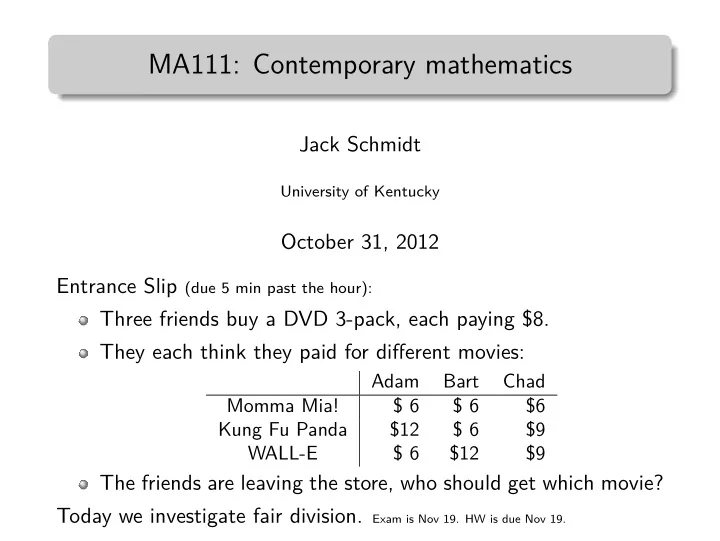
October 31, 2012 Entrance Slip (due 5 min past the hour): Three friends buy a DVD 3-pack, each paying $8. They each think they paid for different movies:
Adam Bart Chad Momma Mia! $ 6 $ 6 $6 Kung Fu Panda $12 $ 6 $9 WALL-E $ 6 $12 $9
The friends are leaving the store, who should get which movie? Today we investigate fair division.
Exam is Nov 19. HW is due Nov 19.
SLIDE 2
Context: How to share?
The entrance slip has some trouble: somebody gets the bad piece We’d like to say it is not fair He paid $8 but only got $6 worth of movie What can we do to even things out? Our basic problem is who gets what and do we need to compensate anyone with money
SLIDE 3
Activity: More than one way to be fair
The worksheet describes several different divisions Each one has some sort of claim to “fair” Calculate how good each person feels Try to decide what is important in dividing the stuff up For the last question, what is the right answer?
SLIDE 4
Fast: Fair division
Fair division is a social choice problem Three main ingredients to the problem:
The people The loot How the people value the loot
First we talk about solutions to particular fair division problems Then we talk about games that lead to solutions
SLIDE 5
Fast: A fair division
Each person must receive as much value as they paid for A division is then called fair if every person thinks they get at least their fair share We’ve seen there can be more than one way to get a fair division In #2, everyone thinks they got exactly their fair share In #3, if Adam and Bart pay Chad $2 each, then everyone paid $8 and got $10 worth of stuff!
SLIDE 6
Fast: utility function
People value the same good differently Each person has a utility function that takes the booty and values it in dollars Adam’s utility function (his heart, or cinematic tastes) told him MM was worth $6, KFP was worth $12, and WE was worth $6 Our utility functions in this course are “additive” The three movies together are worth $6+$6+$12 = $24 to Adam
SLIDE 7
Fast: utility functions can make happiness
Since Bart and Adam disagree on the value of the two movies we can make happiness out of nothing If Adam gets his $12 movie, and Bart gets his $12 movie, and Chad gets his $6 movie, then we have $30 total worth of movie, but they paid only $24 total So we have a chance at a happy ending! But how do we get people to agree to the happy ending? We will propose very carefully constructed games
SLIDE 8
Fast: fair division games
We need games with very special properties: The rules are simple and observable; if we video tape the game being played, everyone can tell whether anyone cheated There is a winning strategy; the winning strategy is easy to memorize Once we have such games, then people can agree to play them They are guaranteed to win unless someone obviously cheats, and then everyone will know that person stole The next few classes we will cover specific games
SLIDE 9 Assignments and exit slip
Read 3.1 and 3.2 in the book. Start on online homework; 21 problems due Nov 19 Exit slip: What is wrong with the following game:
. .
1
Adam chooses his favorite movie . .
2
Bart chooses his favorite movie from among those left . .
3
Chad takes the left-over movie and tells Adam and Bart how much they owe him