MA/CSSE 474 Theory of Computation Languages, prefixes, sets, - - PDF document

ma csse 474
SMART_READER_LITE
LIVE PREVIEW

MA/CSSE 474 Theory of Computation Languages, prefixes, sets, - - PDF document

3/7/2018 MA/CSSE 474 Theory of Computation Languages, prefixes, sets, cardinality, functions Your Questions? Syllabus Tuesday's discussion Reading Assignments Must not HW1 or HW2 be a FSM Anything else 1 3/7/2018


slide-1
SLIDE 1

3/7/2018 1

MA/CSSE 474

Theory of Computation

Languages, prefixes, sets, cardinality, functions

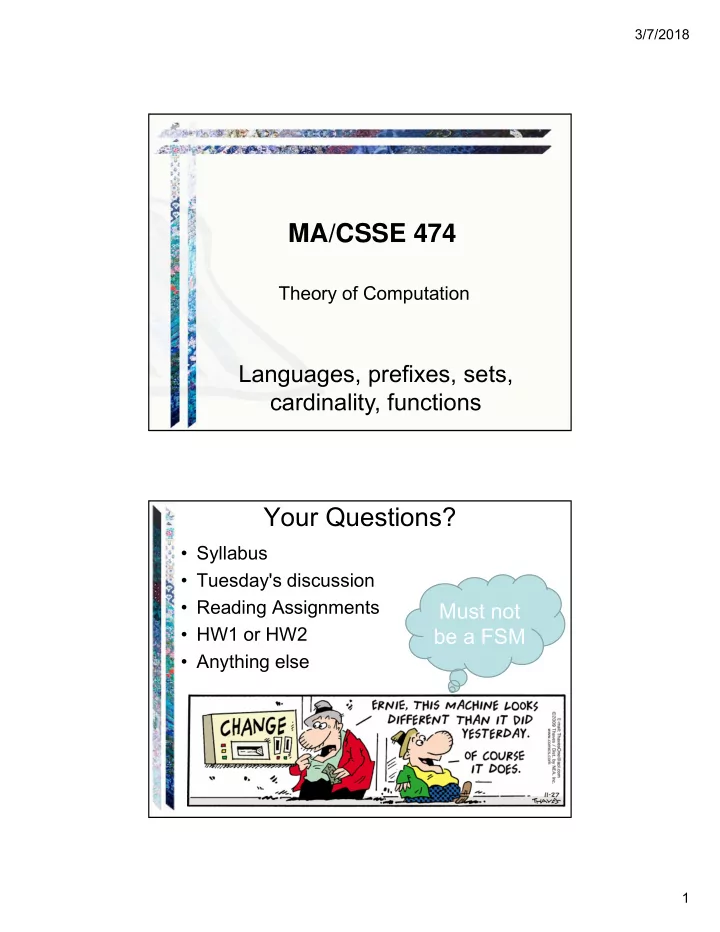
Your Questions?

  • Syllabus
  • Tuesday's discussion
  • Reading Assignments
  • HW1 or HW2
  • Anything else

Must not be a FSM

slide-2
SLIDE 2

3/7/2018 2

Languages and Strings

Mostly very quick. Some should be review of previous courses, and some others you should have gotten for Reading Quiz 2. Ask questions if there are things I list here that you are not sure about.

  • A string is a finite sequence (possibly

empty) of symbols from some finite alphabet .

  •  is the empty string (some books/papers

use  instead)

  • * is the set of all possible strings over an

alphabet 

  • Counting: |s| is the number of symbols in
  • s. || = 0

|1001101| = 7

  • #c(s) is the number of times that c occurs

in s. #a(abbaaa) = 4.

Properties of Strings

slide-3
SLIDE 3

3/7/2018 3

More Functions on Strings

Concatenation: st is the concatenation of s and t. If x = good and y = bye, then xy = goodbye. Note that |xy| = |x| + |y|.  is the identity for concatenation of strings. So: x (x  =  x = x). Concatenation is associative. So: s, t, w ((st)w = s(tw)).

More Functions on Strings

Replication: For each string w and each natural number i, the string wi is: w0 = , wi+1 = wi w Examples: a3 = aaa (bye)2 = byebye a0b3 = bbb Reverse: For each string w, wR is defined as: if |w| = 0 then wR = w =  if |w|  1 then: a   (u  * (w = ua)). So define wR = a u R.

slide-4
SLIDE 4

3/7/2018 4

Concatenation and Reverse of Strings

Theorem: If w and x are strings, then (w x)R = xR wR. Example: (nametag)R = (tag)R (name)R = gateman Proof on next slide

Concatenation and Reverse of Strings

Proof: By induction on |x|: |x| = 0: Then x = , and (wx)R = (w )R = (w)R =  wR = R wR = xR wR. n  0 (((|u| = n)  ((w u)R = uR wR))  ((|x| = n + 1)  ((w x)R = xR wR))): Consider any string x, where |x| = n + 1. Then x = u a for some symbol a and |u| = n. So: (w x)R = (w (u a))R rewrite x as ua = ((w u) a)R associativity of concatenation = a (w u)R definition of reversal = a (uR wR) induction hypothesis = (a uR) wR associativity of concatenation = (ua)R wR definition of reversal = xR wR rewrite ua as x

slide-5
SLIDE 5

3/7/2018 5

Relations on Strings:

Substring, proper substring Every string is a substring of itself.  is a substring of every string. prefix, proper prefix Every string is a prefix of itself.  is a prefix of every string. s is a suffix, proper suffix, self, 

Defining a Language

A language is a (finite or infinite) set of strings over a finite alphabet . Examples for  = {a, b}

  • 1. L = {x  {a, b}* : all a’s precede all b’s}

, a, aa, aabbb, and bb are in L. aba, ba, and abc are not in L.

  • 2. L = {x : u  {a, b}* : x = ua}

Simple English description:

  • 3. L = {x#y: x, y  {0, 1, 2, 3, 4, 5, 6, 7, 8, 9}* and,

when x and y are viewed as the decimal representations of natural numbers, square(x) = y}.

Examples (in L or not?): 3#9, 12#144, 3#8, 12, 12#12#12, #

  • 4. L = {an : n  0} uses replication, simpler description of L?
  • 5. AnBn = {akbk : k 0 }
  • 6. L = Ø = { }
  • 7. L = {ε}

You saw in Reading Quiz 2 that the last two examples are different languages
slide-6
SLIDE 6

3/7/2018 6

Natural Languages are Tricky

L = {w: w is a sentence in English}. Examples: Kerry hit the ball. Colorless green ideas sleep furiously. The window needs fixed. Ball the Stacy hit blue.

A Halting Problem Language

L = {w: w is a Java program that, when given any finite input string, is guaranteed to halt}.

  • Is this language well specified?
  • Can we decide which strings L contains?
slide-7
SLIDE 7

3/7/2018 7

Languages and Prefixes

What are the following languages? L = {w  {a, b}*: no prefix of w contains b} L = {w  {a, b}*: no prefix of w starts with a} L = {w  {a, b}*: every prefix of w starts with a}

Concatenation of Languages

If L1 and L2 are languages over : L1L2 = {w  * : s  L1 (t  L2 (w = st))} Example:

L1 = {a, aa} L2 = {a, c,ε} L1 L2 =

Alternate definition: L1L2 = { st : s  L1 ∧ t  L2 }

Simpler than the first definition, but the first one conveys the idea more precisely.

slide-8
SLIDE 8

3/7/2018 8

Concatenation of Languages

  • L1L2
  • LR
  • L3

Is this the same as {w3 : w  L }

  • L0
  • Lk
  • L*
  • L+

Formally: Kleene Star and + of a Language

L+ = L L* L+ = L* - {} iff   L L+ is the closure of L under concatenation.

slide-9
SLIDE 9

3/7/2018 9

Concatenation and Reverse of Languages

Theorem: (L1 L2)R = L2

R L1 R.

Proof: x (y ((xy)R = yRxR)) Theorem 2.1 we proved last time (L1 L2)R = {(xy)R : x  L1 and y  L2} Definition of concatenation of languages = {yRxR : x  L1 and y  L2} Thm 2.1 = L2

R L1 R

Definition of concatenation of languages

Sets and Relations

slide-10
SLIDE 10

3/7/2018 10

Sets of Sets

  • The power set of S is the set of all subsets of S.

Let S = {1, 2, 3}. Then: P(S) = {, {1}, {2}, {3}, {1, 2}, {1, 3}, {2, 3}, {1, 2, 3}}.

  •   P(S) is a partition of a set S iff:
  • Every element of  is nonempty,
  • Every pair of elements of  is disjoint , and
  • the union of all the elements of  equals S.

Some partitions of = {1, 2, 3}: {{1}, {2, 3}} or {{1, 3}, {2}} or {{1, 2, 3}}. How many different partitions of S?

Closure

  • A set S is closed under binary operation op iff

x,yS ( x op y  S) , closed under unary function f iff xS (f(x)  S)

  • Examples
  • + (the set of all positive integers) is closed under

addition and multiplication but not negation, subtraction,

  • r division.
  • What is the closure of + under subtraction? Under

division?

  • The set of all finite sets is closed under union and
  • intersection. Closed under infinite union?

If S is not closed under unary function f, a closure of S is a set S' such that a) S is a subset of S' b) S' is closed under f c) No proper subset of S' contains S and is closed under f

slide-11
SLIDE 11

3/7/2018 11

Equivalence Relations

A relation on a set A is any set of ordered pairs of elements of A. A relation R  A  A is an equivalence relation iff it is:

  • reflexive,
  • symmetric, and
  • transitive.

Examples of equivalence relations:

  • Equality
  • Lives-at-Same-Address-As
  • Same-Length-As
  • Contains the same number of a's as

Show that ≡₃ is an equivalence relation

Cardinality of a set.

  • a specific natural number (if S is finite),
  • “countably infinite” (if S has the same number of

elements as there are integers), or

  • “uncountably infinite” (if S has more elements than

there are integers). The cardinality of every set we will consider is one of the following :

slide-12
SLIDE 12

3/7/2018 12

The rest of today's slides

  • We probably won't get to them today.
  • But they are here just in case …

Functions whose domains and ranges are languages maxstring(L) = {w  L: z  * (z    wz  L)}. Examples:

  • maxstring( AnBn )
  • maxstring( {a}* )

Let INF be the set of infinite languages. Let FIN be the set of finite languages. Are the language classes FIN and INF closed under maxstring?

Functions on Languages

Exercise for later:

What language is

maxstring({bna: n≥0}) ?

slide-13
SLIDE 13

3/7/2018 13 chop(L) = {w : xL (x = x1cx2, x1  L*, x2  L*, c  L, |x1| = |x2|, and w = x1x2)}. What is chop(AnBn)? What is chop(AnBnCn)? Are FIN and INF closed under chop?

Functions on Languages

firstchars(L) = {w : yL (y = cx  c  L  x  L*  w  {c}*)}. . What is firstchars(AnBn)? What is firstchars({a, b}*)? Are FIN and INF closed under firstchars?

Functions on Languages