M ULTI -A GENT S YSTEMS Overview and Research Directions Whats an - - PDF document

m ulti a gent s ystems
SMART_READER_LITE
LIVE PREVIEW

M ULTI -A GENT S YSTEMS Overview and Research Directions Whats an - - PDF document

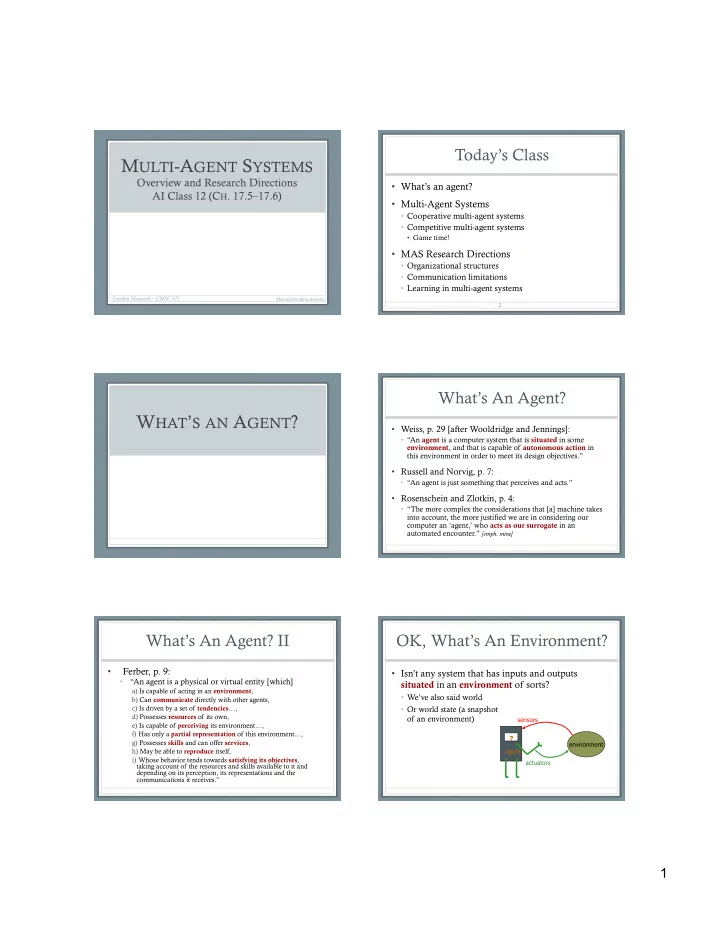
Todays Class M ULTI -A GENT S YSTEMS Overview and Research Directions Whats an agent? AI Class 12 (C H . 17.517.6) Multi-Agent Systems Cooperative multi-agent systems Competitive multi-agent systems Game time! MAS


slide-1
SLIDE 1

1

MULTI-AGENT SYSTEMS

Overview and Research Directions AI Class 12 (CH. 17.5–17.6)

Cynthia Matuszek – CMSC 671

Material from Marie desJardin

Today’s Class

  • What’s an agent?
  • Multi-Agent Systems
  • Cooperative multi-agent systems
  • Competitive multi-agent systems
  • Game time!
  • MAS Research Directions
  • Organizational structures
  • Communication limitations
  • Learning in multi-agent systems

2

WHAT’S AN AGENT?

What’s An Agent?

  • Weiss, p. 29 [after Wooldridge and Jennings]:
  • “An agent is a computer system that is situated in some

environment, and that is capable of autonomous action in this environment in order to meet its design objectives.”

  • Russell and Norvig, p. 7:
  • “An agent is just something that perceives and acts.”
  • Rosenschein and Zlotkin, p. 4:
  • “The more complex the considerations that [a] machine takes

into account, the more justified we are in considering our computer an ‘agent,’ who acts as our surrogate in an automated encounter.” [emph. mine]

What’s An Agent? II

  • Ferber, p. 9:
  • “An agent is a physical or virtual entity [which]

a) Is capable of acting in an environment, b) Can communicate directly with other agents, c) Is driven by a set of tendencies…, d) Possesses resources of its own, e) Is capable of perceiving its environment…, f) Has only a partial representation of this environment…, g) Possesses skills and can offer services, h) May be able to reproduce itself, i) Whose behavior tends towards satisfying its objectives, taking account of the resources and skills available to it and depending on its perception, its representations and the communications it receives.”

OK, What’s An Environment?

  • Isn’t any system that has inputs and outputs

situated in an environment of sorts?

  • We’ve also said world
  • Or world state (a snapshot
  • f an environment)

environment agent

?

sensors actuators

slide-2
SLIDE 2

2

What’s Autonomy?

  • Jennings and Wooldridge, p. 4:
  • “[In contrast with objects] … agents as encapsulate behavior, in

addition to state.

  • An object does not encapsulate behavior: it has no control over

the execution of methods – if an object A invokes a method m

  • n an object B, then B has no control over whether m is executed
  • r not – it just is.
  • In this sense, object B is not autonomous, as it has no control
  • ver its own actions.
  • Because of this …, we do not think of agents as invoking

methods (actions) on agents – rather, we tend to think of them requesting actions to be performed.”

  • Is an if-then-else statement autonomous?

So Now What?

  • If those definitions aren’t useful, is there a useful

definition?

  • Should we bother trying to create “agents” at all?
  • For Tic-Tacs, lemon drops, licorice, gummi bears:
  • Which of these is best?
  • Rank each candy on a scale from 1-10
  • Sort the candy from best to worst

A Pause to Vote... (more on which later)

MULTI-AGENT SYSTEMS

Multi-Agent Systems

  • Jennings et al.’s key properties:
  • Situated [existing in relation to some environment]
  • Autonomous
  • Flexible:
  • Responsive to dynamic environment
  • Pro-active / goal-directed
  • Social interactions with other agents and humans
  • Research questions: How do we design agents to:
  • Interact effectively…
  • …To solve a wide range of problems…
  • …In many different environments?

Aspects of MAS

  • Cooperative vs.

competitive

  • Homogeneous vs.

heterogeneous

  • Macro vs. micro
  • Interaction protocols

and languages

  • Organizational

structure

  • Mechanism design /

market economics

  • Learning
slide-3
SLIDE 3

3

Topics in MAS

  • Cooperative MAS:
  • Distributed problem solving: Less autonomy
  • (At least in a certain sense)
  • Distributed planning: Models for cooperation and

teamwork

  • Competitive or self-interested MAS:
  • Distributed rationality: Voting, auctions
  • Negotiation: Contract nets
  • Strictly adversarial interactions ß least complex

Some Cooperative MAS Domains

  • Distributed sensor network establishment
  • Distributed vehicle monitoring
  • Distributed delivery

NSF; www.linkedin.com/pulse/3g4g-gps-vehicle-cctv-systems-taxi-bus-truck-kinds-ellies-w; www.cranessoftware.com/alliances/fluid/offshore-dev.php

Distributed Sensing & Monitoring

  • Distributed sensing:
  • Distributed sensor network establishment:
  • Locate sensors to provide the best coverage
  • Centralized vs. distributed solutions
  • Track vehicle/other movements using multiple sensors
  • Distributed vehicle monitoring:
  • Control sensors and integrate results to track vehicles as

they move from one sensor’s “region” to another’s

  • Centralized vs. distributed solutions

Distributed Delivery

  • Logistics problem: move goods from original

locations to destination locations using multiple delivery resources (agents)

  • Dynamic, partially accessible, nondeterministic

environment (goals, situation, agent status)

  • Centralized vs. distributed solution

COMPETITIVE MULTI- AGENT SYSTEMS

Games and Game Theory

  • Much effort to develop programs for artificial games

like chess or poker, played for entertainment

  • Larger issue: account for, model, and predict how

agents (human or artificial) interact with other agents

  • Game theory accounts for mixture of cooperative

and competitive behavior

  • Applies to zero-sum and non-zero-sum games
slide-4
SLIDE 4

4

Basic Ideas

  • Game theory studies how strategic interactions

among rational players produce outcomes with respect to the players’ preferences (or utilities)

  • Outcomes might not have been intended
  • Offers a general theory of strategic behavior
  • Generally depicted in mathematical form
  • Plays important role in economics, decision theory

and multi-agent systems

Pareto Optimality

  • An outcome is Pareto optimal if there is no other
  • utcome that all players would prefer.
  • “a state … from which it is impossible to [change] so as

to make any one individual better off without making at least one individual worse off.” – Wikipedia (simplified)

  • S is a Pareto-optimal solution iff
  • ∀s’ (∃x Ux(s’) > Ux(s) → ∃y Uy(s’) < Uy(s))
  • I.e., if X is better off in s’, then some Y must be worse off

Social Welfare

  • Social welfare, or global utility:
  • Sum of all agents’ utility
  • If state s maximizes social welfare, it is also Pareto-optimal (but

not vice versa)

  • Somewhat poorly named
  • Sum ≠ average
  • Allocation of resources typically affects influence
  • e.g., you get to take 1 turn per point accrued
  • “Fair games” remain fair (given optimal play)

100 100

1 1 1 1 1 1 25 25 25 25 25 25 25 25

>

5 4 3 2 1 1 2 3 4 5 6 7 8

  • S is a Pareto-optimal solution iff
  • ∀s’ (∃x Ux(s’) > Ux(s) → ∃y Uy(s’) < Uy(s))
  • I.e., if X is better off in s’, then some Y must be worse off
  • There is no other outcome that all players would prefer

Pareto Optimality

X’s utility Y’s utility Which solutions are Pareto-optimal? Which solution(s) maximize global utility (social welfare)?

1 2 3 4 5 6

Nash Equilibrium

  • Occurs when each player’s strategy is optimal,

given strategies of the other players

  • No player benefits by unilaterally changing strategy

while others stay fixed

  • Every finite game has at least one Nash equilibrium in

either pure or mixed strategies (proved by John Nash)

  • J. F. Nash. 1950. Equilibrium Points in n-person Games. Proc.

National Academy of Science, 36

  • Nash won 1994 Nobel Prize in economics for this work
  • A Beautiful Mind by Sylvia Nasar (1998) and/or see the 2001 film

23

Stability

  • If an agent can always maximize its own utility

with a particular strategy (regardless of other agents’ behavior) then that strategy is dominant

  • Strategy s dominates s’ iff:
  • Outcome (for player p) of s is better than the outcome of

s’ in every case

  • A set of agent strategies is in Nash equilibrium if

each agent’s strategy Si is locally optimal, given the other agents’ strategies

  • No agent has an incentive to change strategies
  • Hence this set of strategies is locally stable
slide-5
SLIDE 5

5

Prisoner’s Dilemma

  • Famous example of game theory
  • Will two prisoners cooperate to minimize total loss of

liberty or will one of them betray the other so as to go free?

  • Strategies must be undertaken without full knowledge
  • f what other players will do
  • Players adopt dominant strategies, but they don’t

necessarily lead to the best outcome

  • Rational behavior leads to a situation where everyone

is worse off

Bonnie & Clyde

  • Bonnie and Clyde are arrested. They’re questioned

separately, unable to communicate. They know the deal:

  • If both proclaim innocence (deny involvement), they will both

get short sentences

  • If one confesses and the other doesn’t, the

confessor gets a heavy sentence and the denier goes free

  • If both confess, both get moderate sentences
  • What should Bonnie do?
  • What should Clyde do?
  • <Bonnie’s sentence, Clyde’s sentence>
  • Play 1 round – what are results?
  • Switch partners
  • Play 5 rounds, keeping track of total years

Group Work: Prisoner’s Dilemma

Confesses Denies Confesses (3, 3) (5, 0) Denies (0, 5) (1, 1) B C

  • Pareto-optimal and social welfare maximizing

solution: Both agents deny

  • Dominant strategy and Nash equilibrium: Both

agents confess

  • Why?

Prisoner’s Dilemma: Analysis

Confesses Denies Confesses (3, 3) (5, 0) Denies (0, 5) (1, 1) B C

Dominant strategy for Bonnie is to confess because no matter what Clyde does she is better off confessing. If Clyde Confesses

Bonnie 3 Years in Prison 0 Years in Prison Deny Confess Best Strategy

If Clyde Does Not Confess

5 Years in Prison 1 Year in Prison Bonnie Confess Best Strategy

There are two cases to consider:

Deny

Bonnie’s Decision Tree

No wonder Economics is called “the dismal science”

Iterated Prisoner’s Dilemma

  • Rational players should always defect in a PD situation
  • In real situations, people don’t always do this
  • Why not? Possible explanations:
  • People aren’t rational
  • Morality
  • Social pressure
  • Fear of consequences
  • Evolution of species-favoring genes
  • Which make sense? How can we formalize?
slide-6
SLIDE 6

6

Iterated PD

  • Key idea: We often play more than one “game” with someone
  • Players have complete knowledge of past games, including their

choices and other players’ choices

  • Can choose based on whether they’ve been cooperative in past
  • Simulation was first done by Robert Axelrod (Michigan) where

programs played in a round-robin tournament

  • (CD=5, CC=3, DD=1, DC=0)
  • The simplest program won!

Distributed Rationality

How can we encourage/coax/force self- interested agents to play fairly in the sandbox?

  • Voting: Everybody’s opinion counts (but how much?)
  • Auctions: Everybody gets a chance to earn value (but

fairly?)

  • Contract nets: Work goes to the highest bidder
  • Issues:
  • Global utility • Fairness
  • Stability
  • Cheating and lying

Voting: It’s Not Easy

  • How should we rank the possible outcomes, given

individual agents’ preferences (votes)?

  • Six desirable properties which can’t all be satisfied:
  • Every combination of votes should lead to a ranking
  • Every pair of outcomes should have a relative ranking
  • The ranking should be asymmetric and transitive
  • The ranking should be Pareto-optimal
  • Irrelevant alternatives shouldn’t influence the outcome
  • Share the wealth: No agent should always get their way

Voting Protocols

  • Plurality voting:
  • The outcome with the highest number of votes wins
  • Irrelevant alternatives can change the outcome (e.g., Gary Johnson)
  • Borda voting:
  • Agents’ rankings are used as weights, which are summed across all

agents

  • Agents can “spend” high rankings on losing choices, making their

remaining votes less influential

  • Binary voting:
  • Agents rank sequential pairs of choices (“elimination voting”)
  • Irrelevant alternatives can still change the outcome
  • Very order-dependent
  • For Tic-Tacs, lemon drops, licorice, gummi bears:
  • Which of these is best?
  • Rank each candy on a scale from 1-10
  • Sort the candy from best to worst

Voting… Voting game

  • Using plurality (1/0) voting to select a winner:
  • The winner is the candidate with the most votes
  • The naive strategy is to vote for your top choice – is that best?
  • Using the range votes directly to select a winner:
  • Add the range votes
  • Different people use different “widths/ranges” – how does that change it?
  • Using Borda (1..k) voting:
  • Everybody ranks the k candidates that are running in that round
  • Your top choice receives k votes; your second choice, k-1, etc.
  • The winner is the candidate with the most votes
  • Borda voting is often used in combination with a runoff
  • Eliminate the lowest-ranked candidates and try again – how does that change it?

Discuss... did we achieve global social welfare? Fairness? Were there interesting dynamics?

slide-7
SLIDE 7

7

Auctions

  • Many different types and protocols
  • All of the common protocols yield Pareto-optimal
  • utcomes
  • But… bidders can agree to artificially lower prices

in order to cheat the auctioneer

  • What about when the colluders cheat each other?
  • (Now that’s really not playing nicely in the sandbox!)

Learning in MAS

  • Emerging field: How can teams of agents learn?

Individually? As groups?

  • Distributed Reinforcement Learning (next slide)
  • Genetic algorithms:
  • Evolve a society of “fittest” agents
  • In practice: a cool idea that is very hard to make work
  • Strategy learning:
  • In market environments, learn other agents’ strategies

MAS RL

  • Distributed Reinforcement Learning
  • Behave as an individual
  • Receive team feedback
  • Learn to individually contribute to team performance
  • How?
  • Iteratively allocate “credit” for group performance to

individual decisions.

Conclusions and Directions

  • Different types of “multi-agent systems”:
  • Cooperative vs. competitive
  • Heterogeneous vs. homogeneous
  • Micro vs. macro
  • Lots of interesting/open research directions:
  • Effective cooperation strategies
  • “Fair” coordination strategies and protocols
  • Learning in MAS
  • Resource-limited MAS (communication, …)
  • Economics: agents are human players with resources