
SLIDE 1
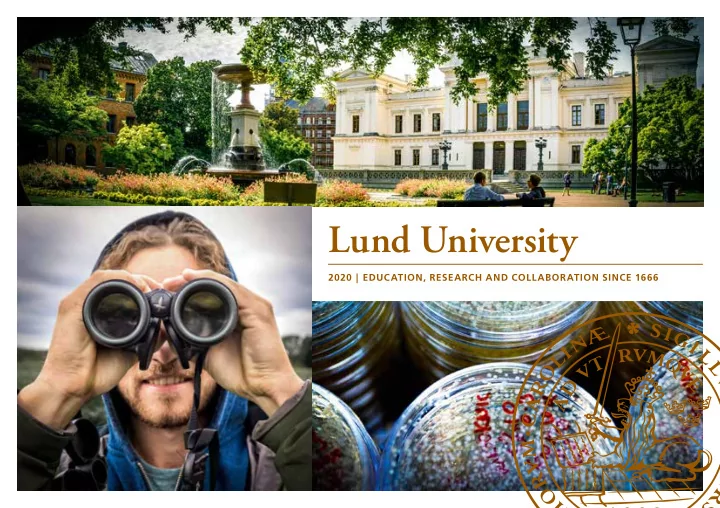
Lund University
2020 | EDUCATION, RESEARCH AND COLLABORATION SINCE 1666
Lund University 2020 | EDUCATION, RESEARCH AND COLLABORATION SINCE - - PowerPoint PPT Presentation
Lund University 2020 | EDUCATION, RESEARCH AND COLLABORATION SINCE 1666 A WORLD-CLASS UNIVERSITY To understand, explain and improve Lund University was founded in 1666 and, ever A WIDE RANGE OF STUDY PROGRAMMES since, has been a centre of
2020 | EDUCATION, RESEARCH AND COLLABORATION SINCE 1666
A WORLD-CLASS UNIVERSITY
Lund University was founded in 1666 and, ever since, has been a centre of culture and learning. We are repeatedly ranked among the world’s top 100 universities. One of our strengths is
to generate boundary-crossing collaboration. Student infmuence, internationalisation and close cooperation with wider society are other characteristics of Lund University. OUTSTANDING RESEARCH Our nine faculties conduct strong research in a wide range of areas. Many scientifjc break- throughs and pioneering innovations have
AN INTERNATIONAL UNIVERSITY Our strong reputation helps to attract students and researchers from all over the world. More international students apply to Lund than to any other university in Sweden. We collaborate with more than 640 universities in 70 countries and we are the only Swedish university to be a member of the international research networks League of European Research Universities (LERU) and Universitas 21 (U21). A WIDE RANGE OF STUDY PROGRAMMES Our study programmes are closely intertwined with current research and we have one of the widest ranges of study programmes in Sweden, including several unique inter- disciplinary programmes for both Swedish and international students. WORLD-LEADING RESEARCH FACILITIES Two of the world’s foremost research facilities for materials research and life sciences are estab- lished in Lund – the synchrotron radiation facility MAX IV, which was inaugurated in June 2016, and the European Spallation Source (ESS) which will feature the world’s most powerful neutron source when it opens for research in 2023. OPEN ACTIVITIES The University offers many open activities, not least the public events at Skissernas Museum – Museum of Artistic Process and Public Art, the Botanical Garden and the Historical Museum.
LUND UNIVERSITY IN BRIEF
FOUNDED: 1666 MOTTO: Ad utrumque (paratus), prepared for both NUMBER OF STUDENTS: 40 000 NUMBER OF EMPLOYEES: 8 160 ANNUAL TURNOVER: EUR 831 million RANKING (2019/20): QS World University Rankings: 92 Times Higher Education: 96 Shanghai ranking: 101–150 FACULTIES:
The University also comprises MAX IV, the International Institute for Industrial Environmental Economics IIIEE, The Pufendorf Institute for Advanced Studies and several other inter- disciplinary centres and facilities open to the general public, such as Skissernas Museum – Museum of Artistic Process and Public Art. The Raoul Wallen berg Institute of Human Rights and Humani- tarian Law is also closely associated with the University. LOCATIONS: Lund, Malmö, Helsing- borg and Ljungbyhed
EDUCATION IN BRIEF
NUMBER OF FREESTANDING COURSES: 1 380 (15 % taught in English) NUMBER OF DEGREE PROGRAMMES: Total 270:
degree (10 % taught in English)
(65 % taught in English) – of which 34 leading to a vocational degree SOCIAL ACTIVITIES: The rich student life in Lund offers a broad range of opportunities. Students can participate in student theatre, radio and TV productions, sports events, festi- vals, debating, mentoring programmes and much more. ENTREPRENEURSHIP: Through Lund University’s innovation system, students with business ideas can get help with business development, patents, fjnancing and offjce space while benefjting from a large network
CAREERS SUPPORT: We have several careers centres and
related seminars. Via our careers portal, students can get tips on jobs, degree project opportunities and internship and trainee vacancies, both in Sweden and abroad.
EDUCATION
Lund University has Scandinavia’s largest range of education taught in English, and
programmes in engineering, science, law, social science, economics and management, medicine, humanities, theology and the fjne and performing arts. We offer degree programmes and freestanding courses at Bachelor’s, Master’s and PhD levels. We educate the knowledge generators, problem solvers and leaders of tomorrow. Our students are taught how to think freely, creatively and critically, and to develop their ability to collaborate in order to tackle demanding problems. We give our students the tools to explore and understand themselves and the world around them. Our alumni include Nobel Prize winners, ministers, ambassadors, business leaders and personalities from the world of culture. Our study programmes are closely intertwined with current research, which is an important quality factor. The majority of our lecturers are also researchers and we place great importance
We are also keen to provide our students with opportunities to have their say in their
decision-making bodies of the University. We place strong emphasis on the employability
and courses in close collaboration with wider society. Lund University is consistently the most popular choice for international students coming to study in Sweden. With students from almost 150 countries, the University is a meeting place which offers opportunities for international engagement, cultural exchange and life-long global networking. Many students also study part of their degree programme abroad, with a choice of exchange studies in almost 70 countries all over the world. Lund is also the most popular student city in Sweden and is known for its variety of student
to get involved in extracurricular social activities.
Society is facing major global challenges in the fjelds of the environment and climate, sustain- able development, migration, digitalisation and demographic change. As a full-scale university, Lund University is particularly well equipped to meet these complex societal challenges by utilising its disciplinary range, interdisciplinary collaborations and strength- ened engagement with wider society. Our success in being awarded major research grants is evidence of our position as an inter- national research university. Annually, about EUR 472 million are destined for research in
the strongest and broadest ranges of research in Scandinavia. We have been commissioned by the Swedish Government to develop various strategic research areas to absolute world-class level. These include among others research on cancer, diabetes, epidemiology, neuroscience, stem cells, nanoscience, climate modelling, biodiversity, Middle Eastern studies, e-science, manufacturing engineering, and IT and mobile communications.
RESEARCH
Lund University also stands out as a strong force in the European research arena, and receives more EU funding than any other Swedish uni-
most active Swedish participants in the EU frame- work programmes for technical and economic
largest collaboration on climate and innovation, Climate-KIC, which entails collaboration with European universities and companies to fjnd solutions to climate change. In 2019 a graduate school focusing on Agenda 2030 was launched, with doctoral students from all faculties The research facilities MAX IV and ESS in Lund will be of great signifjcance for research and industrial development within materials and life sciences. MAX IV is the world’s foremost synchrotron radiation facility and the ESS will be the most powerful neutron source in the world once it opens for research in 2023. Science Village Scandinavia is also developing nearby, destined to become a meeting place for research, education and entrepreneurship. With these facilities, Lund will further reinforce its international research position.
EXAMPLES OF STRONG RESEARCH ENVIRONMENTS
and mobile communications
Industrial Environmental Economics
in a Contemporary World
EXAMPLES OF INNOVATIONS FROM LUND
1946 The artifjcial kidney (Gambro) 1953 Diagnostic ultrasound 1967 Nicorette – nicotine gum to quit smoking 1971 Modern ventilator (ServoVentilator) 1984 Axis – printer and camera servers 1990 Oatly – oat drink 1991 Proviva – probiotic fruit drink 1993 Qlik – software for data visualisation 1995 Bluetooth 1997 Precise Biometrics – fjngerprint reader 2005 Hövding – “invisible“ bicycle helmet with airbag function 2007 A1M Pharma – diagnosis and treatment of pre-eclampsia 2010 SenzaGen – allergy testing without experiments on animals 2011 cTrap – cloth that blocks toxic substances on humidity-damaged surfaces 2012 Orbital Systems – the world’s most water-effjcient shower 2013 Endodrill – instrument for cancer diagnostics 2018 Aimovig – preventive treatment
COLLABORATION AND INNOVATION
Lund University’s wide subject range and ability to collaborate across disciplinary boundaries gives us unique opportunities to create new solutions that improve people’s lives all over the world. As such, we have developed strong collaborations the public and private sectors as well as society at large. In this way, we tackle current problems and challenges, and make sure that the know ledge and research fjndings generated are put to good use. For us, collaboration can refer to the utilisation
and education, administration and cultural activities, as well as to innovations in the form of new successful products, services or processes. Our project managers encourage and facilitate collaboration between the University’s researchers and external partners. Our inno- vation unit supports students and researchers whose ideas and research fjndings are poten tial
vations from Lund is ultrasound diagnostics, a method routinely used nowadays to examine patients in hospitals all over the world. Further examples of innovations include the artifjcial kidney, which formed the basis for a multi- national company, Gambro (now Baxter), and makes life easier for dialysis patients all over the world, and Bluetooth technology, used in millions of products every day. Lund University’s capacity for innovation is evident, not least through Ideon Science Park – the fjrst of its kind in Sweden. A signifjcant proportion of the more than 1200 companies that have been active there since 1983 origi- nated in research at Lund University. We also collaborate by tailoring professional development programmes for companies, public authorities and organisations, and by
at promoting lifelong learning in various areas. In order to raise young people’s interest in research and higher education, we cooper- ate with schools and arrange science shows and theme days. At the Vattenhallen Science Centre, the whole family can conduct experi- ments.
THINGS TO SEE AND DO AT LUND UNIVERSITY
(Kungs huset) was the University’s fjrst edifjce and remained a centre for the University’s activities for almost 200 years.
Historical Museum is Sweden’s second largest archaeological museum.
contains 7 000 plant species and attracts more than half a million visitors per year.
ceremony is a celebration of the 300–400 doctoral students who complete a PhD each year.
heart of the city of Lund.
Sweden’s largest and oldest research
item printed in the country is pre- served here for future generations.
1882 was designed by Helgo Zettervall.
inspiring experimental workshop for amateur scientists of all ages.
Artistic Process and Public Art – is
preliminary studies and models for art in the public environment. 1 3 4 2
7 5 6 8 9
The University has been making its mark on Lund for 350 years and the University campus
pact and charming city centre where everything is within cycling distance. Students and research- ers, coming from almost 150 countries, create a truly international and vibrant atmosphere. Lund is a city of contrasts in which a thousand years of history meet the very latest in modern
with historical features such as the cathedral and the winding cobble-stoned streets. At the same time, new neighbourhoods are expanding in con- nection with Ideon Science Park and the MAX IV and ESS research facilities.Medicon Village is a life science village for research, innovation and
ers and entrepreneurs working here to improve conditions for future patients. Lund University is
Lund University is located in the Greater Copenhagen region, and has activities in Lund, Malmö, Helsingborg and Ljungbyhed. More than 85 per cent of the University’s education and research are conducted in Lund. Activities
Lund Helsingborg Copenhagen Malmö Ljungbyhed
London Berlin Paris Stockholm
LUND AND GREATER COPENHAGEN
SWEDEN IN BRIEF
Northern Europe
innovative, creative and democratic countries
profjciency in English as a second language
to live in
equality
culture
at Campus Helsingborg mainly involve social sciences, humanities and technology. In Malmö, we have the Academy of Music, the Art Academy and the Theatre Academy, as well as parts of the Faculty of Medicine. Ljungbyhed is the site of the Lund University School of Aviation. In the Greater Copenhagen region, everything is within reach – from Lund, it takes about 10 minutes by train to get to Malmö, 28 minutes to Helsingborg and 45 minutes to Copenhagen and its international airport. Every day, some 15 000 people commute over the Öresund bridge between Sweden and Denmark. The Greater Copenhagen region consists of Skåne and eastern Denmark, with a total popula- tion of around 4 million. 14 000 researchers, 150 000 students, 17 science parks and incuba- tors as well as 17 higher education institutions make this one of Scandinavia’s most knowledge- intensive areas. Here, local startups work side by side with well-known international corporations. In the region, there are also good opportunities for rewarding leisure time with vibrant city life and beautiful nature just beyond city limits.
When Lund University was founded in 1666, Sweden was a great power that had con- quered the province of Skåne from Denmark eight years previously. Immediately after the Swedish victory, the Bishop of Lund, Peder Winstrup, proposed that Lund should acquire an academy, since the youth of Skåne could no longer study in Copenhagen. The decision was delayed, but in the end pastor Bernhard Oelreich succeeded in convincing the regency government of Karl XI, under dowager queen Hedvig Eleonora, to found the University. During the Middle Ages, Lund had already been a centre of religious learning with an early form
secondary school which is still operational. Initially, the young academy had four faculties with 14 professors and 80 students – but no
took over the King’s House, most of the teach- ing took place in the Cathedral. The fjrst set
with Saxon legal scholar Samuel Pufendorf the best known among them. In 1676, however, the University was forced to close because of a Danish invasion, only reopening in 1682, with mainly Swedish lecturers at this point. The University’s fjnances were strained for a long time, yet the academy grew during the 1700s and a park was laid out in Lundagård, along with a botanical garden on what is now the University square. During the early 1800s, the University experienced a period of brilliance marked by the polymath geniuses Esaias Tegnér and Carl Adolph Agardh. It was also in the 1800s that the University started conducting research in the modern sense, and new premises were built, including the main University building in 1882. In 1880, the fjrst female student was enrolled but it was not until the 1960s that the fjrst female professor was appointed. During the 1900s, the University continued to expand in Lund, Malmö and Helsingborg. The number of students and staff grew steadily. The faculties also became more numerous – there are currently nine. Over the past century, a series of pioneering research fjndings and innovations have put Lund University on the map, as have the generations of students who, after completing their studies, have gone out and contributed to society, in Sweden and worldwide.
BILD
The fjgures on this page are rounded off and based on the fjnancial year 2019, unless otherwise stated.
Education
STUDENTS No
Individuals, total over year
40 000
Individuals, per semester
29 000
Full-time equivalents
26 800 INTERNATIONAL STUDENTS
Total
20
% In Master’s programmes
60
% Exchange students, outgoing
1 340
Exchange students, incoming
1 680
Fee-paying students
1 530
Other international students
5 280 STUDY PROGRAMMES AND COURSES No
Freestanding courses
1 380
Study programmes total
270
– leading to an undergraduate degree
84
– leading to a Master’s degree
186
– of which leading to a vocational degree
34 DISTRIBUTION OF STUDENTS
Undergraduate, programmes
53 %
Undergraduate, freestanding courses
20 %
Master’s, programme
24 %
Master’s, freestanding courses
3
%
DEGREES AWARDED No
General Bachelor’s
2 800
General Master’s
2 300
Vocational Bachelor’s
680
Vocational Master’s
1 650
PhD
390
Research
RESEARCH STUDENTS No
Individuals
2 720
– of whom new students
480 INTERNATIONAL RESEARCH STUDENTS
Total
40 % NO OF PUBLICATIONS (2018) 5 360 LARGEST FUNDING BODIES SEK/EUR million
Swedish Research Council
926/87
EU
315/30
Knut & Alice Wallenberg Foundation 252/24 Formas
182/17
Swedish Foundation for Strategic Research
116/11
Stafg
EMPLOYEES No
Individuals, of whom
8 160
– professors
840
–
and employed research students
4 560
– technical and administrative staff
2 780 INTERNATIONAL STAFF
Total
30
% Researchers
50
%
Finances
REVENUE
Total SEK 8,8 billion / EUR 831 million,
– direct government funding
54
% – external funding
46
%
EXPENDITURE
Total SEK 8,8 billion / EUR 831 million,
– staff
62
% – premises
12 %
– other
26
%
Ranking
QS
Times Higher Shanghai- Education rankningen 2019/20 92 96 101–150
Production and layout: Corporate Communications, Lund University. Photos: Page 1: Kennet Ruona. Page 2: Kennet Ruona. Page 3: Johan Bävman, Kennet Ruona, Håkan Röjder. Page 4: Kennet Ruona x 3, Johan Bävman, Johan Persson. Page 6: Kennet
Shutterstock, Kennet Ruona x 3. Page 10: Johan Persson, Kennet Ruona, Petra Francke, Kennet Ruona. Page 11: Johan Persson, Petra Francke, Kennet Ruona, Håkan Röjder, Annika Nyberg. Page 12: Mostphotos/Bengt Hultqvist, Perry Nordeng, Kennet Ruona, Shutterstock/ Olesya Kuznetsova. Page 14: Nina Ransmyr. Edition: 11 000 copies. Printed by: Stibo Complete 2020
LUND UNIVERSITY ALUMNI NETWORK Former students, researchers and staff members are wel- come to join the Lund University Alumni Network. Members gain access to an international, social and professional
the University, enjoy special offers and more. Register on lunduniversity.lu.se/alumni SUPPORT LUND UNIVERSITY As a donor, you will contribute to ensuring that Lund Univer- sity will remain a world-class university and an important part
lunduniversity.lu.se/donate MORE INFORMATION Website: lunduniversity.lu.se Facebook: facebook.com / lunduniversity Twitter: twitter.com / lunduniversity LinkedIn: linkedin.com /school / lunduniversity Instagram: instagram.com / lunduniversity YouTube: youtube.com / lunduniversity
LUND UNIVERSITY PO Box 117 SE-221 00 Lund Sweden Telephone +46 46 222 00 00 www.lunduniversity.lu.se
M I L J Ö M Ä R K T 3 4 1 T R Y C K S A K 1 4 5