
SLIDE 1
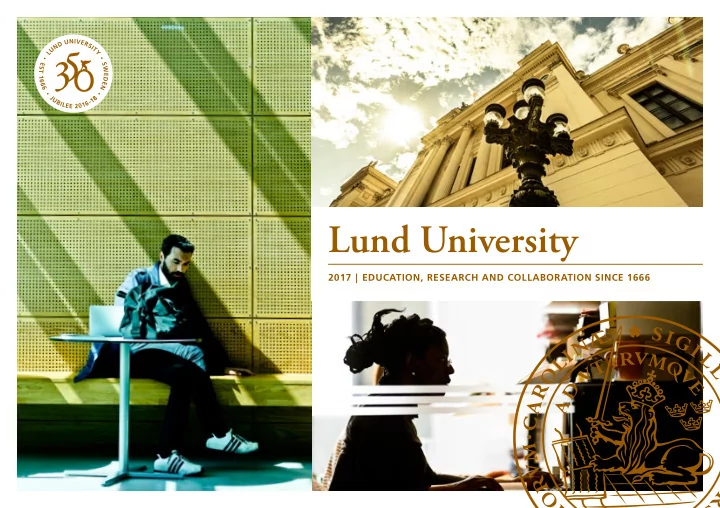
Lund University
2017 | EDUCATION, RESEARCH AND COLLABORATION SINCE 1666
Lund University 2017 | EDUCATION, RESEARCH AND COLLABORATION SINCE - - PowerPoint PPT Presentation
Lund University 2017 | EDUCATION, RESEARCH AND COLLABORATION SINCE 1666 A WORLD-CLASS UNIVERSITY To understand, explain and improve Lund University was founded in 1666 and, ever to be a member of the international research since, has been a
2017 | EDUCATION, RESEARCH AND COLLABORATION SINCE 1666
A WORLD-CLASS UNIVERSITY
Lund University was founded in 1666 and, ever since, has been a centre of culture and learning. We are considered one of Scandinavia’s most
is our unique disciplinary range and our ability to generate boundary-crossing collaboration. Student infmuence, internationalisation and close cooperation with wider society are other characteristics of Lund University. OUTSTANDING RESEARCH Lund University is regularly ranked as one
research in many different areas, including
world-leading. Many scientifjc breakthroughs and pioneering innovations have originated from Lund University. AN INTERNATIONAL UNIVERSITY Our strong reputation helps to attract students and researchers from all over the world. More international students apply to Lund than to any other university in Sweden. We collaborate with around 600 partner universities worldwide and we are also the only Swedish university to be a member of the international research networks League of European Research Univer- sities (LERU) and Universitas 21 (U21). A WIDE RANGE OF STUDY PROGRAMMES We have one of the widest ranges of study programmes in Sweden, including several unique interdisciplinary programmes for both Swedish and international students. WORLD-LEADING RESEARCH FACILITIES Two of the world’s foremost research facilities for materials research and life sciences are estab- lished in Lund – the synchrotron radiation facility MAX IV, which was inaugurated in June 2016, and the European Spallation Source (ESS) which will feature the world’s most powerful neutron source when it opens for research in 2023. 350TH ANNIVERSARY CELEBRATIONS Lund University is celebrating its 350th anni- versary over 13 months – from 19 December 2016 to 28 January 2018. An extensive and inclusive jubilee programme puts the spotlight
innovations through the ages, while raising important issues for the future.
LUND UNIVERSITY IN BRIEF
FOUNDED: 1666 MOTTO: Ad utrumque (paratus), prepared for both NUMBER OF STUDENTS: 42 000 NUMBER OF EMPLOYEES: 7 400 ANNUAL TURNOVER: EUR 800 million RANKING (2016): QS World University Rankings: 73 Times Higher Education: 96 Shanghai ranking: 101–150 FACULTIES:
MAX IV, the International Institute for Industrial Environmental Econom- ics IIIEE, and several specialised centres and facilities open to the general public, such as Skissernas Museum – Museum of Artistic Process and Public Art. The Raoul Wallen- berg Institute of Human Rights and Humanitarian Law is also closely associated with the University. LOCATIONS: Lund, Malmö, Helsingborg and Ljungbyhed
EDUCATION IN BRIEF
NUMBER OF DEGREE PROGRAMMES: 80 leading to an undergraduate degree, of which 6 taught in English 200 leading to a Master’s degree, of which more than 100 taught in English NUMBER OF FREESTANDING COURSES: 2 060, of which more than 1 000 taught in English SOCIAL ACTIVITIES: The rich student life in Lund offers a broad range of opportunities. Students can get involved in student theatre, radio and TV productions, sports events, festivals, elegant balls, debating, mentoring programmes and much more. ENTREPRENEURSHIP: Through Lund University’s innovation system, students with business ideas can get help with business develop- ment, patents, fjnancing and offjce space while benefjting from a large network of potential business coopera- tion partners. CAREERS SUPPORT: We have several careers centres and
related seminars. Via our careers portal, students can get tips on jobs, degree project opportunities and internship and trainee vacancies, both in Sweden and abroad.
EDUCATION
Lund University has Scandinavia’s largest range of education taught in English, and
programmes in engineering, science, law, social science, economics and management, medicine, humanities, theology and the fjne and performing arts. We offer degree programmes and freestanding courses at Bachelor’s, Master’s and PhD levels. We educate the knowledge generators, problem solvers and leaders of tomorrow. Our students are taught how to think freely, crea- tively and critically, and to develop their ability to collaborate in order to tackle demanding
explore and understand themselves and the world around them. Our alumni include Nobel Prize winners, ministers, ambassadors, busi- ness leaders and personalities from the world
Our study programmes are closely linked to current research, which we regard as an important factor for quality. The majority of
great importance on ensuring that they are skilled educators. We are also keen to provide
say in their education. Student representa- tives sit on all decision-making bodies of the
employability of our students and deliver our programmes and courses in close collaboration with wider society. Lund University is consistently the most popu- lar choice for international students coming to study in Sweden. With students from over 100 countries, the University is a meeting place which offers opportunities for international engagement, cultural exchange and global
their degree programme abroad, with a choice
Lund is also the most popular student city in Sweden and is known for its variety of student
ties to get involved in extracurricular social activities.
RESEARCH
Society is facing major global challenges in the fjelds of the environment and climate, sustain- able development, migration, digitalisation and demographic change. As a full-scale university, Lund University is particularly well equipped to meet these complex societal challenges by utilising its disciplinary range, interdisciplinary collaborations and strengthened engage- ment with wider society. Our success in being awarded major research grants is evidence
destined for research in our eight faculties, enabling us to offer one of the strongest and broadest ranges of research in Scandinavia. In more than thirty fjelds, our research teams are among the world’s most outstanding, accord- ing to independent assessments. We have been commissioned by the Swedish Government to develop various strategic re- search areas to absolute world-class level. These include research on cancer, diabetes, epidemiol-
climate modelling, biodiversity, Middle Eastern studies, e-science, manufacturing engineering, and IT and mobile communications. Lund University also stands out as a strong force in the European research arena. For many years, we have been one of the most active Swedish participants in the EU framework pro- grammes for technical and economic develop-
collaboration on climate and innovation, Climate-KIC, which entails collaboration with
fjnd solutions to climate change. The world-leading research facilities MAX IV and ESS which are being established in Lund will be of great signifjcance for research and industrial development within materials and life sciences. MAX IV, which was inaugurated in June 2016, is the world’s foremost synchro- tron radiation facility and the ESS will be the most powerful neutron source in the world
Village Scandinavia is also developing nearby, destined to become a meeting place and a test environment for research, education and
will further reinforce its international research position.
STRONG RESEARCH ENVIRONMENTS
and nanotechnology
spectroscopy
systems
mobile communications
neurodegenerative diseases
animal migration patterns
systems and biodiversity
EXAMPLES OF INNOVATIONS FROM LUND
1944 The Tetra Pak tetrahedron 1946 The artifjcial kidney (Gambro) 1953 Diagnostic ultrasound 1966 Bricanyl – asthma medicine 1967 Nicorette – nicotine gum to quit smoking 1971 Modern ventilator (ServoVentilator) 1984 Axis – printer and camera servers 1990 Oatly – oat drink 1991 Proviva – probiotic fruit drink 1993 Qlik – software for data visualisation 1995 Bluetooth 1997 Precise Biometrics – fjngerprint reader 2005 Hövding – invisible bicycle helmet with airbag function 2007 A1M Pharma – diagnosis and treatment of pre-eclampsia 2010 SenzaGen – allergy testing without experiments on animals 2011 cTrap – cloth that blocks toxic substances on humidity-damaged surfaces 2012 Orbital Systems – the world’s most water-effjcient shower 2013 Endodrill – instrument for cancer diagnostics 2015 Uniti – electric city car
COLLABORATION AND INNOVATION
The breadth of Lund University’s subject range gives us unique opportunities to work across disciplinary boundaries and to create new solu- tions and products which improve people’s lives all over the world. Together with the private sector and wider society, we tackle current problems and challenges, thereby ensuring that the knowledge and research fjndings generated here are put to use. The Skåne Food Innova- tion Network, Mobile Heights and the Skåne Research and Innovation Council are examples
For us, innovations mean new, successful products, services or processes and working methods. One of the most famous innovations from Lund is ultrasound diagnostics, a method routinely used nowadays to examine patients in hospitals all over the world. Further examples of innovations include the artifjcial kidney, which formed the basis for a multina- tional company, Gambro (now Baxter), and makes life easier for dialysis patients all over the world, and Bluetooth technology, used in millions of products every day. The University’s innovation organisation sup- ports students and researchers with ideas and research fjndings which can be converted into
advice, fjnance, contacts with business partners and industry as well as an incubator for stu- dents are part of the support on offer. In 2016, 345 new ideas came in, and since 1999 the University’s holding company has invested in 86 new research companies which generated a total of just over 3 300 work years and over EUR 100 million in tax revenues. Lund University tailors professional training programmes for companies, public authorities and organisations, and runs study programmes all over the world with the aim of promoting the implementation of human rights. Ideon Science Park, Sweden’s fjrst and largest science park, has close links to Lund University. It is one of the most important and successful
panies are based at Ideon, and out of more than 900 companies that have operated from the park since it started in 1983, the majority have their roots in research at Lund University.
THINGS TO SEE AND DO AT LUND UNIVERSITY
ceremony is a celebration of the 3–400 doctoral students who complete a PhD each year.
is Sweden’s second largest archaeo- logical museum.
ing was the University’s fjrst edifjce. It is planned to open as a visitors centre in 2018.
from 1882 was designed by Helgo Zettervall.
contains 7 000 plant species and attracts more than half a million visitors per year.
heart of the city of Lund.
Sweden’s largest and oldest research
item printed in the country is pre- served here for future generations.
Artistic Process and Public Art, reopened in January 2017 after ex- tensive renovation, is one of a kind and exhibits sketches, preliminary studies and models for art in the public environment.
inspiring experimental workshop for amateur scientists of all ages. 1 4 3 2
5 9 6 7 8
Lund Helsingborg Copenhagen Malmö Ljungbyhed
London Berlin Paris Stockholm
The University has been making its mark on Lund for 350 years and the University campus
pact and charming city centre where everything is within cycling distance. Students and research- ers, coming from over 130 countries, create a truly international and vibrant atmosphere. Lund is a city of contrasts in which a thousand years of history meet the very latest in modern
with many historical features such as the cathe- dral and the winding cobble-stoned streets. At the same time, new districts are emerging with the continually expanding Ideon Science Park and the world-leading research facilities MAX IV and ESS. In Medicon Village, our researchers and innovators collaborate with entrepreneurs and business people with the aim of making a difference for future patients, within fjelds such as cancer, diabetes and nanomedicine. Lund University conducts activities in Lund, Malmö, Helsingborg and Ljungbyhed, all
Copenhagen region. The distances are short and communications are good. From Lund, it takes 10 minutes to reach Malmö by train and around 45 minutes to central Copenhagen, and its international airport. A bridge links Sweden and Denmark, with around 15 000 people commuting across the strait every day. Greater Copenhagen comprises Skåne and eastern Denmark, with a total of 4 million
dents, 19 research parks and incubators and 17 higher education institutions make Greater Copenhagen one of Scandinavia’s most knowledge-intensive areas. Start-ups work side by side with well-known international companies, which have often chosen to locate part of their activities here in order to make the most of the region’s unique dynamism and innovative expertise. A highly skilled labour force is available locally in fjelds such as design, medicine, biochemis- try, biotechnology, IT, telecom, environmental technology and food production. The region also offers great opportunities for a rich
all the attractions of a big city with the added advantage of beautiful nature.
LUND AND GREATER COPENHAGEN
SWEDEN IN BRIEF
Northern Europe
innovative, creative and democratic countries
profjciency in English as a second language
world and ranked as one of the best to live in
equality
culture
350TH ANNIVERSARY | COMPLETE PROGRAMME ON LU.SE / 350
When Lund University was founded in 1666, Sweden was a great power that had conquered Skåne from Denmark eight years previously. Im- mediately after the Swedish victory, the Bishop
should acquire an academy, since the youth of Skåne could no longer study in Copenhagen. The decision was delayed, but in the end pastor Bernhard Oelreich succeeded in convincing the regency government of Karl XI, under dowager queen Hedvig Eleonora, to found the University. During the Middle Ages, Lund had already been a centre of religious learning with an early form
secondary school which is still operational. Initially, the young academy had four faculties with 14 professors and 80 students – but no
took place in the Cathedral. The fjrst set of lecturers had a clear international profjle, with Saxon legal scholar Samuel Pufendorf the best known among them. In 1676, however, the University was forced to close because of a Danish invasion, only reopening in 1682, with mainly Swedish lecturers at this point. The University’s fjnances were strained for a long time, yet the academy grew during the 1700s and a park was laid out in Lundagård, along with a botanical garden on what is now the University square. During the early 1800s, the University experienced a period of brilliance marked by the polymath geniuses Esaias Tegnér and Carl Adolph Agardh. It was also in the 1800s that the University started conducting re- search in the modern sense, and new premises were built, including the main University build- ing in 1882. In 1880, the fjrst female student was enrolled but it was not until the 1960s that the fjrst female professor was appointed. During the 1900s, the University continued to expand in Lund, Malmö and Helsingborg. The number of students and staff grew steadily. The faculties also became more numerous – there are currently nine. Over the past century, a series of pioneering research fjndings and in- novations have put Lund University on the map. The 350th anniversary will be celebrated between 19 December 2016 and 28 January
the inauguration of the University respectively.
BILD
The student’s union addresses the newly appointed vice-chancellor Seved Ribbing on 1 May 1904.
Research
RESEARCH STUDENTS No
Individuals 2 900 – of whom new students 450 No of publications (prel.) 5 300
LARGEST FUNDING BODIES SEK/EUR million
Swedish Research Council 1 020 /100 EU 225 / 23 The Knut & Alice Wallenberg Foundation 220 / 22 Formas 120 / 13 Vinnova 115 / 11
Education
STUDENTS No
Individuals, total over year 42 000 Individuals, per semester 30 000
STUDY PROGRAMMES AND COURSES No
Freestanding courses 2 060 Study programmes total 280 – leading to an undergraduate degree 80 – leading to a Master’s degree 200
DEGREES AWARDED No
Bachelor’s 3 700 Master’s 4 000 PhD 450
DISTRIBUTION OF STUDENTS BY EDUCATION CYCLE
Undergraduate, programmes 50 % Undergraduate, freestanding courses 20 % Master’s, programmes 25 % Master’s, freestanding courses 5 %
Stafg
EMPLOYEES No
Individuals, of whom: 7 400 – professors 800 –
and employed research students 4 000 – technical and administrative staff 2 500
International
STUDENTS
Total 20 % On Master’s programmes 60 %
The fjgures on this page are rounded off.
RESEARCH STUDENTS
Total 40 %
STAFF
Total 30 % Researchers 50 %
Finances
REVENUE
Total SEK 8 billion / EUR 800 million, of which: – direct government funding 55 % – external grants 35 % – fees and other charges 10 %
EXPENDITURE
Total SEK 8 billion / EUR 800 million, of which: – staff 60 % – premises 15 % – other 25 %
Ranking
Times Higher Shanghai QS Education Ranking
2016 73 96 101–150
LUND UNIVERSITY IS TURNING 350! Join the celebration! The jubilee programme contains thematic research weeks, lectures, cultural exhibitions and musical perfor- mances, an Alumni Homecoming Weekend, festive events and much more. Read more on lunduniversity.lu.se / 350 SUPPORT LUND UNIVERSITY In connection with the University’s 350th anniversary celebrations, we are running a fundraising campaign entitled “Lund University – for a better world”. Read more about how you can contribute
LUND UNIVERSITY ALUMNI NETWORK Former students, researchers and staff members are welcome to join the Lund University Alumni Network. Members gain access to an international, social and professional platform. Take part in events, receive the latest news from the University, enjoy special
MORE INFORMATION Website: lunduniversity.lu.se Facebook: facebook.com / lunduniversity Twitter: twitter.com / lunduniversity LinkedIn: linkedin.com /company / lunduniversity Instagram: instagram.com / lunduniversity YouTube: youtube.com / lunduniversity
Production and layout: Corporate Communications, Lund University. Photos (starting from top left): Cover: Kennet Ruona. Page 2: Håkan Röjder. Page 3: Charlotte Carlberg Bärg, Kennet Ruona, Charlotte Carlberg Bärg. Page 4: Charlotte Carlberg Bärg, Johan Persson, Johan Persson, Kennet Ruona, Johan Bävman. Page 6: Kennet Ruona, Charlotte Carlberg Bärg. Page 7: Kennet Ruona. Page 8: Kennet Ruona, Kennet Ruona, Tetra Pak. Page 10 –11: no 1 Kennet Ruona, no 2 Gunnar Menander, no 3 Johan Persson, no 4 Kennet Ruona, no 5 Johan Bävman, no 6 Johan Persson, no 7 Håkan Röjder, no 8 Nina Ransmyr, no 9 Annika Nyberg. Page 12: Johan Wessman / News Øresund, Leif Jansson, Kennet Ruona, Kennet Ruona. Page 13: Mikael Risedal. Page 14: Per Bagge/UB. Edition: 11 000 copies. Printed by: Printfabriken AB, March 2017. LUND UNIVERSITY PO Box 117 SE-221 00 Lund Sweden Telephone +46 46 222 00 00 www.lunduniversity.lu.se