Lunar Reflectance in Lyman Julie Feldt University of Kansas - - PowerPoint PPT Presentation

lunar reflectance in lyman
SMART_READER_LITE
LIVE PREVIEW

Lunar Reflectance in Lyman Julie Feldt University of Kansas - - PowerPoint PPT Presentation

Lunar Reflectance in Lyman Julie Feldt University of Kansas Mentors : Marty Snow and Greg Holsclaw 1 Outline i. Scientific Background ii. Data Reduction iii. Lunar Albedo measurement iv. Future Work 2 Why is the Lunar Albedo


slide-1
SLIDE 1

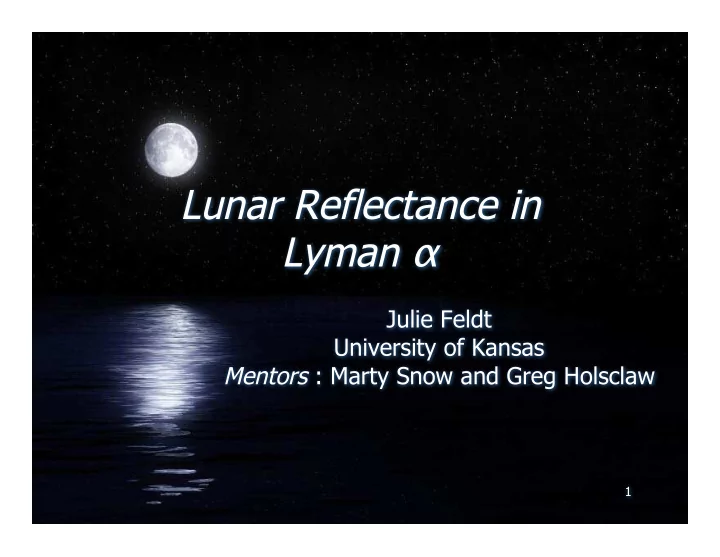
Julie Feldt University of Kansas Mentors : Marty Snow and Greg Holsclaw

Lunar Reflectance in Lyman α

1
slide-2
SLIDE 2

Outline

i. Scientific Background ii. Data Reduction

  • iii. Lunar Albedo measurement
  • iv. Future Work

2

slide-3
SLIDE 3

Why is the Lunar Albedo important?

What is Albedo? Learn more about the Lunar Surface Properties Calibration for other Instruments

3

  • /

/

S M M M

E E A

  • =
slide-4
SLIDE 4

Remote Sensing of the Moon

 Mineralogy Surface composition  Space Weathering Changes to the reflectance properties of a material that’s exposed to the space environment for long periods of time  Photometry Reflectance properties as a function of phase angle depends on details of the surface

4

slide-5
SLIDE 5

Lunar Observations as a Calibration Standard

 Photometrically stable  Visible from any Earth orbit  Ultraviolet instruments are difficult to calibrate accurately  Limited sources that are well-characterized  Carefully measuring the Moon with SOLSTICE could provide an ultraviolet standard from which future instruments could benefit  The Robotic Lunar Observatory (ROLO) is a US Geological Survey project with this goal in the visible to near-infrared; SOLSTICE would extend this to the UV

5

slide-6
SLIDE 6

Geometrical Terms

6

Phase Angle Solar Zenith Angle

slide-7
SLIDE 7

Wavelength Coverage

 SORCE Satellite – SOLSTICE instrument

measures UV (~115-310 nm) – Lyman α (121.6nm) 1 nm resolution in stellar mode and 0.1 nm resolution in solar mode

7

slide-8
SLIDE 8

Solar Spectrum - Lyman α

8

slide-9
SLIDE 9

Lunar Spectrum

slide-10
SLIDE 10

Airglow

 SORCE satellite is still within part of the Earth’s atmosphere  Caused by light scattering off the hydrogen atoms of the atmosphere  This background light adds to the lunar signal that SOLSTICE

  • bserves

10

slide-11
SLIDE 11

Determine Airglow

  • Three scans of just the

atmosphere

  • Data Reduction
  • Each peak is at a

different Solar Zenith Angle

  • 218.6°
  • 207.4°
  • 196.2°
  • Gaussian Fits
slide-12
SLIDE 12

Background Prediction

 Polynomial fit

6th order χ^2 = 57.395

12

slide-13
SLIDE 13

Lyman Alpha after Background Subtraction

13

slide-14
SLIDE 14

Lunar Phase Curve at Lyman Alpha

14

slide-15
SLIDE 15

Opposition Effect

15

slide-16
SLIDE 16

Summary

Lunar albedo can be a good thing to know

Lunar properties Calibration

Reduced the SOLSTICE data Airglow subtraction Found the lunar albedo

slide-17
SLIDE 17

Future Work

 Improving the model to prevent the scatter in albedo

Try other fits Testing the background prediction to find the uncertainty

17

slide-18
SLIDE 18

Questions?

slide-19
SLIDE 19

Space Weathering in the Ultraviolet

Lunar Rocks and Soil

  • Spectra of lunar

soils exhibit an upturn toward shorter wavelengths in the UV, while the spectra of lunar rocks do not exhibit this reversal, this suggests that the

  • ptical effects due

to space weathering in the visible are different in the ultraviolet

19

slide-20
SLIDE 20

To Do This…

 Make Corrections

Issues with the data

Flybacks Observations without data Observations with bad data Timing of instrument off In the lunar observations, shifting of Wavelength due to movement of the Moon

Remove background - Airglow according to the position of the satellite to predict background

20

slide-21
SLIDE 21

Data Reduction

21

slide-22
SLIDE 22

Data Reduction

Filtering data points Observations without data Observations with bad data Shifting of Wavelength due to movement of the Moon

22

slide-23
SLIDE 23

To Do This…

 Make Corrections

Issues with the data

Flybacks Observations without data Observations with bad data Timing of instrument off Shifting of Wavelength due to movement of the Moon

Remove background - Airglow according to the position of the satellite to predict the amount of background

23