LSST Project and Survey: Some lessons learned Tony Tyson - - PowerPoint PPT Presentation

lsst project and survey
SMART_READER_LITE
LIVE PREVIEW

LSST Project and Survey: Some lessons learned Tony Tyson - - PowerPoint PPT Presentation

LSST Project and Survey: Some lessons learned Tony Tyson University of California Davis LSST Chief Scientist 1 Unprecedented control of systematic errors 30 trillion photometric measurements leads to unusually small statistical error


slide-1
SLIDE 1

1

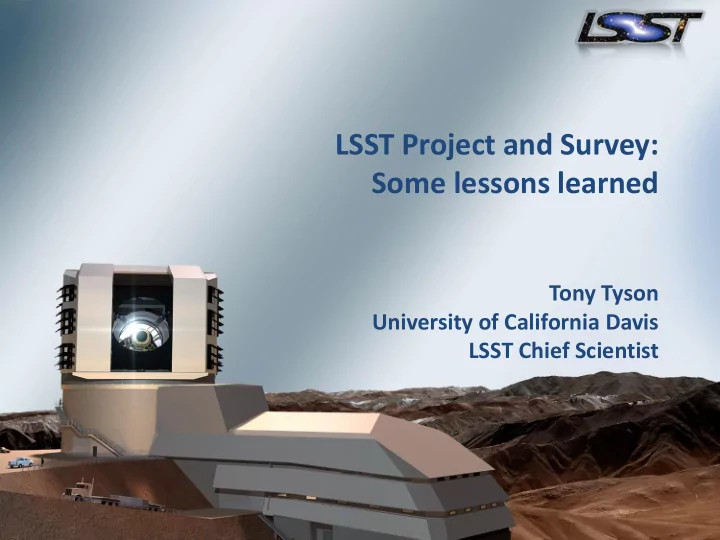
LSST Project and Survey: Some lessons learned

Tony Tyson University of California Davis LSST Chief Scientist

slide-2
SLIDE 2

2

Unprecedented control of systematic errors − 30 trillion photometric measurements leads to unusually small statistical error − Each LSST field of view contains over 10 million objects; each 30 second visit contains 500,000 objects with S/N > 10. − Statistical errors average down like root N; systematics don’t − LSST cosmology and time-domain science drivers require unprecedented precision for astrometry and PSF shape − This leads to unprecedented control of systematic errors

slide-3
SLIDE 3

3

slide-4
SLIDE 4

4

LSST Project

Build facility, conduct 10-year survey, process, archive, and serve images and data products

+

8.4m Telescope 3.2Gpix Camera Peta-scale Data Management Science and EPO user Interfaces

slide-5
SLIDE 5

5

The 189 sensor LSST focal plane constructed from 21 rafts

4K x 4 K Science Sensor

Raft Sensor Assembly Raft Electronics Cage Raft Electronics Board (REB) with Custom Integrated circuits (ASPIC and CABAC) Corner rafts with guiders and WFS not shown

slide-6
SLIDE 6

6

Lesson learned #1

  • CCD R&D began in 2002
  • In 2017 we are hard at work characterizing the

CCDs so that data management can correct for “instrument signature” systematics

  • Lesson: Detectors for precision astronomy

take a long time to develop.

slide-7
SLIDE 7

7

Data Management must transport, process, archive and serve 15 Tb of raw data / night – 500Pb in 10 years

Petascale Database Design Petascale Computing Design Algorithm Design Gigascale Network Design

slide-8
SLIDE 8

8

Petascale Computing, Gbps Networks

The computing cluster at the LSST Archive at NCSA will run the processing pipelines.

  • Single-user, single-application data

center

  • Commodity computing clusters.
  • Distributed file system for scaling and

hierarchical storage

  • Local-attached, shared-nothing storage

when high bandwidth needed

Long Haul Networks to transport data from Chile to the U.S.

  • 2x100 Gbps from Summit to La Serena (new fiber)
  • 2x40 Gbps for La Serena to Champaign, IL (path

diverse, existing fiber)

Archive Site and U.S. Data Access Center

NCSA, Champaign, IL

Base Site and Chilean Data Access Center

La Serena, Chile

slide-9
SLIDE 9

9

Database and Science User Interface

Massively parallel, distributed, fault-tolerant relational database.

  • To be built on existing, robust, well-

understood, technologies (MySQL and xrootd)

  • Commodity hardware, open source
  • Advanced prototype in existence (qserv)

Science User Interface to enable the access to and analysis of LSST data

  • Web and machine interfaces to LSST databases
  • Visualization and analysis capabilities
slide-10
SLIDE 10

10

LSST From the User’s Perspective

− A stream of ~1-10 million time-domain events per night, detected and transmitted to event distribution networks within 60 seconds of

  • bservation.

− A catalog of orbits for ~6 million bodies in the Solar System. − A catalog of ~37 billion objects (20B galaxies, 17B stars), ~7 trillion

  • bservations (“sources”), and ~30 trillion measurements (“forced

sources”), produced annually, accessible through online databases. − Deep co-added images. − Services and computing resources at the Data Access Centers to enable user-specified custom processing and analysis. − Software and APIs enabling development of analysis codes.

Level 3 Level 1 Level 2

slide-11
SLIDE 11

11

slide-12
SLIDE 12

12

slide-13
SLIDE 13

13

slide-14
SLIDE 14

14

slide-15
SLIDE 15

15

Lesson learned #2

  • Coordinated management of all parts of the

project is critically important.

  • Lesson: Communication is key. Frequent “all

hands” and “joint technical” meetings.

slide-16
SLIDE 16

16

Lesson learned #3

  • LSST Data Management construction (only): 417

person-years + $55 million hardware, 10 years.

  • Euclid Data Management construction (only): 750

person-years + 50 million euro, 10 years

  • Gaia DPAC construction (only): 1400 person-years
  • Lesson: Data Management is a BIG effort and

must begin early in a project.

slide-17
SLIDE 17

52% 21% 15% 8% 4%

LSST Operations Plan and Total Survey Cost

Operations: 140 FTE’s, $40m/yr (2014USD)

Data Management Observatory Operations Project Management EPO Community Software

Total LSST Survey cost: $1.3 billion

$10m/year from International Partners

slide-18
SLIDE 18

LSST

WFIRST Euclid

CSS-OS