LR Parsing Compiler Design CSE 504 Shift-Reduce Parsing 1 LR - - PDF document

lr parsing
SMART_READER_LITE
LIVE PREVIEW

LR Parsing Compiler Design CSE 504 Shift-Reduce Parsing 1 LR - - PDF document

LR Parsing Compiler Design CSE 504 Shift-Reduce Parsing 1 LR Parsers 2 SLR and LR(1) Parsers 3 Last modifled: Fri Mar 06 2015 at 13:50:06 EST Version: 1.7 16:58:46 2016/01/29 Compiled at 12:57 on 2016/02/26 Compiler Design LR Parsing


slide-1
SLIDE 1

LR Parsing

Compiler Design CSE 504

1

Shift-Reduce Parsing

2

LR Parsers

3

SLR and LR(1) Parsers

Last modifled: Fri Mar 06 2015 at 13:50:06 EST Version: 1.7 16:58:46 2016/01/29 Compiled at 12:57 on 2016/02/26 Compiler Design LR Parsing CSE 504 1 / 32 Shift-Reduce Parsing

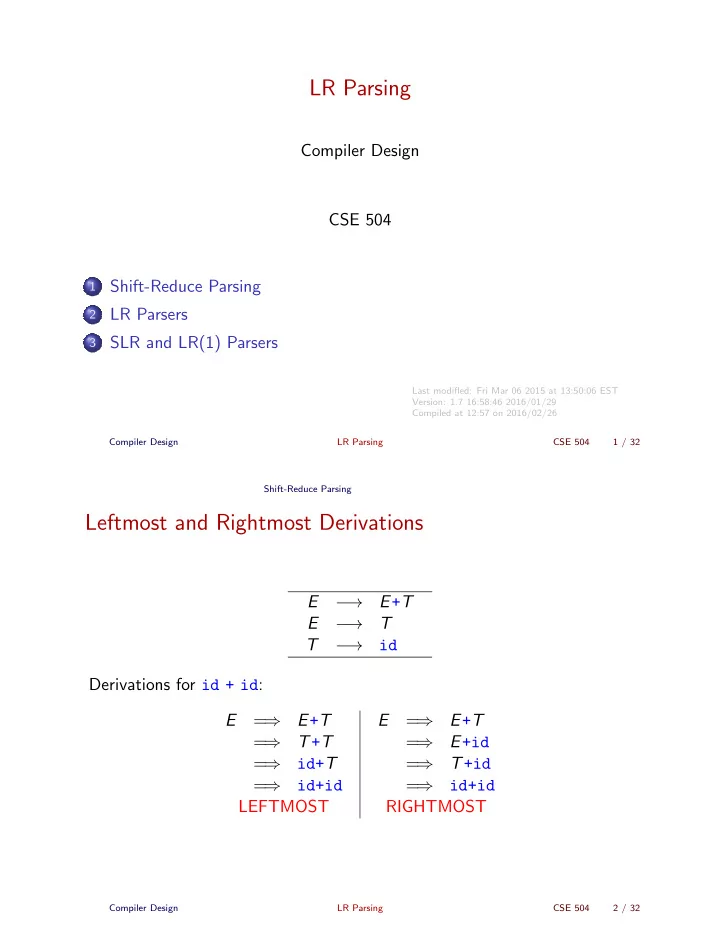
Leftmost and Rightmost Derivations

E − → E+T E − → T T − → id Derivations for id + id: E = ⇒ E+T = ⇒ T+T = ⇒ id+T = ⇒ id+id E = ⇒ E+T = ⇒ E+id = ⇒ T+id = ⇒ id+id LEFTMOST RIGHTMOST

Compiler Design LR Parsing CSE 504 2 / 32

slide-2
SLIDE 2

Shift-Reduce Parsing

Bottom-up Parsing

Given a stream of tokens w, reduce it to the start symbol. E − → E+T E − → T T − → id Parse input stream: id + id: id + id T + id E + id E + T E Reduction ≡ Derivation−1.

Compiler Design LR Parsing CSE 504 3 / 32 Shift-Reduce Parsing

Shift-Reduce Parsing: An Example

E − → E+T E − → T T − → id Stack Input Stream Action $ id + id $ shift $ id + id $ reduce by T − → id $ T + id $ reduce by E − → T $ E + id $ shift $ E + id $ shift $ E + id $ reduce by T − → id $ E + T $ reduce by E − → E+T $ E $ ACCEPT

Compiler Design LR Parsing CSE 504 4 / 32

slide-3
SLIDE 3

Shift-Reduce Parsing

Handles

“A structure that furnishes a means to perform reductions” E − → E+T E − → T T − → id Parse input stream: id + id: id + id T + id E + id E + T E

Compiler Design LR Parsing CSE 504 5 / 32 Shift-Reduce Parsing

Handles

Handles are substrings of sentential forms:

1 A substring that matches the right hand side of a production 2 Reduction using that rule can lead to the start symbol 3 The rule forms one step in a rightmost derivation of the string

E = ⇒ E + T = ⇒ E + id = ⇒ T + id = ⇒ id + id Handle Pruning: replace handle by corresponding LHS.

Compiler Design LR Parsing CSE 504 6 / 32

slide-4
SLIDE 4

Shift-Reduce Parsing

Shift-Reduce Parsing

Bottom-up parsing Shift: Construct leftmost handle on top of stack Reduce: Identify handle and replace by corresponding RHS Accept: Continue until string is reduced to start symbol and input token stream is empty Error: Signal parse error if no handle is found.

Compiler Design LR Parsing CSE 504 7 / 32 Shift-Reduce Parsing

Implementing Shift-Reduce Parsers

Stack to hold grammar symbols (corresponding to tokens seen thus far). Input stream of yet-to-be-seen tokens. Handles appear on top of stack. Stack is initially empty (denoted by $). Parse is successful if stack contains only the start symbol when the input stream ends.

Compiler Design LR Parsing CSE 504 8 / 32

slide-5
SLIDE 5

Shift-Reduce Parsing

Preparing for Shift-Reduce Parsing

1 Identify a handle in string.

Top of stack is the rightmost end of the handle. What is the leftmost end?

2 If there are multiple productions with the handle on the RHS, which

  • ne to choose?

Construct a parsing table, just as in the case of LL(1) parsing.

Compiler Design LR Parsing CSE 504 9 / 32 Shift-Reduce Parsing

Shift-Reduce Parsing: Derivations

Stack Input Stream Action $ id + id $ shift $ id + id $ reduce by T − → id $ T + id $ reduce by E − → T $ E + id $ shift $ E + id $ shift $ E + id $ reduce by T − → id $ E + T $ reduce by E − → E+T $ E $ ACCEPT Left to Right Scan of input Rightmost Derivation in reverse.

Compiler Design LR Parsing CSE 504 10 / 32

slide-6
SLIDE 6

LR Parsers

A Simple Example of LR Parsing

S − → BC B − → a C − → a Stack Input Stream Action $ a a $ shift $ a a $ reduce by B − → a $ B a $ shift $ B a $ reduce by C − → a $ B C $ reduce by S − → BC $ S $ ACCEPT

Compiler Design LR Parsing CSE 504 11 / 32 LR Parsers

A Simple Example of LR Parsing: A Detailed Look

S′ − → S S − → B C B − → a C − → a Stack Input State Action $ a a $ S′ − → • S S − → • BC B − → • a shift $ a a $ B − → a• reduce by 3 $ B a $ S − → B• C C − → • a shift $ B a $ C − → a• reduce by 4 $ B C $ S − → BC• reduce by 2 $ S $ S′ − → S• ACCEPT

Compiler Design LR Parsing CSE 504 12 / 32

slide-7
SLIDE 7

LR Parsers

LR Parsing: Another Example

E ′ − → E E − → E+T E − → T T − → id Stack Input State Action $ id + id $ E ′ − → • E E − → • E+T E − → • T T − → • id shift $ id + id $ T − → id• reduce by 4 $ T + id $ E − → T• reduce by 3 $ E + id $ E ′ − → E• E − → E• +T shift $ E + id $ E − → E+• T T − → • id shift $ E + id $ T − → id• reduce by 4 $ E + T $ E − → E+T• reduce by 2 $ E $ E − → E• +T E ′ − → E• ACCEPT

Compiler Design LR Parsing CSE 504 13 / 32 LR Parsers

States of an LR parser

I0: E ′ − → • E E − → • E+T E − → • T T − → • id Item: A production with “• ” somewhere on the RHS. Intuitively, grammar symbols before the “• ” are on stack; grammar symbols after the “• ” represent symbols in the input stream. Item set: A set of items; corresponds to a state of the parser.

Compiler Design LR Parsing CSE 504 14 / 32

slide-8
SLIDE 8

LR Parsers

States of an LR parser (contd.)

I0 E ′ − → • E E − → • E+T E − → • T T − → • id Initial State = closure({E ′ − → • E}) Closure: What other items are “equivalent” to the given item? Given an item A − → α• Bβ, closure(A − → α• Bβ) is the smallest set that contains

1

the item A − → α• Bβ, and

2

every item in closure(B − → • γ) for every production B − → γ ∈ G

Compiler Design LR Parsing CSE 504 15 / 32 LR Parsers

States of an LR parser (contd.)

I0 E ′ − → • E E − → • E+T E − → • T T − → • id Initial State = closure({E ′ − → • E}) I3 T − → id• = goto(I0, id) Goto: goto(I, X) specifies the next state to visit.

X is a terminal: when the next symbol on input stream is X. X is a nonterminal: when the last reduction was to X.

goto(I, X) contains all items in closure(A − → αX • β) for every item A − → α• Xβ ∈ I.

Compiler Design LR Parsing CSE 504 16 / 32

slide-9
SLIDE 9

LR Parsers

Collection of LR(0) Item Sets

The canonical collection of LR(0) item sets, C = {I0, I1, . . .} is the smallest set such that closure({S′ − → • S}) ∈ C. I ∈ C ⇒ ∀X, goto(I, X) ∈ C.

Compiler Design LR Parsing CSE 504 17 / 32 LR Parsers

Canonical LR(0) Item Sets: An Example

E ′ − → E E − → E+T E − → T T − → id I0 = closure({E ′ − → • E}) E ′ − → • E E − → • E+T E − → • T T − → • id I1 = goto(I0, E) E ′ − → E• E − → E• +T I2 = goto(I0, T) E − → T• I3 = goto(I0, id) T − → id• I4 = goto(I1, +) E − → E+• T T − → • id I5 = goto(I4, T) E − → E+T•

Compiler Design LR Parsing CSE 504 18 / 32

slide-10
SLIDE 10

LR Parsers

LR Action Table

E ′ − → E E − → E+T E − → T T − → id id + $ S, 3 1 S, 4 A 2 R3 R3 R3 3 R4 R4 R4 4 S, 3 5 R2 R2 R2

Compiler Design LR Parsing CSE 504 19 / 32 LR Parsers

LR Goto Table

E ′ − → E E − → E+T E − → T T − → id E T 1 2 1 2 3 4 5 5

Compiler Design LR Parsing CSE 504 20 / 32

slide-11
SLIDE 11

LR Parsers

LR Parsing: States and Transitions

Action Table: id + $ S, 3 1 S, 4 A 2 R3 R3 R3 3 R4 R4 R4 4 S, 3 5 R2 R2 R2 Goto Table: E T 1 2 1 2 3 4 5 5

E ′ − → E E − → E+T E − → T T − → id State Stack Symbol Stack Input Action $ 0 $ id + id $ shift, 3 $ 0 3 $ id + id $ reduce by 4 $ 0 2 $ T + id $ reduce by 3 $ 0 1 $ E + id $ shift, 4 $ 0 1 4 $ E + id $ shift, 3 $ 0 1 4 3 $ E + id $ reduce by 4 $ 0 1 4 5 $ E + T $ reduce by 2 $ 0 1 $ E $ ACCEPT

Compiler Design LR Parsing CSE 504 21 / 32 LR Parsers

LR Parser

while (true) { switch (action(state stack.top(), current token)) { case shift s′: symbol stack.push(current token); state stack.push(s′); next token(); case reduce A − → β: pop |β| symbols off symbol stack and state stack; symbol stack.push(A); state stack.push(goto(state stack.top(), A)); case accept: return; default: error; }}

Compiler Design LR Parsing CSE 504 22 / 32

slide-12
SLIDE 12

LR Parsers

LR Parsing: A review

E ′ − → E E − → E+T E − → T T − → id

Table-driven shift reduce parsing: Shift Move terminal symbols from input stream to stack. Reduce Replace top elements of stack that form an instance of the RHS of a production with the corresponding LHS Accept Stack top is the start symbol when the input stream is exhausted Table constructed using LR(0) Item Sets.

Compiler Design LR Parsing CSE 504 23 / 32 SLR and LR(1) Parsers

Conflicts in Parsing Table

Grammar: S′ − → S S − → a S S − → ǫ Item Sets: I0 = closure({S′ − → • S}) S′ − → • S S − → • a S S − → • I1 = goto(I0, S) S′ − → S• I2 = goto(I0, a) S − → a • S S − → • a S S − → • I3 = goto(I2, S) S − → a S • Action Table: a $ S, 2 R 3 R 3 1 A 2 S, 2 R 3 R 3 3 R 2 R 2 Shift-Reduce Conflict

Compiler Design LR Parsing CSE 504 24 / 32

slide-13
SLIDE 13

SLR and LR(1) Parsers

“Simple LR” (SLR) Parsing

Constructing Action Table action, indexed by states × terminals, and Goto Table goto, indexed by states × nonterminals: Construct {I0, I1, . . . , In}, the LR(0) sets of items for the grammar. For each i, 0 ≤ i ≤ n, do the following: If A − → α• aβ ∈ Ii, and goto(Ii, a) = Ij, set action[i, a] = shift j . If A − → γ• ∈ Ii (A is not the start symbol), for each a ∈ FOLLOW (A), set action[i, a] = reduce A − → γ . If S′ − → S• ∈ Ii, set action[i, $] = accept . If goto(Ii, A) = Ij (A is a nonterminal), set goto[i, A] = j .

Compiler Design LR Parsing CSE 504 25 / 32 SLR and LR(1) Parsers

SLR Parsing Table

Grammar: S′ − → S S − → a S S − → ǫ Item Sets: I0 = closure({S′ − → • S}) S′ − → • S S − → • a S S − → • I1 = goto(I0, S) S′ − → S• I2 = goto(I0, a) S − → a • S S − → • a S S − → • I3 = goto(I2, S) S − → a S • FOLLOW (S) = {$} SLR Action Table: a $ S, 2 R 3 1 A 2 S, 2 R 3 3 R 2

Compiler Design LR Parsing CSE 504 26 / 32

slide-14
SLIDE 14

SLR and LR(1) Parsers

Deficiencies of SLR Parsing

SLR(1) treats all occurrences of a RHS on stack as identical. Only a few of these reductions may lead to a successful parse. Example:

S − → AaAb S − → BbBa A − → ǫ B − → ǫ

I0 = {[S′ → • S], [S → • AaAb], [S → • BbBa], [A → • ], [B → • ]}. Since FOLLOW (A) = FOLLOW (B), we have reduce/reduce conflict in state 0.

Compiler Design LR Parsing CSE 504 27 / 32 SLR and LR(1) Parsers

LR(1) Item Sets

Construct LR(1) items of the form A − → α• β, a, which means: The production A − → αβ can be applied when the next token

  • n input stream is a.

S − → AaAb S − → BbBa A − → ǫ B − → ǫ

An example LR(1) item set: I0 = {[S′ → • S, $], [S → • AaAb, $], [S → • BbBa, $], [A → • , a], [B → • , b]}.

Compiler Design LR Parsing CSE 504 28 / 32

slide-15
SLIDE 15

SLR and LR(1) Parsers

LR(1) and LALR(1) Parsing

LR(1) parsing: Parse tables built using LR(1) item sets. LALR(1) parsing: Look Ahead LR(1) Merge LR(1) item sets; then build parsing table. Typically, LALR(1) parsing tables are much smaller than LR(1) parsing table. SLR(1) ⊂ LALR(1) ⊂ LR(1). LL(1) ⊆ SLR(1), but LL(1) ⊂ LR(1).

Compiler Design LR Parsing CSE 504 29 / 32 SLR and LR(1) Parsers

YACC

Yet Another Compiler Compiler: LALR(1) parser generator. Grammar rules written in a specification (.y) file, analogous to the regular definitions in a lex specification file. Yacc translates the specifications into a parsing function yyparse(). spec.y yacc − −− → spec.tab.c yyparse() calls yylex() whenever input tokens need to be consumed. bison: GNU variant of yacc. ply: Python’s “yacc”; provides function yacc() that is similar to Yacc’s yyparse()

Compiler Design LR Parsing CSE 504 30 / 32

slide-16
SLIDE 16

SLR and LR(1) Parsers

Using Yacc

%{ ... C headers (#include) %} ... Yacc declarations: %token ... %union{...} precedences %% ... Grammar rules with actions: Expr: Expr TOK_PLUS Expr | Expr TOK_STAR Expr ; %% ... C support functions

Compiler Design LR Parsing CSE 504 31 / 32 SLR and LR(1) Parsers

Parsing in PLY

See http://www.dabeaz.com/ply/ply.html

import ply.yacc as yacc ... import tokens from PLY/lexer # precedences: precedence = ( (’left’, ’TOK_PLUS’), (’left’, ’TOK_STAR’) ) # Grammar rules with actions: def p_expression_plus(p): ’expr: expr TOK_PLUS expr’ pass #action, if necessary def p_expression_minus(p): ’expr: expr TOK_STAR expr’ pass #action, if necessary

Compiler Design LR Parsing CSE 504 32 / 32