Low-energy QED tests (and what we can learn from them) e ( 0 ) 2 ( - - PowerPoint PPT Presentation

low energy qed tests and what we can learn from them
SMART_READER_LITE
LIVE PREVIEW

Low-energy QED tests (and what we can learn from them) e ( 0 ) 2 ( - - PowerPoint PPT Presentation

Low-energy QED tests (and what we can learn from them) e ( 0 ) 2 ( 4 ) ( 1 ) 3 ( 5 ) Indirect Searches for New Physics at the time of LHC Florence, March 2010 Andrzej Czarnecki U. of Alberta & CERN Outline


slide-1
SLIDE 1

Low-energy QED tests (and what we can learn from them)

Andrzej Czarnecki U. of Alberta & CERN Indirect Searches for New Physics at the time

  • f LHC

Florence, March 2010

e

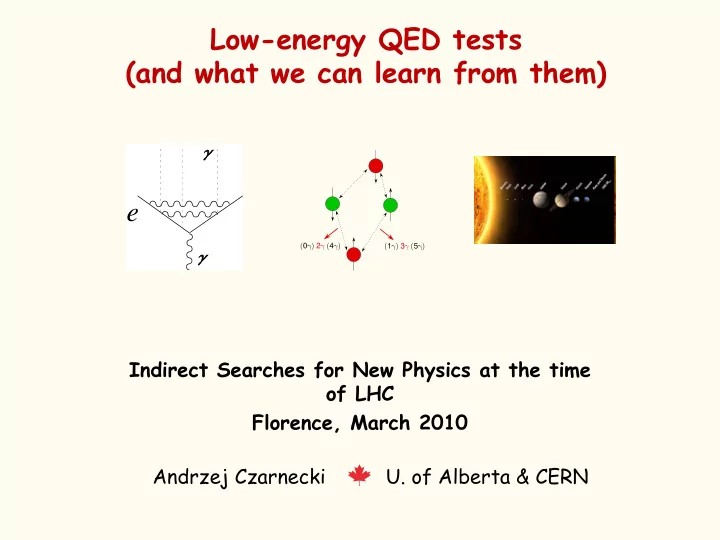
(0γ) 2γ (4γ) (1γ) 3γ (5γ)
slide-2
SLIDE 2

Outline Gyromagnetic factors and the determination of fundamental constants (α, me ) Polyelectrons and tests of few-body QED Muonic atoms and new physics searches (lepton flavor violation, new weak-scale forces)

e

(0γ) 2γ (4γ) (1γ) 3γ (5γ)

slide-3
SLIDE 3

Gyromagnetic factors and the determination of * the electron mass * the fine structure constant

e

slide-4
SLIDE 4

Free-electron g-factor

If you remember three decimal places, 137.036, you get another three free!

( )

[ ]

1/137.035999084 51 0.37ppb α =

e

slide-5
SLIDE 5

Free-electron g-factor

( )( )

[ ]

1/137.035999084 33 39 0.37ppb α =

Experimental and theoretical uncertainties:

e

slide-6
SLIDE 6

Motion in the Penning trap

Motion in the xy plane:

e

slide-7
SLIDE 7

e

Bound-electron g-2: measurement

From Werth

M and m have different origins!

slide-8
SLIDE 8

Bound-electron g-2: theory

e e

( ) ( ) ( ) ( )

2 4 6 2

2 2 2 1 2 1 3 6 3 Z Z g O Z Z α α α α ⎡ ⎤ = − − + = + − ⎢ ⎥ ⎣ ⎦

Breit 1928 – Dirac theory Note: Breit’s calculation predates Schwinger’s by 20 years

e

slide-9
SLIDE 9

Bound-electron g-2: theory

e

( ) ( ) ( )

2 4 6

2 2 3 6 Z Z g O Z α α α = − − +

( ) ( ) ( ) ( )

2 4 5 41 40 2

1 1 ln 6 Z Z a a O Z Z α α α α π α ⎡ ⎤ ⎛ ⎞ ⎢ ⎥ + + + + + ⎜ ⎟ ⎜ ⎟ ⎢ ⎥ ⎝ ⎠ ⎣ ⎦

  • ne-loop corrections

e

Pachucki, Jentschura, Yerokhin 2004 e

slide-10
SLIDE 10

e

Bound-electron g-2: theory

e

( ) ( ) ( )

2 4 6

2 2 3 6 Z Z g O Z α α α = − − +

( ) ( ) ( ) ( )

2 4 5 41 40 2

1 1 ln 6 Z Z a a O Z Z α α α α π α ⎡ ⎤ ⎛ ⎞ ⎢ ⎥ + + + + + ⎜ ⎟ ⎜ ⎟ ⎢ ⎥ ⎝ ⎠ ⎣ ⎦

two-loop corrections

( ) ( ) ( )

2 2 4 41 40 2

1 0.65.. 1 ln .. 6 Z Z b b Z α α α π α ⎡ ⎤ ⎛ ⎞ ⎛ ⎞ ⎛ ⎞ ⎢ ⎥ + − + + + + ⎜ ⎟ ⎜ ⎟ ⎜ ⎟ ⎜ ⎟ ⎜ ⎟ ⎝ ⎠ ⎢ ⎥ ⎝ ⎠ ⎝ ⎠ ⎣ ⎦

e e

slide-11
SLIDE 11

The two-loop bound-state effect

41 40

28 9 16.4 b b = = −

Pachucki, AC, Jentschura, Yerokhin 2005

( )

( ) ( )

12 5 exp th

0.00054857990931 29 1

e

m C u

+ =

Theoretical error: negligible

e

slide-12
SLIDE 12

2010: new measurement with oxygen, 16O7+ Theoretical prediction:

( ) ( )

th

8 2.00004702032 11 g Z = =

( ) ( )

exp

8 2.0000470201 25 g Z = =

Measured value:

(preliminary) e

slide-13
SLIDE 13

The “kinematic” method of finding alpha

Rydberg constant is extremely well measured,

2 2 1

13.6eV R 2

e

m c hc hc α

∞ =

  • 2

Cs Cs

2 R 2R

e p e p

h m c m m h c m m m α

∞ ∞

= =

We can find alpha if we measure the quotient

  • f the Planck constant and the “electron” mass,

In practice heavier particles are better: neutrons or atoms.

e

slide-14
SLIDE 14

Fine structure constant: other methods

ν ' ν

Rb

( )

2 2 2 Rb 2 2 Rb

2 ' 2 h h m c h c m ν ν ν ν ν ⋅ − Δ =

  • 2

Rb Rb

2 Ry 2Ry

e p e p

h m c m m h c m m m α = =

Nature 442 (2006) 516.

e

slide-15
SLIDE 15

about 450 Bloch oscillations in each direction : 1800 recoils

α from Paris

α-1 = 137.035 998 78 (91) uncertainty 6.7 × 10- 9

Cladé et al, PRL 96, 033001 (2006)

Statistical uncertainty on α = 4.4×10⁻⁹

from F. Nez

Future goal: 1ppb

e

slide-16
SLIDE 16

Polyelectrons

(0γ) 2γ (4γ) (1γ) 3γ (5γ)

slide-17
SLIDE 17

Dipositronium Ps2

(0γ) 2γ (4γ) (1γ) 3γ (5γ)

e+ e+ e- e-

(0γ) 2γ (4γ) (1γ) 3γ (5γ)

slide-18
SLIDE 18

Discovery of dipositronium 2007

Molecule formation kills long-lived positronia. At higher temperature, fewer atoms on the surface, fewer molecules formed. Indeed: at high-T, more long-lived positronia

  • bserved.

Cassidy & Mills, Nature 2007

(0γ) 2γ (4γ) (1γ) 3γ (5γ)

slide-19
SLIDE 19

Spectrum of the molecule Ps2

From Suzuki & Usukura, 2000

Non-molecular states of e- e- e+ e+ Molecular states

(0γ) 2γ (4γ) (1γ) 3γ (5γ)

slide-20
SLIDE 20

A direct signal of the molecule: transition line.

From Suzuki & Usukura, 2000

Autodissociation forbidden by Bose-Einstein statistics

(0γ) 2γ (4γ) (1γ) 3γ (5γ)

slide-21
SLIDE 21

A direct signal of the molecule: transition line.

From Suzuki & Usukura, 2000

Observable UV transition

(0γ) 2γ (4γ) (1γ) 3γ (5γ)

slide-22
SLIDE 22

Questions about this transition:

What is its accurate energy? Similar to atomic positronium, but softer (dielectric effect?):

0.1815867(8)a.u. 4.9eV

P S

E E E Δ = − =

  • with Puchalski,

PRL 101, 183001 (2008)

3 1 a.u.=0.1875a.u. 4 4

P S

E E − = ×

(0γ) 2γ (4γ) (1γ) 3γ (5γ)

slide-23
SLIDE 23

Questions about this transition:

How often does radiative transition appear (before annihilation)?

with Puchalski, PRL 101, 183001 (2008)

( ) ( ) ( ) ( ) ( )

dip annih dip

BR 0.191 2 P S P S P P S Γ → → = = Γ + Γ →

(0γ) 2γ (4γ) (1γ) 3γ (5γ)

slide-24
SLIDE 24

Muonic atoms

slide-25
SLIDE 25

Muonic hydrogen Lamb shift and the proton radius

Slides on this topic are not included in this version; please contact Randolf Pohl randolf.pohl@mpq.mpg.de for detailed information about the recent PSI results.

slide-26
SLIDE 26

Searches for Lepton Flavor Violation

We heard yesterday about MEG: now 10-11, goal ~10-13 Muon-electron conversion: Fermilab proposal Mu2E: 10-16 New idea: µ-e-→e-e- Koike et al, 1003.1578, in a large-Z atom. Competition with muon capture.

slide-27
SLIDE 27

Muon capture

Average of HBChPT calculations of ΛS : Apply new rad. correction (2.8%):

further sub percent theory required ΛS

Theory

= 710.6 s-1 ΛS

Theory

= 710.6 s-1

PRL 99, 032001 (2007)

ΛS

MuCap

= 725.0 ± 13.7stat ± 10.7sys s-1 ΛS

MuCap

= 725.0 ± 13.7stat ± 10.7sys s-1

Theory and experiment agree, after years of confusion.

slide-28
SLIDE 28

Summary

Continuing progress in determination of α and me . New opportunities to test QED with three- and four-body bound states. An open problem: organization of the perturbative series; origin of dominant corrections.