Local Government Funding Reform: Settlement 2019/20 and the Road - - PowerPoint PPT Presentation

local government funding reform settlement 2019 20 and
SMART_READER_LITE
LIVE PREVIEW

Local Government Funding Reform: Settlement 2019/20 and the Road - - PowerPoint PPT Presentation

Local Government Funding Reform: Settlement 2019/20 and the Road Ahead 1 Outline for the briefing today 2019/20 Provisional Settlement and NNDR1 2019/20 Funding Reform Consultations Fair Funding Business Rates Retention 2


slide-1
SLIDE 1

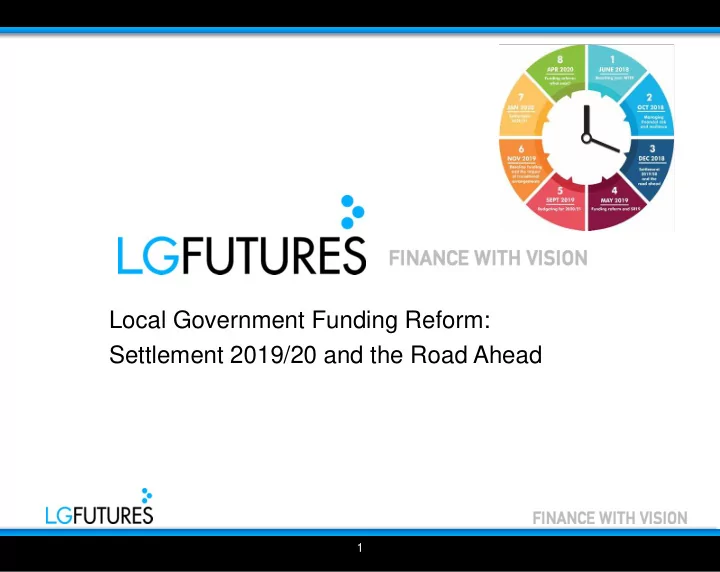
Local Government Funding Reform: Settlement 2019/20 and the Road Ahead

1
slide-2
SLIDE 2

Outline for the briefing today

  • 2019/20 Provisional Settlement and NNDR1 2019/20
  • Funding Reform Consultations

– Fair Funding – Business Rates Retention

2

slide-3
SLIDE 3

Session 1: 2019/20 Provisional Settlement & NNDR1 2019/20

3

slide-4
SLIDE 4

Provisional Settlement 2019/20

  • Announced on 13 December 2018
  • Updated Core Spending Power figures
  • Confirmation of continuing cuts to RSG
  • Removal of Negative RSG
  • Increases to RSDG (+£16m) and NHB (+£18m) Funding
  • £180m released from the BRR levy account
  • Provisional Social Care Allocations of £650m (Budget 2018)
  • 15 new 75% Pilot areas announced for 2019/20 (and 7 back to 50%)
  • No changes to the Council Tax referenda principles (aside from Police)

4

slide-5
SLIDE 5

The biggest missing headline - confirmation of continuing large cuts to RSG

  • Continued major reductions to

RSG

  • A cut of £1.3bn or 36% 2018/19

to 2019/20

  • A confirmed cut of £4.9bn or

68% 2016/17 to 2019/20

  • BUT part hidden by changes

made for 100% BRR pilots (in 17/18,18/19 and 19/20)

5 7.2 5.0 3.6 2.3 1 2 3 4 5 6 7 8 2016/17 2017/18 2018/19 2019/20

£bn

RSG 2016/17 to 2019/20

slide-6
SLIDE 6

Funding 2012/13 to 2019/20

  • Funding reduced from £28.1bn to £18.6bn over the period (34%)

6

slide-7
SLIDE 7

Change in SFA funding

  • Change in SFA Funding by class of authority

7

Lower tier Upper tier Fire ✓ ✓ ✓ ✓ ✓ ✓ ✓ ✓ ✓ ✓ ✓ ✓ ✓ ✓ ✓ ✓ England

  • 2.4%
  • 5.8%
  • 8.0%
  • 6.3%
  • 6.5%

2019/20

  • 4.1%

Outer London Boroughs Unitaries with fire Counties with fire Authority group

Services

  • 9.9%
  • 5.6%
  • 7.4%
  • 8.4%
  • 8.6%
  • 9.9%
  • 7.1%
  • 5.6%
  • 4.7%
  • 6.8%
  • 7.4%

2018/19

  • 13.6%
  • 7.5%
  • 6.4%

Unitaries without fire

  • 9.9%

2016/17 2017/18 Metropolitan Districts Inner London Boroughs Counties without fire Shire Districts Fire Authorities

  • 11.5%
  • 10.9%
  • 9.0%
  • 9.6%

Change in SFA from previous year

  • 7.8%
  • 6.8%
  • 8.9%
  • 12.4%
  • 10.6%
  • 13.0%
  • 11.0%
  • 13.6%
  • 11.8%
  • 16.7%
  • 15.1%
  • 17.0%
  • 15.0%
  • 16.9%
  • 15.0%
  • 42.7%
  • 38.8%
  • 20.6%
  • 31.4%

Cumulative change since 2015/16

  • 34.4%
  • 28.4%
  • 25.1%
  • 33.2%
  • 35.4%
  • 41.7%
slide-8
SLIDE 8

Change in SFA funding

8 Cumulative change in SFA by class of authority

Cumulative change between 205/16 and 2019/20

slide-9
SLIDE 9

Information provided by MHCLG

  • Updated Core Spending Power including split by grant source
  • Key Information for local authorities (and Pilots) i.e. SFA split
  • Calculator for NHB
  • SFA calculation Model
  • Council Tax referendum limits and rules
  • Funding allocations outside of Core Spending Power

– Social Care – Levy Account

  • Relative Need Consultation
  • Business Rates Retention Consultation

9

slide-10
SLIDE 10

Core Spending Power: England

10

2015-16 2016-17 2017-18 2018-19 2019-20 £m £m £m £m £m

SFA

21,250 18,602 16,633 15,574 14,560

Under indexation grant

165 165 175 275 400

Council Tax

22,036 23,247 24,666 26,332 27,927

Improved Better Care Fund

1,115 1,499 1,837

New Homes Bonus

1,200 1,485 1,252 947 918

Rural Services Delivery Grant

16 81 65 81 81

Transition Grant

150 150

Adult Social Care Support Grant

241 150

Winter Pressures Grant

240 240

Social Care Support Grant

410

Core Spending Power

44,666 43,730 44,296 45,098 46,373 No change Slight Increase Budget 2018 Change Tax rate Assumptions Slight Increase No change Budget 2018 Change No change Slight Increase

  • RSG removal + inflation
slide-11
SLIDE 11

Core Spending Power: England

11

2018-19 2019-20 £m £m

Settlement Funding Assessment 162 Under indexation grant 25 Council Tax

  • 269
  • 120

Improved Better Care Fund New Homes Bonus 18 Rural Services Delivery Grant 16 Transition Grant Adult Social Care Support Grant Winter Pressures Grant 240 240 Social Care Support Grant 410 Core Spending Power

  • 28

751

Slight Increase Budget 2018 Change Tax rate Assumptions Slight Increase Budget 2018 Change Slight Increase

  • RSG removal + inflation
slide-12
SLIDE 12

Individual Authority (1)

  • Net increase to Core

Spending Power of £7.4m

  • Other Grants increase of

£1.6m

  • SFA Reduction of £3.5m
  • Net Central Funding Change
  • f - £2.0m
  • Offset by a Council Tax

forecast increase of £9.4m

12

slide-13
SLIDE 13

Individual Authority (1)

  • Other Grants +£1.6m

– NHB change of – £1.0m – Multiplier Grant +£0.4m – Social Care Support Grant +£2.0m – Improved Better Care Fund +£0.9m – Adult Social Care Support Grant -£0.7m

13

2018-19 2019-20 £ millions £ millions Settlement Funding Assessment 41.4 37.9 Compensation for under-indexing the business rates multiplier 0.8 1.2 Council Tax of which; 150.6 160.0 Improved Better Care Fund 5.4 6.3 New Homes Bonus 3.5 2.5 Rural Services Delivery Grant 0.0 0.0 The Adult Social Care Support Grant 0.7 0.0 Winter pressures Grant 1.2 1.2 Social Care Support Grant 0.0 2.0 Core Spending Power 203.7 211.1

slide-14
SLIDE 14

Individual Authority (2)

  • Net decrease to Core

Spending Power of £0.527m

  • Other Grants

decrease of £0.439m

  • SFA Reduction of

£0.418m

  • Net Central Funding

Change of - £0.857m

  • Offset by a Council

Tax forecast increase

  • f £0.330m

14

slide-15
SLIDE 15

Individual Authority (2)

  • Other Grants -£0.439m

– NHB change of – £0.478m – Multiplier Grant +£0.039m

15

2018-19 2019-20 £ millions £ millions Settlement Funding Assessment 4.435 4.017 Compensation for under-indexing the business rates multiplier 0.086 0.125 Council Tax of which; 6.146 6.476 New Homes Bonus 2.086 1.608 Core Spending Power 12.753 12.225

slide-16
SLIDE 16

Business Rates Pilots

  • 2018/19

– A further 10 Pilot areas created for 2018/19 plus London extended – Total cost to HMT of pilot status for 2018/19 forecast at over £0.8bn (IFS) – Announced as 1 year only

  • 2019/20

– It should be the final year of “pilots” – Original 5 areas to continue at 100% – London moved from 100% to 75% (but was 67% anyway in 2017/18) – 7 of the 10 new 2018/19 Pilot areas moving back from 100% to 50% – 15 Pilot areas at 75% outside of London (12 new – 3 from 2018/19) – Not just an extra 25% of growth for some (i.e. 50% to 75%), due to the levy also not payable – Will the pilot changes result in income distortion?

16

slide-17
SLIDE 17

Business Rates Pools

  • A combination of existing pools that did not bid for pilot status and areas that

bid for pilot status, where plan B was to pool

  • Usual 28 days to decide whether to remain as a pool or not (all or nothing) –

same as the pilots.

  • It remains to be seen if MHCLG can make pooling worthwhile under the

75% scheme. Whilst a levy is proposed, will not (under the proposals) impact on most authorities, therefore what other incentives can there be to pool? – Higher safety net ? – Keep growth for longer ?

17

slide-18
SLIDE 18

Council Tax Referendum Limits

  • Government has maintained the limit from 2018/19. So:

– Upper tier authorities 2.99% plus (potentially up to 3%) can be made without a referendum – Lower tier authorities increases of less than 3% or £5 (whichever is the higher) can be made without a referendum

  • Social Care Precept is as was, so:

– Balance of 6% over 3 years not used by end 18/19

  • Town and Parish councils – deferred setting of referendum principles for

town and parish councils

  • Extended limits for PCCs - £24 per annum

18

slide-19
SLIDE 19

Council Tax – the change to the balance of funding

2015/16 £bn 2016/17 £bn 2017/18 £bn 2018/19 £bn 2019/20 £bn Government funding (including SFA) 22.6 20.5 19.6 18.8 18.5 Council tax 22.0 23.2 24.7 26.3 27.9 Council Tax as a Proportion of Total 49% 53% 56% 58% 60%

19

  • National funding has reduced by £4.1bn over 5 years, an 18% decline
  • Council tax projected CSP funding has increased by £5.9bn over 5 years,

a 27% increase

  • Council tax will fund 60% of all CSP by 2019/20 compared to 49% in 2015
  • Next CSP?
slide-20
SLIDE 20

Council Taxbase Growth Assumptions – CLG inconsistency, but reduced

  • CLG have made following assumptions for changes in the taxbase

– Average annual growth 2014-15 to 2018-19 up to 2019/20: calculated at nationally 1.96% – Increases in line with maximum use of new referendum limits

  • Starting point of council tax revenue in 2018/19 is lower by -£268m and

estimate for 2019/20 is lower (excluding extra GLA Police) by -£154m (note additional SC precept to be raised in 19/20)

  • Likely taxbase growth for 2019/20 could be 1.5% so MHCLG overestimate

could be approximately £115m

20

slide-21
SLIDE 21

Other issues

  • New Homes Bonus – no change on pervious method set out, with the extra

£18m in funding averting the possible increase to the deadweight for 2019/20, but no indicative future numbers now provided

  • An extra £153m of funding for high taxbase / tax rate authorities to avoid

having negative RSG for 2019/20. Reducing SR15 funding reductions for these authorities

  • Additional RSDG – an increase of £16m to funding, to match 2018/19 levels
  • £180m released from the BRR levy account

– Not shown in Core Spending Power. Why? 2020/21 comparisons? – Allocated based on 2013/14 SFA – not reflect SR 2015 reductions (taking into account tax rate and base) – Allocated after negative RSG wiped out

21

slide-22
SLIDE 22

Completing NNDR1 2019/20

22

slide-23
SLIDE 23

2019/20 NNDR1

  • Main changes anticipated:

– Changes to local splits for the pilot authorities (and those no longer pilots) – S31 Grant Calculation for SBRR reflects the proposed revised threshold factors – Additional Retail relief and resulting additional S31 grant

  • Important for Pilot areas to understand any local governance

arrangements and how they may alter the amounts from NNDR1

  • Highly unlikely that the figures to be used within the Reset / setting

authorities’ NNDR Baseline for 2020/21 and beyond

  • Part 4 may see some areas change their attitude to the appeals

provisions from the 2017 list

23

slide-24
SLIDE 24

2019/20 NNDR1 - Appeals

  • Not likely that appeals can be nationalised under the current system
  • But the alternative ‘simplification’ (see later) effectively does nationalise

appeals

  • 2010 List

– Any adjustment needed (more or less) to part 4 – More authorities concerned regarding the knock on impact of 2010 appeals being settled adversely

  • 2017 List

– Feedback suggest very little information / activity – Authorities already have …

  • Made a forecast for 2018/19 (in 2018/19 NNDR1)
  • Put aside an amount in 2017/18 NNDR3

24

slide-25
SLIDE 25

2019/20 NNDR1 - Appeals

  • Is the amount set aside in 2017/18 NNDR3 still the best estimate?
  • If so, it needs repeating in part 4 for 2018/19 and including in Part 3 for

2019/20

  • If not, (depending on whether a similar approach was taken in 2018/19

NNDR1) there could be a significant one-off change in resources in 2019/20 and potentially an ongoing increase in future years Potential example

  • District (40% local share) £40m business rates income - £16m local share
  • Put aside 5% in 2017/18, and forecast 5% in 2018/19 NNDR

25

slide-26
SLIDE 26

2019/20 NNDR1 - Appeals

Scenario A – no change in appeals approach

  • 2019/20 - £40m less 5% = £38m
  • It will take £2.0m (£0.8m local share) of the forecast 2018/19 income in part

4

  • Local share that the authority will receive = £16m less £0.8m = £15.2m
  • Future years £15.2m per annum also

Scenario B – Appeals % changed to 0%

  • 2019/20 - £40m less 0% = £40m
  • 2019/20 local share that the authority will receive = £16m
  • It will also be able to reverse the £0.8m set aside from 2017/18
  • It will also no longer need to include the £0.8m future years repayments for

2018/19

  • Total Received in 2019/20 = £16.0m + £0.8m + £0.8m = £17.6m
  • Future years = £16.0m per annum

26

slide-27
SLIDE 27

2019/20 NNDR1 - Appeals

Issues

  • What percentage / approach to use for the 2017 list?
  • What is your auditor saying?
  • Pilot / pooling considerations
  • The future of business rates retention

Risks to consider

  • Not having sufficient / too much appeals provision
  • Changing local share putting aside a provision for others to gain!
  • Appeals being nationalised (and needing maybe 4.7% + backdated)
  • Recognising the one-off nature of any gain
  • Not qualifying for the safety net

27

slide-28
SLIDE 28

2017/18 NNDR3: Collection Fund balances

28

2013/14 £bn 2014/15 £bn 2015/16 £bn 2016/17 £bn 2017/18 £bn 2018/19 £bn

Rates overpaid 1.2 0.8 0.7

  • 0.1

0.1 Deficit distributed 0.5 0.5 1.3 0.5

  • 0.2

Main messages

  • In 2016/17 there was the first surplus on the collection fund, of

£0.1bn

  • Overpayments of business rates revenues to date have totalled

£2.7bn over five years

  • Estimated deficits have been distributed between 2013/14 and

2018/19 of £2.6bn which means there is an outstanding deficit to distribute in 2019/20 of £0.1bn

slide-29
SLIDE 29

Appeals analysis at NNDR3 – balance at year end

29

2013/14 £m 2014/15 £m 2015/16 £m 2016/17 £m 2017/18 £m All England 1,744 2,515 2,806 2,639 2,810

Main messages

  • All England balances up to a high as 31 March 2018 – now added

in one year for 2017 List

  • Will additional 2017 List additions exceed reductions to 2010 List

(and 2005 List)?

slide-30
SLIDE 30

2017/18 NNDR3: Balances on appeals

30

  • There was a mixed picture of movement between 2016/17 and 2017/18 with

declines in Inner London but increases in all other types of authority;

  • There was a reduction of 2.4% in the proportion of NRP set aside in appeals Inner

London compared to increases in Shire Unitaries of 2.0% and Shire Districts of 1.8%;

  • At the end of 2017/18 it is Metropolitan Authorities who on average have the

highest proportion of NRP set aside in appeals at year end (prev. Inner London Boroughs).

slide-31
SLIDE 31

NNDR1: Budgeted repayments for 2017 List

31

  • Chart 2 shows that over the two years, local authorities across England have

quantified the amount due as repayments from reductions to valuation at 4.8% of Net Rates Payable.

  • Inner London Boroughs (6.1%) have the highest cumulative total quantified and

Outer London Boroughs (3.5%) the lowest total.

  • Metropolitan Authorities have a 4.7% level of cumulative repayments shows at

NNDR1, which matches the levels assumed by CLG at Revaluation 2017.

slide-32
SLIDE 32

Summary for session 1

  • Least complex year of the 4 year Settlement
  • Grant funding additions continue to be made to part compensate for high

reductions at SR15

  • Council taxbase assumptions from MHCLG continue to be overly high
  • NNDR1 2019/20 – only a small amount of additional information for

budgeting for repayments compared to NNDR1 2017/18 & 2018/19 but how will appeals provisions figure for future BRR from 2020/21?

32

slide-33
SLIDE 33

Session 2: Reform of Local Government Funding

33

slide-34
SLIDE 34

Covering

  • A review of local authorities relative needs and resources
  • Business Rates Retention Reform – sharing risk, managing volatility and

setting up the reformed system

  • Both published on 13 December, closing date for responses by 21

February 2019

34

slide-35
SLIDE 35

Fair Funding Review: a review of needs and resources – technical consultation on relative need

Relative Need Formulas Relative Resources Transitional Arrangements Greater detail Clearer policy steer, but lacking in depth of detail Principles outlined, no attempt at providing any depth of detail 4 questions 9 questions 2 questions Covering:

  • Structure
  • Key cost driver(s)
  • Service Specific

Formulas

  • Area Cost Adjustment
  • Weighting

Covering:

  • Tax Base
  • Council tax levels
  • Collection Rates
  • Tier splits
  • Future council tax
  • Sales, Fees and

Charges Covering:

  • Principles
  • Baseline

35

slide-36
SLIDE 36

Main points

  • Enhanced understanding of how the Needs and Resources Formulas might work

– Much simplified Needs Model – Clear structure (mostly) in place – Importance of Population / Population Projections emphasised – Clarity of inclusion of Public Health (but possible implications for future) – Emphasis of maintaining use of ‘notional’ council tax levels

  • But lack of information / options / consistency on:

– Weighting or data which are crucial – Resourcing ‘notional’ figures – Not using council tax base projections whilst using Population projections

  • Lack of any detail, beyond principles, on Transition means at this stage there is no

knowledge of how quickly gain or pain after April 2020/21 could materialise

36

slide-37
SLIDE 37

Timetable - update

  • Potentially introduced 2020/21
  • Set funding baselines and finalise transitional arrangements Oct 2019 –

January 2020

  • Significant amount of technical work in next 8 months needed and

political decision making to be made – any more consultation?

  • Before then government’s current aim (subject to Spending Review 19) is

to publish indicative allocations through a further stage of formal consultation before the 2020/21 provisional local government finance settlement

37

slide-38
SLIDE 38

Relative Needs: Proposed structure

38

slide-39
SLIDE 39

Relative Needs: Foundation Formula

39

Proposal for a Foundation Formula will be per capita, with population recognised as by far the main and therefore only cost driver to be used and then adjusted for an Area Cost Adjustment (inc. Rurality)

slide-40
SLIDE 40

Relative Needs: Other costs drivers

40

Upper Tier: Population alone explained 88.1% of variances in past expenditure Lower Tier: Population alone explained 84% of variances in past expenditure

slide-41
SLIDE 41

Relative Needs: The Seven Service Formulas

  • Adult Social Care: Split 18-64 and 65+; Small Area Modelling, ACA
  • Children & Young People’s Services: Cost Drivers TBD; Multi Level

Modelling, ACA

  • Public Health: Formula from 2015, subject to further DSS / PH England

review, ACA

  • Highways Maintenance: Road Length & Traffic Flow; Expenditure

regression; ACA

  • Fire & Rescue: Retaining separate; Expenditure regression proposed;

ACA

  • Legacy capital: Assumed Debt & Interest; No ACA
  • Flood Defence & Coastal protection: Upper tier – within Funding

Foundation; Lower Tier each separate, own formula, Expenditure regression with further work, ACA

41

slide-42
SLIDE 42

Relative Needs: Other Areas Considered

  • Concessionary travel
  • Local Bus Support
  • Waste Services
  • Homelessness
  • Fixed Costs
  • Unaccompanied Asylum Seeking Children
  • People with no recourse to public funds

42

slide-43
SLIDE 43

Relative Needs: Area Cost Adjustment

  • The proposed Area Cost Adjustment will continue to adjust for differences in labour and

business rates costs, and also considers the impact of ‘Accessibility’ and ‘Remoteness’

  • The Government is minded to incorporate the factors set out below:

– A rates cost adjustment, including rents, to reflect the variation between areas in the cost of using equivalent premises due to differences in local supply and demand factors, – A labour cost adjustment, including accessibility, to reflect the fact that authorities will need to compete with other potential employers to secure and retain suitably skilled staff, and – A remoteness adjustment, to account for variation in the cost of some inputs due to the size of local markets or isolation from major markets.

  • Proposed Area Cost Adjustment methodology - tailored Area Cost Adjustment for the

Foundation Formula and each service area it is applied to

  • The factors set out above will be weighted together into a single index for each funding

formula, using evidence-based weights which are appropriate for the relevant service(s)

43

slide-44
SLIDE 44

Relative Needs: Weightings

  • As the proposed system will include several funding formulas it will be necessary to decide

the proportion of overall funding that is allocated by each one - the government intends to further explore the approach to determining control totals

  • The consultation sates that statistical techniques offer an evidence-based way to determine

funding allocations by minimising the use of judgement in constructing funding formulas, with different services more suited to a particular technique

  • In determining the merits of a particular technique the following factors are under

consideration: –

  • i. the analytical robustness offered by a technique

  • ii. the level of sophistication employed by a technique (and the trade-off between

complexity, robustness and transparency), and –

  • iii. practicalities, including the availability of appropriate data sources
  • The paper does on to discuss the relative merits of the two leading statistical techniques

identified for the review i.e. ‘multi-level’ modelling and expenditure based regression

44

slide-45
SLIDE 45

Relative Needs: Future Proofing

  • Respondents to December 2017 consultation expressed strong consensus around

using official population projections to reflect changing population sizes when assessing the relative needs of local authorities.

  • The Government is minded to agree that:

– Using Office for National Statistics population projections to calculate allocations for each year of a forward funding period – Taken at the outset of the period – Updating these when the needs assessment is refreshed

  • They consider this is most appropriate way to reflect future population changes,

while giving authorities certainty over income for the duration of the funding period

  • They don’t ask for further views on this

45

slide-46
SLIDE 46

Questions on Relative Needs

  • Question 1): Do you have views at this stage, or evidence not previously

shared with us, relating to the proposed structure of the relative needs assessment set out in this section?

  • Question 2): What are your views on the best approach to a Fire and

Rescue Services funding formula and why?

  • Question 3): What are your views on the best approach to Home to School

Transport and Concessionary Travel?

  • Question 4): What are your views on the proposed approach to the Area

Cost Adjustment?

46

slide-47
SLIDE 47

Relative Resources: Council Tax (1)

  • Tax base

– Minded to continue including the effect of all non-discretionary discounts and exemptions in its measure of the tax base – Minded to continue with an assumption-based approach to take account of the second homes discount, the empty homes discount and the empty homes premium in its measure of council tax base – Government is looking to explore options on working age CTS and is keen to hear wider views before determining a preferred approach

  • Council tax level: The government is minded to use a notional assessment
  • f council tax levels when making the relative resources adjustment. This

is an approach that has precedent in previous local government funding settlements, including the 2013-14 methodology

47

slide-48
SLIDE 48

Relative Resources: Council Tax (2)

  • Collection rate: A uniform notional collection rate could be set at various

levels (e.g. at the minimum, average, or maximum collection rate); however, it would have the same effect for all authorities in the relative resources adjustment irrespective of their actual collection rate

  • Tier splits: government is minded to calculate the average share in council

tax receipts in multi-tier areas between the shire county precept, the shire district element and the fire element of council tax bills across the country, and apply that percentage uniformly to the measure of council tax in the resources adjustment for relevant areas

  • Council tax in successive years: government is minded to fix a single

measure of council tax resource over the period

48

slide-49
SLIDE 49

Relative Resources: Sales, Fees and Charges

  • Not previously been taken into account in a relative resources adjustment
  • Previously been netted off against authorities’ gross expenditure to

determine the level of net revenue expenditure

  • Consideration of whether appropriate to make more direct adjustment for

sales, fees and charges income when assessing relative resources

  • Having taken into account factors such as scale, ability, choice and

incentive effects, volatility and data availability the government “recognises that there are practical challenges in taking direct account of sales, fees and charges income and are broadly minded not to do so”

  • However, may be a case for taking specific service areas into account

which have generated an increasingly significant level of surplus income for some authorities, such as on and off-street parking. The government are keen to hear wider views on potential options before determining a preferred approach

49

slide-50
SLIDE 50

Questions on Relative Resources

  • Question 5): Do you agree that the Government should continue to take account of non-discretionary

council tax discounts and exemptions (e.g. single person discount and student exemptions) and the income forgone due to the pensioner-age element of local council tax support, in the measure of the council tax base? If so, how should we do this?

  • Question 6): Do you agree that an assumptions-based approach to measuring the impact of discretionary

discounts and exemptions should be made when measuring the council tax base? If so, how should we do this?

  • Question 7): Do you agree that the Government should take account of the income forgone due to local

council tax support for working age people? What are your views on how this should be determined?

  • Question 8): Do you agree that the Government should take a notional approach to council tax levels in the

resources adjustment? What are your views on how this should be determined?

  • Question 9): What are your views on how the Government should determine the measure of council tax

collection rate in the resources adjustment?

  • Question 10): Do you have views on how the Government should determine the allocation of council tax

between each tier and/or fire and rescue authorities in multi-tier areas?

  • Question 11): Do you agree that the Government should apply a single measure of council tax resource

fixed over the period between resets for the purposes of a resources adjustment in multi-year settlement funding allocations?

  • Question 12): Do you agree that surplus sales, fees and charges should not be taken into account when

assessing local authorities’ relative resources adjustment?

  • Question 13): If the Government was minded to do so, do you have a view on the basis on which surplus

parking income should be taken into account?

50

slide-51
SLIDE 51

Relative Resources: Transitional Arrangements

  • Application: introduced taking into consideration wider factors including business rates

baseline reset, development of the business rates retention system and SR2019

  • Principles

– Stability: transition from existing funding to new target allocations must be manageable and sustainable in the context of wider changes to the local government finance system – Transparency: the process must be clear and understandable to support financial planning and help explain the nature of transition to a wider audience – Time-limited: support for authorities with a reduction in settlement funding allocations using deferred gains provided over fixed period of time to enable target allocations to be reached as soon as practicable – Flexibility: the speed of change could vary across the sector to achieve greater

  • efficiency. Considerations might include local revenue raising capacity, distances from

target allocations or relative funding pressures, for example to deliver statutory services

  • Baseline for Transition: measure of the funding available to each local authority in 2019/20

with adjustments, with approach only be finalised after local authorities’ new funding baselines have been determined - government would like to build early consensus around the principles used in designing these arrangements next year

51

slide-52
SLIDE 52

Questions on Transitional Arrangements

  • Question 14): Do you agree with the proposed transition principles, and

should any others be considered by the Government in designing of transitional arrangements?

  • Question 15): Do you have views on how the baseline should be

constructed for the purposes of transition?

52

slide-53
SLIDE 53

Relative Resources: So what do we know now?

  • Foundation Formula (FF) plus a 7 block Needs Model
  • Population, population projections and ACA key factors in the FF
  • Public Health a new block with associated implications included
  • Emphasis of maintaining use of ‘notional’ council tax levels and not using

council tax base projections

  • Council tax working age claimants - not yet known how to reflect
  • Other notional levels re council tax to be determined
  • No inclusion of sales, fees and charges (but car parking excess income)
  • Weighting remains outstanding and crucial issue
  • Transition methodology likely broader than in the past
  • Transition framework late in the process
  • Consultation on indicative numbers intended pre Settlement but post

SR19

53

slide-54
SLIDE 54

Business Rates Retention Reform

  • Balancing risk and reward

– Resets – Safety net – Levy – Ties splits – Pooling

  • Simplifying the system

– Review of the central/local list – Addressing volatility – Simplification

  • Setting up the system

– Resetting Business Rates Baselines

54

slide-55
SLIDE 55

BRR Reform: Balancing risk and reward

Resets

  • Government intends to carry out a full reset for 2020/21
  • Approach in future could be different
  • Types of reset

– Full: – Partial: – Phased:

  • Intermittent full resets regardless (potentially every 15 years)
  • Timing – how often and to reflect Revaluation or not?
  • Asking:

– Question 1: Do you prefer a partial reset, a phased reset or a combination of the two? – Question 2: Please comment on why you think a partial / phased reset is more desirable. – Question 3: What is the optimal time period for your preferred reset type?

55

slide-56
SLIDE 56

BRR Reform: Balancing risk and reward

Safety net and Levy

  • Continued safety net
  • Level set only once clarity on wider system specifics
  • Funded through general top slice affecting all and not a levy
  • No future levy
  • Future threshold will be applied beyond which 100% of all growth lost
  • Asking:

– Question 4: Do you have any comment on the proposed approach to the safety net? – Question 5: Do you agree with this approach to the reform of the levy? – Question 6: If so, what do you consider to be an appropriate level at which to classify growth as ‘extraordinary’?

56

slide-57
SLIDE 57

BRR Reform: Balancing risk and reward

Tier splits and Pooling

  • Continues to evade suggesting what these might be
  • Continues to push the sector led solution
  • Identifies a fall back – local government’s own ‘backstop’ – is required
  • Tier split between GLA and London Boroughs a local discussion
  • Fire share proposed to stay at 1%
  • Future Pools could have ability to change shares
  • Still trying to identify how to incentivise future Pools
  • Asking:

– Question 7: What should the fall-back position be for the national tier split between counties and districts, should these authorities be unable to reach an agreement? – Question 8: Should a two-tier area be able to set their tier splits locally? – Question 9: What fiscally neutral measures could be used to incentivise pooling within the reformed system?

57

slide-58
SLIDE 58

BRR Reform: Simplifying the system

Central/Local Lists

  • Government carrying out a review
  • Implemented at reset
  • Criteria for listing outlined

– Nature and use of the property – Size and geographical spread of the property – Suitability or otherwise for assessment of the property on local non-domestic rating lists

  • Government not minded to facilitate moving premises where likelihood that a

hereditament’s presence on local list will cause significant short-term disruption

  • Asking:

– Question 10: On applying the criteria outlined in Annex A, are there any hereditaments which you believe should be listed in the central list? Please identify these hereditaments by name and location. – Question 11: On applying the criteria outlined in Annex A, are there any listed in the central list which you believe should be listed in a local list? Please identify these hereditaments by name and location.

58

slide-59
SLIDE 59

BRR Reform: Simplifying the system

Addressing Volatility

  • Identifies potential use of a proxy to measure losses on appeals
  • Outlines four possible approaches to mitigate losses
  • But then says it sees none can work and so they would like to simplify the

system

  • Implicit is if continue with current system, losses on appeals and volatility

resulting - local government will have to live with

  • Asking only:

– Question 12: Do you agree that the use of a proxy provides an appropriate mechanism to calculate the compensation due to local authorities to losses resulting from valuation change?

59

slide-60
SLIDE 60

BRR Reform: Simplifying the system

Proposals to simplify administration of the system

  • Why simplification - reasons
  • How the reformed system would work (showing how future funding calculated

and when)

  • Risk and reward under the reformed system – explaining
  • Asking:

– Question 13: Do you believe that the Government should implement the proposed reform to the administration of the business rates retention system?

60

slide-61
SLIDE 61

BRR Reform: Simplifying the system

Why simplification

  • It offers a way of addressing the issue of volatility caused by appeals and other

valuation change

  • It would also simplify the system and give more certainty to authorities of the

level of income they can expect to see on a year to year basis

  • It negates the need to Reset Business Rates Baselines for all authorities

61

slide-62
SLIDE 62

BRR Reform: Simplifying the system

How the reformed system would work

  • Split out annual income from reward and risk
  • Floating top up and tariffs introduced so that NNDR1 can match Baseline

Need each year

  • NNDR1 to NNDR3 variances would also be reflected in the calculation of the

floating top up and tariffs so Collection Fund surplus / deficits don’t impact in- year either

  • All before growth or decline is taken into account
  • Any future changes to business rates reliefs could be reflected in adjustments

in top-ups and tariffs in subsequent years, rather than relying on separate Section 31 grants

  • NNDR1 completion would need to be brought forward to probably September

62

slide-63
SLIDE 63

BRR Reform: Simplifying the system

Risk and reward under the reformed system

  • Under 75% business rates retention, local authorities would keep 75% of their business

rates growth (notwithstanding decisions taken on the levy and tier splits) and 75% of any decline (notwithstanding decisions taken on the level of the safety net)

  • The growth achieved and retained by local authorities would more closely represent the

actual growth achieved and would not be affected by changes in provisions

  • Under the proposed reform, the government is minded to measure growth and decline

based on outturn figures (provided in NNDR3 forms), net of provisions

  • NNDR forms do not currently require local authorities to separately identify ‘prior year

adjustments’ for ‘gross rates payable’ but will in future need to do so to remove impact in assessing ‘growth’ with a ‘baseline’ being set by the adjusted previous years’ NNDR3

  • Any growth or decline in business rates income in a local area would be recognised by

adjusting the following year’s top-up and tariff payments, i.e. top-ups and tariffs would be used both to redistribute business rates to ensure determined need is provided for and to reflect growth

63

slide-64
SLIDE 64

BRR Reform: Alternative system – comparison

64

Criteria Current Alternative

Existing Growth? Added toBaseline Need Nationalised appeals? Problematic Yes Realistic starting position? Lottery Increased chance Complexity? Complex (although fair ?) Less complex / Fair Reward genuine growth? Yes, but could undermined by the starting position or appeals Yes, but still subjective

slide-65
SLIDE 65

BRR Reform: Potential future funding (simplified)

65

BRR System 2020/21 Resources 2021/22 Resources 2022/23 Resources New System Baseline Need only Baseline Need +/- 2020/21 growth Baseline Need +/- 2021/22 growth Old System Plus/Minus Estimated surplus/deficit 2019/20 Plus/Minus Outstanding surplus/deficit 2019/20 No impact

slide-66
SLIDE 66

The Reformed System – summary

  • It’s a late new addition to the discussions (July 2018)
  • Could potentially simplify the system significantly
  • There will be new complexities – around reward and risk
  • There will be migration complexities e.g. what happens to existing provisions,

how will old system C/F surplus/deficits be managed

  • Rewards and s31 grants – how will reward not be influenced by past and

future central government policy decisions?

  • When will there be certainty about which ‘horse will be backed’
  • Will there be further consultations on how it will work, and if so, when?
  • What will be the view of local government?

66

slide-67
SLIDE 67

BRR Reform: Resetting Business Rates Baselines

  • Emphasise only required if local government does not go for simplification
  • Proposals:

– Based on NNDR3 with inevitable imperfect Baselines – Single year data – Bottom up baseline – so no EBRA nationally and shares of this – Using 2018/19 NNDR3 uprated by multiplier – Net Rates Payable – amount for allowance for non collection less amount for provisions less disregarded amounts – Allowance for non collection – data over x years (not specified) – Using NNDR3 based estimates of future 2017 appeal losses or using own estimate

  • f 4.7% or authorities own stand alone estimate using centrally determined method
  • Less than perfect and rushed proposals
  • Very much based on assumption of moving to a simplified system
  • Asking:

– Question 14: What are your views on the approach to resetting Business Rates Baselines?

67

slide-68
SLIDE 68

BRR Reform: So what do we know now?

  • Full reset at 2020/21 so all individual growth lost to FFR / SR19
  • Future resets could be on a quite different basis (even phased)
  • Intermittent full reset planned, but how practical?
  • Safety net to continue, at a level to be set at the end of the process
  • No levy, but a growth threshold (not yet determined) at which 100% of

gains lost

  • Tier splits and Pooling – decisions and system long way off, but

potential back stop for tier splits where sector cannot decide itself

  • Fire share likely staying at 1%
  • Review of central list – but scope as originally expected
  • Local government either goes for simplified BRR system or:

– Appeals driven volatility here to stay – Even more imperfect Baselines will be set at 202/21

  • MHCLG would really like to go with the simplification of BRR

68

slide-69
SLIDE 69

Summary – consultation papers

  • Continuing progress
  • A lot of systemic knowns
  • A lot of systemic known ‘unknowns’
  • Indicative numbers not until after SR19
  • Simplified BRR highly likely so will need to get used to a brand new

system

69

slide-70
SLIDE 70

Rupert Dewhirst rupert.dewhirst@lgfutures.co.uk 07775 428145 Lee Geraghty lee.geraghty@lgfutures.co.uk 07738 000 368 www.lgfutures.co.uk

70