Little Village Rahm Emanuel, Mayor David Reifman, Commissioner - - PowerPoint PPT Presentation

little village
SMART_READER_LITE
LIVE PREVIEW

Little Village Rahm Emanuel, Mayor David Reifman, Commissioner - - PowerPoint PPT Presentation

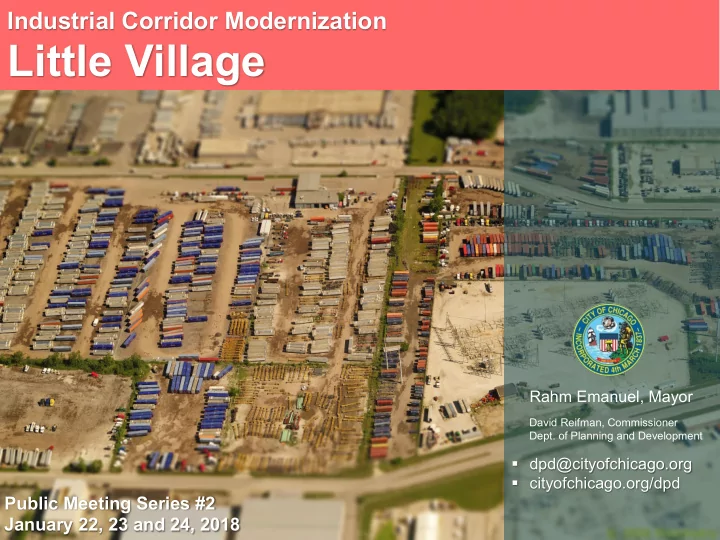
Industrial Corridor Modernization Little Village Rahm Emanuel, Mayor David Reifman, Commissioner Dept. of Planning and Development dpd@cityofchicago.org cityofchicago.org/dpd Public Meeting Series #2 January 22, 23 and 24, 2018


slide-1
SLIDE 1
  • dpd@cityofchicago.org
  • cityofchicago.org/dpd

Rahm Emanuel, Mayor

David Reifman, Commissioner

  • Dept. of Planning and Development

Industrial Corridor Modernization

Little Village

Public Meeting Series #2 January 22, 23 and 24, 2018

slide-2
SLIDE 2
  • 1. Project overview and status
  • 2. Community engagement to date
  • 3. Refined Framework strategies:
  • Land Use
  • Transportation
  • Sustainability
  • 4. Proposed boundary changes
  • 5. Next steps

We will pause for small group discussion and report out after each topic is presented. Meeting Agenda

slide-3
SLIDE 3

Re-cap: Chicago’s Industrial Corridor System

slide-4
SLIDE 4

In 2016, DPD began evaluating Chicago’s 26 Industrial Corridors in order to:

  • Better understand the industrial marketplace
  • Evaluate the need for updates to land

regulations necessary to promote job creation

  • Respond to changing employment trends by

recommending physical improvements to public spaces Eventually, each corridor study will result in: 1. A new land use framework reflecting trends specific to that area 2. Design and/or sustainability guidelines if applicable Many planning recommendations will require further study, engineering and funding.

Re-cap: Industrial Corridor Modernization Initiative

slide-5
SLIDE 5

March 2018 April 2018

Working Group Kick-off Meeting

DPD Begins Collecting Existing Condition Data

June 2018

Working Group Meeting #2

August 2018

Public Meetings to Review Draft Strategies

December 2018

Proposed Timeline

October 2018

Working Group Meeting #3 Post Final Framework & Guidelines Online for Public Comment Public Meetings to Review Final Framework Final Working Group Meeting

January 2018 February 2018

Present to Plan Commission

slide-6
SLIDE 6

Public Engagement Summary

Date Meeting Key Content Presented 4/26/18 Working Group Meeting #1

  • Introduced the Industrial Corridor Modernization Process
  • Reviewed existing conditions data
  • Introduced proposed topic areas and plan goals

6/22/18 Working Group Meeting #2

  • Refined project goals & proposed community priorities
  • Proposed strategies to meet project goals
  • Extended timeline for public meetings milestone

8/8 & 8/9, 2018 Public Meetings (3 sessions)

  • Reviewed existing conditions and presented Health and

Environment Data

  • Presented draft community priorities and strategies
  • Facilitated interactive feedback activities for all ages

10/12/18 Working Group Meeting #3

  • Presented revised strategies
  • Presented non-compatible uses within the industrial corridor
  • Discussed potential revisions to the industrial corridor boundary
  • Extended project completion timeline

12/14/18 Working Group Meeting #4

  • Presented proposed draft industrial corridor boundary revisions
  • Presented revised strategies
  • Presented sample design guidelines

1/22, 23 & 24, 2019 Public Meetings (3 sessions)

  • Review & discuss proposed final strategies and design guidelines
  • Review & discuss proposed industrial corridor revisions
slide-7
SLIDE 7

What We’ve Heard….

  • Interest in high quality jobs for the community, particularly in agriculture

and food manufacturing.

  • Traffic congestion and truck traffic, particularly along 31st Street is a

public safety concern.

  • Proposed changes to the Sustainable Development Policy need to be

effective in addressing air quality.

  • An understanding of how land use changes may affect housing

affordability.

  • A strong desire for more time in the project schedule to allow for

additional community feedback.

  • Simultaneous translation should provided at public meetings.
slide-8
SLIDE 8

Little Village Industrial Corridor

Existing Boundary

22nd Ward 14th Ward 12th Ward 25th Ward

slide-9
SLIDE 9

Maintain the Little Village Industrial Corridor as an Employment Center

1

Provide Better Access for all Modes within and around the Little Village Industrial Corridor

2

Incorporate best practices for new development within the Little Village Industrial Corridor to improve economic, environmental and social conditions

3

Proposed Goals

slide-10
SLIDE 10

Maintain the Little Village Industrial Corridor as an Employment Center

1

Provide Better Access for all Modes within and around the Little Village Industrial Corridor

2

Incorporate best practices for new development within the Little Village Industrial Corridor to improve economic, environmental and social conditions

3

Project Goals

slide-11
SLIDE 11

Maintain the Little Village Industrial Corridor as an employment center

  • Strategy 1.1: Facilitate business expansion and relocation to

the Little Village Industrial Corridor

  • Strategy 1.2: Promote partnerships to provide job readiness
  • Strategy 1.3: Incorporate sustainability best practices in new

development to encourage a modern employment center

  • Strategy 1.4: Encourage innovative and sustainable models
  • f industry within the Little Village Industrial Corridor for

quality job creation

For Feedback Today

Land Use

slide-12
SLIDE 12

12 Maintain the Little Village Industrial Corridor as an employment center

For Feedback Today

THE HATCHERY FOOD BUSINESS INCUBATOR

  • Supports small business food

manufacturing

  • Provides job training & readiness in

food manufacturing

  • Is an innovative model for food

manufacturing

  • Incorporates sustainable best

practices

Land Use

CASE STUDY

slide-13
SLIDE 13

Chicago’s Sustainable Development Policy requires projects receiving public funding or needing special approvals to incorporate sustainable design elements (requirements vary by project type) The policy was updated in 2016 to:

  • Reflect changes in market developments since 2004
  • Incorporate broader environmental context
  • Recognize innovation in sustainable design
  • Increase flexibility in meeting the City’s sustainability goals
  • Create environmental, social and economic value in

development projects The tools is intended to be flexible and can be amended as new information or best practices become appropriate to incorporate.

Implementation: Chicago Sustainable Development Policy

Land Use

slide-14
SLIDE 14

Existing Sustainable Development Policy

Implementation: Chicago Sustainable Development Policy

Land Use

During 2019, a working group of sustainability experts will be assembled to discuss and provide recommendations for prioritization of existing strategies or the addition of new strategies. Prioritized and new strategies could include:

  • On-site renewable energy
  • Sustainable landscapes
  • Rating system adoption, such as Sustainable SITES;
  • Implementation of electric vehicle charger readiness for

freight operations

  • Clean construction principles
  • Guaranteed living wage
  • Local hiring
  • Ability to work in one’s native language

Prioritization or addition of new strategies requires research documenting how the strategies have or will address the issues in the corridor.

slide-15
SLIDE 15

15

For Feedback Today

Design Guidelines

GREEN INFRASTRUCTURE & STORMWATER MANAGEMENT ANTI-IDLING POLICY

Land Use

slide-16
SLIDE 16

Pause for Discussion at Your Table

Land Use

Feedback

slide-17
SLIDE 17

Maintain the Little Village Industrial Corridor as an Employment Center

1

Provide Better Access for all Modes within and around the Little Village Industrial Corridor

2

Incorporate best practices for new development within the Little Village Industrial Corridor to improve economic, environmental and social conditions

3

Proposed Goals

slide-18
SLIDE 18

Provide better access for all modes within and around the Little Village Industrial Corridor

For Feedback Today

Transportation

  • Strategy 2.1: Continue to assess existing traffic and roadway

conditions within the City’s industrial corridors on the Southwest Side

  • Strategy 2.2: Assess the feasibility of establishing an

East/West industrial access road

  • Strategy 2.3: To enhance access, improve the Little Village

Industrial Corridor to better serve all modes

slide-19
SLIDE 19

For Feedback Today

  • Strategy 2.4: Assess viaduct clearance projects for

North/South and East/West viaducts outside of the Industrial Corridor

  • Strategy 2.5: Modernize traffic signals and timing to alleviate

traffic congestion

  • Strategy 2.6: Coordinate appropriate corridor improvements

to facilitate transit access to the corridor

  • Strategy 2.7: Evaluate existing bus stops along 31st Street

and Kedzie Avenue in coordination with CTA

Provide better access for all modes within and around the Little Village Industrial Corridor

Transportation

slide-20
SLIDE 20

Implementation: Future Planning

Transportation

For Feedback Today

Transportation Study for Industrial Corridors on Southwest Side will seek funding to:

  • Better understand traffic conditions

for industrial corridors as a system

  • Identify opportunities to make the

corridors more accessible and safer for all users

slide-21
SLIDE 21

Implement Intelligent Transportation Systems Assess viaduct clearance

Implementation: Future Planning

Transportation

slide-22
SLIDE 22

For Feedback Today

Transportation

Design Guidelines

slide-23
SLIDE 23

For Feedback Today

Transportation

Design Guidelines

slide-24
SLIDE 24

Pause for Discussion at Your Table

Transportation

Feedback

slide-25
SLIDE 25

Maintain the Little Village Industrial Corridor as an Employment Center

1

Provide Better Access for all Modes within and around the Little Village Industrial Corridor

2

Incorporate best practices for new development within the Little Village Industrial Corridor to improve economic, environmental and social conditions

3

Proposed Goals

slide-26
SLIDE 26

Incorporate best practices for new development within the Little Village Industrial Corridor to improve economic, environmental and social conditions

  • Strategy 3.1: Preserve the waterway infrastructure of the

Chicago Sanitary and Ship Canal for industrial users

  • Strategy 3.2: Encourage the use of alternative fuel vehicles

for freight operations

  • Strategy 3.3: Support improvement and remediation of the

Collateral Channel to enhance the local environment for people and nature

  • Strategy 3.4: Increase public access and use of open space

along the river’s edge

For Feedback Today

Sustainability

slide-27
SLIDE 27
  • Strategy 3.5: Support the development of El Paseo as an
  • pportunity to provide access for people biking and walking

to the employment center

  • Strategy 3.6: Encourage owners of large, flat roofed

industrial buildings to use their roofs for solar, greenhouses

  • r other sustainable purposes
  • Strategy 3.7: Support CDPH in the development and

implementation of enhanced regulations for industrial users such as bulk storage, rock crushing and metal recyclers

For Feedback Today

Incorporate best practices for new development within the Little Village Industrial Corridor to improve economic, environmental and social conditions

Sustainability

slide-28
SLIDE 28

28

For Feedback Today

Sustainability

Design Guidelines

ALTERNATIVE FUEL VEHICLES SETBACKS

slide-29
SLIDE 29

29

For Feedback Today

Sustainability

Design Guidelines

SOLAR ACCESS & DAYLIGHTING SUSTAINABLE USES OF INDUSTRIAL ROOFTOPS

slide-30
SLIDE 30

Pause for Discussion at Your Table

Sustainability

Feedback

slide-31
SLIDE 31

31

For Feedback Today

Industrial Corridor Boundary Revisions

slide-32
SLIDE 32

Daley Park – Boat Launch

  • Existing Open Space
  • Non-supportive of Industrial Uses

Richard J. Daley Park

For Feedback Today

Industrial Corridor Boundary Revisions

slide-33
SLIDE 33

La Villita Park Vacant Parcel Focal Point PD Focal Point Parcels Paul Simon Job Corps Center

Kedzie & 31st

  • Existing or future uses include:
  • Open Space
  • Institutional (schools & hospital)
  • Residential (dormitory)
  • Non-supportive of Industrial Uses

For Feedback Today

Industrial Corridor Boundary Revisions

slide-34
SLIDE 34

Kostner & 31st

  • Existing uses include:
  • Open Space
  • Institutional (schools)
  • Commercial (Retail)
  • Extend industrial Corridor North to create

contiguity with Roosevelt/Cicero Industrial Corridor

Unilever PD Little Village Lawndale High School Piotrowski Park Vacant Parcels

For Feedback Today

Industrial Corridor Boundary Revisions

slide-35
SLIDE 35

Pause for Discussion at Your Table

Industrial Corridor Boundary Revisions

Feedback

slide-36
SLIDE 36

March 2018 April 2018

Working Group Kick-off Meeting

DPD Begins Collecting Existing Condition Data

June 2018

Working Group Meeting #2

August 2018

Public Meetings to Review Draft Strategies

December 2018

Proposed Timeline

October 2018

Working Group Meeting #3 Post Final Framework & Guidelines Online for Public Comment Public Meetings to Review Final Framework Final Working Group Meeting

January 2018 February 2018

Present to Plan Commission

slide-37
SLIDE 37

DPD will take written comments until February 15, 2019 by e-mail at dpd@cityofchicago.org. Through U.S. Mail at: Department of Planning and Development Division of Planning, Design and Historic Preservation c/o Gerardo Garcia 121 N. Lasalle St. Suite 1006 Chicago, IL 60602 Comment can also be offered in person at the Chicago Plan Commission meeting: February 21, 2019 at 10 a.m. City Council Chambers (2nd floor) City Hall 121 N. Lasalle St. Chicago, IL 60602

Next Steps – Public Comment

slide-38
SLIDE 38

Goals of the Pilsen and Little Village Preservation Strategy

Housing Affordability and Preservation

  • Increase ARO requirements to align with what the community is already asking

for from developers

  • Establish new affordable housing programs

El Paseo Multi-use Trail

  • Connect communities along the trail network
  • Increase access to active, public open space
  • Incorporate community culture into the design

Industrial Corridor Modernization

  • Maintain as an employment center
  • Provide better access for all transportation modes
  • Incorporate sustainability best practices for new development

Next Steps – Complementary Planning Efforts