Litigating R&D Cases Insights, Strategies, and Traps for the - - PowerPoint PPT Presentation

litigating r d cases
SMART_READER_LITE
LIVE PREVIEW

Litigating R&D Cases Insights, Strategies, and Traps for the - - PowerPoint PPT Presentation

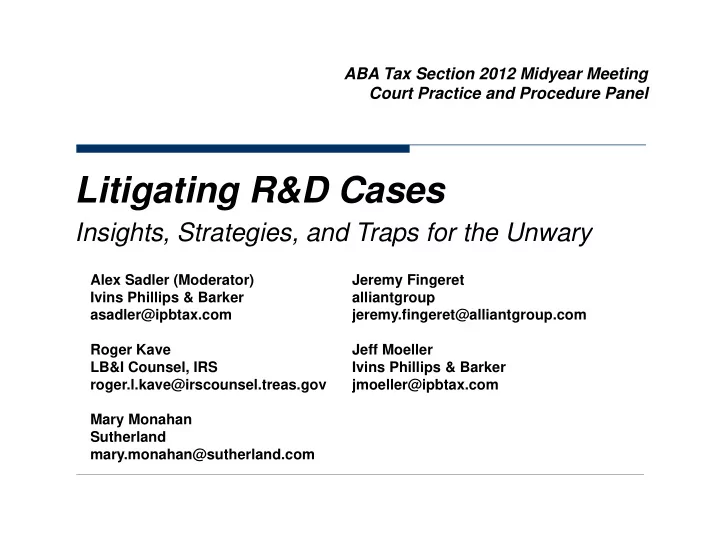
ABA Tax Section 2012 Midyear Meeting Court Practice and Procedure Panel Litigating R&D Cases Insights, Strategies, and Traps for the Unwary g , g , p y Alex Sadler (Moderator) Jeremy Fingeret Ivins Phillips & Barker alliantgroup


slide-1
SLIDE 1

ABA Tax Section 2012 Midyear Meeting Court Practice and Procedure Panel

Litigating R&D Cases

Insights, Strategies, and Traps for the Unwary g , g , p y

Alex Sadler (Moderator) Jeremy Fingeret Ivins Phillips & Barker alliantgroup asadler@ipbtax com jeremy fingeret@alliantgroup com asadler@ipbtax.com jeremy.fingeret@alliantgroup.com Roger Kave Jeff Moeller LB&I Counsel, IRS Ivins Phillips & Barker roger l kave@irscounsel treas gov jmoeller@ipbtax com roger.l.kave@irscounsel.treas.gov jmoeller@ipbtax.com Mary Monahan Sutherland mary monahan@sutherland com mary.monahan@sutherland.com

slide-2
SLIDE 2

The Research Credit: A 2-Minute Primer

Q lifi d h IRC § 41(d) R § 1 41 4

  • Qualified research – IRC § 41(d); Reg. § 1.41-4
  • Satisfies four primary definitional tests
  • Section 174 test (undertaken to eliminate uncertainty

Section 174 test (undertaken to eliminate uncertainty regarding capability, method, or design)

  • Technological in nature test

P f i t ti t t

  • Process of experimentation test
  • Business component test
  • Primary tests are applied at business component level

y pp p (i.e., product, process, software, etc.)

  • Must not be an excluded activity (i.e., post-commercial

d i d li i f d d h ) production, duplication, funded research, etc.)

2

slide-3
SLIDE 3

The Research Credit: A 2-Minute Primer

  • QREs – IRC § 41(b); Reg. § 1.41-2
  • Wages – amounts paid to employees performing
  • r directly supervising or supporting qualified
  • r directly supervising or supporting qualified

research

  • Supplies – non-depreciable property used in the

pp p p p y conduct of qualified research

  • Contract research expenses – 65 percent of

amounts paid to non employees to perform amounts paid to non-employees to perform qualified research

3

slide-4
SLIDE 4

The Research Credit: A 2-Minute Primer

C dit t ti IRC § 41( ) R §§

  • Credit computation – IRC § 41(c); Reg. §§

1.41-3, -9

  • Traditional computation

reference point is taxpayer’s

  • Traditional computation – reference point is taxpayer’s

QREs in 1984-88

  • Alternative simplified credit (ASC) – reference point is

taxpayer’s QREs in three prior years

  • Consistency requirement – QREs must be determined in

credit years and reference years on a consistent basis credit years and reference years on a consistent basis

  • Taxpayer must make timely IRC § 280C(c) election to

avoid disallowance of deductions in amount of credit

4

slide-5
SLIDE 5

Recent Developments

C P Ob

  • Congress – Pres. Obama
  • Courts
  • Union Carbide appeal
  • FedEx reconsideration motion
  • Trinity Industries trial
  • Bayer sampling motion

5

slide-6
SLIDE 6

Recent Developments

IRS

  • IRS
  • Plans to move research credit claims from Tier I to

an IPG but they will remain a compliance priority an IPG, but they will remain a compliance priority

  • Review/concurrence removed at Appeals
  • IRS/tax practitioner meetings
  • IRS/tax practitioner meetings
  • Issues coming up in the field

6

slide-7
SLIDE 7

Common Areas of Dispute

S b t ti ti

  • Substantiation
  • Burden of proof

H t i l h dit t d i d

  • How a typical research credit study is prepared
  • Project versus cost center accounting and the

“nexus” issue nexus issue

  • Base period issues
  • Document retention and collection

Document retention and collection

  • Use of SMEs, experts, and estimates (Cohan) in the

absence of contemporaneous documentation

7

p

slide-8
SLIDE 8

Common Areas of Dispute

S li

  • Sampling
  • The problem
  • Judgment versus statistical samples
  • IRS guidance
  • Judicial guidance
  • Recent experiences

8

slide-9
SLIDE 9

Common Areas of Dispute

P i lifi d h t t

  • Primary qualified research tests
  • Identifying specific business components
  • Section 174 test
  • Process of experimentation

9

slide-10
SLIDE 10

Common Areas of Dispute

E l d d ti iti

  • Excluded activities
  • Research after commercial production
  • Adaptation/duplication of existing business

component F d d h

  • Funded research
  • Internal use software
  • Dual-purpose supplies

10

slide-11
SLIDE 11

Litigating Insights and Strategies

Di

  • Discovery
  • Fact-intensive nature of R&D disputes

T C t f d t ib l

  • Tax Court versus refund tribunals
  • What to expect from IRS and DOJ

Di t t f th

  • Discovery taxpayers may want from the

government

11

slide-12
SLIDE 12

Litigating Insights and Strategies

P ti l j d t

  • Partial summary judgment
  • Qualified research exclusions
  • Applicable legal standards
  • Computational issues
  • Eligibility of types of costs
  • Stipulations
  • Tax Court versus refund tribunals
  • Potential uses

12

slide-13
SLIDE 13

Litigating Insights and Strategies

E t

  • Experts
  • Tax Court versus refund tribunals
  • Potential uses
  • Qualified research eligibility

Wh i f h ?

  • What is state of the art?
  • Accounting for QREs
  • Identifying base period activities and costs
  • Identifying base period activities and costs
  • Statistical sampling
  • Identifying testifying experts

13

  • Identifying testifying experts
slide-14
SLIDE 14

Litigating Insights and Strategies

Oth t i l t t id ti

  • Other trial strategy considerations
  • Fact witnesses
  • Demonstrative exhibits
  • Electronic courtroom technology

14

slide-15
SLIDE 15

Q & A Q &

14