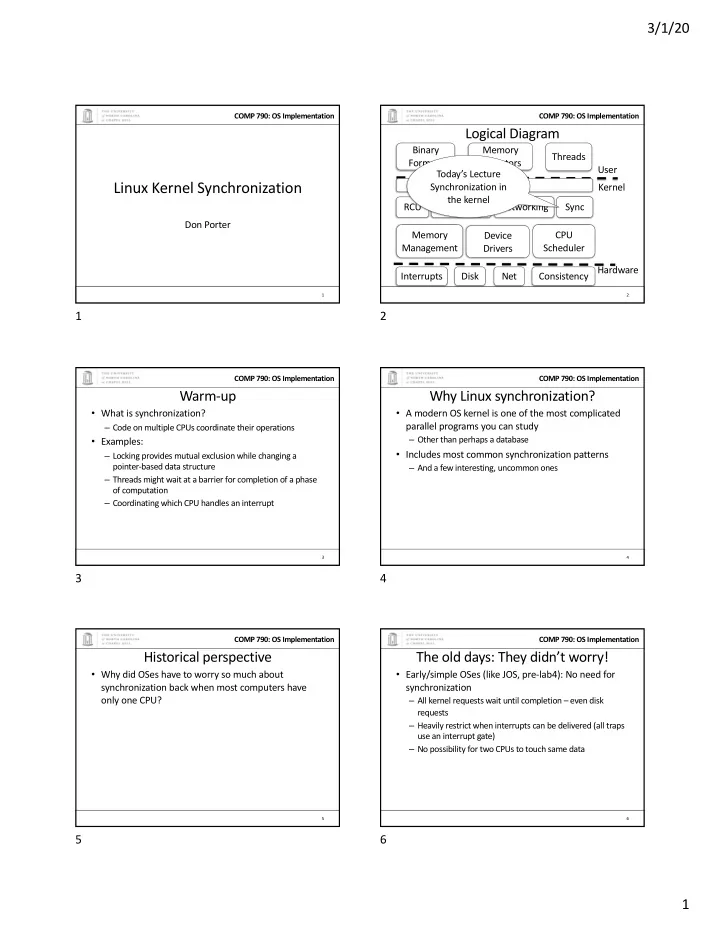
Linux Kernel Synchronization System Calls Synchronization in - - PDF document

linux kernel synchronization
SMART_READER_LITE
LIVE PREVIEW

Linux Kernel Synchronization System Calls Synchronization in - - PDF document

3/1/20 COMP 790: OS Implementation COMP 790: OS Implementation Logical Diagram Binary Memory Threads Formats Allocators User Todays Lecture Linux Kernel Synchronization System Calls Synchronization in Kernel the kernel RCU File


slide-1
SLIDE 1

3/1/20 1

COMP 790: OS Implementation

Linux Kernel Synchronization

Don Porter

1

1

COMP 790: OS Implementation

Logical Diagram

Memory Management CPU Scheduler User Kernel Hardware Binary Formats Consistency System Calls Interrupts Disk Net RCU File System Device Drivers Networking Sync Memory Allocators Threads Today’s Lecture Synchronization in the kernel

2

2

COMP 790: OS Implementation

Warm-up

  • What is synchronization?

– Code on multiple CPUs coordinate their operations

  • Examples:

– Locking provides mutual exclusion while changing a pointer-based data structure – Threads might wait at a barrier for completion of a phase

  • f computation

– Coordinating which CPU handles an interrupt

3

3

COMP 790: OS Implementation

Why Linux synchronization?

  • A modern OS kernel is one of the most complicated

parallel programs you can study

– Other than perhaps a database

  • Includes most common synchronization patterns

– And a few interesting, uncommon ones

4

4

COMP 790: OS Implementation

Historical perspective

  • Why did OSes have to worry so much about

synchronization back when most computers have

  • nly one CPU?

5

5

COMP 790: OS Implementation

The old days: They didn’t worry!

  • Early/simple OSes (like JOS, pre-lab4): No need for

synchronization

– All kernel requests wait until completion – even disk requests – Heavily restrict when interrupts can be delivered (all traps use an interrupt gate) – No possibility for two CPUs to touch same data

6

6

slide-2
SLIDE 2

3/1/20 2

COMP 790: OS Implementation

Slightly more recently

  • Optimize kernel performance by blocking inside the

kernel

  • Example: Rather than wait on expensive disk I/O,

block and schedule another process until it completes

– Cost: A bit of implementation complexity

  • Need a lock to protect against concurrent update to

pages/inodes/etc. involved in the I/O

  • Could be accomplished with relatively coarse locks
  • Like the Big Kernel Lock (BKL)

– Benefit: Better CPU utilitzation

7

7

COMP 790: OS Implementation

A slippery slope

  • We can enable interrupts during system calls

– More complexity, lower latency

  • We can block in more places that make sense

– Better CPU usage, more complexity

  • Concurrency was an optimization for really fancy

OSes, until…

8

8

COMP 790: OS Implementation

The forcing function

  • Multi-processing

– CPUs aren’t getting faster, just smaller – So you can put more cores on a chip

  • The only way software (including kernels) will get

faster is to do more things at the same time

9

9

COMP 790: OS Implementation

Performance Scalability

  • How much more work can this software complete in

a unit of time if I give it another CPU?

– Same: No scalability---extra CPU is wasted – 1 -> 2 CPUs doubles the work: Perfect scalability

  • Most software isn’t scalable
  • Most scalable software isn’t perfectly scalable

10

10

COMP 790: OS Implementation

Performance Scalability

2 4 6 8 10 12 1 2 3 4 Execution Time (s) CPUs Perfect Scalability Not Scalable Somewhat scalable

Ideal: Time halves with 2x CPUS

11

11

COMP 790: OS Implementation

Performance Scalability (more visually intuitive)

0.05 0.1 0.15 0.2 0.25 0.3 0.35 0.4 0.45 1 2 3 4 Performance 1 / Execution Time (s) CPUs Perfect Scalability Not Scalable Somewhat scalable

Slope =1 == perfect scaling

12

12

slide-3
SLIDE 3

3/1/20 3

COMP 790: OS Implementation

Performance Scalability (A 3rd visual)

5 10 15 20 25 30 35 1 2 3 4 Execution Time (s) * CPUs CPUs Perfect Scalability Not Scalable Somewhat scalable

Slope = 0 == perfect scaling

13

13

COMP 790: OS Implementation

Coarse vs. Fine-grained locking

  • Coarse: A single lock for everything

– Idea: Before I touch any shared data, grab the lock – Problem: completely unrelated operations wait on each

  • ther
  • Adding CPUs doesn’t improve performance

14

14

COMP 790: OS Implementation

Fine-grained locking

  • Fine-grained locking: Many “little” locks for individual

data structures

– Goal: Unrelated activities hold different locks

  • Hence, adding CPUs improves performance

– Cost: complexity of coordinating locks

15

15

COMP 790: OS Implementation

Current Reality

Performance Complexity

Fine-Grained Locking Course-Grained Locking

ò Unsavory trade-off between complexity and performance scalability

16

16

COMP 790: OS Implementation

How do locks work?

  • Two key ingredients:

– A hardware-provided atomic instruction

  • Determines who wins under contention

– A waiting strategy for the loser(s)

17

17

COMP 790: OS Implementation

Atomic instructions

  • A “normal” instruction can span many CPU cycles

– Example: ‘a = b + c’ requires 2 loads and a store – These loads and stores can interleave with other CPUs’ memory accesses

  • An atomic instruction guarantees that the entire
  • peration is not interleaved with any other CPU

– x86: Certain instructions can have a ‘lock’ prefix – Intuition: This CPU ‘locks’ all of memory – Expensive! Not ever used automatically by a compiler; must be explicitly used by the programmer

18

18

slide-4
SLIDE 4

3/1/20 4

COMP 790: OS Implementation

Atomic instruction examples

  • Atomic increment/decrement ( x++ or x--)

– Used for reference counting – Some variants also return the value x was set to by this instruction (useful if another CPU immediately changes the value)

  • Compare and swap

– if (x == y) x = z; – Used for many lock-free data structures

19

19

COMP 790: OS Implementation

Atomic instructions + locks

  • Most lock implementations have some sort of

counter

  • Say initialized to 1
  • To acquire the lock, use an atomic decrement

– If you set the value to 0, you win! Go ahead – If you get < 0, you lose. Wait L – Atomic decrement ensures that only one CPU will decrement the value to zero

  • To release, set the value back to 1

20

20

COMP 790: OS Implementation

Waiting strategies

  • Spinning: Just poll the atomic counter in a busy loop;

when it becomes 1, try the atomic decrement again

  • Blocking: Create a kernel wait queue and go to sleep,

yielding the CPU to more useful work

– Winner is responsible to wake up losers (in addition to setting lock variable to 1) – Create a kernel wait queue – the same thing used to wait

  • n I/O
  • Note: Moving to a wait queue takes you out of the scheduler’s run

queue

21

21

COMP 790: OS Implementation

Which strategy to use?

  • Main consideration: Expected time waiting for the

lock vs. time to do 2 context switches

– If the lock will be held a long time (like while waiting for disk I/O), blocking makes sense – If the lock is only held momentarily, spinning makes sense

  • Other, subtle considerations we will discuss later

22

22

COMP 790: OS Implementation

Linux lock types

  • Blocking: mutex, semaphore
  • Non-blocking: spinlocks, seqlocks, completions

23

23

COMP 790: OS Implementation

Linux spinlock (simplified)

1: lock; decb slp->slock jns 3f 2: pause cmpb $0,slp->slock jle 2b jmp 1b 3:

// Locked decrement of lock var // Jump if not set (result is zero) to 3 // Low power instruction, wakes on // coherence event // Read the lock value, compare to zero // If less than or equal (to zero), goto 2 // Else jump to 1 and try again // We win the lock

24

24

slide-5
SLIDE 5

3/1/20 5

COMP 790: OS Implementation

Rough C equivalent

while (0 != atomic_dec(&lock->counter)) { do { // Pause the CPU until some coherence // traffic (a prerequisite for the counter // changing) saving power } while (lock->counter <= 0); }

25

25

COMP 790: OS Implementation

Why 2 loops?

  • Functionally, the outer loop is sufficient
  • Problem: Attempts to write this variable invalidate it

in all other caches

– If many CPUs are waiting on this lock, the cache line will bounce between CPUs that are polling its value

  • This is VERY expensive and slows down EVERYTHING on the system

– The inner loop read-shares this cache line, allowing all polling in parallel

  • This pattern called a Test&Test&Set lock (vs.

Test&Set)

26

26

COMP 790: OS Implementation

Test & Set Lock

CPU 0 Cache Memory Bus 0x1000 RAM CPU 1 Cache atomic_dec

Cache Line “ping-pongs” back and forth

while (!atomic_dec(&lock->counter)) 0x1000 CPU 2 // Has lock atomic_dec Write Back+Evict Cache Line

27

27

COMP 790: OS Implementation

Test & Test & Set Lock

CPU 0 Cache Memory Bus 0x1000 RAM CPU 1 Cache read

Line shared in read mode until unlocked

while (lock->counter <= 0)) 0x1000 CPU 2 // Has lock read Unlock by writing 1

28

28

COMP 790: OS Implementation

Why 2 loops?

  • Functionally, the outer loop is sufficient
  • Problem: Attempts to write this variable invalidate it

in all other caches

– If many CPUs are waiting on this lock, the cache line will bounce between CPUs that are polling its value

  • This is VERY expensive and slows down EVERYTHING on the system

– The inner loop read-shares this cache line, allowing all polling in parallel

  • This pattern called a Test&Test&Set lock (vs.

Test&Set)

29

29

COMP 790: OS Implementation

Reader/writer locks

  • Simple optimization: If I am just reading, we can let
  • ther readers access the data at the same time

– Just no writers

  • Writers require mutual exclusion

30

30

slide-6
SLIDE 6

3/1/20 6

COMP 790: OS Implementation

Linux RW-Spinlocks

  • Low 24 bits count active readers

– Unlocked: 0x01000000 – To read lock: atomic_dec_unless(count, 0)

  • 1 reader: 0x:00ffffff
  • 2 readers: 0x00fffffe
  • Etc.
  • Readers limited to 2^24. That is a lot of CPUs!
  • 25th bit for writer

– Write lock – CAS 0x01000000 -> 0

  • Readers will fail to acquire the lock until we add 0x1000000

31

31

COMP 790: OS Implementation

Subtle issue

  • What if we have a constant stream of readers and a

waiting writer?

– The writer will starve

  • We may want to prioritize writers over readers

– For instance, when readers are polling for the write – How to do this?

32

32

COMP 790: OS Implementation

Seqlocks

  • Explicitly favor writers, potentially starve readers
  • Idea:

– An explicit write lock (one writer at a time) – Plus a version number – each writer increments at beginning and end of critical section

  • Readers: Check version number, read data, check

again

– If version changed, try again in a loop – If version hasn’t changed and is even, neither has data

33

33

COMP 790: OS Implementation

Seqlock Example

70 % Time for CSE 506 30 % Time for All Else Version Lock Invariant: Must add up to 100%

34

34

COMP 790: OS Implementation

Version Lock

Seqlock Example

70 % Time for CSE 506 30 % Time for All Else

Reader: do { v = version; a = cse506; b = other; } while (v % 2 == 1 || v != version); Writer: lock(); version++;

  • ther = 20;

cse506 = 80; version++; unlock();

1 2 80 20

What if reader executed now?

35

35

COMP 790: OS Implementation

Seqlocks

  • Explicitly favor writers, potentially starve readers
  • Idea:

– An explicit write lock (one writer at a time) – Plus a version number – each writer increments at beginning and end of critical section

  • Readers: Check version number, read data, check

again

– If version changed, try again in a loop – If version hasn’t changed and is even, neither has data

36

36

slide-7
SLIDE 7

3/1/20 7

COMP 790: OS Implementation

Composing locks

  • Suppose I need to touch two data structures (A and

B) in the kernel, protected by two locks.

  • What could go wrong?

– Deadlock! – Thread 0: lock(a); lock(b) – Thread 1: lock(b); lock(a)

  • How to solve?

– Lock ordering

37

37

COMP 790: OS Implementation

Lock Ordering

  • A program code convention
  • Developers get together, have lunch, plan the order
  • f locks
  • In general, nothing at compile time or run-time

prevents you from violating this convention

– Research topics on making this better:

  • Finding locking bugs
  • Automatically locking things properly
  • Transactional memory

38

38

COMP 790: OS Implementation

How to order?

  • What if I lock each entry in a linked list. What is a

sensible ordering?

– Lock each item in list order – What if the list changes order? – Uh-oh! This is a hard problem

  • Lock-ordering usually reflects static assumptions

about the structure of the data

– When you can’t make these assumptions, ordering gets hard

39

39

COMP 790: OS Implementation

Linux solution

  • In general, locks for dynamic data structures are
  • rdered by kernel virtual address

– I.e., grab locks in increasing virtual address order

  • A few places where traversal path is used instead

40

40

COMP 790: OS Implementation

Lock ordering in practice

From Linux: fs/dcache.c

void d_prune_aliases(struct inode *inode) { struct dentry *dentry; struct hlist_node *p; restart: spin_lock(&inode->i_lock); hlist_for_each_entry(dentry, p, &inode->i_dentry, d_alias) { spin_lock(&dentry->d_lock); if (!dentry->d_count) { __dget_dlock(dentry); __d_drop(dentry); spin_unlock(&dentry->d_lock); spin_unlock(&inode->i_lock); dput(dentry); goto restart; } spin_unlock(&dentry->d_lock); } spin_unlock(&inode->i_lock); }

Care taken to lock inode before each alias Inode lock protects list; Must restart loop after modification

41

41

COMP 790: OS Implementation

mm/filemap.c lock ordering

/* * Lock ordering: * ->i_mmap_lock (vmtruncate) * ->private_lock (__free_pte->__set_page_dirty_buffers) * ->swap_lock (exclusive_swap_page, others) * ->mapping->tree_lock * ->i_mutex * ->i_mmap_lock (truncate->unmap_mapping_range) * ->mmap_sem * ->i_mmap_lock * ->page_table_lock or pte_lock (various, mainly in memory.c) * ->mapping->tree_lock (arch-dependent flush_dcache_mmap_lock) * ->mmap_sem * ->lock_page (access_process_vm) * ->mmap_sem * ->i_mutex (msync) * ->i_mutex * ->i_alloc_sem (various) * ->inode_lock * ->sb_lock (fs/fs-writeback.c) * ->mapping->tree_lock (__sync_single_inode) * ->i_mmap_lock * ->anon_vma.lock (vma_adjust) * ->anon_vma.lock * ->page_table_lock or pte_lock (anon_vma_prepare and various) * ->page_table_lock or pte_lock * ->swap_lock (try_to_unmap_one) * ->private_lock (try_to_unmap_one) * ->tree_lock (try_to_unmap_one) * ->zone.lru_lock (follow_page->mark_page_accessed) * ->zone.lru_lock (check_pte_range->isolate_lru_page) * ->private_lock (page_remove_rmap->set_page_dirty) * ->tree_lock (page_remove_rmap->set_page_dirty) * ->inode_lock (page_remove_rmap->set_page_dirty) * ->inode_lock (zap_pte_range->set_page_dirty) * ->private_lock (zap_pte_range->__set_page_dirty_buffers) * ->task->proc_lock * ->dcache_lock (proc_pid_lookup) */

42

42

slide-8
SLIDE 8

3/1/20 8

COMP 790: OS Implementation

Semaphore

  • A counter of allowed concurrent processes

– A mutex is the special case of 1 at a time

  • Plus a wait queue
  • Implemented similarly to a spinlock, except spin loop

replaced with placing oneself on a wait queue

43

43

COMP 790: OS Implementation

Ordering blocking and spin locks

  • If you are mixing blocking locks with spinlocks, be

sure to acquire all blocking locks first and release blocking locks last

– Releasing a semaphore/mutex schedules the next waiter

  • On the same CPU!

– If we hold a spinlock, the waiter may also try to grab this lock – The waiter may block trying to get our spinlock and never yield the CPU – We never get scheduled again, we never release the lock

44

44

COMP 790: OS Implementation

Summary

  • Understand how to implement a

spinlock/semaphore/rw-spinlock

  • Understand trade-offs between:

– Spinlocks vs. blocking lock – Fine vs. coarse locking – Favoring readers vs. writers

  • Lock ordering issues

45

45