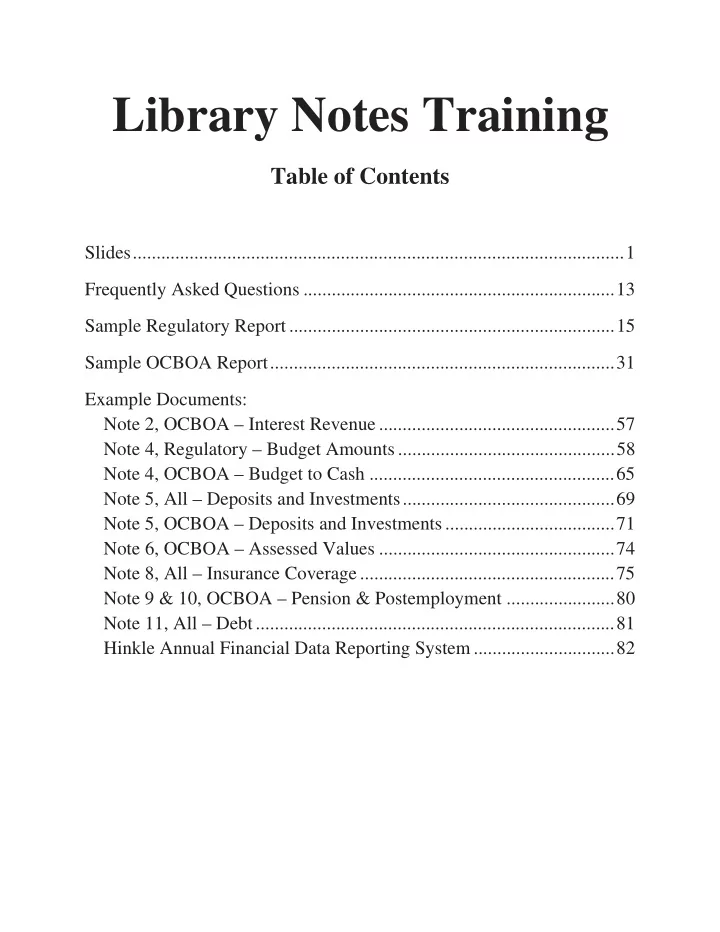
Library Notes Training Table of Contents Slides - - PDF document

library notes training
SMART_READER_LITE
LIVE PREVIEW

Library Notes Training Table of Contents Slides - - PDF document

Library Notes Training Table of Contents Slides ........................................................................................................ 1 Frequently Asked Questions


slide-1
SLIDE 1

Library Notes Training

Table of Contents

Slides ........................................................................................................ 1 Frequently Asked Questions .................................................................. 13 Sample Regulatory Report ..................................................................... 15 Sample OCBOA Report ......................................................................... 31 Example Documents: Note 2, OCBOA – Interest Revenue .................................................. 57 Note 4, Regulatory – Budget Amounts .............................................. 58 Note 4, OCBOA – Budget to Cash .................................................... 65 Note 5, All – Deposits and Investments ............................................. 69 Note 5, OCBOA – Deposits and Investments .................................... 71 Note 6, OCBOA – Assessed Values .................................................. 74 Note 8, All – Insurance Coverage ...................................................... 75 Note 9 & 10, OCBOA – Pension & Postemployment ....................... 80 Note 11, All – Debt ............................................................................ 81 Hinkle Annual Financial Data Reporting System .............................. 82

slide-2
SLIDE 2

This Page Intentionally Left Blank

slide-3
SLIDE 3

1

{

Notes to the Financial Statements for Libraries

Presented by: Local Government Services DAVE YOST

Ohio Auditor of State

  • Why do I have to prepare notes to the financial

statements now?

  • My auditors have always done this for me in the

past; can they still prepare the notes for me?

  • If I don’t prepare notes for my entity, what is the

penalty?

  • My entity has a two‐year audit, do I still need to

prepare notes each year?

  • My entity uses UAN, do I still need to prepare

notes?

Frequently Asked Questions

  • Shells are available on the Auditor of State website as a

word document.

  • Contact the auditors who did your last audit; they may be

able to send you their notes file to be used as a starting point.

  • Look at prior audit reports on the Auditor of State website

for your entity.

  • We will go over each note and give tips on how to fill it in
  • Remember to customize every note for your entity – if it

doesn’t apply to you, delete it out!

Getting Started

1

slide-4
SLIDE 4

2

  • Go to www.ohioauditor.gov
  • Hover your mouse on Local Government at the

top, then click Reference Materials

  • On the left side, choose Financial Statement

Shells and Footnotes

Note Shells

  • Choose OCBOA or Regulatory, then find your entity type
  • Click on Notes and save the file on your computer in an

easy to find place

  • Consider naming the file with the year you’re working on,

so that you can go back to it in future years

  • These shells are updated about once a year, so check back

for updates and incorporate them into your file each year

  • The OCBOA shells include the most common note

disclosures

Note Shells ‐ continued

  • The shells have colors to help guide you
  • Yellow highlights are helpful guidance
  • Green highlights are generic information; modify to fit your

entity

  • The shells use CY for current year and PY for prior year
  • You can use “find and replace” to make them 16 and 15, or

whatever year you are in

  • The shells include a header that if modified on the first

page, will carry your entity name, county, and year through all pages of the report

Note Shells ‐ continued

2

slide-5
SLIDE 5

3

Ready to Dive Into Notes?

  • Describe the services that your library provides
  • Other organizations – We’ll come back to this when

we look at Notes 14 through 17

Note 1 – Reporting Entity

  • Most of this note is standard language that you will just

leave as‐is

  • Fund types – delete those that don’t apply; list significant

funds under each type with a brief description

  • Budgetary process – update certain sentences if you had no

encumbrances at year‐end; yellow highlights will guide you

  • Deposits and investments – modify to fit your investments,

if you have any (we will go into more detail on this in Note 5)

Note 2 ‐ SSAP

3

slide-6
SLIDE 6

4

  • List any budgetary violations that the library had

during the year, by fund

  • Expenditures plus encumbrances exceeded

appropriations

  • Appropriations exceeded estimated resources plus

carryover balance

  • List any funds that had a deficit cash balance at year‐

end, if any

  • Later on during your audit, the auditors may add
  • ther items here if they find non‐compliance

Note 3 ‐ Compliance

  • Regulatory notes have charts – budgeted vs actual activity

by fund type for both receipts and expenditures

  • Make sure you use budget amounts from your most recent Amended

Certificate of Estimated Resources and Appropriations for the year being reported

  • Actual amounts should match the financial statements
  • OCBOA notes have a chart that reconciles the difference

between the cash balance of the general and major special revenue funds with the budget basis balance of those funds

  • There is a worksheet to help fill in this chart included in the handout

Note 4 – Budgetary Activity

  • Regulatory notes have a chart that lists all the

cash/investment accounts by type

  • All accounts of one type are added together, you don’t

have to list out each bank or account separately

  • OCBOA notes describe the amount of deposits and

what portion was uninsured by FDIC

  • OCBOA notes provide more detail on investments,

including information from the library’s investment policy

Note 5 – Deposits and Investments

4

slide-7
SLIDE 7

5

  • Regulatory notes – if you don’t have any public

utility taxpayers, delete the 2nd paragraph

  • OCBOA – you will need the full tax rate and

assessed values; these can be obtained from your County Auditor

Note 6 – Property Taxes

  • OCBOA – also describe transfers made during the year

and their purpose; the shell includes a chart but if you

  • nly have one or two funds with transfers, you could

just describe them in a sentence

Note 7 – Interfund Transfers

  • Regulatory – describe any material outstanding

advance(s) not repaid at year end, including what the purpose of the advance was

  • OCBOA – describe any outstanding advance(s) not

repaid at year end and their purpose; the shell includes a chart but if you only have one or two funds with advances, you could just describe them in a sentence

Note 7 – Interfund Advances 5

slide-8
SLIDE 8

6

  • Regulatory – in the list of types of insurance, only include

those that your library has

  • If participating in a risk pool for insurance, use and update

that section with the name of pool and what it covers

  • If self insured for a type of insurance, use and update that

section

  • OCBOA – fill in chart with each type of insurance your library

has, including amount of coverage and deductibles

  • If participating in a group rating plan or self insured, use and

update those paragraphs

Note 8 – Risk Management

  • Include notes for Ohio Public Employees Retirement

System and/or Ohio Police and Fire Pension Fund, and/or Social Security, depending on what your employees participate in

  • Update the percentages for the current year
  • OCBOA – include the amount of your library’s

contractually required contribution to OPERS and OPF in each note

  • There is a worksheet to help calculate this included in

the handout

Note 9 – Defined Benefit Pension Plans

  • Include notes for Ohio Public Employees Retirement

System and/or Ohio Police and Fire Pension Fund, depending on what your employees participate in

  • Update the percentages for the current year
  • OCBOA – include the amounts contributed for

health care for the current year and two prior years

  • There is a worksheet to help calculate this included in

the handout

Note 10 – Postemployment Benefits

6

slide-9
SLIDE 9

7

  • Describe the various debt obligations your library has,

including bonds, notes, loans, and leases

  • Regulatory – in the first chart, include amount of each debt
  • utstanding at 12/31/CY and the interest rate
  • OCBOA – in the charts, include amount of each debt
  • utstanding at 12/31/PY, new debts issued, amounts retired

during the current year, and then the amount outstanding at 12/31/CY will calculate automatically

  • Both – fill in the chart with principal and interest payments

remaining to be made on each type of debt; first 5 years separately and then remaining in 5 year pieces

Note 11 ‐ Debt

  • List any significant construction or other contractual

commitments.

  • Example – At December 31, 2016, the Library had

$81,145 in outstanding contractual commitments related to the construction of new fire station.

  • OCBOA – List encumbrances, since those dollars are

set aside for a particular use in the future.

Note 12 – Construction and Contractual Commitments

  • These are items that could impact the library’s

financial position in the future

  • Examples:
  • Lawsuits the library is involved in
  • Grants subject to audit
  • We suggest you ask the library’s legal counsel to

write a letter indicating if there are any legal issues that could impact the library’s financial position

Note 13 – Contingent Liabilities

7

slide-10
SLIDE 10

8

  • All these notes relate to organizations that the library may be

involved with

  • Each organization will need to be analyzed to see if it fits the

definition of one of the types in Notes 14 through 17

  • The definition of each type is listed in the shell to help get you

started

  • Look at prior audit reports to see if anything was listed
  • Also look at audit reports of other entities in your area – larger city,

county, or school district reports may include some of these

  • rganizations that the library is involved with too

Notes 14 through 17

  • List any transactions that meet the definition listed

in the shells; the opposite of an arm’s length transaction

  • There are a couple of examples in the shells but if

you aren’t sure if your situation applies, please consult with your legal counsel, call LGS, or ask your auditors

Note 18 – Related Party Transactions

  • This note is not required for regulatory filers and is not included in the

regulatory shell on the Auditor of State website

  • The chart should match to the total Nonspendable, Restricted,

Committed, Assigned, and Unrestricted on your financial statements, the note just provides more detail

  • There is a worksheet in the financial statement file (OCBOA) where

fund balance will be summarized

  • If you need more information on how to categorize fund balance,

please see Auditor of State Bulletin 2011‐004 (https://ohioauditor.gov/publications/bulletins/2011/2011‐004.pdf)

  • The Bulletin includes a chart with many of the common library funds

and how the fund balance should be classified.

Note 19 – Fund Balances (OCBOA)

8

slide-11
SLIDE 11

9

  • Unclaimed Monies Fund is to be shown as nonspendable.
  • Special Revenue Funds
  • Must be restricted or committed revenue source(s) as its foundation

revenue

  • Assigned revenues, transfer‐in, or other financing sources cannot be

foundation to establish a special revenue fund.

  • Debt Service and Capital Project Funds
  • These funds can have transfers as sole revenue source.
  • If Library Board identifies specific purpose by ordinance or resolution for the
transfer, the fund balance is committed
  • If Library Board doesn’t identify a specific purpose by ordinance or resolution,
the fund balance is assigned.
  • Permanent Funds
  • Donation where principal can’t be spent – principal is nonspendable
  • Donation where earnings on principal can be spent – restricted.

Fund Balances

  • Encumbrances for General Fund type funds should be

included in the restricted, committed, and assigned fund balance classifications.

  • Purchase order assigns the amount of the purchase order to a

specific purpose and should be classified as assigned unless the purchase order relates to restricted or committed resources.

  • Future appropriations
  • When appropriations in the next calendar year in General Fund

type funds exceed the next calendar year estimated resources.

  • Year end 2017 ‐ 2018 current year appropriations for General Fund

are $850,000 and estimated resources for 2018 are $750,000.

 Assigned Balance of $100,000

Fund Balance Continued

  • Significant financial event that happens after

12/31/CY

  • Examples:
  • Issuance of debt
  • New levy or other major revenue
  • Major expenditures known after year‐end

Note 20 – Subsequent Events

9

slide-12
SLIDE 12

10

  • This note would be included if your library would change

from reporting on a Regulatory Basis one year to reporting on an OCBOA Basis in the following year.

Note 22 – Change in Basis of Accounting and Restatement of Net Position/Fund Equity (OCBOA)

  • Notes 23 and beyond in the OCBOA shell will not

apply to many libraries, but please let us know if you would like to discuss them

Note 23 and Beyond (OCBOA)

Any Questions on Notes??? 10

slide-13
SLIDE 13

11

  • Everyone is required to use the Hinkle System to file

their financial statements annually

  • If you use UAN, filing will be part of the year end

closing process

  • For non‐UAN users:
  • A link just for your entity will be emailed to the address our
  • ffice has on file, and you must click that link to file
  • Financial data and certain demographic information is entered

into the system

  • A full copy of your annual report, including required financial

statements and notes, must be uploaded as one PDF file

Hinkle System

  • Frequently Asked Questions on the Hinkle System can be

found on the web at: http://www.ohioauditor.gov/financialreporting/default.html

  • This same web page has “Quick Guides”; these documents

give step by step instructions on how to use the Hinkle System, including screen shots for each step

  • This same web page also has contact information to access

your account or send in questions on the Hinkle System

Hinkle System

  • Most common software to create PDF files is Adobe

Acrobat

  • There are other software programs that you can

access for free on the following websites:

  • Small PDF ‐ https://smallpdf.com/merge‐pdf
  • PDF Forge ‐ http://www.pdfforge.org/
  • Office Converter ‐ http://www.office‐

converter.com/Convert‐to‐PDF

  • PDF Merge ‐ http://www.pdfmerge.com/

Creating a PDF File

11

slide-14
SLIDE 14

12

  • Each software may work slightly differently, but

typically you will “print” to create a file; we will demonstrate this

  • Once you have all pieces saved as PDFs, then you

will need to combine them into one file for

  • uploading. Again, your software may work

differently, but we will demonstrate on Adobe Acrobat so that you get a general idea of how it works

  • You could also print each page of your report, scan it

in, and save as a PDF (if you have a copier or scanner with that option)

Creating a PDF File

  • For libraries choosing to do OCBOA, the annual

financial report will include financial statements, notes, and the Management’s Discussion & Analysis (MD&A)

  • The MD&A is a document that goes at the front of

the report and gives an overview of the library’s financial picture for the year

  • It includes tables and narratives; the tables compare

the CY to the PY and the narratives describe any significant changes from year to year

MD&A

  • The MD&A is unaudited, but your auditors will still

read it and offer suggestions or changes. This is to make sure that it doesn’t contradict the financial statements or notes

  • At the end, there is a current issues section; this

should only include items that have an impact on the library’s financial position and should be known facts; do not include things that may or may not happen

MD&A

12

slide-15
SLIDE 15

13

Local Government Services

88 East Broad Street Columbus, Ohio 43215

Nita Hendryx and Anna Mary Thomas Presenter Phone: (800) 345‐2519 Presenter Fax: (866) 882‐0004 Email: contactus@ohioauditor.gov

Ohio Auditor of State Dave Yost

88 E. Broad St. Columbus, Ohio 43215 Phone: (800) 282‐0370 Fax: (614) 466‐4490 Email: ContactUs@OhioAuditor.gov

www.OhioAuditor.gov

13

slide-16
SLIDE 16

Frequently Asked Questions

Q: When are local governments required to prepare notes to the financial statements? A: Beginning with the year ending December 31, 2016, local governments must file a full annual financial report, including notes. The deadline for filing is 60 days from year-end for non-GAAP filers and 150 days from year-end for GAAP filers. See AOS Technical Bulletin 2015-007 for specific requirements for each type of entity. Q: The auditors have always prepared notes in the past, are they still able to do so? A: Auditors could still prepare the notes as a non-audit service; however, it is unlikely they will be able to do so by the deadline for most local governments. Therefore, the fiscal officer should prepare and file the annual financial report, including notes to the financial statements. Q: What is the penalty for not filing notes to the financial statements by the deadline? A: If notes are not included with the annual financial statements submitted via the Hinkle System, the annual financial report will be considered incomplete and could be subject to non-compliance citations and an unauditable declaration. The notes and financial statements can be refiled at the time of audit, however, they will be subject to the same as listed above. Q: If a local government receives a basic audit or an agreed upon procedures (AUP) is there still a requirement to file notes to the financial statements? A: Yes, although the basic audit report or AUP do not contain notes, local governments are still required to file a full annual financial report, including notes to the financial statements, as set forth in AOS Technical Bulletin 2015-007. Q: If the local government has a two-year audit, is there still a requirement to file a report annually? A: Yes, local governments are still required to file a full annual financial report, including notes to the financial statements, each year, as set forth in AOS Technical Bulletin 2015-007. The auditors will combine the two years into one audit report. Q: If a local government uses the Uniform Accounting Network (UAN), is there still a requirement to file notes to the financial statements? A: Yes, UAN entities will be able to meet the filing requirement through the year-end closing

  • process. The fiscal officer should prepare notes to the financial statements prior to completing the

year-end closing procedures. Further information will be given at UAN year-end training and in the year-end closing checklist. Q: Does the Auditor of State have any resources that will help local governments prepare and file the annual financial report? A: Yes, there are sample shells for both the financial statements and the notes on the AOS website, www.ohioauditor.gov. From the home page, click Local Government, then choose Reference

  • Materials. On the left side, choose Financial Statement Shells and Footnotes. For information on

filing with the Hinkle System, from the home page, click Local Government, then choose Annual Financial Reporting.

14

slide-17
SLIDE 17

This Page Intentionally Left Blank

15

slide-18
SLIDE 18

Sample Library Regulatory Report

Financial Statements Notes

16

slide-19
SLIDE 19

Happy Public Library Regulatory Financial Statements Silly County

Combined Statement of Receipts, Disbursements and Changes in Fund Balances (Regulatory Cash Basis) All Governmental Fund Types For the Year Ended December 31, 2015 To be submitted. Totals Special Capital (Memorandum General Revenue Projects Only) Cash Receipts Property and Other Local Taxes $278,502 $0 $0 $278,502 Public Library 921,250 921,250 Intergovernmental 25,000 25,000 Patron Fines and Fees 34,508 34,508 Contributions, Gifts and Donations 10,232 10,232 Earnings on Investments 16,102 16,102 Miscellaneous 3,463 3,463 Total Cash Receipts 1,264,057 25,000 1,289,057 Cash Disbursements Current: Library Services: Public Services and Programs 1,059,823 25,000 1,084,823 Collection Development and Processing 24,283 24,283 Debt Service: Principal 24,577 24,577 Interest 3,914 3,914 Capital Outlay 13,535 13,535 Total Cash Disbursements 1,126,132 25,000 1,151,132 Net Change in Fund Cash Balances 137,925 137,925 Fund Cash Balances, January 1 3,006,861 78,913 57,528 3,143,302 Fund Cash Balances, December 31 Nonspendable Restricted 78,913 57,528 136,441 Committed Assigned Unassigned (Deficit) 3,144,786 3,144,786 Fund Cash Balances, December 31 $3,144,786 $78,913 $57,528 $3,281,227

This is an unaudited financial statement. comb govt 1

17

slide-20
SLIDE 20

Happy Public Library Regulatory Financial Statements Silly County

Combined Statement of Receipts, Disbursements and Changes in Fund Balances (Regulatory Cash Basis) All Governmental Fund Types For the Year Ended December 31, 2015 To be submitted. Totals Special Capital (Memorandum General Revenue Projects Only) ************************************ ****Fund Balance Classification Worksheet**** ************************************ Net Change in Fund Cash Balances $137,925 $0 $0 $137,925 Fund Cash Balances, January 1 3,006,861 78,913 57,528 3,143,302 Fund Cash Balances, December 31 $3,144,786 $78,913 $57,528 $3,281,227 Fund Balances Amounts identified as: Nonspendable: Unclaimed Monies $0 $0 $0 $0 Total Nonspendable Restricted for: Library Programs 78,913 78,913 Buildings and Repairs 57,528 57,528 Total Restricted 78,913 57,528 136,441 Committed to: Total Committed Assigned to: Total Assigned Unassigned 3,144,786 3,144,786 Total Fund Cash Balances, December 31 $3,144,786 $78,913 $57,528 $3,281,227

This is an unaudited financial statement. comb govt 2

18

The above Fund Balance Classification Worksheet (Worksheet) is not required to be submitted; however, it is to be completed and retained for audit. Although not required, this Worksheet can be submitted at the fiscal officer's discretion.

slide-21
SLIDE 21

Happy Public Library, Ohio Silly County Notes to the Financial Statements For the Year Ended December 31, 2015

1

Note 1 - Reporting Entity The Happy Library (the Library), Silly County, is a body politic and corporate established to exercise the rights and privileges conveyed to it by the constitution and laws of the State of Ohio. Silly County Board

  • f County Commissioners appoints a 7 member Board of Trustees to govern the Library. The Library

provides the community with various educational and literary resources. The Library’s management believes these financial statements present all activities for which the Library is financially accountable Note 2 - Summary of Significant Accounting Policies Basis of Presentation The Library’s financial statements consist of a combined statement of receipts, disbursements and changes in fund balances (cash basis) for all governmental fund types. Fund Accounting The Library uses funds to maintain its financial records during the year. A fund is defined as a fiscal and accounting entity with a self-balancing set of accounts. The funds of the Library are presented below: General Fund The general fund accounts for and reports all financial resources not accounted for and reported in another fund. The general fund balance is available to the Library for any purpose provided it is expended or transferred according to the general laws of Ohio. Special Revenue Funds These funds account for and report the proceeds of specific revenue sources that are restricted or committed to expenditure for specified purposes other than debt service or capital

  • projects. The Library had the following significant Special Revenue Fund:

Children’s Program Grant Fund The children’s program grant fund accounts for and reports grant monies restricted for children’s programming functions within the Library. Basis of Accounting These financial statements follow the accounting basis permitted by the financial reporting provisions of Ohio Revised Code Section 117.38 and Ohio Administrative Code Section 117-2-03 (D). This basis is similar to the cash receipts and disbursements accounting basis. The Board recognizes receipts when received in cash rather than when earned, and recognizes disbursements when paid rather than when a liability is incurred. Budgetary presentations report budgetary expenditures when a commitment is made (i.e., when an encumbrance is approved). These statements include adequate disclosure of material matters, as the financial reporting provisions of Ohio Revised Code Section 117.38 and Ohio Administrative Code Section 117-2-03 (D) permit.

19

slide-22
SLIDE 22

Happy Public Library, Ohio Silly County Notes to the Financial Statements For the Year Ended December 31, 2015

  • 2 -

Budgetary Process The Board must annually approve appropriation measures and subsequent amendments. Unencumbered appropriations lapse at year end. Budgetary expenditures (that is, disbursements and encumbrances) may not exceed appropriations at the fund, function, and object level of control. A summary of 2015 budgetary activity appears in Note 3. Deposits and Investments The Library’s accounting basis includes investments as assets. This basis does not record disbursements for investment purchases or receipts for investment sales. This basis records gains or losses at the time of sale as receipts or disbursements, respectively. Capital Assets The Library records disbursements for acquisitions of property, plant, and equipment when paid. The accompanying financial statements do not report these items as assets. Accumulated Leave In certain circumstances, such as upon leaving employment, employees are entitled to cash payments for unused leave. The financial statements do not include a liability for unpaid leave. Fund Balance Fund balance is divided into five classifications based primarily on the extent to which the Library must

  • bserve constraints imposed upon the use of its governmental-fund resources. The classifications are as

follows: Nonspendable The Library classifies assets as nonspendable when legally or contractually required to maintain the amounts intact. Restricted Fund balance is restricted when constraints placed on the use of resources are either externally imposed by creditors (such as through debt covenants), grantors, contributors, or laws or regulations of other governments; or is imposed by law through constitutional provisions. Committed The Board of Trustees can commit amounts via formal action (resolution). The Library must adhere to these commitments unless the Board amends the resolution. Committed fund balance also incorporates contractual obligations to the extent that existing resources in the fund have been specifically committed to satisfy contractual requirements. Assigned Assigned fund balances are intended for specific purposes but do not meet the criteria to be classified as restricted or committed. Governmental funds other than the general fund report all fund balances as assigned unless they are restricted or committed. In the general fund, assigned amounts represent intended uses established by Library Board or a Library official delegated that authority by resolution, or by State Statute.

20

slide-23
SLIDE 23

Happy Public Library, Ohio Silly County Notes to the Financial Statements For the Year Ended December 31, 2015

  • 3 -

Unassigned Unassigned fund balance is the residual classification for the general fund and includes amounts not included in the other classifications. In other governmental funds, the unassigned classification is used only to report a deficit balance. The Library applies restricted resources first when expenditures are incurred for purposes for which either restricted or unrestricted (committed, assigned, and unassigned) amounts are available. Similarly, within unrestricted fund balance, committed amounts are reduced first followed by assigned, and then unassigned amounts when expenditures are incurred for purposes for which amounts in any of the unrestricted fund balance classifications could be used. Note 3 – Compliance (Happy Library did not have any compliance issues, so this note was not needed. We have left it here as a placeholder, so that the remaining note numbers match to the handout. In the real world, you would delete it and renumber the rest of your notes.) Note 4 - Budgetary Activity Budgetary activity for the year ending 2015 follows:

Budgeted Actual Fund Type Receipts Receipts Variance General $1,137,875 $1,264,057 $126,182 Special Revenue 25,000 25,000 Total $1,162,875 $1,289,057 $126,182 2015 Budgeted vs. Actual Receipts Appropriation Budgetary Fund Type Authority Expenditures Variance General $1,351,630 $1,126,132 $225,498 Special Revenue 94,743 25,000 69,743 Capital Projects 57,528 57,528 Total $1,503,901 $1,151,132 $352,769 2015 Budgeted vs. Actual Budgetary Basis Expenditures

Note 5 – Deposits and Investments The Library maintains a deposit and investments pool all funds use. The Ohio Revised Code prescribes allowable deposits and investments. The carrying amount of deposits and investments at December 31 was as follows:

21

See pages 60 to 63

slide-24
SLIDE 24

Happy Public Library, Ohio Silly County Notes to the Financial Statements For the Year Ended December 31, 2015

  • 4 -

2015 Demand deposits $3,281,227

Deposits are insured by the Federal Depository Insurance Corporation; or collateralized by securities specifically pledged by the financial institution to the Library; or collateralized by the financial institution’s public entity deposit pool. Note 6 – Grants in Aid and Taxes Grants in Aid The primary source of revenue for Ohio public libraries is the Public Library Fund (PLF). The State allocates PLF to each county based on the total tax revenue credited to the State’s general revenue fund during the preceding month. This method of distribution is called the “percentage of revenue” method. This method was not used for August 2011 through June 2013. During that 23 month period PLF received a designated percentage of the dollar amounts received by the fund during the corresponding month of the fiscal year 2011 “base-year” period. Effective July 2013 the statutory allocation method reverted to the “percentage of revenue” method for PLF distribution. The fund received an amount equal to a specified percentage of the amount of GRF tax revenue received during the previous month. Beginning with the July 2013 distribution the “statutory allocation method” was implemented. The calendar year 2013 entitlements were used in the computation as the basis of each county’s allocation

  • percentage. Those percentages were used through December 2013. In December 2013 the actual calendar

year entitlement was computed. Any difference was adjusted evenly to the PLF distributions from January-June 2014. In calendar year 2014 the statutory entitlement computation method continued. Estimated entitlement figures were issued to County Auditors in July 2013, December 2013 and June

  • 2014. The actual 2014 entitlements will be computed in December 2014. The difference between the

estimate and actual will be adjusted evenly in the PLF distributions made from January-June 2015. Property Taxes Real property taxes become a lien on January 1 preceding the October 1 date for which the taxing authority of the subdivision to whose jurisdiction the Library is subject adopts rates. The State Department of Taxation, Division of Tax Equalization, adjusts these rates for inflation. Property taxes are also reduced for applicable homestead and rollback deductions. The financial statements include homestead and rollback amounts the State pays as Other Governments’ Grants In Aid. Payments are due to the County by December 31. If the property owner elects to pay semiannually, the first half is due December 31. The second half payment is due the following June 20. Public utilities are also taxed on personal and real property located within the taxing district. The County is responsible for assessing property, and for billing, collecting, and distributing all property taxes on behalf of the Library.

22

See page 64

slide-25
SLIDE 25

Happy Public Library, Ohio Silly County Notes to the Financial Statements For the Year Ended December 31, 2015

  • 5 -

Note 7 – Interfund Balances (Happy Library did not have any material outstanding advance(s) not repaid by the end of the year, so this note was not needed. We have left it here as a placeholder, so that the remaining note numbers match to the handout. In the real world, you would delete it and renumber the rest of your notes.) Note 8 - Risk Management Commercial Insurance The Library has obtained commercial insurance for the following risks:

  • Comprehensive property and general liability;
  • Vehicles

The Library is uninsured for the following risks:

  • Errors and omissions.

Note 9 - Defined Benefit Pension Plans Ohio Public Employees Retirement System The Libraries employees belong to the Ohio Public Employees Retirement System (OPERS). OPERS is a cost-sharing, multiple-employer plan. The Ohio Revised Code prescribes this plan’s benefits, which include postretirement healthcare and survivor and disability benefits. The Ohio Revised Code also prescribes contribution rates. OPERS members contributed 10% of their gross salaries and the Library contributed an amount equaling 14% of participants’ gross salaries. The Library has paid all contributions required through December 31, 2015. Note 10 - Postemployment Benefits OPERS offers cost-sharing, multiple-employer defined benefit postemployment plans, which include multiple health care plans including medical coverage, prescription drug coverage, deposits to a Health Reimbursement Arrangement and Medicare Part B premium reimbursements, to qualifying benefit recipients of both the traditional pension and the combined plans. OPERS contributes 2 percent of the employer contribution to fund these benefits.

23

slide-26
SLIDE 26

Happy Public Library, Ohio Silly County Notes to the Financial Statements For the Year Ended December 31, 2015

  • 6 -

Note 11 – Debt Debt outstanding at December 31, 2015 was as follows:

Principal Interest Rate General Obligation Notes $129,653 3%

During 2012, the Library entered into a loan agreement with PNC Bank for a $200,000 loan to purchase

  • property. The loan was issued at a 3% interest rate, with final maturity on December 31, 2020.

Amortization of the above debt, including interest, is scheduled as follows:

Year ending December 31: General Obligation Notes 2016 $28,491 2017 28,491 2018 28,492 2019 28,492 2020 27,662 Total $141,628

Note 12 – Construction and Contractual Commitments (Happy Library did not have significant outstanding construction or other contractual commitments, so this note was not needed. We have left it here as a placeholder, so that the remaining note numbers match to the handout. In the real world, you would delete it and renumber the rest of your notes.) Note 13 – Contingent Liabilities Amounts grantor agencies pay to the Library are subject to audit and adjustment by the grantor, principally the federal government. The grantor may require refunding any disallowed costs. Management cannot presently determine amounts grantors may disallow. However, based on prior experience, management believes any refunds would be immaterial. Note 14 – Joint Ventures (Happy Library did not have any joint ventures, so this note was not needed. We have left it here as a placeholder, so that the remaining note numbers match to the handout. In the real world, you would delete it and renumber the rest of your notes.)

24

See page 76

slide-27
SLIDE 27

Happy Public Library, Ohio Silly County Notes to the Financial Statements For the Year Ended December 31, 2015

  • 7 -

Note 15 – Jointly Governed Organizations (Happy Library did not have any jointly governed organizations, so this note was not needed. We have left it here as a placeholder, so that the remaining note numbers match to the handout. In the real world, you would delete it and renumber the rest of your notes.) Note 16 – Public Entity Risk Pool (Happy Library did not have any public entity risk pools, so this note was not needed. We have left it here as a placeholder, so that the remaining note numbers match to the handout. In the real world, you would delete it and renumber the rest of your notes.) Note 17 – Related Organizations (Happy Library did not have any related organizations, so this note was not needed. We have left it here as a placeholder, so that the remaining note numbers match to the handout. In the real world, you would delete it and renumber the rest of your notes.) Note 18 – Related Party Transactions (Happy Library did not have any related party transactions, so this note was not needed. We have left it here as a placeholder, so that the remaining note numbers match to the handout. In the real world, you would delete it and renumber the rest of your notes.) Note 19 – Fund Balances (This note is not required for regulatory filers and is not included in the regulatory shell on the Auditor of State website. We have left it here as a placeholder, so that the remaining note numbers match to the handout.) Note 20 – Subsequent Events (Happy Library did not have any subsequent events, so this note was not needed. We have left it here as a placeholder, so that the remaining note numbers match to the handout. In the real world, you would delete it and renumber the rest of your notes.)

25

slide-28
SLIDE 28

This Page Intentionally Left Blank

26

slide-29
SLIDE 29

Sample Library OCBOA Report

MD&A Financial Statements Notes

27

slide-30
SLIDE 30

HAPPY PUBLIC LIBRARY Management’s Discussion and Analysis For the Year Ended December 31, 2015 Unaudited

1

This discussion and analysis of Happy Public Library’s financial performance provides an overall review

  • f the Happy Public Library’s (the Library) financial activities for the year ended December 31, 2015

within the limitations of the Library’s modified cash basis accounting. Readers should also review the basic financial statements and notes to enhance their understanding of the Library’s financial performance. Financial Highlights Key highlights for 2015 are as follows:

  • The Library received $99,957 in additional monies from the Public Library Fund during 2015.
  • Disbursements held consistent when comparing 2015 with 2014.

Using the Basic Financial Statements This annual report is presented in a format consistent with the presentation requirements of Governmental Accounting Standards Board Statement No. 34, as applicable to the Library’s modified cash basis of accounting. Report Components The statement of net position and the statement of activities provide information about the cash activities

  • f the Library as a whole.

Fund financial statements provide a greater level of detail. Funds are created and maintained on the financial records of the Library as a way to segregate money whose use is restricted to a particular specified purpose. These statements present financial information by fund, presenting funds with the largest balances or most activity in separate columns. The notes to the financial statements are an integral part of the government-wide and fund financial statements and provide expanded explanation and detail regarding the information reported in the statements. Basis of Accounting The basis of accounting is a set of guidelines that determine when financial events are recorded. The Library has elected to present its financial statements on a cash basis of accounting. This basis of accounting is a basis of accounting other than generally accepted accounting principles. Under the Library’s cash basis of accounting, receipts and disbursements are recorded when cash is received or paid.

28

slide-31
SLIDE 31

HAPPY PUBLIC LIBRARY Management’s Discussion and Analysis For the Year Ended December 31, 2015 Unaudited

2

As a result of using the cash basis of accounting, certain assets and their related revenues (such as accounts receivable) and certain liabilities and their related expenses (such as accounts payable) are not recorded in the financial statements. Therefore, when reviewing the financial information and discussion within this report, the reader must keep in mind the limitations resulting from the use of the cash basis of accounting. Reporting the Government as a Whole The statement of net position and the statement of activities reflect how the Library did financially during 2015, within the limitations of cash basis accounting. The statement of net position presents the cash balances of the governmental activities of the Library at year end. The statement of activities compares cash disbursements with program receipts for each governmental program activity. Program receipts include charges paid by the recipient of the program’s goods or services and grants and contributions restricted to meeting the operational or capital requirements of a particular program. General receipts are all receipts not classified as program receipts. The comparison of cash disbursements with program receipts identifies how each governmental function draws from the Library’s general receipts. These statements report the Library’s cash position and the changes in cash position. Keeping in mind the limitations of the cash basis of accounting, you can think of these changes as one way to measure the Library’s financial health. Over time, increases or decreases in the Library’s cash position is one indicator of whether the Library’s financial health is improving or deteriorating. When evaluating the Library’s financial condition, you should also consider other non-financial factors as well, such as the Library’s property tax base, the condition of the Library’s capital assets and infrastructure, the extent of the Library’s debt obligations, the reliance on non-local financial resources for operations, and the need for continued growth in the major local revenue sources such as property taxes and contributions. In the statement of net position and the statement of activities, we divide the Government into one type of activity: Governmental Activities. Most of the Library’s basic services are reported here, including patron fines and fees. The Public Library Fund finances most of these activities. Reporting the Government’s Most Significant Funds Fund financial statements provide detailed information about the Library’s major funds – not the Library as a whole. The Library establishes separate funds to better manage its many activities and to help demonstrate that money that is restricted as to how it may be used is being spent for the intended purpose. The funds of the Library are split into one category: governmental. Governmental Funds – the Library’s activities are reported in governmental funds. The Library’s fund financial statements provide a detailed view of the Library’s governmental operations and the basic services it provides. Library fund information helps determine whether there are more or less financial resources that can be spent to finance the Library’s programs. The Library’s significant governmental funds are presented on the financial statements in separate columns. The information for non-major funds (funds whose activity or balances are not large enough to warrant separate reporting) is combined and presented in total in a single column. The Library’s only major

29

slide-32
SLIDE 32

HAPPY PUBLIC LIBRARY Management’s Discussion and Analysis For the Year Ended December 31, 2015 Unaudited

3

governmental fund is the General Fund. The programs reported in governmental funds are closely related to those reported in the governmental activities section of the entity-wide statements. We describe this relationship in reconciliations presented with the governmental fund financial statements. The Library as a Whole Table 1 provides a summary of the Government’s net assets for 2015 compared to 2014 on a cash basis: Table 1 Net Position Governmental Activities 2015 2014 Change Assets Cash and Cash Equivalents $3,281,227 $3,143,302 $137,925 Net Position Restricted for: Capital Projects 57,528 57,528 Other Purposes 78,913 78,913 Unrestricted 3,144,786 3,006,861 137,925 Total Net Position $3,281,227 $3,143,302 $137,925 The Net Position of governmental activities increased by $137,925 during 2015. The primary reason contributing to the increase in cash balances is the Library received additional monies from the Public Library Fund compared to 2014. Table 2 reflects the changes in net position on a cash basis for 2015 and 2014 for governmental activities.

30

See page 33

slide-33
SLIDE 33

HAPPY PUBLIC LIBRARY Management’s Discussion and Analysis For the Year Ended December 31, 2015 Unaudited

4

(Table 2) Changes in Net Position Governmental Activities 2015 2014 Change Receipts: Program Receipts: Charges for Services and Sales $34,508 $39,931 ($5,423) Operating Grants and Contributions 25,000 9,052 15,948 Capital Grants and Contributions Total Program Receipts 59,508 48,983 10,525 General Receipts: Property and Other Local Taxes 278,502 178,546 99,956 Public LibraryFund 921,250 901,250 20,000 Grants and Entitlements Not Restricted to Specific Programs Unrestricted Gifts and Contributions 10,232 10,232 Earnings on Investments 16,102 15,818 284 Miscellaneous 3,463 4,803 (1,340) Total General Receipts 1,229,549 1,100,417 129,132 Total Receipts 1,289,057 1,149,400 139,657 Disbursements: Library Services Public Services and Programs 1,084,823 1,091,373 (6,550) Collection Development and Processing 24,283 24,283 Debt Service: Principal 24,577 23,861 716 Interest 3,914 4,630 (716) Capital Outlay 13,535 35,721 (22,186) Total Disbursements 1,151,132 1,155,585 (4,453) Change in Net Position 137,925 (6,185) 144,110 Net Position, Beginning of Year 3,143,302 3,149,487 (6,185) Net Position, End of Year $3,281,227 $3,143,302 $137,925 General Receipts increased mainly due to an increase in monies received from the Public Library Fund.

31

See page 34

slide-34
SLIDE 34

HAPPY PUBLIC LIBRARY Management’s Discussion and Analysis For the Year Ended December 31, 2015 Unaudited

5

The Library’s Funds In 2015, the Library funds had total receipts of $1,289,058 and disbursements of $1,151,133. The greatest change within governmental funds occurred within the General Fund. The fund balance of the General Fund increased $137,925 during 2015 to an increase in monies received from the Public Library Fund compared to 2014. General Fund Budgeting Highlights The Library’s budget is prepared according to Ohio law and is based upon accounting for certain transactions on a basis of cash receipts, disbursements, and encumbrances. The most significant budgeted fund is the General Fund. During 2015 the Library amended its General Fund budget as necessary. Final budgeted receipts were slightly above original budgeted receipts. The Library budgeted and received $921,250 from the Public Library Fund. Overall, our receipts were $126,182 above the final estimates. Original budgeted disbursements were less than final budgeted disbursements. Final disbursements for the General Fund were budgeted at $1,351,630 while actual disbursements were $1,126,132. The Library kept spending as close to the budgeted amounts as was possible and in many areas, spending was below budgeted amounts. Debt Administration At December 31, 2015, the Library had $129,653 in General Obligation Notes outstanding, of which $24,577 is due within one year. Table 3 summarizes the debt outstanding: Table 3 Oustanding Debt at Year-End 2015 2014 Purchase Property $129,653 $154,230 For more information regarding the Library’s debt, see Note 11 of the Basic Financial Statements. Contacting the Government’s Financial Management This financial report is designed to provide our citizens, taxpayers, investors, and creditors with a general

  • verview of the Library’s finances and to reflect the Library’s accountability for the monies it receives.

Questions concerning any of the information in this report or requests for additional information should be directed to Fairy Godmother, Fiscal Officer, Happy Public Library, 100 Pixie Dust Lane, Happy, Ohio 55555.

32

See page 36 See page 37 See page 50

slide-35
SLIDE 35

Governmental Activities Assets Cash and Cash Equivalents $3,281,227 Total Assets $3,281,227 Net Position Restricted for: Capital Projects $57,528 Other Purposes 78,913 Unrestricted 3,144,786 Total Net Position $3,281,227 See accompanying notes to the basic financial statements Happy Public Library Statement of Net Position - Cash Basis December 31, 2015 Silly County

33

slide-36
SLIDE 36

Net (Disbursements) Receipts and Changes in Net Position Operating Cash Grants and Governmental Disbursements Contributions Activities Governmental Activities Current: Library Services: Public Services and Programs $1,084,823 $34,508 $25,000 ($1,025,315) Collection Development and Processing 24,283 (24,283) Debt Service: Principal 24,577 (24,577) Interest 3,914 (3,914) Capital Outlay 13,535 (13,535) Total Governmental Activities $1,151,132 $34,508 $25,000 (1,091,624) General Receipts: Property and Other Local Taxes 278,502 Library and Local Government Support 921,250 Unrestricted Gifts and Contributions 10,232 Earnings on Investments 16,102 Miscellaneous 3,463 Total General Receipts 1,229,549 Change in Net Position 137,925 Net Position Beginning of Year 3,143,302 Net Position End of Year $3,281,227 See accompanying notes to the basic financial statements for Services and Sales Program Cash Receipts Charges Happy Public Library Silly County Statement of Activities - Cash Basis For the Year Ended December 31, 2015

34

slide-37
SLIDE 37

Other Total Governmental Governmental General Funds Funds Assets Equity in Pooled Cash and Cash Equivalents $3,144,786 $136,441 $3,281,227 Total Assets $3,144,786 $136,441 $3,281,227 Fund Balances Nonspendable $0 $0 $0 Restricted 136,441 136,441 Committed Assigned Unassigned 3,144,786 3,144,786 Total Fund Balances $3,144,786 $136,441 $3,281,227 See accompanying notes to the basic financial statements Happy Public Library Silly County Statement of Assets and Fund Balances- Cash Basis Governmental Funds December 31, 2015

35

slide-38
SLIDE 38

Other Total Governmental Governmental General Funds Funds Receipts Property and Other Local Taxes $278,502 $0 $278,502 Public Library 921,250 921,250 Intergovernmental 25,000 25,000 Patron Fines and Fees 34,508 34,508 Contributions, Gifts and Donations 10,232 10,232 Earnings on Investments 16,102 16,102 Miscellaneous 3,463 3,463 Total Receipts 1,264,057 25,000 1,289,057 Disbursements Current: Library Services Public Services and Programs 1,059,823 25,000 1,084,823 Collection Development and Processing 24,283 24,283 Debt Service: Principal 24,577 24,577 Interest 3,914 3,914 Capital Outlay 13,535 13,535 Total Disbursements 1,126,132 25,000 1,151,132 Net Change in Fund Balances 137,925 137,925 Fund Balances Beginning of Year 3,006,861 136,441 3,143,302 Fund Balances End of Year $3,144,786 $136,441 $3,281,227 See accompanying notes to the basic financial statements Happy Public Library Silly County Statement of Receipts, Disbursements and Changes in Fund Balances - Cash Basis For the Year Ended December 31, 2015 Governmental Funds

36

slide-39
SLIDE 39

Happy Public Library Statement of Receipts, Disbursements and Changes In Fund Balance - Budget and Actual - Budget Basis General Fund For the Year Ended December 31, 2015 Variance with Budgeted Amounts Final Budget Positive Original Final Actual (Negative) Receipts Property and Other Local Taxes $150,025 150,025 278,502 $128,477 Public Library 915,000 921,250 921,250 Patron Fines and Fees 35,000 45,000 34,508 (10,492) Contributions, Gifts and Donations 5,000 5,000 10,232 5,232 Earnings on Investments 10,000 15,600 16,102 502 Miscellaneous 1,000 3,463 2,463 Total Receipts 1,115,025 1,137,875 1,264,057 126,182 Disbursements Current: Library Services Public Services and Programs 1,170,418 1,264,048 1,059,823 204,225 Collection Development and Processing 26,091 26,091 24,283 1,808 Debt Service: Principal 24,577 24,577 24,577 Interest 3,914 3,914 3,914 Capital Outlay 25,000 33,000 13,535 19,465 Total Disbursements 1,250,000 1,351,630 1,126,132 225,498 Net Change in Fund Balance (134,975) (213,755) 137,925 351,680 Fund Balance Beginning of Year 3,006,861 3,006,861 3,006,861 Fund Balance End of Year $2,871,886 $2,793,106 $3,144,786 $351,680 See accompanying notes to the basic financial statements Silly County

37

slide-40
SLIDE 40

Happy Public Library, Ohio Silly County Notes to the Basic Financial Statements For the Year Ended December 31, 2015

  • 1 -

Note 1 - Reporting Entity The Happy Public Library (the Library) was organized as a district public library under the laws of the State of Ohio. The Library has its own seven-member Board of Trustees who are appointed either by the Silly County Commissioners, or in some instances, the Judge of Common Pleas Court of Silly County. Appointments are for seven-year terms and members serve without compensation. Under Ohio statutes, the Library is a body politic and corporate capable of suing and being sued, contracting, acquiring, holding, possessing, and disposing of real property, and of exercising such other powers and privileges conferred upon it by law. The Library also determines and operates under its own budget. Control and management of the Library is governed by sections 3375.33 to 3375.39 of the Ohio Revised Code with the administration of the day-to-day operations of the Library being the responsibility of the Director and financial accountability being that of the Fiscal Officer. The Library is fiscally independent of the Board, although the Board serves in a ministerial capacity as the taxing authority for the Library. The determination to request approval of a tax levy, the role and purpose(s) of the levy, are discretionary decisions made solely by the Board of Library Trustees. The Friends of the Happy Public Library, Inc. is a not-for-profit organization with a self-appointing

  • board. The Library is not financially accountable for the organization, nor does the Library approve the

budget or the issuance of debt of the organization. Further, this organization is not accumulating large resources for the benefit of the Library. Therefore, this organization has been excluded from the reporting entity of the Library. The Library’s management believes these financial statements present all activities for which the Library is financially accountable. Note 2 - Summary of Significant Accounting Policies As discussed further in the “Basis of Accounting” section of this note, these financial statements are presented on a cash basis of accounting. This cash basis of accounting differs from accounting principles generally accepted in the United States of America (GAAP). Generally accepted accounting principles include all relevant Governmental Accounting Standards Board (GASB) pronouncements, which have been applied to the extent they are applicable to the cash basis of accounting. Following are the more significant of the Library’s accounting policies. Basis of Presentation The Library’s basic financial statements consist of government-wide financial statements, including a statement of net position and a statement of activities, and fund financial statements which provide a more detailed level of financial information. Government-Wide Financial Statements The statement of net position and the statement of activities display information about the Library as a whole. These statements include the financial activities of the primary government, except for fiduciary funds. The activity of the internal service fund is eliminated to avoid “doubling up” receipts and disbursements. The statements distinguish between those activities of the Library that are governmental in nature. Governmental activities generally are financed through taxes, intergovernmental receipts or other nonexchange transactions.

38

slide-41
SLIDE 41

Happy Public Library, Ohio Silly County Notes to the Basic Financial Statements For the Year Ended December 31, 2015

  • 2 -

The statement of net position presents the cash balance of the governmental activities of the Library at year end. The statement of activities compares disbursements with program receipts for each program or function of the Library’s governmental activities. Disbursements are reported by function. A function is a group of related activities designed to accomplish a major service or regulatory program for which the Library is responsible. Program receipts include charges paid by the recipient of the program’s goods or services, grants and contributions restricted to meeting the operational or capital requirements of a particular program, and receipts of interest earned on grants required to be used to support a particular

  • program. General receipts are all receipts not classified as program receipts, with certain limited
  • exceptions. The comparison of direct disbursements with program receipts identifies the extent to which

each governmental program is self-financing on a cash basis or draws from the general receipts of the Library. Fund Financial Statements During the year, the Library segregates transactions related to certain Library functions or activities in separate funds in order to aid financial management and to demonstrate legal compliance. Fund financial statements are designed to present financial information of the Library at this more detailed level. The focus of governmental and enterprise fund financial statements is on major funds. Each major fund is presented in a separate column. Nonmajor funds are aggregated and presented in a single column. Proprietary fund statements distinguish operating transactions from nonoperating transactions. Operating receipts generally result from exchange transactions such as charges for services directly relating to the funds’ principal services. Operating disbursements include costs of sales and services and administrative

  • costs. The fund statements report all other receipts and disbursements as nonoperating.

Fund Accounting The Library uses funds to maintain its financial records during the year. A fund is defined as a fiscal and accounting entity with a self-balancing set of accounts. The funds of the Library are presented in one category: governmental. Governmental Funds Governmental funds are those through which most governmental functions of the Library are financed. The following are the Library’s major governmental funds: General The general fund accounts for and reports all financial resources not accounted for and reported in another fund. The general fund balance is available to the Library for any purpose provided it is expended or transferred according to the general laws of Ohio. The other governmental funds of the Library account for and report grants and other resources, whose use is restricted, committed or assigned to a particular purpose. Basis of Accounting The Library’s financial statements are prepared using the cash basis of accounting. Receipts are recorded in the Library’s financial records and reported in the financial statements when cash is received rather than when earned and disbursements are recorded when cash is paid rather than when a liability is incurred.

39

slide-42
SLIDE 42

Happy Public Library, Ohio Silly County Notes to the Basic Financial Statements For the Year Ended December 31, 2015

  • 3 -

As a result of the use of this cash basis of accounting, certain assets and their related revenues (such as accounts receivable and revenue for billed or provided services not yet collected) and certain liabilities and their related expenses (such as accounts payable and expenses for goods or services received but not yet paid, and accrued expenses and liabilities) are not recorded in these financial statements. Budgetary Process All funds, except agency funds, are legally required to be budgeted and appropriated. The appropriations resolution is the Trustee’s authorization to spend resources and sets annual limits on cash disbursements plus encumbrances at the level of control selected by the Trustees. The legal level of control has been established at the fund and character or major category of the object code level for all funds. Budgetary modifications at the legal level of control may only be made by resolution of the Board of Library Trustees. For control purposes, the Library estimates cash receipts for the year. These estimated receipts, together with the unencumbered carry-over balances from the prior year, set a limit on the amount the Trustees may appropriate. The estimated receipts may be revised during the year if projected increases or decreases in receipts are identified by the Clerk Treasurer. The amounts reported as the original budgeted amounts on the budgetary statements reflect the amounts of estimated resources when the original appropriations were adopted. The amounts reported as the final budgeted amounts on the budgetary statements reflect the amounts of estimated resources at the time final appropriations were enacted by the Trustees. The appropriations ordinance is subject to amendment throughout the year with the restriction that appropriations cannot exceed estimated resources. The amounts reported as the original budgeted amounts reflect the first appropriation ordinance for that fund that covered the entire year, including amounts automatically carried forward from prior years. The amounts reported as the final budgeted amounts represent the final appropriation amounts passed by the Trustees during the year. Cash and Investments To improve cash management, cash received by the Library is pooled and invested. Individual fund integrity is maintained through Library records. Interest in the pool is presented as “Equity in Pooled Cash and Cash Equivalents”. Investments of the cash management pool and investments with an original maturity of three months or less at the time of purchase are presented on the financial statements as cash equivalents. Investments with an initial maturity of more than three months that were not purchased from the pool are reported as investments. Investments are reported as assets. Accordingly, purchases of investments are not recorded as disbursements, and sales of investments are not recorded as receipts. Gains or losses at the time of sale are recorded as receipts or negative receipts (contra revenue), respectively. The Library had no investments as of year end. Interest earnings are allocated to Library funds according to State statutes, grant requirements, or debt related restrictions. Interest receipts credited to the General Fund during 2015 was $16,102, which includes $670 assigned from other Library funds.

40

See page 53

slide-43
SLIDE 43

Happy Public Library, Ohio Silly County Notes to the Basic Financial Statements For the Year Ended December 31, 2015

  • 4 -

Restricted Assets Assets are reported as restricted when limitations on their use change the nature or normal understanding

  • f the availability of the asset. Such constraints are either externally imposed by creditors, contributors,

grantors, or laws of other governments, or are imposed by law through constitutional provisions or enabling legislation. Inventory and Prepaid Items The Library reports disbursements for inventory and prepaid items when paid. These items are not reflected as assets in the accompanying financial statements. Capital Assets Acquisitions of property, plant and equipment are recorded as disbursements when paid. These items are not reflected as assets in the accompanying financial statements. Accumulated Leave In certain circumstances, such as upon leaving employment or retirement, employees are entitled to cash payments for unused leave. Unpaid leave is not reflected as a liability under the Library’s cash basis of accounting. Employer Contributions to Cost-Sharing Pension Plans The Library recognizes the disbursement for employer contributions to cost-sharing pension plans when they are paid. As described in Notes 9 and 10, the employer contributions include portions for pension benefits and for postretirement health care benefits. Long-Term Obligations The Library’s cash basis financial statements do not report liabilities for bonds and other long-term

  • bligations. Proceeds of debt are reported when cash is received and principal and interest payments are

reported when paid. Net Position Net position is reported as restricted when there are limitations imposed on their use through external restrictions imposed by creditors, grantors, or laws or regulations of other governments. Net position restricted for other purposes include resources restricted for street and state highway improvements and federal and state grants restricted to cash disbursements for specified purposes. The Library’s policy is to first apply restricted resources when an expense is incurred for purposes for which both restricted and unrestricted resources are available.

41

slide-44
SLIDE 44

Happy Public Library, Ohio Silly County Notes to the Basic Financial Statements For the Year Ended December 31, 2015

  • 5 -

Fund Balance Fund balance is divided into five classifications based primarily on the extent to which the Library is bound to observe constraints imposed upon the use of the resources in the governmental funds. The classifications are as follows: Nonspendable The nonspendable fund balance category includes amounts that cannot be spent because they are not in spendable form, or are legally or contractually required to be maintained

  • intact. The “not in spendable form” criterion includes items that are not expected to be converted

to cash. It also includes the long-term amount of interfund loans. Restricted Fund balance is reported as restricted when constraints placed on the use of resources are either externally imposed by creditors (such as through debt covenants), grantors, contributors, or laws or regulations of other governments; or is imposed by law through constitutional provisions. Committed The committed fund balance classification includes amounts that can be used only for the specific purposes imposed by formal action (ordinance or resolution, as both are equally binding) of the Board of Trustees. Those committed amounts cannot be used for any other purpose unless the Board of Trustees removes or changes the specified use by taking the same type of action (ordinance or resolution, as both are equally binding) it employed to previously commit those amounts. Committed fund balance also incorporates contractual obligations to the extent that existing resources in the fund have been specifically committed for use in satisfying those contractual requirements. Assigned Amounts in the assigned fund balance classification are intended to be used by the Library for specific purposes but do not meet the criteria to be classified as restricted or

  • committed. In governmental funds other than the general fund, assigned fund balance represents

the remaining amount that is not restricted or committed. In the general fund, assigned amounts represent intended uses established by the Board of Trustees or a Library official delegated that authority by resolution or by State Statute. State Statute authorizes the Library Clerk Treasurer to assign fund balance for purchases on order provided such amounts have been lawfully appropriated. Unassigned Unassigned fund balance is the residual classification for the general fund and includes amounts not contained in the other classifications. In other governmental funds, the unassigned classification is used only to report a deficit balance. The Library applies restricted resources first when expenditures are incurred for purposes for which either restricted or unrestricted (committed, assigned, and unassigned) amounts are available. Similarly, within unrestricted fund balance, committed amounts are reduced first followed by assigned, and then unassigned amounts when expenditures are incurred for purposes for which amounts in any of the unrestricted fund balance classifications could be used.

42

slide-45
SLIDE 45

Happy Public Library, Ohio Silly County Notes to the Basic Financial Statements For the Year Ended December 31, 2015

  • 6 -

Internal Activity Internal allocations of overhead expenses from one function to another or within the same function are eliminated on the Statement of Activities. Payments for interfund services provided and used are not eliminated. Exchange transactions between funds are reported as receipts in the seller funds and as disbursements in the purchaser funds. Subsidies from one fund to another without a requirement for repayment are reported as interfund transfers. Interfund transfers are reported as other financing sources/uses in governmental funds and after nonoperating receipts/disbursements in proprietary funds. Repayments from funds responsible for particular disbursements to the funds that initially paid for them are not presented in the financial statements. Note 3 – Accountability and Compliance (Happy Public Library did not have any accountability or compliance issues, so this note was not needed. We have left it here as a placeholder, so that the remaining note numbers match to the handout. In the real world, you would delete it and renumber the rest of your notes.) Note 4 - Budgetary Basis of Accounting The budgetary basis as provided by law is based upon accounting for certain transactions on the basis of cash receipts, disbursements, and encumbrances. The Statement of Receipts, Disbursements and Changes in Fund Balance – Budget and Actual – Budgetary Basis presented for the general fund and street maintenance and street levy special revenue funds are prepared on the budgetary basis to provide a meaningful comparison of actual results with the budget. The difference(s) between the budgetary basis and the cash basis are as follows: 1. Budgetary receipts and disbursements of the park fund is reclassified to the general fund for cash basis reporting. 2. Outstanding year end encumbrances are treated as cash disbursements (budgetary basis) rather than as restricted, committed or assigned fund balance (cash basis). Adjustments necessary to convert the results of operations at the end of the year on the budget basis to the cash basis are as follows: General Cash Basis $137,925 Encumbrances Budget Basis $137,925

43

See pages 36 and 37

slide-46
SLIDE 46

Happy Public Library, Ohio Silly County Notes to the Basic Financial Statements For the Year Ended December 31, 2015

  • 7 -

Note 5 – Deposits and Investments State statutes classify monies held by the Library into three categories. Active deposits are public monies determined to be necessary to meet current demands upon the Library

  • treasury. Active monies must be maintained either as cash in the Library treasury, in commercial

accounts payable or withdrawable on demand, including negotiable order of withdrawal (NOW) accounts,

  • r in money market deposit accounts.

Inactive deposits are public deposits that Council has identified as not required for use within the current five year period of designation of depositories. Inactive deposits must either be evidenced by certificates

  • f deposit maturing not later than the end of the current period of designation of depositories, or by

savings or deposit accounts including, but not limited to, passbook accounts. Interim deposits are deposits of interim monies. Interim monies are those monies which are not needed for immediate use but which will be needed before the end of the current period of designation of

  • depositories. Interim deposits must be evidenced by time certificates of deposit maturing not more than
  • ne year from the date of deposit or by savings or deposit accounts including passbook accounts.

Interim monies held by the Library can be deposited or invested in the following securities: 1. United States Treasury bills, bonds notes, or any other obligation or security issued by the United States Treasury, or any other obligation guaranteed as to principal and interest by the United States; 2. Bonds, notes, debentures, or any other obligations or securities issued by any federal government agency or instrumentality, including, but not limited to, Federal National Mortgage Association, Federal Home Loan Bank, Federal Farm Credit Bank, Federal Home Loan Mortgage Corporation, and Government National Mortgage Association. All federal agency securities shall be direct issuances of federal government agencies or instrumentalities; 3. No-load money market mutual funds consisting exclusively of obligations described in (1) or (2) and repurchase agreements secured by such obligations, provided that investments in securities described in this division are made only through eligible institutions; 4. Time certificates of deposit or savings or deposit accounts including, but not limited to, passbook accounts; 5. Bonds and other obligations of the State of Ohio, and with certain limitations bonds and

  • ther obligations of political subdivisions of the State of Ohio;

6. The State Treasurer's investment pool (STAR Ohio); 7. Certain bankers’ acceptances and commercial paper notes for a period not to exceed one hundred eighty days in an amount not to exceed 40 percent of the interim monies available for investment at any one time if training requirements have been met; and

44

slide-47
SLIDE 47

Happy Public Library, Ohio Silly County Notes to the Basic Financial Statements For the Year Ended December 31, 2015

  • 8 -

8. Written repurchase agreements in the securities described in (1) or (2) provided the market value of the securities subject to the repurchase agreement must exceed the principal value of the agreement by at least two percent and be marked to market daily, and the term of the agreement must not exceed thirty days. Investments in stripped principal or interest obligations, reverse repurchase agreements and derivatives are prohibited. The issuance of taxable notes for the purpose of arbitrage, the use of leverage and short selling are also prohibited. An investment must mature within five years from the date of purchase unless matched to a specific obligation or debt of the City, and must be purchased with the expectation that it will be held to maturity. Investments may only be made through specified dealers and institutions. Payment for investments may be made only upon delivery of the securities representing the investments to the treasurer or, if the securities are not represented by a certificate, upon receipt of confirmation of transfer from the custodian. Deposits Custodial credit risk is the risk that in the event of bank failure, the Library will not be able to recover deposits or collateral securities that are in the possession of an outside party. At year end, $3,042,644 of the Library’s bank balance of $3,292,644 was exposed to custodial credit risk because those deposits were uninsured and collateralized. Although all statutory requirements for the deposit of money had been followed, non-compliance with federal requirements could potentially subject the Library to a successful claim by the FDIC. The Library has no deposit policy for custodial risk beyond the requirements of State statute. Ohio law requires that deposits be either insured or be protected by eligible securities pledged to and deposited either with the Library or a qualified trustee by the financial institution as security for repayment, or by a collateral pool of eligible securities deposited with a qualified trustee and pledged to secure the repayment

  • f all public monies deposited in the financial institution whose market value at all times shall be at least
  • ne hundred five percent of the deposits being secured.

Note 6 – Grants in Aid and Taxes Grants in Aid The primary source of revenue for Ohio public libraries is the Public Library Fund (PLF). The State allocates PLF to each county based on the total tax revenue credited to the State’s general revenue fund during the preceding month. This method of distribution is called the “percentage of revenue” method. This method was not used for August 2011 through June 2013. During that 23 month period PLF received a designated percentage of the dollar amounts received by the fund during the corresponding month of the fiscal year 2011 “base-year” period. Effective July 2013 the statutory allocation method reverted to the “percentage of revenue” method for PLF distribution. The fund received an amount equal to a specified percentage of the amount of GRF tax revenue received during the previous month. Beginning with the July 2013 distribution the “statutory allocation method” was implemented. The calendar year 2013 entitlements were used in the computation as the basis of each county’s allocation

  • percentage. Those percentages were used through December 2013. In December 2013 the actual calendar

year entitlement was computed. Any difference was adjusted evenly to the PLF distributions from January-June 2014. In calendar year 2014 the statutory entitlement computation method continued. Estimated entitlement figures were issued to County Auditors in July 2013, December 2013 and June

45

See page 64 See page 66

slide-48
SLIDE 48

Happy Public Library, Ohio Silly County Notes to the Basic Financial Statements For the Year Ended December 31, 2015

  • 9 -
  • 2014. The actual 2014 entitlements will be computed in December 2014. The difference between the

estimate and actual will be adjusted evenly in the PLF distributions made from January-June 2015. Property Taxes Property taxes include amounts levied against all real and public utility property located in the Library. Property tax revenue received during 2015 for real and public utility property taxes represents collections

  • f 2014 taxes.

2015 real property taxes are levied after October 1, 2015, on the assessed value as of January 1, 2015, the lien date. Assessed values are established by State law at 35 percent of appraised market value. 2015 real property taxes are collected in and intended to finance 2016. Real property taxes are payable annually or semi-annually. If paid annually, payment is due December 31; if paid semi-annually, the first payment is due December 31, with the remainder payable by June 20. Under certain circumstances, State statute permits later payment dates to be established. Public utility tangible personal property currently is assessed at varying percentages of true value; public utility real property is assessed at 35 percent of true value. 2015 public utility property taxes which became a lien December 31, 2014, are levied after October 1, 2015, and are collected in 2016 with real property taxes. The full tax rate for all Library operations for the year ended December 31, 2015, was $1.00 per $1,000 of assessed value. The assessed values of real property and public utility personal property upon which 2015 property tax receipts were based are as follows: Real Property $276,851,460 Public Utility Personal Property 2,758,540 Total $279,610,000 The County Treasurer collects property taxes on behalf of all taxing districts in the county, including the

  • Library. The County Auditor periodically remits to the Library its portion of the taxes collected.

Note 7 – Interfund Transfers Happy Public Library did not have any interfund transfers, so this note was not needed. We have left it here as a placeholder, so that the remaining note numbers match to the handout. In the real world, you would delete it and renumber the rest of your notes.) Note 8 - Risk Management The Library is exposed to various risks of loss related to torts; theft of, damage to, and destruction of assets; errors and omissions; injuries to employees; and natural disasters. During 2015, the Library contracted with several companies for various types of insurance as follows:

46

See page 69