Liability Insurance Requirements $25,000 for injury/death to one - - PDF document

liability insurance requirements
SMART_READER_LITE
LIVE PREVIEW

Liability Insurance Requirements $25,000 for injury/death to one - - PDF document

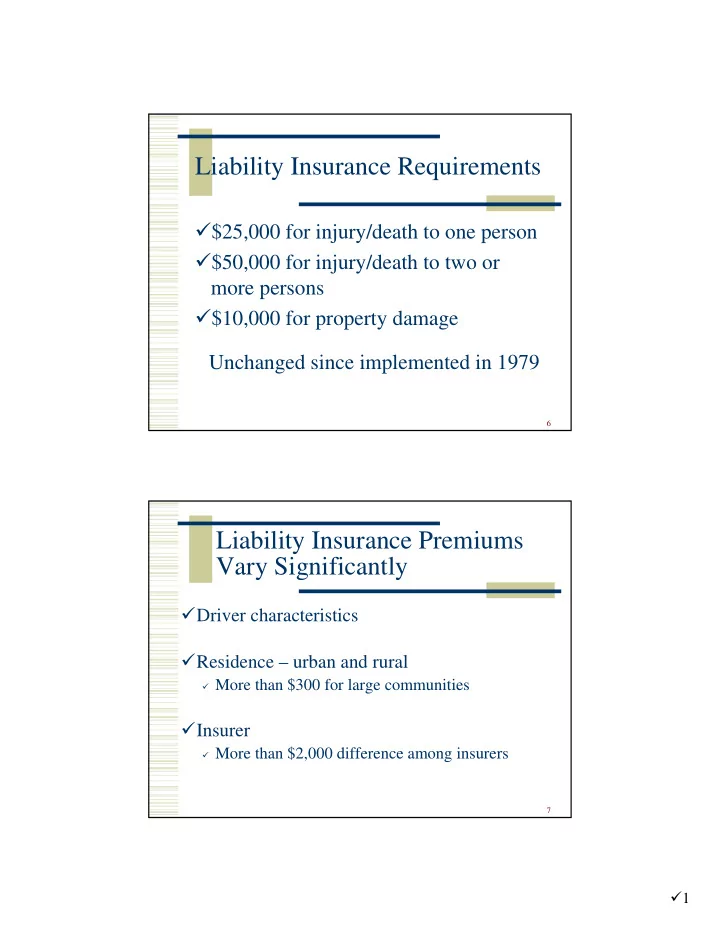
Liability Insurance Requirements $25,000 for injury/death to one person $50,000 for injury/death to two or more persons $10,000 for property damage Unchanged since implemented in 1979 6 Liability Insurance Premiums Vary


slide-1
SLIDE 1

1

6

Liability Insurance Requirements

$25,000 for injury/death to one person $50,000 for injury/death to two or more persons $10,000 for property damage Unchanged since implemented in 1979

7

Liability Insurance Premiums Vary Significantly

Driver characteristics Residence – urban and rural

More than $300 for large communities

Insurer

More than $2,000 difference among insurers

slide-2
SLIDE 2

2

8

Uninsured Motor Vehicles Are A Problem

More Than 11% of Accidents Involved at Least One Uninsured Vehicle

9

Estimated Non-Compliance Rates

Insurance Industry Estimate 9% Non-Compliance

(based on injury claims data)

slide-3
SLIDE 3

3

10

Estimated Non-Compliance Rates

Cont’d

Department Data Indicates Increasing Non-Compliance 15% of convictions are for violating the law. 17% increase in convictions

11

Estimated Non-Compliance Rates

Cont’d – Other States

14% non-compliance nationwide 6% to +20% non-compliance in

  • ther states
slide-4
SLIDE 4

4

12

Conclusion

Between 9 and 15 percent of registered vehicles do not have liability insurance 74,000 – 115,000 Vehicles

13

Three Types of Controls

Detective – Identifying non-compliance Prevention – Deterring non-compliance Corrective – Preventing repeated non- compliance

slide-5
SLIDE 5

5

14

Detecting Non-Compliance

Rely on law enforcement to detect non- compliance

(5% chance of being caught)

Insurance cards have limited value CONCLUSION Montana has ineffective detection controls

15

Preventive Controls (Deterrents)

Fines may be less costly than insurance Jail not a likely option CONCLUSION Penalties are ineffective deterrents

slide-6
SLIDE 6

6

16

Corrective Controls

CONCLUSION Registration and driver license suspensions are not effective at preventing continued non-compliance

17

Corrective Controls

(cont’d)

Suspensions don’t affect some drivers Suspensions may unfairly penalize some drivers Driver license suspensions can’t always be imposed Penalties for subsequent offenses may be less than for 1st offense Some drivers may keep license plates

slide-7
SLIDE 7

7

18

Alternatives for Improving Detection

Sampling programs Reporting systems Verification systems

19

Sampling Programs

Probably less costly Only detect non-compliance in sample Detection risk may remain low Requires all persons in sample to demonstrate compliance Persons can still cancel insurance

slide-8
SLIDE 8

8

20

Reporting Systems

Widely used by almost one-half the states Requires insurers to regularly provide policy data Data is quickly outdated More costly than sampling systems

21

Verification Systems

Provides real-time verification of vehicle insurance status Requires only data necessary to verify insurance status New system

slide-9
SLIDE 9

9

22

Improving Preventive Controls

(Deterrence) Increased fines Increase administrative fees

Registration reinstatement Driver license reinstatement

Increased penalties provides only marginal improvements

Detection risk remains low

23

Improving Corrective Controls

(Preventing repeat offenses) Expand use of SR22 insurance

Insurers required to notify state if SR22

policy is canceled.

SR22 liability insurance tied to an

individual – not a vehicle

slide-10
SLIDE 10

10

24

Effectiveness of Alternative Strategies

Improved Detection Appears to be Most Effective Strategy

25

Impact on Insurance Rates

Impact on insurance rates unknown

No immediate impact – insurance based on

long term claims history

Other factors impact insurance rates

Highway safety Vehicle safety

slide-11
SLIDE 11

11

26

Overall Conclusion

Montana Can Improve Compliance Potential reduction in non-compliance and estimated cost benefits cannot be readily determined

27

Overall Conclusion

(cont’d)

Legislators must balance costs and public benefits of improved compliance with the law