Bank D&O Liability: FDIC Litigation Update Leveraging - - PowerPoint PPT Presentation

bank d o liability fdic litigation update
SMART_READER_LITE
LIVE PREVIEW

Bank D&O Liability: FDIC Litigation Update Leveraging - - PowerPoint PPT Presentation

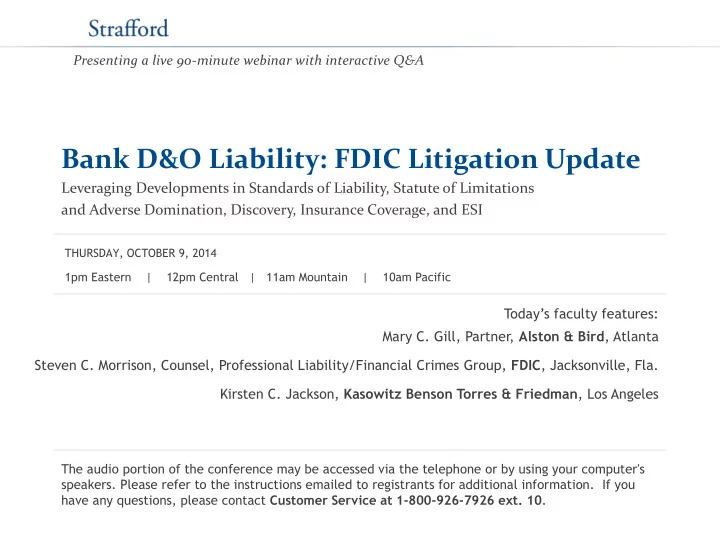
Presenting a live 90-minute webinar with interactive Q&A Bank D&O Liability: FDIC Litigation Update Leveraging Developments in Standards of Liability, Statute of Limitations and Adverse Domination, Discovery, Insurance Coverage, and ESI


slide-1
SLIDE 1

Bank D&O Liability: FDIC Litigation Update

Leveraging Developments in Standards of Liability, Statute of Limitations and Adverse Domination, Discovery, Insurance Coverage, and ESI

Today’s faculty features:

1pm Eastern | 12pm Central | 11am Mountain | 10am Pacific

The audio portion of the conference may be accessed via the telephone or by using your computer's

  • speakers. Please refer to the instructions emailed to registrants for additional information. If you

have any questions, please contact Customer Service at 1-800-926-7926 ext. 10.

THURSDAY, OCTOBER 9, 2014

Presenting a live 90-minute webinar with interactive Q&A Mary C. Gill, Partner, Alston & Bird, Atlanta Steven C. Morrison, Counsel, Professional Liability/Financial Crimes Group, FDIC, Jacksonville, Fla. Kirsten C. Jackson, Kasowitz Benson Torres & Friedman, Los Angeles

slide-2
SLIDE 2

Sound Quality If you are listening via your computer speakers, please note that the quality

  • f your sound will vary depending on the speed and quality of your internet

connection. If the sound quality is not satisfactory, you may listen via the phone: dial 1-866-328-9525 and enter your PIN when prompted. Otherwise, please send us a chat or e-mail sound@straffordpub.com immediately so we can address the problem. If you dialed in and have any difficulties during the call, press *0 for assistance. Viewing Quality To maximize your screen, press the F11 key on your keyboard. To exit full screen, press the F11 key again.

FOR LIVE EVENT ONLY

slide-3
SLIDE 3

For CLE purposes, please let us know how many people are listening at your location by completing each of the following steps:

  • In the chat box, type (1) your company name and (2) the number of

attendees at your location

  • Click the word balloon button to send

FOR LIVE EVENT ONLY

slide-4
SLIDE 4

FDIC LITIGATION UPDATE BANK OFFICERS & DIRECTORS

A Point/Counterpoint Discussion

MARY C. GILL Partner – Alston & Bird LLP Securities Litigation & Regulatory Enforcement mary.gill@alston.com STEVEN C. MORRISON Counsel – FDIC Professional Liability & Financial Crimes stemorrison@fdic.gov

slide-5
SLIDE 5

5

5

FDIC LITIGATION: BY THE NUMBERS

  • 502 – Banks closed since 2008
  • 145 – Lawsuits authorized by the FDIC against

D&Os

  • 97 – FDIC lawsuits filed against D&Os
  • 1,171 –D&Os against whom the FDIC has been

authorized to file suit

  • 749 – D&Os against whom the FDIC has filed suit
slide-6
SLIDE 6

6

6

FDIC LITIGATION: BY STATE

  • 24 – Georgia
  • 14 – California
  • 12 – Florida
  • 11 – Illinois
  • 5 – Washington
  • 4 – Nevada
  • 3 – North Carolina, Puerto Rico, South Carolina
  • 2 – Arizona, New Mexico
  • 1 – Colorado, Indiana, Iowa, Kansas, Maryland, Michigan,

Missouri, Nebraska, Oregon, Pennsylvania, Utah, West Virginia, Wisconsin, Wyoming

slide-7
SLIDE 7

7

7

FDIC LITIGATION: BY YEAR

Authorized D&O Defendants 11 98 264 369 316 113 Suits Filed 2 16 26 40 13 Year 2009 2010 2011 2012 2013 2014

slide-8
SLIDE 8

8

8

FDIC LITIGATION: SETTLEMENTS AND JUDGMENTS

  • ~300 – Settlements published by FDIC
  • 26 – Post litigation settlements
  • 2 – Decisions on motions for summary judgment
  • 1 – Trials
slide-9
SLIDE 9

9

9

STANDARD OF LIABILITY: DETERMINED UNDER STATE LAW

  • The Financial Institutions Reform, Recovery and

Enforcement Act of 1989 (“FIRREA”) establishes gross negligence as a floor for officer and director liability.

  • Under FIRREA, the FDIC may pursue claims against

D&Os under a stricter standard of liability (i.e.,

  • rdinary negligence), if permissible under state law.
slide-10
SLIDE 10

10

10

STANDARD OF LIABILITY: GEORGIA

FDIC v. Loudermilk, 761 S.E.2d 332 (Ga. 2014)

  • Certified Question: “Does the business judgment rule

in Georgia preclude as a matter of law a claim for

  • rdinary negligence against the officers and directors of

a bank in a lawsuit brought by the FDIC as receiver for the bank?”

slide-11
SLIDE 11

11

11

FDIC v. Loudermilk

  • “[T]he business judgment rule is a settled part of our common law in

Georgia, and it generally precludes claims against officers and directors for their business decisions that sound in ordinary negligence, except to the extent that those decisions are shown to have been made without deliberation, without the requisite diligence to ascertain and assess the facts and circumstances upon which the decisions are based, or in bad faith.”

  • “[T]he wisdom of the decision is ordinarily insulated from judicial review,

and as for the process by which the decision was made, the officers and directors are presumed to have acted in good faith and to have exercised

  • rdinary care. Although this presumption may be rebutted, the plaintiff

bears the burden of putting forward proof sufficient to rebut it.”

slide-12
SLIDE 12

12

12

FDIC v. Loudermilk

  • “[B]ank officers and directors are only expected to

exercise the same diligence and care as would be exercised by ‘ordinarily prudent’ officers and directors

  • f a similarly situated bank.”
  • The Georgia statute, “conclusively presumes that it is

reasonable for an officer or director to rely upon certain information as a part of the diligence with which the standard of ordinary care is concerned.”

slide-13
SLIDE 13

13

13

STANDARD OF LIABILITY: GEORGIA

FDIC v. Skow, 2014 WL 4670371 (Ga. Sept. 22, 2014)

  • Certified Question: “Does a bank director or officer violate the

standard of care established by O.C.G.A. § 7-1-490 when he acts in good faith but fails to act with ‘ordinary diligence,’ as that term is defined in O.C.G.A. § 51-1-2?”

  • Certified Question: “In a case like this one, applying Georgia’s

business judgment rule, can the bank officer or director defendants be held individually liable if they, in fact as alleged, are shown to have been ordinarily negligent or to have breached a fiduciary duty, based on ordinary negligence in performing professional duties?”

slide-14
SLIDE 14

14

14

FDIC v. Skow

  • “A bank director or officer may violate the standard of care . . .

even where he acts in good faith, where, with respect to the process by which he makes decisions, he fails to exercise the diligence, care, and skill of ‘ordinarily prudent men [acting] under similar circumstances in like positions. . . .’”

  • “[P]rocess in this context refers to the mode by which one

deliberates and ascertains the facts relevant to the decision at

  • hand. . . . the level of diligence required is only that as would be

exercised by ‘ordinarily prudent’ officers and directors of a similarly situated bank.”

slide-15
SLIDE 15

15

15

FDIC v. Skow

  • “In a case like this one, the bank officer or director

defendants may be held individually liable if they are shown to have violated the standard of care established by O.C.G.A. § 7-1-490, as construed in Loudermilk.”

slide-16
SLIDE 16

16

16

Georgia Post-Loudermilk

FDIC v. Boggus, No. 2:13-cv-00162-WCO (N.D. Ga. Aug. 25, 2014)

  • “Plaintiff adequately alleges procedural defects in the

loan approval process. Although defendants may later find statutory sanctuary from liability, the exact contours

  • f whether defendants exercised sufficient diligence to

‘ascertain the relevant facts’ may not be decided on the pleadings alone.”

slide-17
SLIDE 17

17

17

STANDARD OF LIABILITY: NORTH CAROLINA

FDIC v. Willetts, No. 7:11-cv-165-BO (E.D.N.C. Sept. 11, 2014), Dkt. No. 42

  • “The business judgment rule involves two presumptions. First, it establishes ‘an

initial evidentiary presumption that in making a decision the directors [and

  • fficers] acted with due care (i.e., on an informed basis) and in good faith in the

honest belief that their action was in the best interest of the corporation.’ Second, the business judgment rule establishes, absent rebuttal of the first presumption, a ‘powerful substantive presumption that a decision by a loyal and informed board will not be overturned by a court unless it cannot be attributed to any rational business purpose.’”

  • “[T]he business judgment rule precludes the court from delving into whether or

not the decisions were ‘good,’ limiting the court to a determination of whether the decisions were made in ‘good faith’ or were founded on a ‘rational business purpose.’”

slide-18
SLIDE 18

18

18

FDIC v. Willetts

  • “Although there were clearly risks involved in Cooperative's

approach, the mere existence of risks cannot be said, in hindsight, to constitute irrationality. Further, corporations are expected to take risks and their directors and officers are entitled to protection from the business judgment rule when those risks turn out poorly.”

  • “Where, as here, defendants do not display a conscious

indifference to risks and where there is no evidence to suggest that they did not have an honest belief that their decisions were made in the company’s best interests, then the business judgment rule applies even if those judgments ultimately turned out to be poor.”

slide-19
SLIDE 19

19

19

FDIC v. Willetts

  • “It appears that the only factor between defendants

being sued for millions of dollars and receiving millions

  • f dollars in assistance from the government is that

Cooperative was not considered to be ‘too big to fail.’ Taking the position that a big bank’s directors and

  • fficers should be forgiven for failure due to its size and

an unpredictable economic catastrophe while aggressively pursuing monetary compensation from a small bank's directors and officers is unfortunate if not

  • utright unjust.”
slide-20
SLIDE 20

20

20

  • “Under North Carolina law, gross negligence has the

same basic elements as negligence, but requires either intentional wrongdoing or deliberate misconduct affecting the safety of others, such as when the act is done purposely and with knowledge that such act is a breach of duty to others.” Boykin Anchor Co., Inc. v. AT&T Corp., 825 F. Supp. 2d 706 (E.D.N.C. 2011) (emphasis added).

FDIC v. Willetts

slide-21
SLIDE 21

21

21

Post Willetts

  • FDIC filed a Notice of Appeal on October 2, 2014.
  • Intersection with 12 U.S.C. § 1821(k)?
  • “In light of Atherton, we have serious doubts about

whether it is permissible to borrow from state law a definition of ‘gross negligence’ that effectively raises the standard of culpability to recklessness.” FDIC-R Broadway Bank v. Giannoulias, No. 1:12-cv-01665 (E.D. Ill. Jan. 16, 2013).

slide-22
SLIDE 22

22

22

POTENTIAL DEFENSES TO CONSIDER

  • Business Judgment Rule
  • Reliance on management, committees, or advisors
  • Failure to establish elements of liability
  • Failure to mitigate damages
  • Comparative or contributory fault
  • Statute of limitations
slide-23
SLIDE 23

23

23

AFFIRMATIVE DEFENSES

O’Melveny & Myers v. FDIC, 512 U.S. 79 (1994)

  • In O’Melveny & Myers v. FDIC, the Supreme Court rejected the

premise of “federal common law,” upon which the FDIC had primarily relied in arguing that a “no duty” rule afforded it unique protections from affirmative state-law defenses.

  • The Court held that neither federal policy nor FIRREA itself created a

federal rule to protect the FDIC, concluding that “any defense good against the original party is good against the receiver.”

  • Exception: Where a “‘previously established and long standing’ rule
  • f federal common law predated FIRREA’s enactment.” FDIC v.

Skow, 741 F.3d 1342, 1347 (11th Cir. 2013).

slide-24
SLIDE 24

24

24

AFFIRMATIVE DEFENSES

Post-O’Melveny & Myers v. FDIC

  • FDIC v. Skow, 741 F.3d 1342, 1349 (11th Cir. 2013) (holding that the

FDIC “failed to demonstrate the existence of an established and long- standing common law rule barring Defendants’ affirmative defenses” so as to exempt the “no-duty” rule from preclusion under O’Melveny & Myers).

  • W Holding Co., Inc. v. AIG Ins. Co., No. 3:11-cv-02271-GAG-BJM

(D.P.R. Aug. 8, 2014), Dkt. No. 1166 (denying FDIC’s motion for summary judgment on defendants’ failure to mitigate affirmative defense).

  • FDIC v. Willetts, 882 F. Supp. 2d 859, 870 (E.D.N.C. 2012) (denying

FDIC’s motion to strike affirmative defenses and holding “[t]hat after O’Melveny, ‘state law controls what defenses are available against the FDIC when the agency is acting as the receiver of a failed financial institution.’”).

slide-25
SLIDE 25

25

25

AFFIRMATIVE DEFENSES

Post-O’Melveny & Myers v. FDIC

  • FDIC v. Appleton, No. 2:11-cv-00476-JAK-PLA (C.D. Cal.

July 23, 2012) (holding that “the no duty rule remains viable following the Supreme Court’s decision in O’Melveny & Myers

  • v. FDIC”).
  • FDIC v. Van Dellen, No. 2:10-cv-04915-DSF-SH (C.D. Cal.
  • Sept. 27, 2011) (barring defendants from raising certain

affirmative defenses to extent they were based on FDIC’s post-

  • r pre-receivership conduct, because the defenses could not

have been asserted against the bank).

slide-26
SLIDE 26

26

26

AFFIRMATIVE DEFENSES: STATUTE OF LIMITATIONS

  • FIRREA Section 1821(d)(14)(A) - Statute of limitations or statute of repose?
  • FDIC v. Jones, No. 2:13-cv-00168-JAD-GWF (D. Nev. Sept 19, 2014),
  • Dkt. No. 79 (holding that section 1821(d)(14)(A) is a statute of limitations,

that it could be tolled by agreement, and that state limitations period reset upon appointment of FDIC as receiver).

  • W Holding Co., Inc. v. Chartis Insur. Co., No. 3:11-cv-02271-GAG

(D.P.R. Oct. 23, 2012) (applying adverse domination doctrine to toll statute of limitations).

  • National Credit Union Administration Board v. Credit Suisse Securities

USA LLC, No. 12-2648-JWL, 2013 U.S. Dist. LEXIS 95749 (D. Kan. July 10, 2013) (holding that extender statute may not be tolled by the agreement of the parties).

slide-27
SLIDE 27

27

27

DISCOVERY DISPUTES

  • Which party bears the costs of producing ESI?
  • What documents are within the FDIC-R’s possession,

custody and control?

  • Are regulatory documents protected from discovery?
slide-28
SLIDE 28

The Failed Bank Crisis: Update On The Insurance Debate

Linda Kornfeld Kirsten C. Jackson Kasowitz Benson Torres & Friedman lkornfeld@kasowitz.com kjackson@kasowitz.com 424.288.7900

28

slide-29
SLIDE 29

kasowitz benson torres & friedman llp

KASOWITZ BENSON TORRES & FRIEDMAN LLP

Introduction

  • Multiple years in to this event, what coverage issues are

being debated?

  • Insured v. Insured exclusion
  • “Loan Loss” exception
  • Regulatory exclusion
  • “Prior acts” exclusions/retroactive dates

29

slide-30
SLIDE 30

kasowitz benson torres & friedman llp

KASOWITZ BENSON TORRES & FRIEDMAN LLP

Insured vs. Insured Exclusion

  • Is underlying action “collusive”?
  • Does the policy contain a “bankruptcy trustee” carve out?
  • Is the FDIC truly acting as or on behalf of the “company”?
  • Is the FDIC a “genuinely adverse party”?
  • Is the FDIC acting as a creditor representing other

creditors?

  • Is the exclusion at least “ambiguous” with respect to

application to FDIC?

30

slide-31
SLIDE 31

kasowitz benson torres & friedman llp

KASOWITZ BENSON TORRES & FRIEDMAN LLP

Insured vs. Insured Exclusion

Cases Holding Exclusion Inapplicable

31

slide-32
SLIDE 32

kasowitz benson torres & friedman llp

KASOWITZ BENSON TORRES & FRIEDMAN LLP

Insured vs. Insured Exclusion

Michigan Heritage Bank (E.D. MI 2012), insurer summary judgment motion denied: “the FDIC has shown that some ambiguity exists in the insured vs. insured exemption [sic] due to the 'security holder exception,' the omission of a regulatory exclusion, and statements by plaintiff that regulatory suits, which might include the instant action are covered.”

32

slide-33
SLIDE 33

kasowitz benson torres & friedman llp

KASOWITZ BENSON TORRES & FRIEDMAN LLP

Insured vs. Insured Exclusion

  • W. Holding Co. v. Chartis (D. Puerto Rico

2012): Exclusion inapplicable because:

  • When regulatory agency asserts claims on

behalf of both insured organization and third- party interests, its applicability is ambiguous.

  • Purpose of exclusion is to deter collusion.
  • Policy defined “organization” as named entity,

each subsidiary and debtors in BK proceedings; none of which were the FDIC.

33

slide-34
SLIDE 34

kasowitz benson torres & friedman llp

KASOWITZ BENSON TORRES & FRIEDMAN LLP

Insured vs. Insured Exclusion

Progressive v FDIC (N.D. Ga. 2013): Exclusion inapplicable because:

  • it is unclear whether the FDIC as receiver’s

claims are “by” or “on behalf of” the failed bank.

  • court cited multiple roles FDIC takes on in

representing the insured, depositors, creditors, and shareholders to support conclusion that exclusion is ambiguous.

34

slide-35
SLIDE 35

kasowitz benson torres & friedman llp

KASOWITZ BENSON TORRES & FRIEDMAN LLP

Insured vs. Insured Exclusion

  • W. Holding Co. v. AIG (1st Cir. July 9, 2014):
  • Court held that there was a duty to advance

defense costs despite IvI exclusion.

  • Insurer argued that the FDIC was proceeding
  • nly its capacity as receiver. However, FDIC

alleged not only that it had succeeded to the rights of the failed bank, but also that it had succeeded to the rights of the bank’s depositors and account holders, and also that it was suing to recover “money the insurance fund had shelled out” after the bank failed.

35

slide-36
SLIDE 36

kasowitz benson torres & friedman llp

KASOWITZ BENSON TORRES & FRIEDMAN LLP

Insured vs. Insured Exclusion

  • St. Paul Mercury Ins. Co. v. Hahn (C.D. Cal tent.
  • Oct. 6, 2014)
  • Exclusion inapplicable, as FDIC represents a

number of interests, and does not simply act on behalf of the failed bank.

  • “Repeated disputes over the IvI Exclusion have

placed insurers on notice that it is ambiguous” and “any ambiguity . . . is to be resolved against the insurer.”

  • “Travelers had the opportunity to make clear in the

Policy that the IvI exclusion applied to FDIC-R, and it could have done so with a simple statement.”

36

slide-37
SLIDE 37

kasowitz benson torres & friedman llp

KASOWITZ BENSON TORRES & FRIEDMAN LLP

Insured vs. Insured Exclusion

Cases Holding Exclusion Applicable

37

slide-38
SLIDE 38

kasowitz benson torres & friedman llp

KASOWITZ BENSON TORRES & FRIEDMAN LLP

Insured vs. Insured Exclusion

Hawker v. Bancinsurance (E.D. Cal. Apr. 7, 2014):

  • Exclusion applicable where it expressly referred to “a

claim by . . . any other insured person, the company,

  • r any successor, trustee, assignee or receiver of the

company.”

  • While “not accusing the FDIC of collusion,” Court

noted that the interests of the FDIC as receiver “could be aligned with the interests of the directors and

  • fficers of a failed bank when an insurer is involved.”
  • Unusual express reference to a company’s

“receivers” key. Judge distinguished cases finding coverage on this basis.

38

slide-39
SLIDE 39

kasowitz benson torres & friedman llp

KASOWITZ BENSON TORRES & FRIEDMAN LLP

Insured vs. Insured Exclusion

  • St. Paul v. Miller (N.D. Ga. 2013) (Currently on

appeal—Oral Argument 10/14/14): Exclusion applicable:

  • Court relied upon O’Melveny & Myers, 512 U.S.

79 (1994) and concluded that the exclusion unambiguously applied because FDIC “step[ped] into the shoes” of the failed bank.

  • Court rejected all arguments relied upon by
  • ther courts in finding the exclusion inapplicable

(i.e. absence of collusion, public policy)

39

slide-40
SLIDE 40

kasowitz benson torres & friedman llp

KASOWITZ BENSON TORRES & FRIEDMAN LLP

Insured vs. Insured Exclusion

  • St. Paul v. Miller (N.D. Ga. 2013):

However:

  • Court expressly limited decision to policy

language before it (precluding coverage for loss “on account of any Claim made against any Insured . . . Brought or maintained by or on behalf of any Insured or Company in any Capacity.”)

40

slide-41
SLIDE 41

kasowitz benson torres & friedman llp

KASOWITZ BENSON TORRES & FRIEDMAN LLP

Insured vs. Insured Exclusion

  • St. Paul v. Miller (N.D. Ga. 2013):

Arguments on Appeal:

  • The plain language of the IvI exclusion does

not apply, because the FDIC is not a named insured, and brings suit for the benefit of the receivership and third parties, not the Bank.

  • This interpretation does not read the phrase of

“on behalf of” out of the policy, as it could apply to others (i.e. holding co’s debtor-in-possession)

  • Insurer could have expressly excluded FDIC

claims from coverage.

41

slide-42
SLIDE 42

kasowitz benson torres & friedman llp

KASOWITZ BENSON TORRES & FRIEDMAN LLP

Insured vs. Insured Exclusion

  • St. Paul v. Miller (N.D. Ga. 2013):

Arguments on Appeal:

  • Purpose of IvI exclusion to preclude coverage

for potentially collusive claims, as demonstrated by shareholder derivative action exception.

  • At a minimum, IvI exclusion ambiguous.

42

slide-43
SLIDE 43

kasowitz benson torres & friedman llp

KASOWITZ BENSON TORRES & FRIEDMAN LLP

“Loan Loss” Exception

Loss Definition sometimes excludes: “any unrepaid, unrecoverable or outstanding loan, lease or extension of credit to any … Borrower.” Insurers now looking at this exception as additional basis to deny coverage.

43

slide-44
SLIDE 44

kasowitz benson torres & friedman llp

KASOWITZ BENSON TORRES & FRIEDMAN LLP

“Loan Loss” Exception

Progressive v FDIC (N.D. Ga. 2013): Exclusion inapplicable because “ambiguity exists in the definition of ‘loss’” and the “loan loss carve-out” does not “clearly exempt tortious claims” brought by the FDIC in the underlying D&O liability action.

44

slide-45
SLIDE 45

kasowitz benson torres & friedman llp

KASOWITZ BENSON TORRES & FRIEDMAN LLP

“Regulatory” Exclusion

Hawker v. Bancinsurance (E.D. Cal. 2014):

  • “The regulator exclusion would bar suits brought by the

FDIC in its capacity as federal insurer, also known as its ‘corporate capacity,’ whereas the insured v. insured exclusion would only bar claims by the FDIC in its capacity as receiver.”

  • Insured v. insured exclusion in that case expressly

included suits by a “receiver.”

45

slide-46
SLIDE 46

kasowitz benson torres & friedman llp

KASOWITZ BENSON TORRES & FRIEDMAN LLP

“Regulatory” Exclusion

Reis v. FDIC (C.D. Cal. 2013):

  • Coverage barred where unusually broad regulatory

exclusion provided that “the Company shall not be liable for Loss on account of any Claim by, on behalf of, or at the behest of . . . the Federal Deposit Insurance Corporation . . . in any capacity whatsoever.”

46

slide-47
SLIDE 47

kasowitz benson torres & friedman llp

KASOWITZ BENSON TORRES & FRIEDMAN LLP

Conclusion

47

slide-48
SLIDE 48

kasowitz benson torres & friedman llp

KASOWITZ BENSON TORRES & FRIEDMAN LLP

Biography

Linda D. Kornfeld is a partner in the Kasowitz’s Litigation Department and a member of the Insurance Litigation and Counseling Practice. A nationally recognized insurance coverage litigator whom Chambers USA has described as

  • ne of “the best attorneys in California” for coverage litigation, Ms. Kornfeld has

extensive trial and appellate experience representing corporate and individual policyholders in high-stakes litigation in California and across the country.

  • Ms. Kornfeld has assisted clients in obtaining substantial recoveries in various

types of insurance matters. Linda presently is representing clients in Directors and Officers coverage litigation related to failed banks.

  • Ms. Kornfeld has been repeatedly cited as an exceptional insurance litigator and
  • ne of the top women lawyers in California by leading legal publications and

directories, including Chambers USA, since 2007; and in 2011 she was included as one of Lawdragon’s top 500 “leading lawyers” in America, and named by Benchmark Litigation as a “Litigation Star” both nationally and in California.

  • Ms. Kornfeld also has been recognized by the Daily Journal as one of California’s

top 100 women litigators, by Business Insurance as one of the country’s “50 Women to Watch” in insurance, in Southern California Super Lawyers, as one of the top 50 women lawyers in Southern California. Ms. Kornfeld also is included in the Legal Media Group’s Guide to the World’s Leading Insurance and Reinsurance Lawyers.

48

slide-49
SLIDE 49

kasowitz benson torres & friedman llp

KASOWITZ BENSON TORRES & FRIEDMAN LLP

Biography

Kirsten C. Jackson works on behalf of companies to recover insurance assets. She assists in obtaining millions of dollars in insurance coverage for clients under commercial general liability, professional liability, directors and officers liability, errors and omissions liability, and life insurance. Kirsten is experienced in all stages of litigation and non-adversarial dealings with insurers, including coverage analysis and advising, claims correspondence, mediations, pleadings, written discovery, document production, depositions, motion practice, trial preparation and settlement. Kirsten was recognized in “Who’s Who Legal” and Lawyers of Color’s “Hot List.”

49