
SLIDE 1
1
Lender and Distressed Debt Investment Panel: State of the Market - - PowerPoint PPT Presentation
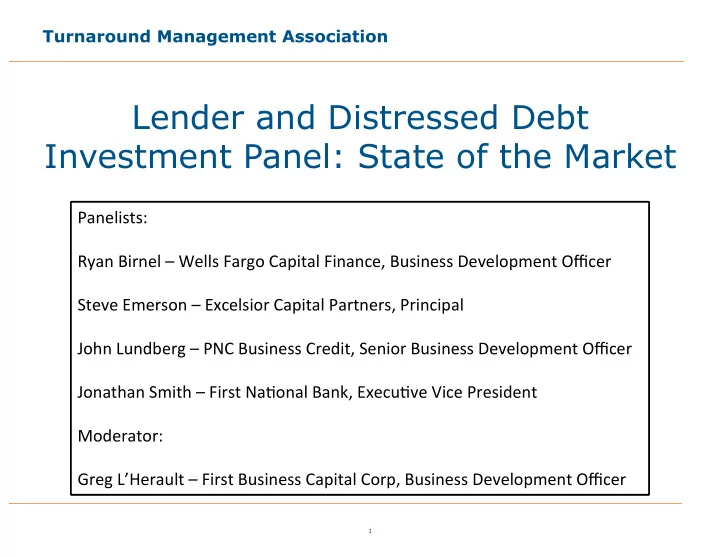
Turnaround Management Association Lender and Distressed Debt Investment Panel: State of the Market Panelists: Ryan Birnel Wells Fargo Capital Finance, Business Development Officer Steve Emerson Excelsior Capital Partners, Principal
1
FIRST NATIONAL
2
FIRST NATIONAL
3
4
Downgrade / Upgrade Distressed Ratios Default Rate Remains Below Average § The U.S. speculative default rate was 2.76% in October 2015; Moody’s default rate forecast predicts the default rate will rise modestly to 3.77% in the U.S. by end of October 2016 – inching back to the historic average. § Distressed ratios have ticked up in 2015. − Worsening metrics are being impacted by certain industries such as metals and energy. § Moody’s downgrade / upgrade ratio has been a leading indicator for the speculative grade default rate in recent history.
Source: Moody’s, Federal Reserve Board, Bureau of Economic Analysis 0% 2% 4% 6% 8% 10% 12% 14% 16% 18% 1985 1987 1989 1991 1993 1995 1997 1999 2001 2003 2005 2007 2009 2011 2013 2015 U.S. Speculative Grade Default Rate Actual Baseline Forecast Average 0% 5% 10% 15% 20% 25% 30% 35% Jan-11 Apr-11 Jul-11 Oct-11 Jan-12 Apr-12 Jul-12 Oct-12 Jan-13 Apr-13 Jul-13 Oct-13 Jan-14 Apr-14 Jul-14 Oct-14 Jan-15 Apr-15 Jul-15 Oct-15 Difference S&P Distress Ratio MLHY Distress Ratio 0% 2% 4% 6% 8% 10% 12% 14% 0x 1x 2x 3x 4x 5x 6x 1998 2000 2002 2004 2006 2008 2010 2012 2014 Moody's Downgrade/Upgrade Ratio U.S. Speculative Grade Default Rate
Solid M&A Offset by Lack of Refinancings
§ Refinancing Activity: Following a significant increase in refinancing activity in 2Q15, refinancing volume declined to $13.8 billion in 3Q15, down 75.6% from 2Q15 volume of $56.5 billion. − The decline in refinancing was a result of deteriorating technical conditions in the institutional market (lack of CLO issuance and retail outflows), paired with the fact that most high-quality borrowers have already tapped the market for a refinance. § Mergers & Acquisitions: Non-LBO M&A activity increased to $62.1 billion in 3Q15, up approximately 62.5% from 2Q15, mostly as a result of increased activity in the pro rata market. − Non-LBO M&A activity in the pro rata market increased from $12.3 billion in 2Q15 to $34.8 billion in 3Q15. − While LBO issuance increased slightly from the second quarter, YTD issuance is down 14.6%. Private equity firms continue to be squeezed between high purchase price multiples and regulatory pressures to keep leverage ratios inside predetermined thresholds, lowering the population of leveraged debt LBO transactions that translate to attractive IRRs.
Source: S&P Capital IQ (LCD)
Leveraged Loan Volume By Purpose Quarterly M&A Leveraged Loan Volume
$0 $10 $20 $30 $40 $50 $60 $70 $80 $90 3Q09 1Q10 3Q10 1Q11 3Q11 1Q12 3Q12 1Q13 3Q13 1Q14 3Q14 1Q15 3Q15 Volume ($ in billions) LBO Strategic (PE) Strategic (corp)
5
($ in billions) YTD 2015 YTD 2014 ∆ from 2014 3Q15 2Q15 ∆ from 2Q15 LBO $60.3 $70.6 -14.6% $20.5 $18.7 9.5% M&A (non-LBO) 142.1 144.1
62.1 38.2 62.5% Total M&A 202.3 214.7
82.6 56.9 45.1% Refinancing 95.6 151.7 -37.0% 13.8 56.5
Dividend 35.9 48.7
14.3 13.7 4.4% Other 12.6 46.3
1.7 8.0
Total $346.4 $461.4 -24.9% $112.3 $135.1 -16.9%
6
§
The increase in leveraged debt issuance to record highs across the loan and bond asset classes in 2013 has caused regulators to issue stringent guidelines regarding this development.
–
Goal is to stem the potential for broad systemic risk and protect the soundness of banks.
–
Guidelines have resulted in increased tracking and reporting required by banks for leveraged credits.
§
These recent guidelines have caused certain highly leveraged deals to be constrained as banks more closely evaluate the necessary yields that will be required to lend to these credits. ≤ 3.00x Non-Leveraged Lending > 3.00x Leveraged Lending ≤ 4.00x Non-Leveraged Lending > 4.00x Leveraged Lending Leveraged Lending Tests Total Leverage Senior Leverage
7
Sponsored Loan Volume at 3-year Low LBO Equity Contributions Rise Increased Lender Impact from LLG
Source: Loan Pricing Corporation
§ Regulators finalized Leveraged Lending Guidance (“LLG”) in 2013, causing many banks to evaluate and often reduce their risk tolerance levels. § Many lenders are more reluctant to invest in transactions considered to be Highly Leveraged Transactions (“HLTs”), which appears to have correlated to a lower trend in average leverage levels. – The rules around leveraged lending guidance continue to make the structuring of sponsored financings more difficult for arrangers and private equity firms. At $221.9 billion, 1-3Q15 sponsored loan volume was down 31% compared to the same time last year. – Although average equity contributions among sponsors have remained stable at about 39%, the distribution of equity contributions did become more weighted to buckets of 40-50+%, which represented a combined 48% of total equity weightings for 2015 sponsored deals so far this year. § Although lenders still face uncertainty with regards to LLG, market respondents have begun to express a significant impact on lender behavior compared to previous years; in 2015 no respondents indicated the LLG regulations would have zero impact
§ The elevated level of diligence and economics required for banks to support HLTs has contributed to the emergence of non- regulated entities competing in the leveraged market.
0% 10% 20% 30% 40% 50% 60% 70% 80% 90% 2013 2014 2015 % of Respondents Significant Impact Modest Impact No Impact 0.0% 5.0% 10.0% 15.0% 20.0% 25.0% 30.0% 35.0% 40.0% 45.0% 50.0% 2H04 2Q05 4Q05 2Q06 4Q06 2Q07 4Q07 2009 3Q10 1Q11 3Q11 1Q12 3Q12 1Q13 3Q13 1Q14 3Q14 1Q15 3Q15 Equity Contribution (%) $- $50 $100 $150 $200 $250 $300 $350 $400 $450 1Q-3Q97 1Q-3Q98 1Q-3Q99 1Q-3Q00 1Q-3Q01 1Q-3Q02 1Q-3Q03 1Q-3Q04 1Q-3Q05 1Q-3Q06 1Q-3Q07 1Q-3Q08 1Q-3Q09 1Q-3Q10 1Q-3Q11 1Q-3Q12 1Q-3Q13 1Q-3Q14 1Q-3Q15 Sponsored Issuance ($ in Billions) Non-LBO LBO
Non-Sponsored MM Loan Volume
§ Non-sponsored Middle Market (“MM”) loan issuance year-to-date through 3Q15 was the lowest since 2010, reaching only $66.4 billion — a 31% decline from the same period in 2014. – New money and refinancing's declined significantly in 3Q15, driving overall MM loan volume to a five-year quarterly low. – Stabilization in pricing, coupled with the recent extension of a large number of deals, has provided little incentive for borrowers to refinance, while record purchase price multiples have deterred significant M&A volume in the MM. § Non-sponsored MM M&A loan volume was relatively quiet in 3Q15 at only $1.3 billion, a 67% decline year-over-year, despite the Large Corporate market benefiting from a surge in M&A activity. – An LPC survey of lenders showed that lenders expect M&A activity will drive the bulk of loan volume in 4Q15; however, expectations for the amount of new money issuance have tempered since late 2014 given MM borrowers’ hesitation to pursue M&A transactions in the current market environment.
Source: Loan Pricing Corporation
Non-Sponsored M&A Loan Volume
8
*Traditional Middle Market: Deal size ≤ $100.0 million *Large Middle Market: Deal size $100.0 million to $500.0 million
New Money & Refinancing Volume
$0.0 $5.0 $10.0 $15.0 $20.0 $25.0 $30.0 $35.0 $40.0 1Q11 2Q11 3Q11 4Q11 1Q12 2Q12 3Q12 4Q12 1Q13 2Q13 3Q13 4Q13 1Q14 2Q14 3Q14 4Q14 1Q15 2Q15 3Q15 Issuance ($ in billions) Traditional Large $0.0 $5.0 $10.0 $15.0 $20.0 $25.0 $30.0 $35.0 $40.0 1Q11 2Q11 3Q11 4Q11 1Q12 2Q12 3Q12 4Q12 1Q13 2Q13 3Q13 4Q13 1Q14 2Q14 3Q14 4Q14 1Q15 2Q15 3Q15 Issuance ($ in billions) Refinancings New Money 0.0% 2.0% 4.0% 6.0% 8.0% 10.0% 12.0% 14.0% $0.0 $0.5 $1.0 $1.5 $2.0 $2.5 $3.0 $3.5 $4.0 $4.5 $5.0 1Q11 2Q11 3Q11 4Q11 1Q12 2Q12 3Q12 4Q12 1Q13 2Q13 3Q13 4Q13 1Q14 2Q14 3Q14 4Q14 1Q15 2Q15 3Q15 M&A (% of Non-Sponsored) M&A Volume ($ in billions) M&A M&A% of Non-Sponsored
§ Total debt multiples for MM loans reached a record 5.6x in 3Q15 as a weak loan pipeline, record purchase price multiples, and increasing competition between bank and non-bank lenders outweighed the impact of Leveraged Lending regulations. – Record Total Leverage levels were supported by an increase in Second-lien financings in 3Q15. § With banks conscious of the implications of Leveraged Lending, non-bank lenders are competing on leverage and providing structures, such as unitranche financings, that have allowed borrowers to stretch their leverage profiles. – Heading into 4Q15, an LPC survey of bank respondents identified that the average tolerance levels of most banks for Senior Leverage and Total Leverage ranged from 2.5x ─ 3.0x and 3.5x ─ 4.0x, respectively, as regulations continue to challenge aggressive structures. – However, non-bank lenders continue to loosen their leverage tolerance as 70% indicated a willingness to lend above 4.0x First-lien Leverage and 5.5x Total Leverage.
Source: S&P LCD and Loan Pricing Corporation
Average Debt Multiples of Middle Market Loans
Middle Market defined as issuers with EBITDA of ≤ $50.0 million Prior to 2002, media and telecom deals were excluded EBITDA adjusted for prospective cost savings and synergies
9
4.8x 4.6x 4.1x 4.0x 3.6x 3.8x 3.9x 4.1x 4.3x 4.4x 4.8x 4.3x 3.4x 3.7x 4.2x 4.2x 4.8x 5.0x 4.9x 5.6x 0.0x 1.0x 2.0x 3.0x 4.0x 5.0x 6.0x 1997 1998 1999 2000 2001 2002 2003 2004 2005 2006 2007 2008 2009 2010 2011 2012 2013 2014 1Q-3Q15 3Q15 First-lien Debt/EBITDA Second-lien Debt/EBITDA Other Senior Debt/EBITDA Subordinated Debt/EBITDA
Rank Bank Holding Company # of Deals 1 PNC Bank 40 2 Bank of America Merrill Lynch 34 3 Wells Fargo & Company 26 4 PrivateBancorp Inc 6 5 JP Morgan 5 5 Citizens Financial Group 5 5 SunTrust Bank 5 8 U.S. Bancorp 4 8 CIT Group Inc 4 10 Antares Capital Corporation 3 2015 U.S. Asset Based Lending Middle Market Bookrunner Ranking by Number of Deals
Source: Loan Pricing Corporation 12/31/15
Rank Bank Holding Company Volume 1 PNC Bank 2,769 $ 2 Bank of America Merrill Lynch 2,563 3 Wells Fargo & Company 2,138 4 JP Morgan 405 5 U.S. Bancorp 350 6 CIT Group Inc 312 7 Citizens Financial Group 283 8 PrivateBancorp Inc 267 9 Banco Santander SA 180 10 NewStar Financial Inc 150 2015 U.S. Asset Based Lending Middle Market Bookrunner Ranking by Volume ($ in millions)
Source: Loan Pricing Corporation 12/31/15
§ PNC Loan Syndications has consistently ranked in the top tier of Lead Arrangers in the U.S. primary loan market. – During 2015, PNC Loan Syndications was Lead Arranger and Bookrunner on 40 middle market Asset Based Lending transactions, totaling approximately $2.8 billion in commitments. – Deal team staffed with senior transactors with expertise in leading deals for private and public companies. – Well established investor base, successful track record and demonstrated strong execution. § PNC Agency Services manages the loan activity for over 450 clients totaling approximately $70.0 billion in commitments. – A dedicated closing staff is in place to set up, review and coordinate funding with all parties involved in the pre-closing/closing process. – Clients are provided with an experienced loan administrator from an efficient team of 40+ members and back-up contact with detailed knowledge of the specific requirements of the credit agreement. 10
Asset-Based Volume & Purpose
Asset-Based Purpose by % of Dollar Volume Asset-Based Volume
Note: Data represents broadly syndicated transactions reported in 2015 Source: Thomson Reuters Note: Includes only deals >$100 million Source: Thomson Reuters
Asset-Based Pricing
Undrawn Pricing Drawn Pricing
Note: ABL data represents broadly syndicated transactions >$100 million reported in 2015. Source: Thomson Reuters, S&P Loan Stats & Wells Fargo Capital Finance Note: ABL data represents broadly syndicated transactions >$100 million reported in 2015. Source: Thomson Reuters, S&P Loan Stats & Wells Fargo Capital Finance
Comparison: Asset-Based vs Leveraged Loans
ABL as a % of Leveraged Loans Pricing Comparison: ABL vs Leveraged Loans
Note: Leveraged loans includes both institutional and pro rata. Source: Thomson Reuters, S&P Loan Stats & Wells Fargo Capital Finance Note: ABL data represents broadly syndicated transactions >$100 million reported in 2015. BB/BB- pricing represents all-in yield including the benefit of LIBOR floor and OID. Source: Thomson Reuters, S&P Loan Stats & WFCF
Select Recent Transactions 2015 Asset-Based Bookrunner League Table
Wells Fargo is a leading arranger
transactions, serving as bookrunner for $15.4 billion of volume in 2015, accounting for 18% market share We support our clients with superior market knowledge and significant capital commitments in the deals we lead Wells Fargo committed more capital to asset-based deals in 2015 than any other lender with
commitments to 132 syndicated transactions1
$1.0 Billion Senior Secured Revolver
Administrative Agent $2.1 Billion Senior Secured Revolver
Syndication Agent $1.2 Billion Senior Secured Revolver
Administrative Agent $1.0 Billion Senior Secured Revolver
Administrative Agent $1.0 Billion
Administrative Agent $1.0 Billion Senior Secured Revolver
Administrative Agent $3.7 Billion Senior Secured Revolver
Syndication Agent $2.35 Billion Senior Secured Revolver
Administrative Agent
1 Includes syndicated transactions ≥$100 million
Rank Institution Deals Dollar Volume Market Share 1 Bank of America Merrill Lynch 139 $17,909,169,594 21% 2 Wells Fargo & Co 116 15,389,317,742 18% 3 JP Morgan 55 7,973,515,079 9% 4 PNC Bank 59 6,515,135,542 8% 5 Citi 29 5,792,779,210 7% 6 Deutsche Bank AG 25 3,140,058,371 4% 7 Barclays 24 2,887,857,143 3% 8 Morgan Stanley 16 2,359,958,178 3% 9 SunTrust Bank 20 2,327,384,921 3% 10 General Electric Capital Corp 13 2,307,771,429 3% Top 10 Volume $66,602,947,209 79% Other Institutions 17,967,185,357 21% Total Volume $84,570,132,566 100%
Source: Thomson Reuters
FIRST NATIONAL
52% 19% 10% 4% 3% 4% 3% 5%
6,326 InsFtuFons
Top 10 >$50.0bn $10.0bn - $50.0bn $5.0bn - $10.0bn $2.5bn - $5.0bn $1.0bn - $2.5bn $500mm - $1bn <$500mm 15
20% 17% 13% 11% 8% 6% 25%
12,798 InsFtuFons
Top 10 $10.0bn - $50.0bn $5.0bn - $10.0bn $2.5bn - $5.0bn $1.0bn - $2.5bn $500mm - $1bn <$500mm
Source: SNL Financial. Includes public and private commercial and savings banks.
FIRST NATIONAL
16
Source: SNL Financial. Includes public and private commercial and savings banks.
FIRST NATIONAL
17
ROAE
Source: SNL Financial. Includes public and private commercial and savings banks.
9.61% 11.60% 12.51% 12.87% 13.88% 14.43% 15.93% 7.94% 8.36% 8.67% 9.43% 8.41% 8.54% 8.92% 0.00% 2.00% 4.00% 6.00% 8.00% 10.00% 12.00% 14.00% 16.00% 18.00% <$500mm $500mm - $1bn $1.0bn - $2.5bn $2.5bn - $5.0bn $5.0bn - $10.0bn $10.0bn - $50.0bn >$50.0bn 2004YE 2015Q3
FIRST NATIONAL
18
Source: SNL Financial
200 400 600 800 1,000 1,200 2007Y 2008Y 2009Y 2010Y 2011Y 2012Y 2013Y 2014Y 2015Y $ in Billions
C&I CRE ConstrucGon & Land
FIRST NATIONAL
19
Source: SNL Financial
4.3 3.6 4.4 3.2 3.0 3.2 3.4 3.6 3.8 4.0 4.2 4.4 4.6 4.8 5.0
Banks < $10B Banks >= $10B
FIRST NATIONAL
20
FIRST NATIONAL
21
FIRST NATIONAL
22
FIRST NATIONAL
23
FIRST NATIONAL
24
FIRST NATIONAL
25
FIRST NATIONAL
26
FIRST NATIONAL
27
FIRST NATIONAL
28
FIRST NATIONAL
29
FIRST NATIONAL
30
FIRST NATIONAL
31