Lecture 22/Chapter 19 Finding Data in Life: 1. Part 4. Statistical - - PowerPoint PPT Presentation

lecture 22 chapter 19
SMART_READER_LITE
LIVE PREVIEW

Lecture 22/Chapter 19 Finding Data in Life: 1. Part 4. Statistical - - PowerPoint PPT Presentation

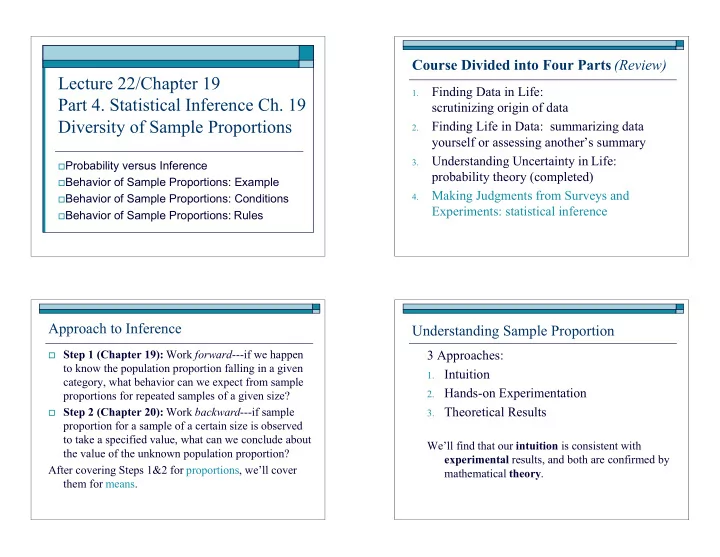
Course Divided into Four Parts (Review) Lecture 22/Chapter 19 Finding Data in Life: 1. Part 4. Statistical Inference Ch. 19 scrutinizing origin of data Diversity of Sample Proportions Finding Life in Data: summarizing data 2. yourself or


slide-1
SLIDE 1

Lecture 22/Chapter 19 Part 4. Statistical Inference Ch. 19 Diversity of Sample Proportions

Probability versus Inference Behavior of Sample Proportions: Example Behavior of Sample Proportions: Conditions Behavior of Sample Proportions: Rules

Course Divided into Four Parts (Review)

1.

Finding Data in Life: scrutinizing origin of data

2.

Finding Life in Data: summarizing data yourself or assessing another’s summary

3.

Understanding Uncertainty in Life: probability theory (completed)

4.

Making Judgments from Surveys and Experiments: statistical inference

Approach to Inference

Step 1 (Chapter 19): Work forward---if we happen

to know the population proportion falling in a given category, what behavior can we expect from sample proportions for repeated samples of a given size?

Step 2 (Chapter 20): Work backward---if sample

proportion for a sample of a certain size is observed to take a specified value, what can we conclude about the value of the unknown population proportion? After covering Steps 1&2 for proportions, we’ll cover them for means.

Understanding Sample Proportion

3 Approaches:

  • 1. Intuition
  • 2. Hands-on Experimentation
  • 3. Theoretical Results

We’ll find that our intuition is consistent with experimental results, and both are confirmed by mathematical theory.

slide-2
SLIDE 2

Example: Intuit Behavior of Sample Proportion

Background: Population proportion of blue

M&M’s is 1/6=0.17.

Question: How does sample proportion

behave for repeated random samples of size 25 (a teaspoon)?

Response: Summarize by telling

________________________________

Experiment: sample teaspoons of M&Ms, record

sample proportion of blues on sheet and in notes (need a calculator)

Example: Intuit Behavior of Sample Proportion

Background: Population proportion of blue

M&M’s is 1/6=0.17.

Note: The shape of the underlying distribution (sample size 1) will play a role in the shape of sample proportions for various sample sizes. sample proportion of blues in samples of size 1 5/6 1/6 1

Example: Intuit Behavior of Sample Proportion

Response: (continued) Center: some sample proportions will be less

than 0.17 and others more; the mean of all sample proportions should be ______________________

Spread: depends on sample size; if we’d sampled

  • nly 5, we’d easily get sample proportions

ranging from 0 to 0.6 or 0.8. For samples of 25, proportions ______________________________

Shape: proportions close to _____ would be most

common, and those far from ______ increasingly less likely---shape ________________________

Example: Intuit Behavior of Sample Proportion

Background: Population proportion of blue

M&M’s is 1/6=0.17.

Question: How does sample proportion

behave for repeated random samples of size 75 (a Tablespoon)?

Response: Again, we summarize by telling

_______________________

Now sample Tablespoons of M&Ms, record

sample proportion of blues on sheet and in notes (need a calculator)

slide-3
SLIDE 3

Example: Intuit Behavior of Sample Proportion

Response: (samples of size 75) Center: The mean of all sample proportions

should be _______________________, regardless of sample size.

Spread: should be______ than what it would be

for samples of size 25.

Shape: should bulge more close to 0.17, taper

more at the ends, less right-skewness: it should be _____________

Conditions for Rule of Sample Proportions

Randomness [affects center] Can’t be biased for or against certain values Independence [affects spread] If sampling without replacement, sample should be

less than 1/10 population size

Large enough sample size [affects shape] Should sample enough to expect at least 5 each in

and out of the category of interest.

Example: Checking Conditions for Rule

  • Background: Population proportion of blue

M&M’s is 1/6=0.17. Students repeatedly take random samples of size 1 teaspoon (about 25) and record the proportion that are blue.

  • Question: Are the 3 Conditions met?
  • Response:

1.

________________________________________

2.

________________________________________

3.

________________________________________

Example: Checking Conditions (larger sample)

  • Background: Population proportion of blue

M&M’s is 1/6=0.17. Students repeatedly take random samples of size 1 Tablespoon (about 75) and record the proportion that are blue.

  • Question: Are the 3 Conditions met?
  • Response:

1.

________________________________________

2.

________________________________________

3.

________________________________________

slide-4
SLIDE 4

Rule for Sample Proportions

Center: The mean of sample proportions equals

the true population proportion.

Spread: The standard deviation of sample

proportions is standard error = population proportion(1-population proportion)

.. sample size

Shape: (Central Limit Theorem) The frequency

curve of proportions from the various samples is approximately normal. Example: Applying Rules for Sample Proportions

  • Background: Proportion of blue M&Ms is 1/6=0.17.
  • Question: What does the Rule tell us about sample

proportions that are blue in teaspoons (about 25)?

  • Response:
  • Center: the mean of sample proportions will be ______
  • Spread: the standard deviation of sample proportions will be

standard error =

  • Shape: __________________________

Example: Applying Rules for Sample Proportions

  • Background: Proportion of blue M&Ms is 1/6=0.17.
  • Question: What does the Rule tell us about sample

proportions that are blue in Tablespoons (about 75)?

  • Response:
  • Center: the mean of sample proportions will be ______
  • Spread: the standard deviation of sample proportions will be

standard error =

  • Shape: __________________________

Empirical Rule (Review)

For any normal curve, approximately

68% of values are within 1 sd of mean 95% of values are within 2 sds of mean 99.7% of values are within 3 sds of mean

slide-5
SLIDE 5

Example: Applying Empirical Rule to M&Ms

  • Background: Population proportion of blue M&M’s

is 1/6=0.17. Students repeatedly take random samples

  • f size 1 Tablespoon (about 75) and record the

proportion that are blue.

  • Question: What does the Empirical Rule tell us?
  • Response:
  • 68% of the sample proportions should be within

________________: in [0.127, 0.213]

  • 95% of the sample proportions should be within

________________: in [0.084, 0.256]

  • 99.7% of the sample proportions should be within

________________: in [0.041, 0.299] How well did our sampled proportions conform?

Proportions then Means, Probability then Inference

Next time we’ll establish a parallel theory for means, when the variable of interest is quantitative (number

  • n dice instead of color on M&M). After that, we’ll

Perform inference with confidence intervals

For proportions (Chapter 20) For means (Chapter 21)

Perform inference with hypothesis testing

For proportions (Chapters 22&23) For means (Chapters 22&23)