
Lecture #20: Tree Recursions, Memoization, Tree Structures
Last modified: Tue Mar 18 16:17:50 2014 CS61A: Lecture #20 1Example: Escape from a Maze
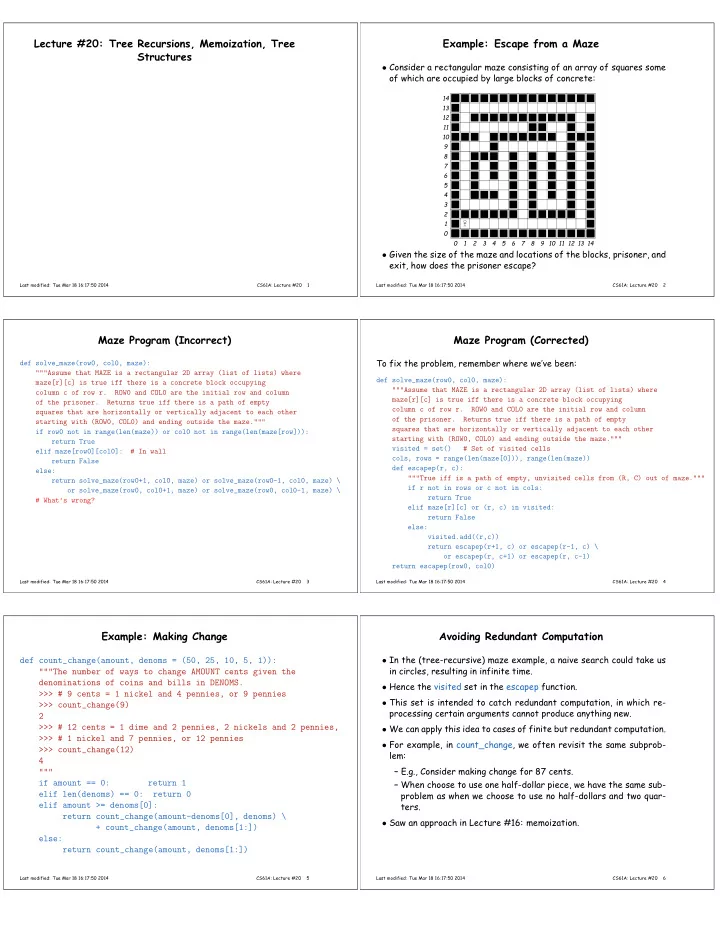
- Consider a rectangular maze consisting of an array of squares some
- f which are occupied by large blocks of concrete:
1 1 2 2 3 3 4 4 5 5 6 6 7 7 8 8 9 9 10 10 11 11 12 12 13 13 14 14
- Given the size of the maze and locations of the blocks, prisoner, and
exit, how does the prisoner escape?
Last modified: Tue Mar 18 16:17:50 2014 CS61A: Lecture #20 2Maze Program (Incorrect)
def solve_maze(row0, col0, maze): """Assume that MAZE is a rectangular 2D array (list of lists) where maze[r][c] is true iff there is a concrete block occupying column c of row r. ROW0 and COL0 are the initial row and column
- f the prisoner.
Returns true iff there is a path of empty squares that are horizontally or vertically adjacent to each other starting with (ROW0, COL0) and ending outside the maze.""" if row0 not in range(len(maze)) or col0 not in range(len(maze[row])): return True elif maze[row0][col0]: # In wall return False else: return solve_maze(row0+1, col0, maze) or solve_maze(row0-1, col0, maze) \
- r solve_maze(row0, col0+1, maze) or solve_maze(row0, col0-1, maze) \
# What’s wrong?
Last modified: Tue Mar 18 16:17:50 2014 CS61A: Lecture #20 3Maze Program (Corrected)
To fix the problem, remember where we’ve been:
def solve_maze(row0, col0, maze): """Assume that MAZE is a rectangular 2D array (list of lists) where maze[r][c] is true iff there is a concrete block occupying column c of row r. ROW0 and COL0 are the initial row and column
- f the prisoner.
Returns true iff there is a path of empty squares that are horizontally or vertically adjacent to each other starting with (ROW0, COL0) and ending outside the maze.""" visited = set() # Set of visited cells cols, rows = range(len(maze[0])), range(len(maze)) def escapep(r, c): """True iff is a path of empty, unvisited cells from (R, C) out of maze.""" if r not in rows or c not in cols: return True elif maze[r][c] or (r, c) in visited: return False else: visited.add((r,c)) return escapep(r+1, c) or escapep(r-1, c) \
- r escapep(r, c+1) or escapep(r, c-1)
return escapep(row0, col0)
Last modified: Tue Mar 18 16:17:50 2014 CS61A: Lecture #20 4Example: Making Change
def count_change(amount, denoms = (50, 25, 10, 5, 1)): """The number of ways to change AMOUNT cents given the denominations of coins and bills in DENOMS. >>> # 9 cents = 1 nickel and 4 pennies, or 9 pennies >>> count_change(9) 2 >>> # 12 cents = 1 dime and 2 pennies, 2 nickels and 2 pennies, >>> # 1 nickel and 7 pennies, or 12 pennies >>> count_change(12) 4 """ if amount == 0: return 1 elif len(denoms) == 0: return 0 elif amount >= denoms[0]: return count_change(amount-denoms[0], denoms) \ + count_change(amount, denoms[1:]) else: return count_change(amount, denoms[1:])
Last modified: Tue Mar 18 16:17:50 2014 CS61A: Lecture #20 5Avoiding Redundant Computation
- In the (tree-recursive) maze example, a naive search could take us
in circles, resulting in infinite time.
- Hence the visited set in the escapep function.
- This set is intended to catch redundant computation, in which re-
processing certain arguments cannot produce anything new.
- We can apply this idea to cases of finite but redundant computation.
- For example, in count_change, we often revisit the same subprob-
lem: – E.g., Consider making change for 87 cents. – When choose to use one half-dollar piece, we have the same sub- problem as when we choose to use no half-dollars and two quar- ters.
- Saw an approach in Lecture #16: memoization.