Learning in Graphical Models Problem Dimensions Model Bayes Nets - - PowerPoint PPT Presentation

learning in graphical models
SMART_READER_LITE
LIVE PREVIEW

Learning in Graphical Models Problem Dimensions Model Bayes Nets - - PowerPoint PPT Presentation

Learning in Graphical Models Problem Dimensions Model Bayes Nets Markov Nets Structure Known Unknown (structure learning) Data Complete Incomplete (missing values or hidden variables) Expectation-Maximization


slide-1
SLIDE 1

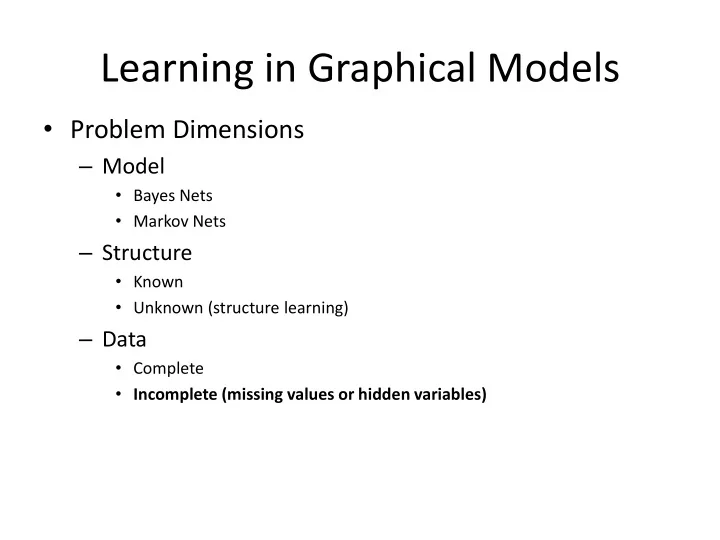
Learning in Graphical Models

  • Problem Dimensions

– Model

  • Bayes Nets
  • Markov Nets

– Structure

  • Known
  • Unknown (structure learning)

– Data

  • Complete
  • Incomplete (missing values or hidden variables)
slide-2
SLIDE 2

Expectation-Maximization

  • Last time:

– Basics of EM – Learning a mixture of Gaussians (k-means)

  • This time:

– Short story justifying EM

  • Slides based on lecture notes from Andrew Ng

– Applying EM for semi-supervised document classification – Homework #4

slide-3
SLIDE 3

10,000 foot level EM

  • Guess some parameters, then

– Use your parameters to get a distribution over hidden variables – Re-estimate the parameters as if your distribution

  • ver hidden variables is correct
  • Seems magical. When/why does this work?
slide-4
SLIDE 4

Jensen’s Inequality

  • For f convex, E[f(X)] >= f(E[X])
slide-5
SLIDE 5

Maximizing likelihood

  • x(i) = data, z(i) = hidden vars,  = parameters
  • This lower bound is easier to maximize, but

– What is Q? What good is maximizing a lower bound?

slide-6
SLIDE 6

What do we use for Q?

  • EM: Given a guess old for  , improve it
  • Idea: choose Q such that our lower bound

equals the true log likelihood at old:

slide-7
SLIDE 7

Ensure the bound is tight at old

  • When does Jensen’s inequality hold exactly?
slide-8
SLIDE 8

Ensure the bound is tight at old

  • When does Jensen’s inequality hold exactly?
  • Sufficient that

be constant with respect to z(i)

  • Thus, choose Q(z(i)) = p(z(i) | x(i) ; old)
slide-9
SLIDE 9

Putting it together

slide-10
SLIDE 10

For exponential family

  • E step:

– Use n to estimate expected sufficient statistics

  • ver complete data
  • M step

– Set n+1 = ML parameters given sufficient statistics

  • (Or MAP parameters)
slide-11
SLIDE 11

EM in practice

  • Local maxima

– Random re-starts, simulated annealing…

  • Variants

– Generalized EM: increase (not nec. maximize) likelihood in each step – Approximate E-step (e.g. sampling)

slide-12
SLIDE 12

Semi-supervised Learning

  • Unlabeled data abounds in the world

– Web, measurements, etc.

  • Labeled data is expensive

– Image classification, natural language processing, speech recognition, etc. all require large #s of labels

  • Idea: use unlabeled data to help with learning
slide-13
SLIDE 13

13

Supervised Learning

?

Learn function from x = (x1, …, xd) to y  {0, 1} given labeled examples (x, y) x1 x2

slide-14
SLIDE 14

14

Semi-Supervised Learning (SSL)

Learn function from x = (x1, …, xd) to y  {0, 1} given labeled examples (x, y) and unlabeled examples (x) x1 x2

slide-15
SLIDE 15

SSL in Graphical Models

  • Graphical Model describes how data (x, y) is

generated

  • Missing Data: y
  • So use EM
slide-16
SLIDE 16

Example: Document classification with Naïve Bayes

  • xi = count of word i in document
  • cj= document class (sports, politics, etc.)
  • xit= count of word i in docs of class t
  • M classes, W = |X| words

(from Semi-supervised Text Classification Using EM, Nigam, et al.)

slide-17
SLIDE 17

Semi-supervised Training

  • Initialize  ignoring missing data
  • E-step:

– E[xit]= count of word i in docs of class t in training set

+ E[count of word i in docs of class t in unlabeled data] – E[#ct] = count of docs in class t in training + E [count of docs of class t in unlabeled data]

  • M-step:

– Set  according to expected statistics above, I.e.:

  • P (wt | ct) = (E[xit] + 1) / (W + i E[xit] )
  • P(ct) = (E[#ct] + 1) / (#words + M)
slide-18
SLIDE 18

Semi-supervised Learning

slide-19
SLIDE 19

When does semi-supervised learning work?

  • When a better model of P(x) -> a better model
  • f P(y | x)
  • Can’t use purely discriminative models
  • Accurate modeling assumptions are key

– Consider: negative class

slide-20
SLIDE 20

Good example

slide-21
SLIDE 21

Issue: negative class

slide-22
SLIDE 22

Negative

  • NB*, EM* represent the negative class with the
  • ptimal number of model classes (ci’s)
slide-23
SLIDE 23

Problem: local maxima

  • “Deterministic Annealing”
  • Slowly increase 
  • Results: works, but can end up confusing

classes (next slide)

slide-24
SLIDE 24

Annealing performance

slide-25
SLIDE 25

Homework #4 (1 of 3)

  • What if we don’t know the target classes in advance?
  • Example: Google Sets
  • Wait until query time to run EM? Slow.
  • Strategy: Learn a NB model in advance, obtain mapping from

examples->”classes”

  • Then at “query time” compare examples
slide-26
SLIDE 26

Homework #4 (2 of 3)

  • Classify noun phrases based on context in text

– E.g. ___ prime minister CEO of ___

  • Model noun phrases (NPs) as P(z | w):

P(z | Canada) =

  • Experiment with different N
  • Query time input: “seeds” (e.g., Algeria, UK)

Output: ranked list of other NPs, using KL div.

0.14 0.01 … 0.06

z=1 2 N

slide-27
SLIDE 27

Homework #4 (3 of 3)

  • Code: written in Java
  • You write ~5 lines

– (important ones)

  • Run some experiments
  • Homework also has a few written exercises

– Sampling

slide-28
SLIDE 28

Road Map

  • Basics of Probability and Statistical Estimation
  • Bayesian Networks
  • Markov Networks
  • Inference
  • Learning

– Parameters, Structure, EM

  • HMMs
  • Something else?

– Candidates: Active Learning, Decision Theory, Statistical Relational Models… Role of Probabilistic Models in the Financial Crisis?