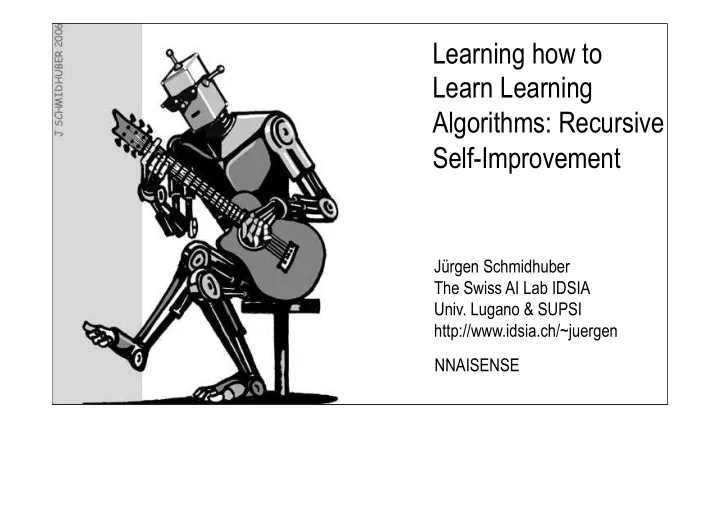
SLIDE 1 Jürgen Schmidhuber The Swiss AI Lab IDSIA
http://www.idsia.ch/~juergen
Learning how to Learn Learning Algorithms: Recursive Self-Improvement
NNAISENSE
SLIDE 2
Jürgen Schmidhuber You_again Shmidhoobuh
SLIDE 3 “True” Learning to Learn (L2L) is not just transfer learning! Even a simple feedforward NN can transfer-learn to learn new images faster through pre-training
True L2L is not just about learning to adjust a few hyper- parameters such as mutation rates in evolution strategies (e.g., Rechenberg & Schwefel, 1960s)
SLIDE 4 Radical L2L is about encoding the initial learning algorithm in a universal language (e.g., on an RNN), with primitives that allow to modify the code itself in arbitrary computable fashion Then surround this self-referential, self- modifying code by a recursive framework that ensures that
modifications are executed or survive (RSI)
SLIDE 5
remarks on an intelligence explosion through recursive self-improvement (RSI) for super-intelligences My concrete algorithms for RSI: 1987, 93, 94, 2003
SLIDE 6 R-learn & improve learning algorithm itself, and also the meta-learning algorithm, etc… My diploma thesis (1987): first concrete design of recursively self-improving AI
http://people.idsia.ch/~juergen/metalearner.html
SLIDE 7 Genetic Programming recursively applied to itself, to obtain Meta-GP and Meta-Meta-GP etc: J. Schmidhuber (1987). Evolutionary principles in self-referential learning. On learning how to learn: The meta-meta-... hook. Diploma thesis, TU Munich
http://people.idsia.ch/~juergen/diploma.html
SLIDE 8 With Hochreiter (1997), Gers (2000), Graves, Fernandez, Gomez, Bayer…
1997-2009. Since 2015 on your phone! Google, Microsoft, IBM, Apple, all use LSTM now
http://www.idsia.ch/~juergen/rnn.html
SLIDE 9
http://www.idsia.ch/~juergen/rnn.html Separation of Storage and Control for NNs: End-to-End Differentiable Fast Weights (Schmidhuber, 1992) extending v.d. Malsburg’s non-differentiable dynamic links (1981)
SLIDE 10
1993: More elegant Hebb-inspired addressing to go from (#hidden) to (#hidden)2 temporal variables: gradient- based RNN learns to control internal end-to-end differentiable spotlights of attention for fast differentiable memory rewrites – again fast weights Schmidhuber, ICANN 1993: Reducing the ratio between learning complexity and number of time- varying variables in fully recurrent nets. Similar to NIPS 2016 paper by Ba, Hinton, Mnih, Leibo, Ionesco
SLIDE 11
2005: Reinforcement- Learning or Evolving RNNs with Fast Weights
Robot learns to balance 1 or 2 poles through 3D joint
http://www.idsia.ch/~juergen/evolution.html
Gomez & Schmidhuber: Co-evolving recurrent neurons learn deep memory POMDPs. GECCO 2005
SLIDE 12 1993: Gradient- based meta- RNNs that can learn to run their
change algorithm:
A self-referential weight matrix. ICANN 1993 This was before LSTM. In 2001, however, Sepp Hochreiter taught a meta-LSTM to learn a learning algorithm for quadratic functions that was faster than backprop
SLIDE 13
E.g., Schmidhuber, Zhao, Wiering: MLJ 28:105-130, 1997
Success-story algorithm (SSA) for self-modifying code (since 1994) R(t)/t < [R(t)-R(v1)] / (t-v1) < [R(t)-R(v2)] / (t-v2) <… R(t): Reward until time t. Stack of past check points v1v2v3 … with self-mods in between. SSA undoes selfmods after vi that are not followed by long-term reward acceleration up until t (now):
SLIDE 14
SLIDE 15
SLIDE 16
SLIDE 17
SLIDE 18
SLIDE 19
SLIDE 20 1997: Lifelong meta-learning with self- modifying policies and success-story algorithm: 2 agents, 2 doors, 2
southeast wins 5, the other 3. Through recursive self-modifications
300,000 steps per trial down to 5,000.
SLIDE 21
Universal problem solver Gödel machine uses self reference trick in a new way Kurt Gödel, father of theoretical computer science, exhibited the limits of math and computation (1931) by creating a formula that speaks about itself, claiming to be unprovable by a computational theorem prover: either formula is true but unprovable, or math is flawed in an algorithmic sense
SLIDE 22
Gödel Machine (2003): agent-controlling program that speaks about itself, ready to rewrite itself in arbitrary fashion once it has found a proof that the rewrite is useful, given a user-defined utility function Theoretically optimal self-improver!
goedelmachine.com
SLIDE 23 Initialize Gödel Machine by Marcus Hutter‘s asymptotically fastest method for all well- defined problems Given f:X→Y and x∈X, search proofs to find program q that provably computes f(z) for all z∈X within time bound tq(z); spend most time
- n f(x)-computing q with best current bound
IDSIA 2002
SNF grant
n3+101000=n3+O(1)
As fast as fastest f-computer, save for factor 1+ε and f-specific const. independent of x!
SLIDE 24
PowerPlay not only solves but also continually invents problems at the borderline between what's known and unknown - training an increasingly general problem solver by continually searching for the simplest still unsolvable problem
SLIDE 25
now talking to investors
neural networks-based artificial intelligence
SLIDE 26
Reinforcement learning to park Cooperation NNAISENSE - AUDI
SLIDE 27 1.
- J. Schmidhuber. Evolutionary principles in self-referential learning, or on learning how
to learn: The meta-meta-... hook. Diploma thesis, TUM, 1987. (First concrete RSI.) 2.
- J. Schmidhuber. A self-referential weight matrix. ICANN 1993
3.
- J. Schmidhuber. On learning how to learn learning strategies. TR FKI-198-94, 1994.
4.
- J. Schmidhuber and J. Zhao and M. Wiering. Simple principles of metalearning. TR
IDSIA-69-96, 1996. (Based on 3.) 5.
- J. Schmidhuber, J. Zhao, N. Schraudolph. Reinforcement learning with self-modifying
- policies. In Learning to learn, Kluwer, pages 293-309, 1997. (Based on 3.)
6.
- J. Schmidhuber, J. Zhao, and M. Wiering. Shifting inductive bias with success-story
algorithm, adaptive Levin search, and incremental self-improvement. Machine Learning 28:105-130, 1997. (Based on 3.) 7.
- J. Schmidhuber. Gödel machines: Fully Self-Referential Optimal Universal Self-
- Improvers. In Artificial General Intelligence, p. 119-226, 2006. (Based on TR of 2003.)
8.
- T. Schaul and J. Schmidhuber. Metalearning. Scholarpedia, 5(6):4650, 2010.
9. More under http://people.idsia.ch/~juergen/metalearner.html
SLIDE 28 Jürgen Schmidhuber The Swiss AI Lab IDSIA
http://www.idsia.ch/~juergen
Learning how to Learn Learning Algorithms: Extra Slides
NNAISENSE
SLIDE 29 Super-deep program learner: Optimal Ordered Problem Solver OOPS (Schmidhuber, MLJ, 2004, extending Levin’s universal search, 1973) Time-optimal incremental search and algorithmic transfer learning in program space Branches of search tree are program prefixes Node-oriented backtracking restores partially solved task sets & modified memory components
SLIDE 30 61 primitive instructions operating
- n stack-like and other internal
data structures. For example: push1(), not(x), inc(x), add(x,y), div(x,y), or(x,y), exch_stack(m,n), push_prog(n), movstring(a,b,n), delete(a,n), find(x), define function(m,n), callfun(fn), jumpif(val,address), quote(), unquote(), boost_probability(n,val) …. Programs are integer sequences; data and code look the same; makes functional programming easy
SLIDE 31 Towers of Hanoi: incremental solutions
- +1ms, n=1: (movdisk)
- 1 day, n=1,2: (c4 c3 cpn c4 by2 c3 by2 exec)
- 3 days, n=1,2,3: (c3 dec boostq defnp c4 calltp c3 c5 calltp endnp)
- 4 days: n=4, n=5, …, n=30: by same double-recursive program
- Profits from 30 earlier context-free language tasks (1n2n): transfer learning
- 93,994,568,009 prefixes tested
- 345,450,362,522 instructions
- 678,634,413,962 time steps
- longest single run: 33 billion steps (5% of total time)! Much deeper than
recent memory-based “deep learners” …
- top stack size for restoring storage: < 20,000
SLIDE 32 What the found Towers of Hanoi solver does:
- (c3 dec boostq defnp c4 calltp c3 c5 calltp endnp)
- Prefix increases P of double-recursive procedure:
Hanoi(Source,Aux,Dest,n): IF n=0 exit; ELSE BEGIN Hanoi(Source,Dest,Aux,n-1); move top disk from Aux to Dest; Hanoi(Aux,Source,Dest,n-1); END
- Prefix boosts instructions of previoulsy frozen program, which happens to
be a previously learned solver of a context-free language (1n2n). This rewrites search procedure itself: Benefits of metalearning!
- Prefix probability 0.003; suffix probability 3*10-8; total probability 9*10-11
- Suffix probability without prefix execution: 4*10-14
- That is, Hanoi does profit from 1n2n experience and incremental learning
(OOPS excels at algorithmic transfer learning): speedup factor 1000
SLIDE 33
J.S.: IJCNN 1990, NIPS 1991: Reinforcement Learning with Recurrent Controller & Recurrent World Model
Learning and planning with recurrent networks
SLIDE 34 RNNAIssance 2014-2015 On Learning to Think: Algorithmic Information Theory for Novel Combinations of Reinforcement Learning RNN- based Controllers (RNNAIs) and Recurrent Neural World Models
http://arxiv.org/abs/1511.09249
SLIDE 35