
Learning from Observations
Chapter 18, Sections 1–3
Chapter 18, Sections 1–3 1Outline
♦ Learning agents ♦ Inductive learning ♦ Decision tree learning ♦ Measuring learning performance
Chapter 18, Sections 1–3 2Learning
Learning is essential for unknown environments, i.e., when designer lacks omniscience Learning is useful as a system construction method, i.e., expose the agent to reality rather than trying to write it down Learning modifies the agent’s decision mechanisms to improve performance
Chapter 18, Sections 1–3 3Learning agents
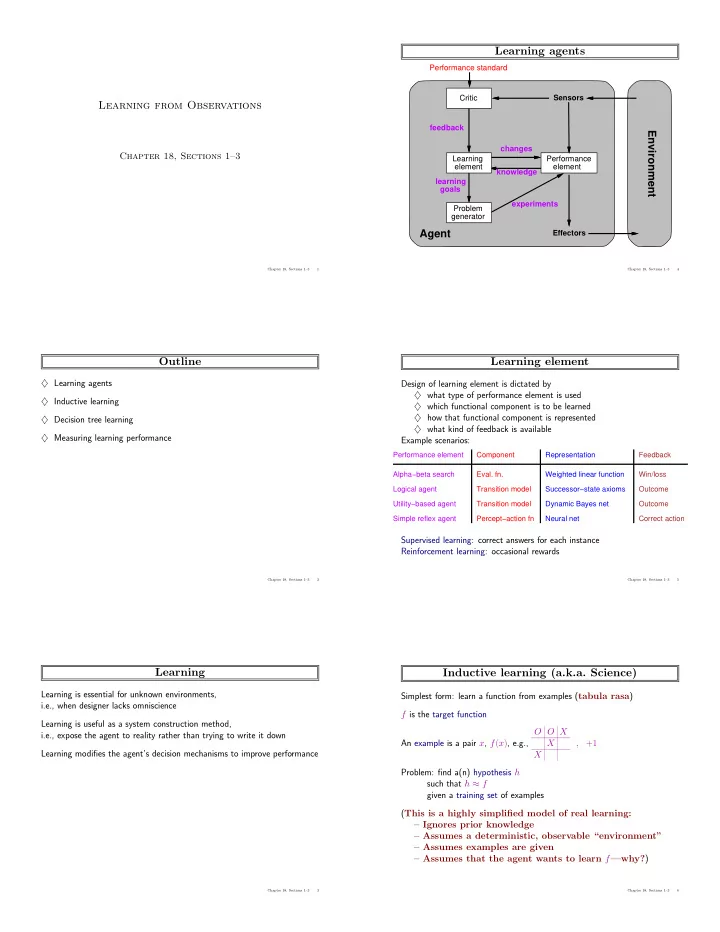
Performance standard
Agent Environment
Sensors Effectors Performance element changes knowledge learning goals Problem generator feedback Learning element Critic experiments
Chapter 18, Sections 1–3 4Learning element
Design of learning element is dictated by ♦ what type of performance element is used ♦ which functional component is to be learned ♦ how that functional component is represented ♦ what kind of feedback is available Example scenarios:
Performance element Alpha−beta search Logical agent Simple reflex agent Component
- Eval. fn.
Transition model Transition model Representation Weighted linear function Successor−state axioms Neural net Dynamic Bayes net Utility−based agent Percept−action fn Feedback Outcome Outcome Win/loss Correct action
Supervised learning: correct answers for each instance Reinforcement learning: occasional rewards
Chapter 18, Sections 1–3 5Inductive learning (a.k.a. Science)
Simplest form: learn a function from examples (tabula rasa) f is the target function An example is a pair x, f(x), e.g., O O X X X , +1 Problem: find a(n) hypothesis h such that h ≈ f given a training set of examples (This is a highly simplified model of real learning: – Ignores prior knowledge – Assumes a deterministic, observable “environment” – Assumes examples are given – Assumes that the agent wants to learn f—why?)
Chapter 18, Sections 1–3 6