
SLIDE 1
Leadership for the future
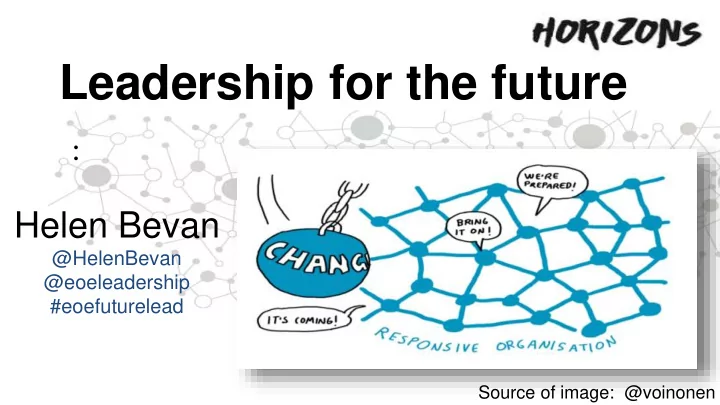
Source of image: @voinonen
:
Helen Bevan
@HelenBevan @eoeleadership #eoefuturelead
Leadership for the future : Helen Bevan @HelenBevan - - PowerPoint PPT Presentation
Leadership for the future : Helen Bevan @HelenBevan @eoeleadership #eoefuturelead Source of image: @voinonen My journey in leading change & improvement: pick three cards 1. Where are you from ? One card that captures how you
Source of image: @voinonen
:
Helen Bevan
@HelenBevan @eoeleadership #eoefuturelead
3 |
My journey in leading change & improvement: pick three cards
One card for how you think and act now
One card about possibilities for your future
One card that captures how you thought and acted when you first saw yourself as a leader
4 |
My journey: pick a card from the other deck (catalyst cards)
Reflect: What is happening in your role right now that might influence your future direction? Choose one card from the second deck that captures something about this reflection
@HelenBevan #eoefuturelearn
5 |
My leadership journey: pick three cards
One card for how you think and act now
One card about possibilities for your future
One card that captures how you thought and acted when you first thought of yourself as a leader
6 |
My journey in leading change & improvement: a final task
On the back of each of the cards from the first deck is a tiny letter or letters (on the bottom right hand side) Make a note of the letter(s) for your from, here and there We will return to them later
@HelenBevan #eoefuturelearn
Transformations is
a tool for understanding key patterns in your life, individually and together in groups, organisations and communities.
@HelenBevan #eoefuturelearn
8 |
Two sets of cards and a User’s Guide:
An interactive tool for exploring life journeys: From → Here → to There
@HelenBevan #eoefuturelearn
The Imagination Age: coming to a health and care system near you soon
Imagination Age
The imagination age - an era beyond the information age
with each other and create economic and social structures
imagination-based work of designers, artists, video makers and actors over rational thinking
Source: Goran Henriks
11 |
Two of our sketchnotes have been shared over a million times
@HelenBevan #eoefuturelearn
14 |
Many of the ways we go about improving health and care were designed in a different mindset for a different set of circumstances We are often operating with 20th century change practice in a 21st century world
:
Source of images : http://www.slideshare.net/dachisgroup/dave- gray-the-connected-company
We still organise health and care like the Tabulating Machine Co. of 1917
Source of image: @corp_rebels
@HelenBevan #eoefuturelearn
The biggest shifts we are seeing are shifts in power
Power is the ability to produce intended effects
Bertrand Russell
@HelenBevan #eoefuturelearn
Jeremy Heimens, Henry Timms New Power: How it’s changing the 21st Century and why you need to know (2018)
new power
Current ent Made de by many Pulled led in Shar ared Open Relat ationsh ionship ip
Curr rrency ency Held d by a few Pushed shed down Comm mmande anded Close sed Trans ansact action
The Network Secrets of Great Change Agents
Julie Battilana &Tiziana Casciaro
As a change agent, my centrality in the informal network is more important than my position in the formal hierarchy
People who are highly connected have twice as much power to influence change as people with hierarchical power
Leandro Herrero http://t.co/Du6zCbrDBC
@HelenBevan #eoefuturelearn
Find the superconnectors!
Just 3% of people in the organisation or system typically influence 85% of the other people
Source: Organisational Network Analysis by Innovisor
Find the 3%: meet Mandy Carney, Head of Patient Flow at Yeovil Hospital
“Knows everyone in the hospital” “Everyone follows Mandy on Facebook” The go-to person for advice Mandy makes sense of things and reduces ambiguity for people Mandy presents her own monthly award “the Carney cup”
As senior leaders, we are less influential than we think
If we want to get the same level of influence through top down change as the 3% get, we need four times more people Source : Jeppe Hansgaard
The 3% rule also appears true for social media
Source: research by Graham MacKenzie using NodeXL
In health and healthcare globally, tweets by 3.3% of tweeters accounted for 85% of retweets
@HelenBevan #eoefuturelearn
The powerful medical “superconnectors”
Source: NodeXL analysis @gmacscotland
@HelenBevan #eoefuturelearn
Across the world, trust is imploding
Source: http://www.edelman.com/news/2017-edelman-trust-barometer-reveals-global-implosion /
25
Peers are now as credible as experts
The inversion of influence
Based on the Edelman Trust Index: the average of a country’s trust in the institutions
governmental organisations
A world of distrust: Edelman Trust Barometer
@HelenBevan #eoefuturelearn
Patients, families, citizens & social media
Sources: Benetol et al (2018) How patients’ use of social media impacts their interactions with healthcare professionals; @RealDoctorMike (2017) Patients trust social media, so be their trusted source
People living with long term conditions and with cancer are some of the most engaged and active audiences on social media Research shows:
media for health-related purposes
professionals
professionals
Patients trust social media, so we must be their trusted source
Empower your staff to be the voice of the
@HelenBevan #eoefuturelearn
Mark Jaben on the science behind resistance
What NOT to do
But what we do do
Engage people here
Mark Jaben on the science behind resistance
What NOT to do
(but what we usually do)
We don’t need buyers (who “buy-in” to change) We need investors
What TO do
Engage people here Engage people here
A big debate in social science
Structure versus Agency
@HelenBevan #eoefuturelearn
33 |
The predominant approach in recent years has been STRUCTURE but globally there is a big shift towards AGENCY
The design dilemma at the heart of change
Structures and systems Performance goals Compliance Regulation Competition Programme Management Incentive systems Activation Ability to make choices Capability Leaders everywhere Social action Solidarity Social movements
The power, individually and collectively, to make a positive difference
@HelenBevan #eoefuturelearn
Source: @NHSChangeDay
35
@HelenBevan #eoefuturelearn
Source: @NHSChangeDay
36
@HelenBevan #eoefuturelearn
Source: @NHSChangeDay
Problematic: changing a “permission culture” can take years The good news: we can usually build agency much more quickly
37
@HelenBevan #eoefuturelearn
@HelenBevan #eoefuturelearn
Source: Brian Donohue https://t.co/znqTPXtCANhttps://t.co/znqTPXtCAN
Source: Bromford P (2015) What’s the difference between a test and a pilot?
#Futurenursing nhs70.crowdicity.com
@HelenBevan #eoefuturelearn
Google image search using the word ‘nurse’ Google image search using the word ‘doctor’
Transforming perceptions of nursing
A digital platform was set up to capture ideas on how about transform perceptions of nursing and midwifery. It was live for five weeks between December 2017 and January 2018, supplemented by Twitter chats.
As a result there were: 23,000 interactions 212 original ideas from the ideas platform 8,520 post views Nearly 1,000 original tweets in twitter chat which generated 40 more ideas
ABC, 30 – 60 – 90 Days - Ideas for Action
Longer Term Actions
Adapted from www.idenk.comWhat could we speed up / do more of ? (Accelerate) What could we stop doing ? (Brake) What could we start doing? (Create) The next month The next 2 months The next quarter
46 |
The “two levels down” rule
What can I achieve in:
a year? a month? a week? a day? an hour?
If you think your idea will take a year to test and implement, consider what you could achieve in a week If you think it will take a week, what you could achieve in an hour?
Source: Paul Plsek
47
the collective brilliance of people who work in ambulance services
(with the help of a few critical friends)
Launch Event 28th June
Film making in action!
Ideas platform 12th July to 5th September
https://projecta.crowdicity.com/
53 |
Ambulance service improvement tweet chat
#ProjectA 17th July: A one hour tweet chat on partnerships between ambulance staff, patients and the public 537 people participated, generating 1,409 tweets and 77 new ideas!
This analysis shows a high level of engagement with the community and strong connections between key influencers. Source: NodeXL Source: FollowtheHashtag
People took part in the tweet chat from across the world
Source: FollowtheHashtag
54 |
What we are working on now
Action on falls: a collaboratively designed falls response framework Action on mental health and emotional distress: an actionable “knowledge bank” for use by frontline ambulance staff Action on partnership: people, families and the wider community: Co-produce a campaign that focusses on how to access and use services; a social movement rather than broadcasting messages Action on staff wellbeing: implementing clinical supervision across all ambulance services A directory of ideas for improvement: Share 70 ideas from #ProjectA and create a series of challenges to help make them happen. Virtual collaboration: Build the capability of the ambulance workforce to collaborate virtually; reducing time away from work and abstraction; increase opportunities for sharing, learning and speeding
The process has been 90% virtual
Creating conversations which match the issue we’re trying to address
58 |
Task: continuums
themes in system transformation
where you think we are today and a green dot below the line for where you think we need to be in future
Time available: 20 minutes
System performance System health
@HelenBevan #eoefuturelearn
59 |
Task: continuums
Bottom up action AND top down strategy Healthcare AND health Tried/tested approaches AND Innovate and experiment Reduce costs AND improve quality Clinical leadership AND patients and families as leaders Old power AND new power Performance & accountability AND system transformation Storytelling AND data Efficiency AND innovation Focus on formal leaders AND focus on informal leaders Hierarchy AND networks Personalised care AND population health System performance AND system health Accountability AND shared decision making
Problems vs. polarities (complex dilemmas)
Problems
answer that provides a solution
problem and it goes away,
you can say that the problem is solved
problem usually contains no alternatives
Polarities
that need to be managed
are in opposition
with a best or right answer
61 |
new power
Currenc ency Held ld by a f few Pushe hed d down wn Comma manded nded Clo losed Transac sactio ion Current ent Made by many Pulled d in Shared ed Op Open Relatio ions nshi hip
AND Action Steps
Actions to gain or maintain the positive results from focussing on this pole. Who? What? By when? Measures?
Early warnings
Measurable indicators that you can count that will let you know that you are getting into the downside
Positive results of focus on this pole Positive results of focus on this pole Negative results of over-focus on this pole to the neglect of the right pole Negative results of over-focus on this pole to the neglect of the left pole
Biggest risk from loss of balance Our goal in balancing this polarity
Early warnings
Measurable indicators that you can count that will let you know that you are getting into the downside
Action Steps
Actions to gain or maintain the positive results from focussing on this pole. Who? What? By when? Measures?
that your team would like to work on
the poles in the boxes in the middle
Task
Reducing cost Improving quality AND Action Steps
Actions to gain or maintain the positive results from focussing on this pole. Who? What? By when? Measures?
Early warnings
Measurable indicators that you can count that will let you know that you are getting into the downside
Positive results of focus on this pole Positive results of focus on this pole Negative results of over-focus on this pole to the neglect of the right pole Negative results of over-focus on this pole to the neglect of the left pole
Biggest risk from loss of balance Our goal in balancing this polarity
Early warnings
Measurable indicators that you can count that will let you know that you are getting into the downside
Action Steps
Actions to gain or maintain the positive results from focussing on this pole. Who? What? By when? Measures?
and
Deeper Fear from loss of balance
Show the current and idea energy flows
Source: adapted from Barry Johnson
Ideal energy flow: work towards the upside of both poles and you create a virtuous circle leading to the higher purpose
Improving quality
Reducing cost
and
Positive results of focus on this pole Positive results of focus on this pole Negative results of over-focus on this pole to the neglect of the right pole Negative results of over-focus on this pole to the neglect of the left pole
Deeper Fear from loss of balance
Step four: show the current and idea energy flows
Source: adapted from Barry Johnson
Typical energy flow
Improving quality
Reducing costs
Feedback
table to feedback to the wider group
activity
68 |
Post conventional leaders
Current global trends call for leaders who can demonstrate a high level of maturity in dealing creatively with increasing complexity, uncertainty, diversity, and numbers of paradoxes
@HelenBevan #eoefuturelearn
69 |
Post conventional leaders
“Tomorrow’s management systems will need to value diversity, dissent and divergence as highly as conformance, consensus and cohesion.” Gary Hamel
@HelenBevan #eoefuturelearn
70 |
Adult development
(Constructivist-development researchers)
Kohlberg, William Torbert, Robert Kegan)
develop “bigger minds”
act at work and home – our “action logics”
transformations that are possible in adulthood Source: Charles Palus, Center for Creative Leadership
71 |
The skills for 2030
Nesta, Pearson and the Martin Oxford School: The future of skills: employment in 2030
Judgment and decision making: Considering the
relative costs and benefits of potential actions to choose the most appropriate one.
Fluency of ideas: The
ability to come up with a number of ideas about a topic (the number of ideas is important, not their quality, correctness, or creativity).
Active learning: Learning
strategies—selecting and using training/instructional methods and procedures appropriate for the situation when learning or teaching new things.
Originality: The ability to
come up with unusual or clever ideas about a given topic or situation, or to develop creative ways to solve a problem
Learning strategies:
Understanding the implications of new information for both current and future problem-solving and decision-making.
Graphics by @scriberian
Horizontal development:
competencies
Vertical development:
strategic and interdependent ways
In a post conventional world, we need to focus
Vertical development is about the ability to think and act in more complex ways. It’s about how you think. It’s about maturity, and growing “up” and increasing
Charles Palus, Centre for Creative Leadership
74 |
The skills for 2030
Nesta, Pearson and the Martin Oxford School: The future of skills: employment in 2030
Judgment and decision making: Considering the
relative costs and benefits of potential actions to choose the most appropriate one.
Fluency of ideas: The
ability to come up with a number of ideas about a topic (the number of ideas is important, not their quality, correctness, or creativity).
Active learning: Learning
strategies—selecting and using training/instructional methods and procedures appropriate for the situation when learning or teaching new things.
Originality: The ability to
come up with unusual or clever ideas about a given topic or situation, or to develop creative ways to solve a problem
Learning strategies:
Understanding the implications of new information for both current and future problem-solving and decision-making.
Graphics by @scriberian
75
Stages of vertical development for change agents
Level of development Time
faithfully
power” authority
and/or project management approaches
Dependent t
Source: adapted from Center for Creative Leadership @HelenBevan #eoefuturelearn
Stages of vertical development for change agents
Level of development Time
faithfully
power” authority
and/or project management approaches
independent way
values
things I believe in
change
Dependent t Independent
Source: adapted from Center for Creative Leadership @HelenBevan #eoefuturelearn
Stages of vertical development for change agents
Level of development Time
faithfully
power” authority
and/or project management approaches
independent way
values
things I believe in
change
dependent ways
and connections
perspectives at the same time
tensions, paradox and contradictions
Dependent t Independent Interd rdependent
Source: adapted from Center for Creative Leadership @HelenBevan #eoefuturelearn
What happens to one affects all the others
79
80 |
Towards interdependent leadership Independent
Division or department My professional expertise The right answer Agile achiever Compromise, cooperate Reliable performer
Source: adapted from the Center for Creative Leadership
Interdependent
System or organisation Our adaptive learning Multiple right answers System leader Creative collaborator Integrating transformer
@HelenBevan #eoefuturelearn
Sources: Being First team (2017) Going for the Big Win in Your Organization Amit S. Mukherjee (2017) We Must Rescue ‘Win-Win’ From Its Buzzword Status
Interdependence
YOU WIN I WIN
@HelenBevan #eoefuturelearn
a or b
answer a or b or c or d many independent right answers
Expanding our mindset
polarities = a and b two interdependent right answers many interdependent right answers multarities = a and b and c and d
A triad of requirements in the
“One system”: we want consistency and standardisation across the country We want creativity, diversity and continuous improvement We want to co-create our responses with partners with local systems in the lead
84 |
Thursday 15 March
Further reading: Nicholas Petrie (2015) The how-to of vertical leadership development
Horizontal development
Vertical development
thinking
Nicolas Petrie
@HelenBevan #eoefuturelearn
87 |
Ways of describing the development stages
Post conventional Interdependent Alchemical Transforming Redefining Conventional Independent Achiever Expert Diplomat Preconventional Dependent Opportunist Terry Sexton Center for Creative Leadership William Torbert
@HelenBevan #eoefuturelearn
Seven transformations (action logics)
Alchemical – Integrates material, spiritual, and societal transformations Transforming – Generates organisational and personal transformations Redefining – Reframes complex problems in unique ways Achiever – Driven by personal and team achievement Expert – Focuses on logic and expertise Diplomat – Wants to belong and fit in Opportunist – Wins for self in any way possible
Rooke, D. & Torbert, W. R. (2005, April). Seven transformations of leadership. Harvard Business Review, 66-77.
Distribution of the “action logics”
Source: Cleveland Consulting Group Expert 37% Diplomat 11% Opportunist 4% Alchemist 2% Transforming 5% Redefining 11% Achiever 30%
@HelenBevan #eoefuturelearn
90 |
Our journey : a final task
On the back of each of the cards from the first deck is a tiny letter or letters (on the bottom right hand side) Make a note of the letter(s) for your from, here and there We will return to them later Did your action logics correspond with the suggested development path?
@HelenBevan #eoefuturelearn
Seven transformations (action logics)
Alchemical – Integrates material, spiritual, and societal transformations Transforming – Generates organisational and personal transformations Redefining – Reframes complex problems in unique ways Achiever – Driven by personal and team achievement Expert – Focuses on logic and expertise Diplomat – Wants to belong and fit in Opportunist – Wins for self in any way possible
Rooke, D. & Torbert, W. R. (2005, April). Seven transformations of leadership. Harvard Business Review, 66-77.
93 |
http://www.nancydixonblog.com/2017/07/the- hidden-knowledge-problem-in-
94 |
The Fundamental Law of Unconferencing
The sum of the expertise of the people in the audience is greater than the sum of expertise of the people on stage Dave Winer
Source of image: www.citynet.com
Liberating Structures
www.liberatingst ructures.com/ls- menu
96 |
Our unconference process
topic that you would be interested to explore with other people
the next twelve months to take your agenda forward
97 |
The unconference: 4 principles and a law
Principles: 1. Whoever comes are the right people 2. Whatever happens is the only thing that could have happened. 3. When it starts is the right time 4. When it's over it's over The Law is known as the Law of Two Feet: "If you find yourself in a situation where you are not contributing
98 |
Back to our
Mark Jaben on the science behind resistance
What NOT to do
(but what we usually do)
We don’t need buyers (who “buy-in” to change) We need investors
What TO do
Engage people here Engage people here
100 |
large scale change: the polarity at the heart of the Long Term Plan)
world
Potential topics for 21st March
ABC, 30 – 60 – 90 Days - Ideas for Action
Longer Term Actions
Adapted from www.idenk.comWhat could we speed up / do more of ? (Accelerate) What could we stop doing ? (Brake) What could we start doing? (Create) The next month The next 2 months The next quarter
102 |
The “two levels down” rule
What can I achieve in:
a year? a month? a week? a day? an hour?
If you think your idea will take a year to test and implement, consider what you could achieve in a week If you think it will take a week, what you could achieve in an hour?
Source: Paul Plsek
103 |
Have we got the power to change things?
Research with groups shows a 25%-10%-3% pattern: When a minority group pushing change was below 25% of the total group, its efforts failed. But they reached 25%, the majority of the population adopted the new way of thinking very quickly When just 10% of a population holds an unshakable belief, their belief is likely to be adopted by the majority Typically in organisations, around 3% of people (the informal influencers) drive conversations and influence 85% of
Source: Harold Jarche 2018: 25-10-3