LCCMR ID: 190-G Project Title: Students and Citizens Partnering to - - PDF document

lccmr id 190 g
SMART_READER_LITE
LIVE PREVIEW

LCCMR ID: 190-G Project Title: Students and Citizens Partnering to - - PDF document

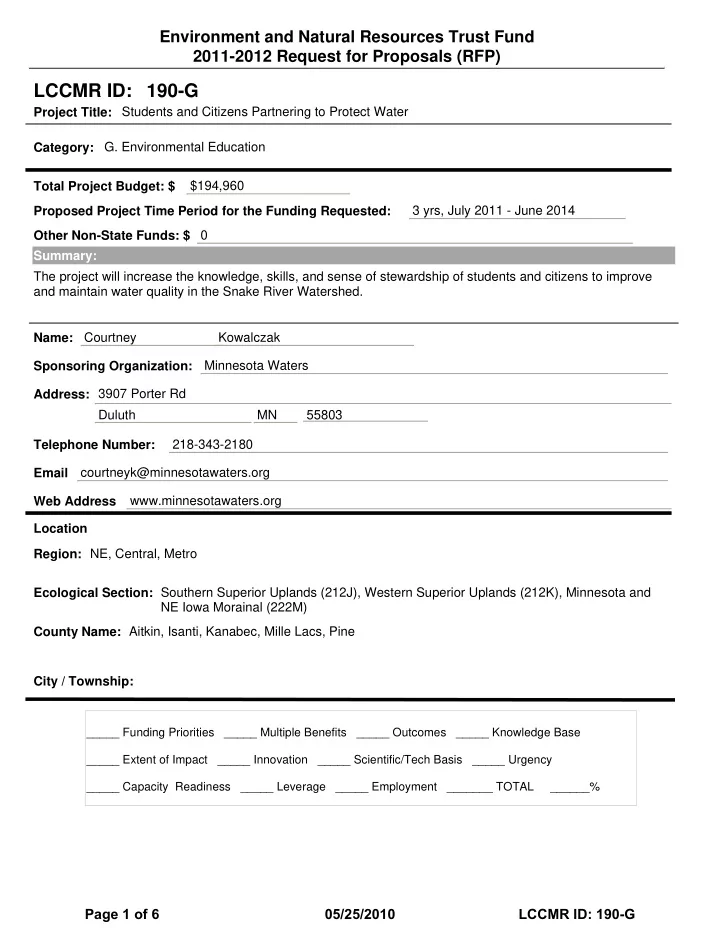
Environment and Natural Resources Trust Fund 2011-2012 Request for Proposals (RFP) LCCMR ID: 190-G Project Title: Students and Citizens Partnering to Protect Water Category: G. Environmental Education Total Project Budget: $ $194,960


slide-1
SLIDE 1

Environment and Natural Resources Trust Fund 2011-2012 Request for Proposals (RFP)

Students and Citizens Partnering to Protect Water $194,960 3 yrs, July 2011 - June 2014 Courtney Kowalczak Minnesota Waters 3907 Porter Rd Duluth MN 55803 218-343-2180 courtneyk@minnesotawaters.org www.minnesotawaters.org Aitkin, Isanti, Kanabec, Mille Lacs, Pine The project will increase the knowledge, skills, and sense of stewardship of students and citizens to improve and maintain water quality in the Snake River Watershed. Project Title: Total Project Budget: $ Proposed Project Time Period for the Funding Requested: Other Non-State Funds: $ Name: Sponsoring Organization: Address: Telephone Number: Email Web Address County Name: City / Township: Region: Summary: NE, Central, Metro Location Ecological Section: Southern Superior Uplands (212J), Western Superior Uplands (212K), Minnesota and NE Iowa Morainal (222M)

_____ Funding Priorities _____ Multiple Benefits _____ Outcomes _____ Knowledge Base _____ Extent of Impact _____ Innovation _____ Scientific/Tech Basis _____ Urgency _____ Capacity Readiness _____ Leverage _____ Employment _______ TOTAL ______%

Category:

  • G. Environmental Education

LCCMR ID: 190-G

Page 1 of 6 05/25/2010 LCCMR ID: 190-G

slide-2
SLIDE 2

2011-2012 M MAIN P PROPOSAL

PRO ROJE JECT T TIT ITLE: Students and Ci Citizens P Partnering t to Protect W Water I. I. PRO ROJE JECT ST STATEMENT

The goal of this project is to increase the knowledge, skills, and sense of stewardship of students

and citizens to improve and maintain water quality in the Snake River Watershed. This is a unique, comprehensive approach involving all levels of the community --from students to adults--in a watershed-wide program that encourages engagement in water quality monitoring, issues, and

  • action. With guidance from the Snake River Watershed Board and county agencies, over 300

students and citizens will be trained how to take physical, chemical, and biological water samples from streams and lakes. At 1,010 sq miles, the Snake River Watershed is the third largest tributary watershed in the St. Croix River Basin. Covering 5 counties, this large watershed’s principal problem is nonpoint source

  • pollution. High levels of sediment, phosphorus, and bacterial contamination are major problems in

the watershed that are unlikely to improve unless changes are made in land use practices at a community level. Partnering secondary school students with citizen groups around lake and stream monitoring serves not only as an opportunity to increase the knowledge of both groups on water quality science but also creates an informed constituency on the issues in the Snake River watershed. Project goals will be achieved by building a broad-based partnership of water resource professionals, teachers, students, and other community members in the Snake River watershed. Our project

  • utcomes will include:
  • Water M

Monitoring W Workshops- 16 workshops will teach over 300 students and community members how to sample water chemistry, macroinvertebrates, bacteria, and take physical measurements

  • Tea

eacher er S Ser ervice ce Meet eeting ngs – 8 meetings will bring regional teachers together to learn about existing water quality curriculum that can support a Snake River Watershed monitoring program and community service projects. Regional water resource professionals will work with teachers to pick activities and sampling sites that will help meet the goals of the Snake River Watershed management plan.

  • Watershed D

Day E Events - 4 events serving 800 participants will be held regionally to highlight Snake River Watershed issues and current monitoring information. These events will include presentations by water resource professionals and will provide a venue for students to share their monitoring project results with the local community. Project success will be evaluated by measuring data collected; as well as the participation, satisfaction, and increased knowledge of engaged stakeholders. This project engages students and citizens on a watershed scale, sets up the training necessary for continuous monitoring and community involvement, and pulls everyone together in a partnership that will last for many years. Connecting watershed residents with their lakes and rivers, as well as with local agencies, will be crucial to the success of the Snake River Watershed management plan.

  • II. D
  • II. DESCRIP

IPTIO ION O OF P PROJECT A ACTIV IVIT ITIE IES Ac Activity 1 1: W : Water M Monitoring Wor

  • rkshop
  • ps Budget:

: $ 125,160 Sixteen water quality monitoring workshops will be given throughout the watershed. Physical, chemical, macroinvertebrate, and bacteria monitoring methods and protocol workshops will be hosted by Minnesota Waters (MW) staff to train students and community members on how to collect quality data. Manuals, data sheets, equipment, and meeting materials will be supplied by MW. All promotion and outreach will be achieved through our website and newsletters.

Page 2 of 6 05/25/2010 LCCMR ID: 190-G

slide-3
SLIDE 3

Outcom

  • me

Co Completion D Date

  • 1. Schools and citizen groups recruited for workshops. Goal:, 300 participants Aug. 2011-

Oct.2013

  • 2. 16 Training workshops held

Apr.-Aug.2012-13

  • 3. Follow up support provided to water quality monitoring groups

Apr 2012-2014 Res esul ult 2: 2: Teacher er S Ser ervice M ce Meet eeting ngs Budget: : $ 28,460 Minnesota Waters will host 8 meetings that will bring together teachers throughout the watershed to learn about existing water quality curriculum that can be used to support a Snake River Watershed monitoring program and community service projects. Regional water resource professionals will work with teachers to pick activities and sampling sites that fit with the Snake River Watershed management plan. MW will provide examples of existing curriculum, a resource guide of online curriculum, and implementation guidance for teachers from 8 -12 schools. Outcom

  • me

Co Completion D Date

  • 1. Outreach to recruit schools for monitoring program- 8-12 schools

Aug 2011-March 2012

  • 2. Teacher Service Meetings – 8 meetings

Sept 2011-2013 Re Result 3: 3: Com

  • mmunity O

Outreach E Events Budget: $ 41,340 Building strong partnerships around water resources includes sharing local water quality issues and discussing data results from the monitoring done by all partners. Minnesota Waters staff will work with teachers and community groups to host special events such as a Watershed Day. These events will bring together students, the community, and water resource professionals to discuss water quality monitoring results and watershed issues. Student-led community presentations will help students learn communication, leadership skills, and relationship building. With help from local water resource professionals and MW staff, watershed water quality reports will be created for dissemination with all partners as well as the greater community. Water resource professionals will review the water monitoring program yearly to make it an efficient and effective effort. Outcom

  • me

Co Completion Date

  • 1. Plan and Host 4 Watershed Day events

Nov.2011- 2013

  • 3. Provide templates for 8-12 watershed reports to be shared with the

community

  • Dec. 2011
  • 4. Follow up communication and watershed report support to watershed

partners Feb.2012-June 2014

  • III. P
  • III. PRO

ROJE JECT ST STRA RATEGY

  • A. P
  • A. Project T

Team/Partners: : Minnesot

  • ta W

Waters will lead the project including promotion; coordinating and producing workshops; conducting follow-up and evaluation; and communications. Sna nake R e River er Water ershed ed staff will provide technical guidance throughout the project and serve as information resources for students and citizens. (In-kind) School

  • ols and com
  • mmunity g

grou

  • ups in the identified

regions will partner and participate in program promotion and implementation. (In-kind)

  • B. T

. Timel eline R ne Req equirements: Program participant recruitment will be focused in the first year (2011) with training workshops, teacher meetings, and Watershed Day events occurring in 2012 through early 2014. This project will end on June 30, 2014. Personnel and staff time will vary depending on the project phase.

  • C. L

. Lon

  • ng-Term S

Strategy: : The partnerships, tools, and materials created in this pilot project will provide the basis for continuing efforts to improve water resource management by engaging local citizens and students in the Snake River Watershed. In addition, after this pilot project, Minnesota Water will seek funding to expand the program to other watersheds around the state.

Page 3 of 6 05/25/2010 LCCMR ID: 190-G

slide-4
SLIDE 4

BUDGET ITEM (See list of Eligible & Non-Eligible Costs, p. 13) Personnel: Program Manager: Manage and Implement project. (.5 FTE for 24 months. 83%Salary, 17% benefits.) Program Coordinator: Assist Manager, help present workshops. (.4 FTE for 16

  • months. 83% salary, 17% benefits.)

Contracts: Technical support for Macroinvertebrate Identification for at least 10 sampling projects. Collected macroinvertebrates will be professionally checked for identification accuracy. $800 per sampling project. Equipment/Tools/Supplies: Macroinvetebrate sampling (nets, waders,forceps, glass vials, alcohol, trays ($870 per school), Physical sampling:transparency tubes, measuring tapes,($140/school) Bacteria: test kits, sterile sample containers ($150/school) Chemical sampling: test kits, sampling containers ($240/school) YSI Multiparameter meter ($2800/region) x 6=16,800 Travel: Travel for MW staff to Teacher Service meetings $300 miles per meeting at $.50/mile ($1200) along with MW staff meals/hotel costs($120/meeting), Training workshops ( MW staff travel 300 miles per training($3200) along with MW staff meals/hotel costs$120/training)),& Watershed Day (MW staff travel 300 miles per event ($600) with staff cost for hotel/ meals ($120/event) Travel costs will be paid for 12 schools to travel to lake & stream sampling sites($300/school) and travel cost for schools( $300/school) attend the Watershed Events. Meeting Expenses: Training Workshop Costs: Manuals ($20 for 300 participants = $6000, Macroinvertebrate Key $20 for 100=$2000, workshop handouts $50 per workshop for 16=$800, venue costs $120/workshop). Teacher Service meetings: Handouts ($50/meeting). Watershed Day Events: Venue costs ($120/venue), Handouts ($200/event), community advertising of the watershed event ($250/event) TOTAL ENVIRONMENT & NATURAL RESOURCES TRUST FUND $ REQUEST SOURCE OF FUNDS AMOUNT Status In-kind Services Teacher time to coordinate and perform water quality monitoring. ( 40 hrs/teacher for $30/hr) Community volunteers time do water quality monitoring. ( 40 hrs/ volunteer fro $21.00/hr) Students time to collect water quality samples, produce water quality reports and presentations( $40 hrs/ student at $21/hr). County and Watershed water resource professional time for project guidance and presentations (20 hrs/ staff at $40/hr) 110,316 $ Funding History: Indicate funding secured prior to July 1, 2011 for activities directly relevant to this specific funding request State specific source(s) of funds

  • $

2011-2012 Detailed Project Budget

  • IV. TOTAL TRUST FUND REQUEST BUDGET 3 years
  • V. OTHER FUNDS

73,080 $ 194,960 $ 33,600 $ 38,920 $ AMOUNT 27,960 $ 13,400 $ 8,000 $

Page 4 of 6 05/25/2010 LCCMR ID: 190-G

slide-5
SLIDE 5

Page 5 of 6 05/25/2010 LCCMR ID: 190-G

slide-6
SLIDE 6

Organization Description Minnesota Waters is a statewide 501(c)3 non-profit organization dedicated to empowering citizens to protect and improve our lakes and rivers. We believe the most effective water stewards and advocates are those who live near, recreate on, and enjoy the resource as the core of their local community. Mission The mission of Minnesota Waters is to promote responsible stewardship of our water resources by engaging citizens, local and state policymakers, and other partners in the protection and restoration of Minnesota’s lakes and rivers. Vision Minnesota Waters envisions an engaged citizenry working to protect and restore Minnesota’s irreplaceable natural assets—our clean and healthy lakes and streams—for current and future generations. Minnesota Waters Programs To achieve our vision, Minnesota Waters provides training, connections, and support to help citizen volunteers turn concern into action. We provide training in water quality monitoring, building effective citizen groups, creating a lake/river management plan, and influencing public

  • policy. We provide connections among citizen groups, agencies, funders and decision-makers

through workshops, regional summits, a bi-annual statewide conference, and our website. We provide support by administering small project grants and offering toll-free phone assistance, how-to guides, fact sheets, and informational print and e-mail newsletters. We also represent the concerns of citizen-led lake, stream and watershed associations by advocating on statewide initiatives such as the Shoreland Rules update, the Star Lakes and Rivers program development, the Dock Rules update and state-level clean water funding. Courtney Kowalczak is the Program Director of the Water Quality Monitoring Program at Minnesota

  • Waters. Since 2003 our citizen water quality monitoring workshops have trained over 900 citizens on

EPA approved sampling protocols, and other monitoring skills. In 2008 alone we helped citizen volunteers gather assessment data on 39 lakes and 26 streams. Courtney Kowalczak brings over 18 years of experience as a water resource researcher, environmental educator, and college volunteer program director. Courtney Kowalczak has strong facilitation, coordination and program development

  • skills. Project management experience includes:

Project Manager Qualifications 1991 - 1998 University of Minnesota – Duluth Stream Ecology Laboratory Assistant Scientist 1998 – 2002 EPA Toxicology Database 2002 - 2007

  • St. Louis River – River Watch Director, USDA Tribal Extension Grant

2007 - 2010 Final grant duties for the 2005 LCCMR grant 2006 Clean Water Legacy Surface Water Assessment Grant “ Minnesota Waters Expanding Citizen Monitoring and Assessment in Minnesota” 2007 Clean Water Legacy Training and Promotion Grant

Page 6 of 6 05/25/2010 LCCMR ID: 190-G