
SLIDE 1
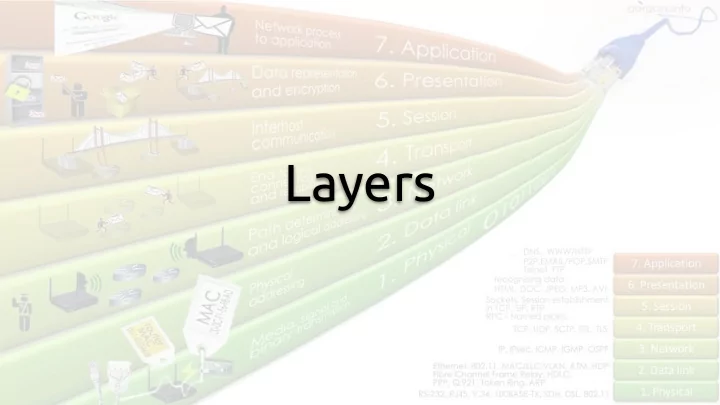
Layers Yelps Mission Connecting people with great local - - PowerPoint PPT Presentation
Layers Yelps Mission Connecting people with great local businesses. (Abstraction) Layers (related: separation of concerns) Abstractions? "Being abstract is something profoundly different from being vague The purpose of
Connecting people with great local businesses.
(related: separation of concerns)
"Being abstract is something profoundly different from being vague … The purpose of abstraction is not to be vague, but to create a new semantic level in which one can be absolutely precise." - Edsger Dijkstra All non-trivial abstractions, to some degree, are leaky. - Joel Spolsky Any problem in computer science can be solved with another layer of indirection. But that usually will create another problem - David Wheeler
A. Persuade the audience that his/her design recommendations are better than the current status quo B. Inform others about the history of architecture decisions in computer science C. Inspire engineers to think outside the box when designing systems D. Entertain the audience with historic anecdotes E. None of the above
DevOps
Features Wireframes Tasks Code / Unit Tests Build + Release Deployment | Monitoring | Alerting QA | Acceptance Tests PM UX Lead Dev Devs QA Release Engineering Operations
“What if we got rid of some of the layers?”
Features Wireframes Tasks Code / Unit Tests QA | Acceptance Tests Build + Release Deployment | Monitoring | Alerting PM UX Devs
Separation Of Concerns
files ext4 dm-crypt Software Raid Raw Block Devices LVM /mnt/stuff/foo /mnt/stuff /dev/mapper/luks-17c8... /dev/mapper/lv0 /dev/md0 /dev/sd{a,b}
“What if we got rid of some of the layers?”
files zfs (zraid) (encryption) (checksums) (pools) (vdevs) Raw Block Devices /mnt/stuff/foo /mnt/stuff /dev/sd{a,b}
Separation Of Concerns
~ $ ssh -vv leb1.xkyle.com -- true OpenSSH_7.7p1 Ubuntu-4ubuntu0.1, OpenSSL 1.0.2n 7 Dec 2017 debug1: Reading configuration data /home/kyle/.ssh/config debug1: /home/kyle/.ssh/config line 1: Applying options for leb1.xkyle.com debug1: Reading configuration data /etc/ssh/ssh_config debug1: /etc/ssh/ssh_config line 19: Applying options for * debug2: resolving "leb1.xkyle.com" port 4242 debug2: ssh_connect_direct: needpriv 0 debug1: Connecting to leb1.xkyle.com [2607:8b00:0:96::d0eb:ec0a] port 4242. ... debug1: Entering interactive session. debug1: pledge: network debug2: channel_input_open_confirmation: channel 0: callback start debug2: fd 3 setting TCP_NODELAY debug2: client_session2_setup: id 0 debug1: Sending environment. debug1: Sending env LANG = en_US.UTF-8 debug2: channel 0: request env confirm 0 debug1: Sending command: true ... Transferred: sent 2696, received 2516 bytes, in 0.1 seconds Bytes per second: sent 23959.5, received 22359.8 debug1: Exit status 0
https://docs.datastax.com/en/cassandra/3.0/cassandra/configuration/configCassandra_yaml.html?hl=commitlog_sync commit_failure_policy (Default: stop) Policy for commit disk failures:
disk_optimization_strategy (Default: ssd) The strategy for optimizing disk reads. Possible values: ssd or spinning. disk_failure_policy (Default: stop) Sets how Cassandra responds to disk failure. Recommend settings: stop or best_effort. Valid values:
replaced.
“Over time, layers tend toward becoming more sympathetic (or merged) in the pursuit of performance.”
Layer 6: Presentation Layer 5: Session Layer 4: Transport Layer 2: Data link Layer 1: Physical Layer 3: Network SSL N/A (Right? HTTP is “stateless”) TCP (Transmission Control Protocol) IP (Internet Protocol) 802.11 (Wi-Fi?) 802.11 (Wi-Fi?) Layer 7: Application HTTP (Hypertext Transfer Protocol)
https://en.wikipedia.org/wiki/Internet_protocol_suite#Comparison_of_TCP/IP_and_OSI_layering
The IETF protocol development effort is not concerned with strict layering. Some of its protocols may not fit cleanly into the OSI model, although RFCs sometimes refer to it and often use the old OSI layer numbers. The IETF has repeatedly stated that Internet protocol and architecture development is not intended to be OSI-compliant. RFC 3439, addressing Internet architecture, contains a section entitled: "Layering Considered Harmful".
RFC 1122, Internet STD 3 (1989) Cisco Academy[28] Kurose,[29] Forouzan[30] Comer,[31] Kozierok[32] Stallings[33] Arpanet Reference Model (RFC 871) OSI model Four layers Four layers Five layers Four+one layers Five layers Three layers Seven layers "Internet model" "Internet model" "Five-layer Internet model" or "TCP/IP protocol suite" "TCP/IP 5-layer reference model" "TCP/IP model" "Arpanet reference model" OSI model Application Application Application Application Application Application/Process Application Presentation Session Transport Transport Transport Transport Host-to-host or transport Host-to-host Transport Internet Internetwork Network Internet Internet Network Link Network interface Data link Data link (Network interface) Network access Network interface Data link Physical (Hardware) Physical Physical
Layer 6: Presentation Layer 5: Session Layer 4: Transport Layer 2: Data link Layer 1: Physical Layer 3: Network SSL N/A (Right? HTTP is “stateless”) TCP (Transmission Control Protocol) IP (Internet Protocol) 802.11 (Wi-Fi?) 802.11 (Wi-Fi?) Layer 7: Application HTTP (Hypertext Transfer Protocol)
“What if we got rid of some of the layers?”
Transport Layer (OSI 4) Link Layer (OSI 1,2) Internet Layer (OSI 3) UDP (User Datagram Protocol) IP (Internet Protocol) 802.11 (Wi-Fi) Application Layer (OSI 5,6,7) Encryption Sessions Multiplexing Error Correction QUIC (Quick UDP Internet Connections)
Separation Of Concerns
Rails App Model View Controller Users Mysql
“What if we ADDED some more layers?”
Users API Gateway Users Service Search Tweets Ads Moments Ads Mysql User Mysql Search Infra
Moments SQL
Tweets NoSQL Followers
Graph DB
Timeline
Layer 3: Application Code Layer 1: IaaS VM Layer 0: IaaS Provider Bare Metal Layer 2: OS Java Jar Ubuntu x86_64 c5.xlarge N/A
“What if we ADDED EVEN MORE layers?”
Layer 4: Pod Layer 3: Container Orchestration Layer 1: IaaS VM Layer 0: IaaS Provider Bare Metal Layer 2: OS pod-foo kublet Ubuntu x86_64 c5.xlarge N/A
Layer 5: Container docker Layer 6: Process java -jar
Layer 5: k8s federation Layer 4: k8s cluster Layer 3: Deployment / ReplicaSet Layer 1: Docker Container Layer 0: Process Layer 2: Pod Prod k8s federation uswest1-prod Frontend replicaset myapp-pod FROM apache2 httpd
“What if we got rid of some of the layers?”
Layer 0/1: IaaS Provider Bare Metal Hardware
Layer 0/1: IaaS Provider Bare Metal Hardware
Layer 2-7: Unikernel (No OS, just a directly booting application) MirageOS, etc
Layer 0/1: IaaS Provider Bare Metal Hardware
Layer 2-5: Amazon / k8s Stuff Same Stuff As Before Layer 7: Your Process Your Code Layer 6: Container Firecracker / Docker
Layer 0/1: IaaS Provider Bare Metal Hardware
Layer 2-5: Amazon / k8s Stuff Same Stuff As Before Layer 7: Your Process Your Code Layer 6: Container Firecracker / Docker
k8s pods Apache API Gateway + FaaS Controller (Request Routing) (Compute Dispatch)
Autoscaling Group (Compute Dispatch) Apache Elastic Load Balancer (Request Routing) Apache
Autoscaling Group MySQL MySQL ? K8s MySQL Operator MySQL MySQL
I know what I must do
(for the greater good!)
your mind
https://www.infoq.com/presentations/Simple-Made-Easy
Hold for (shameless) applause, Then Questions?
SEPARATION OF CONCERNS IS OVERRATED
Linux Kernel GPU X Server
X Client (GUI App) X11 Protocol over Socket /tmp/.X11-unix/X0 Ioctl via libdrm /dev/dri/card0 3d Game Ioctl via libdrm /dev/dri/card0 Window Manager
“What if we got rid of some of the layers?”