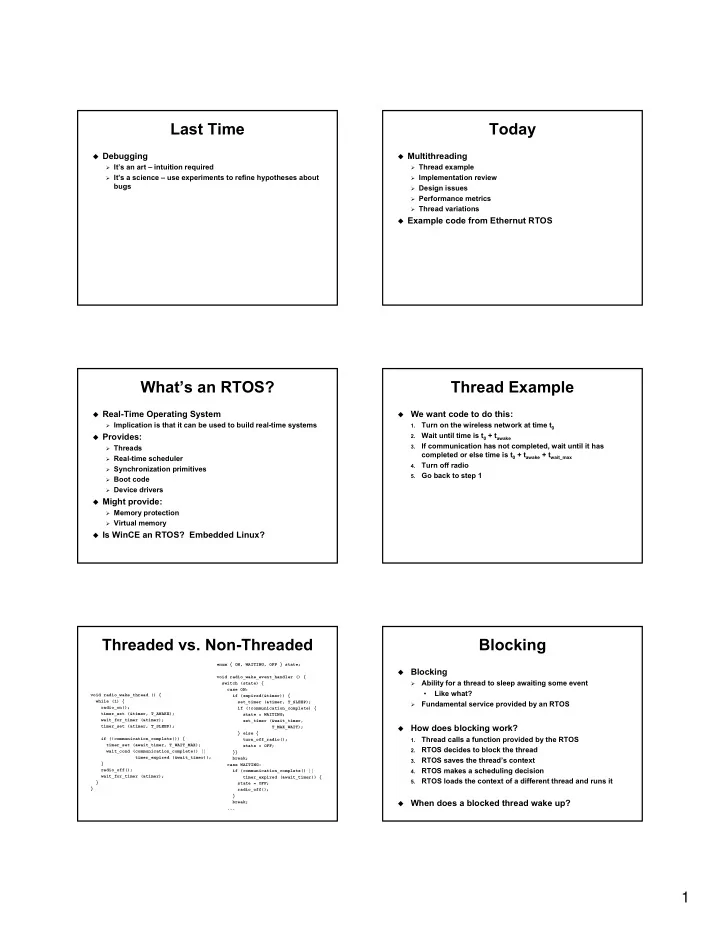
Last Time Today Debugging Multithreading Its an art intuition - - PDF document

last time today
SMART_READER_LITE
LIVE PREVIEW

Last Time Today Debugging Multithreading Its an art intuition - - PDF document

Last Time Today Debugging Multithreading Its an art intuition required Thread example Its a science use experiments to refine hypotheses about Implementation review bugs Design issues Performance


slide-1
SLIDE 1

1

Last Time

Debugging

It’s an art – intuition required It’s a science – use experiments to refine hypotheses about

bugs

Today

Multithreading

Thread example Implementation review Design issues Performance metrics Thread variations

Example code from Ethernut RTOS

What’s an RTOS?

Real-Time Operating System

Implication is that it can be used to build real-time systems

Provides:

Threads Real-time scheduler Synchronization primitives Boot code Device drivers

Might provide:

Memory protection Virtual memory

Is WinCE an RTOS? Embedded Linux?

Thread Example

We want code to do this:

1.

Turn on the wireless network at time t0

2.

Wait until time is t0 + tawake

3.

If communication has not completed, wait until it has completed or else time is t0 + tawake + twait_max

4.

Turn off radio

5.

Go back to step 1

Threaded vs. Non-Threaded

enum { ON, WAITING, OFF } state; void radio_wake_event_handler () { switch (state) { case ON: if (expired(&timer)) { set_timer (&timer, T_SLEEP); if (!communication_complete) { state = WAITING; set_timer (&wait_timer, T_MAX_WAIT); } else { turn_off_radio(); state = OFF; }} break; case WAITING: if (communication_complete() || timer_expired (&wait_timer)) { state = OFF; radio_off(); } break; ... void radio_wake_thread () { while (1) { radio_on(); timer_set (&timer, T_AWAKE); wait_for_timer (&timer); timer_set (&timer, T_SLEEP); if (!communication_complete()) { timer_set (&wait_timer, T_WAIT_MAX); wait_cond (communication_complete() || timer_expired (&wait_timer)); } radio_off(); wait_for_timer (&timer); } }

Blocking

Blocking

  • Ability for a thread to sleep awaiting some event
  • Like what?
  • Fundamental service provided by an RTOS

How does blocking work?

1.

Thread calls a function provided by the RTOS

2.

RTOS decides to block the thread

3.

RTOS saves the thread’s context

4.

RTOS makes a scheduling decision

5.

RTOS loads the context of a different thread and runs it

When does a blocked thread wake up?

slide-2
SLIDE 2

2

More Blocking

When does a blocked thread wake up?

When some predetermined condition becomes true Disk block available, network communication needed, timer

expired, etc.

Often interrupt handlers unblock threads

Why is blocking good?

Preserves the contents of the stack and registers Upon waking up, thread can just continue to execute

Can you get by without blocking?

Yes – but code tends to become very cluttered with state

machines

Preemption

When does the RTOS make scheduling decisions?

Non-preemptive RTOS: Only when a thread blocks or exits Preemptive RTOS: every time a thread wakes up or changes

priority

Advantage of preemption: Threads can respond

more rapidly to events

No need to wait for whatever thread is running to reach a

blocking point

Even preemptive threads sometimes have to wait

For example when interrupts are disabled, preemption is

disabled too

More Preemption

Preemption and blocking are orthogonal

No blocking, no preemption – main loop style Blocking, no preemption – non-preemptive RTOS

  • Also MacOS < 10

No blocking, preemption – interrupt-driven system Blocking, preemption – preemptive RTOS

Thread Implementation

TCB – thread control block

One per thread A struct that stores:

  • Saved registers including PC and SP
  • Current thread state
  • All-threads link field
  • Ready-list / block-list link field

Stack

Dedicated block of RAM per thread

Thread States

Thread invariants

At most one running thread

  • If there’s an idle thread then exactly one running thread

Every thread is on the “all thread” list State-based:

  • Running thread → Not on any list
  • Blocked thread → On one blocked list
  • Active thread → On one ready list

Ethernut TCB

struct _NUTTHREADINFO { NUTTHREADINFO *volatile td_next; /* Linked list of all threads. */ NUTTHREADINFO *td_qnxt; /* Linked list of all queued thread. */ u_char td_name[9]; /* Name of this thread. */ u_char td_state; /* Operating state. One of TDS_ */ uptr_t td_sp; /* Stack pointer. */ u_char td_priority; /* Priority level. 0 is highest priority. */ u_char *td_memory; /* Pointer to heap memory used for stack. */ HANDLE td_timer; /* Event timer. */ HANDLE td_queue; /* Root entry of the waiting queue. */ }; #define TDS_TERM 0 /* Thread has exited. */ #define TDS_RUNNING 1 /* Thread is running. */ #define TDS_READY 2 /* Thread is ready to run. */ #define TDS_SLEEP 3 /* Thread is sleeping. */

slide-3
SLIDE 3

3

Scheduler

Makes a decision when:

Thread blocks Thread wakes up (or is newly created) Time slice expires Thread priority changes

How does the scheduler make these decisions?

Typical RTOS: Priorities Typical GPOS: Complicated algorithm There are many other possibilities u_char NutThreadSetPriority(u_char level) { u_char last = runningThread->td_priority; /* Remove the thread from the run queue and re-insert it with a new * priority, if this new priority level is below 255. A priotity of * 255 will kill the thread. */ NutThreadRemoveQueue(runningThread, &runQueue); runningThread->td_priority = level; if (level < 255) NutThreadAddPriQueue(runningThread, (NUTTHREADINFO **) & runQueue); else NutThreadKill(); /* Are we still on top of the queue? If yes, then change our status * back to running, otherwise do a context switch. */ if (runningThread == runQueue) { runningThread->td_state = TDS_RUNNING; } else { runningThread->td_state = TDS_READY; NutEnterCritical(); NutThreadSwitch(); NutExitCritical(); } return last; }

Dispatcher

Low-level part of the RTOS Basic functionality:

Save state of currently running thread

  • Important not to destroy register values in the process!

Restore state of newly running thread

What if there’s no new thread to run?

Usually there’s an idle thread that is always ready to run In modern systems the idle thread probably just puts the

processor to sleep

Ethernut ARM Context

typedef struct { u_long csf_cpsr; u_long csf_r4; u_long csf_r5; u_long csf_r6; u_long csf_r7; u_long csf_r8; u_long csf_r9; u_long csf_r10; u_long csf_r11; /* AKA fp */ u_long csf_lr; } SWITCHFRAME;

void NutThreadSwitch(void) attribute ((naked)) { /* Save CPU context. */ asm volatile ( /* */ "stmfd sp!, {r4-r11, lr}" /* Save registers. */ "mrs r4, cpsr" /* Save status. */ "stmfd sp!, {r4}" /* */ "str sp, %0" /* Save stack pointer. */ ::"m" (runningThread->td_sp) ); /* Select thread on top of the run queue. */ runningThread = runQueue; runningThread->td_state = TDS_RUNNING; /* Restore context. */ __asm__ __volatile__( /* */ "@ Load context" /* */ "ldr sp, %0" /* Restore stack pointer. */ "ldmfd sp!, {r4}" /* Get saved status... */ "bic r4, r4, #0xC0" /* ...enable interrupts */ "msr spsr, r4" /* ...and save in spsr. */ "ldmfd sp!, {r4-r11, lr}" /* Restore registers. */ "movs pc, lr" /* Restore status and return. */ ::"m"(runningThread->td_sp) ); }

Thread Correctness

Threaded software can be hard to understand

Like interrupts, threads add interleavings

To stop the scheduler from interleaving two threads:

use proper locking

Any time two threads share a data structure, access to the

data structure needs to be protected by a lock

slide-4
SLIDE 4

4

Thread Interaction Primitives

Locks (a.k.a. mutexes)

Allow one thread at a time into critical section Block other threads until exit

FIFO queue (a.k.a. mailbox)

Threads read from and write to queue Read from empty queue blocks Write to empty queue blocks

Message passing

Sending thread blocks until receiving thread has the

message

Similar to mailbox with queue size = 0

Mixing Threads and Interrupts

Problem:

Thread locks do not protect against interrupts

Solution 1:

Mutex disables interrupts as part of taking a lock What happens when a thread blocks inside a mutex?

Solution 2:

Up to the user to disable interrupts in addition to taking a

mutex

Thread Design Issues 1

Static threads:

All threads created at compile time

Dynamic threads:

System supports a “create new thread” and “exit thread”

calls

Tradeoffs – dynamic threads are:

More flexible and user-friendly Not possible to implement without a heap A tiny bit less efficient Much harder to verify / validate

Thread Design Issues 2

Can threads be asynchronously killed?

Alternative: Threads must exit on their own

Tradeoffs – asynchronous termination:

Is sometimes very convenient Raises a difficult question – What if killed thread is in a

critical section?

  • Kill it anyway → Data structure corruption
  • Wait for it to exit → Defeats the purpose of immediate

termination

Why do Windows and Linux processes not have this

problem?

Thread Design Issues 3

Are multiple threads at the same priority permitted? Tradeoffs – multiple same-priority threads:

Can be convenient Makes data structures a bit more complex and less efficient Requires a secondary scheduling policy

  • Round-robin
  • FIFO

Thread Design Issue 4

How to determine thread stack sizes?

  • Use same methods as for non-threaded systems
  • Need to know how interrupts and stacks interact

Possibilities

1.

Interrupts use the current thread stack

2.

Interrupts use a special system stack

slide-5
SLIDE 5

5

Thread Performance Metrics

Thread dispatch latency

Average care and worst case

System call latency

Average case and worst case

Context switch overhead RAM overhead

More or less reduces to heap manager overhead

Thread Variation 1

Protothreads are stackless Can block, but…

Blocking is cooperative All stack variables are lost across a blocking point Blocking can only occur in the protothread’s root function

Tradeoffs – protothreads are another design point

between threads and events

Thread Variation 2

Preemption thresholds

Every thread has two priorities

  • P1 – regular priority, used to decide when the thread

runs

  • P2 – preemption threshold, used to decide whether

another thread can preempt currently running thread

If P1 == P2 for all threads, degenerates to preemptive

multithreading

If P2 == max priority, degenerates to non-preemptive

scheduling

Key benefits:

Threads that are mutually nonpreemptive can share a stack Reduces number of context switches

Thread Pros

Blocking can lead to clearer software

No need to manually save state Reduces number of ad-hoc state machines

Preemptive scheduling can lead to rapid response

times

Only in carefully designed systems

Threads compose multiple activities naturally

As opposed to cyclic executives

Thread Cons

Correctness

Empirically, people cannot create correct multithreaded

software

Race conditions Deadlocks Tough to debug

Performance

Stacks require prohibitive RAM on the smallest systems Context switch overhead can hurt – might end up putting

time critical code into interrupts

Summary

Threads have clear advantages for large systems

Blocking reduces the need to build state machines Threads simplify composing a system from parts

Threads have clear disadvantages

RAM overhead, for small systems Correctness issues