Large-Scale Data Processing and Optimisation (LSDPO) Session 1: - - PDF document

large scale data processing and optimisation lsdpo
SMART_READER_LITE
LIVE PREVIEW

Large-Scale Data Processing and Optimisation (LSDPO) Session 1: - - PDF document

Large-Scale Data Processing and Optimisation (LSDPO) Session 1: Introduction Eiko Yoneki Systems Research Group University of Cambridge Computer Laboratory My Trajectory Cambridge London Tokyo Raleigh Rome Palo Alto 2 1 My Research


slide-1
SLIDE 1

1

Large-Scale Data Processing and Optimisation (LSDPO) Session 1: Introduction

Eiko Yoneki

Systems Research Group University of Cambridge Computer Laboratory

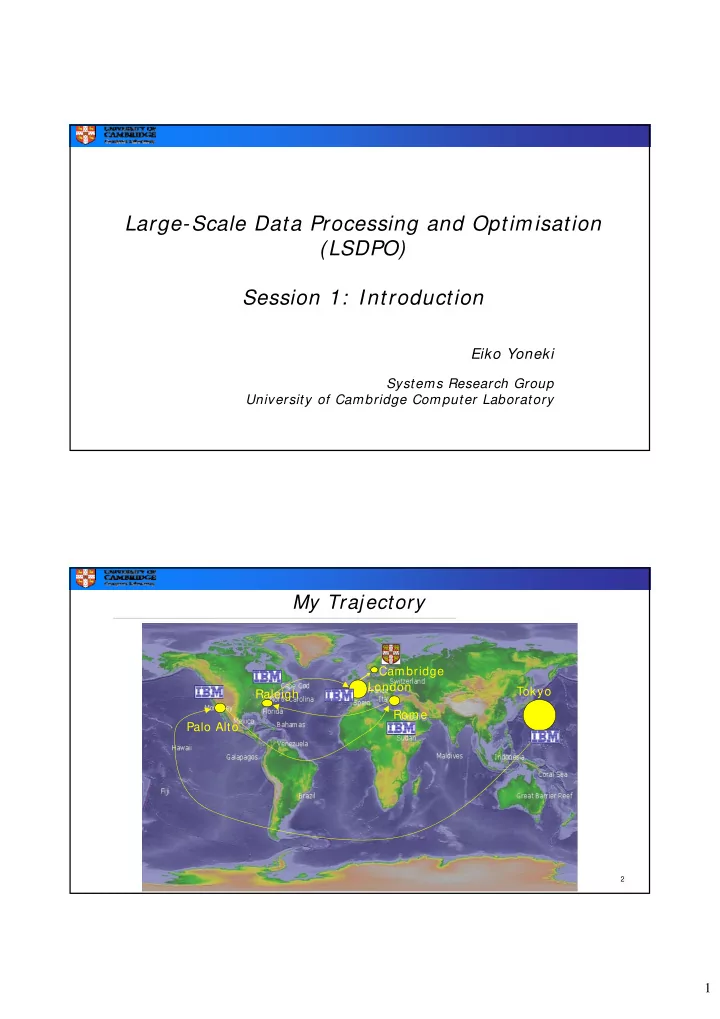
My Trajectory

Tokyo Rome London Raleigh Palo Alto Cambridge

2
slide-2
SLIDE 2

2

My Research Interests

  • Spanning over Distributed Systems, Networking

and Database

  • Current Focus: Large-Scale Data Processing and

Optimisation of Computer Systems exploiting ML

  • MPhil project Suggestions

http: / / www.cl.cam.ac.uk/ ~ ey204/ teaching/ Projects/ 2019_2020

3

My Group: Data-Centric Systems

Large-scale Graph Processing

  • Fast, flexible, and programmable graph processing
  • Cost effective but efficient storage
  • Move to SSDs from RAM
  • Reduce latency
  • Runtime prefetching
  • Dynamic CPU/ GPU scheduling
  • Dynamic SSSP

Data Analysis at the Edge

  • Real world data processing

in Africa/ South America

  • e.g. TB - sensing CO2 and proximity of

people  building complex networks

  • e.g. Pest/ Disease monitoring by

Raspberry Pi camera – use ML to identify at the edge node

Optim isation of Com plex Data Processing in Com puter System s

  • Auto-tuning to deal with complex parameter space using machine-learning
  • Structured Bayesian Optimisation, Reinforcement Learning
  • Build a solid auto-tuning platform in a complex and large parameter space
  • e.g. Cluster task scheduling, ML framework, JVM garbage collector, NN model, LLVM Compiler, ASICS

design, DB indexing, Stream processing, Traffic signal control…

4

slide-3
SLIDE 3

3

R244 Course Objectives

  • Understand key concepts of scalable data processing
  • Understand how to build distributed systems in data

driven approach

  • Understand a large and complex parameter space in

computer system's optimisation and applicability of Machine Learning approach

  • Research skills
  • Establish basic research domain knowledge in large data

processing

  • Obtain your view of research area for thinking forward

5

Topic Areas

Session 1: Introduction Session 2: Data flow programming: Map/ Reduce to TensorFlow Session 3: Large-scale graph data processing Session 4: Hands-on Tutorial: Map/ Reduce and Deep Neural Network Session 5: Probabilistic Programming + Guest lecture (Brooks Paige) Session 6: Exploring ML for optimisation in computer systems Session 7: ML based Optimisation examples in Computer Systems Session 8: Project Study Presentation (2019.12.12 @11: 00)

6

slide-4
SLIDE 4

4

Course Structure

  • Reading Club (not Lecture Class!)
  • ~ 5 Paper review presentations and discussion per session

(~ = 20 minutes presentation + discussion)

  • Each of you will present ~ 2 reviews during the course
  • Revised (if necessary) presentation slides needs to be emailed on the

following day

  • Review_Log: minimum 1 per session
  • Email me by noon on Monday
  • Prepare questions
  • Active participation to review discussion!

7

Review_Log

8

slide-5
SLIDE 5

5

Course Work: Reports 1&2

  • Review report on full length of paper (< 1800 words)
  • Describe the contribution of paper in depth with criticism
  • Crystallise the significant novelty in contrast to the other related work
  • Suggestion for future work
  • Survey report on sub-topic in data centric networking

(< 2000 words)

  • Pick up to 5 papers as core papers in your survey scope
  • Read them and expand your reading through related work
  • Comprehend your view and finish as your survey paper

9

Study of Open Source Project

  • Open Source project normally comes with new proposal of

system/ networking architecture

  • Understand the prototype of proposed architecture, algorithms,

and systems through running an actual prototype

  • Any additional work
  • Writing applications
  • Extending prototype to another platform
  • Benchmarking using online large dataset
  • Present/ explain how prototype runs
  • Some projects are rather large and may require extensive

environment and time; make sure you are able to complete this assignment

10

slide-6
SLIDE 6

6

Course Work: Reports 3

  • Report on project study and exploration of a

prototype (< 2500 words)

  • Project selection by November 8, 2019
  • Title and brief description (> 150 words) by email
  • Project presentation on November 29, 2019
  • Final report on the project study by January 15, 2020

(by December 20, 2019 is preferable)

11

Candidates of Open Source Project

http: / / www.cl.cam.ac.uk/ ~ ey204/ teaching/ ACS/ R244_2019_2020/ opensource_projects.html

  • List is not exhausted and discuss with me if you find more

interesting one for you

  • Expectation of workload on open source project study is

about intensive 3 full days work except writing up report

  • One approach: pick one in the session topic, which you are

interested in along your survey report

slide-7
SLIDE 7

7

Important Dates

  • November 8 (Friday) 16: 00
  • Project selection
  • November 15 (Friday) 16: 00
  • Review report
  • November 29 (Friday) 16: 00
  • Survey report
  • January 15, 2020 (Wednesday) –

December 20 (Friday) is preferable

  • Open source project study report

13

Assessment

  • The final grade for the course will be provided as a letter

grade or percentage and the assessment will consist of two parts:

  • 25% : for a reading club (presentation, participation,

tutorial session exercise and review_log)

  • 10% : Presentation
  • 15% : Participation
  • 75% : for the three reports
  • 15% : Intensive review report
  • 25% : Survey report
  • 35% : Project study

14

slide-8
SLIDE 8

8

Welcome to R244

  • Now tell about yourself
  • Your name and where you studied before ACS (or Part III)
  • What is your research interests (topics)
  • Why are you interested in R244

15

How to Read a Paper?

16

slide-9
SLIDE 9

9

How to Read a Paper?

  • Scope of LSDPO is wide
  • ...includes distributed systems, OS, networking,

programming language, database…

  • Type of papers
  • Building a real system
  • Proposing algorithm/ logic on architecture design
  • Optimising computer systems
  • New idea

17

Critical Thinking

  • Reading a research paper is not like reading a text

book

  • But the most important one is that the paper is not

necessary the truth

  • there is no right and wrong, just good and bad
  • There are inherently subjective qualities…

but you can’t get away with just your opinion: must argue

  • Critical thinking is the skill of marrying subjective and
  • bjective judgment of a piece of work
  • S. Hand’10

18

slide-10
SLIDE 10

10

First Let’s Argue for…

  • S. Hand’10
  • What is the problem?
  • What is important?
  • Why isn’t it solved in previous work?
  • Why graph specific parallel processing? MapReduce is

not good enough?

  • What is the approach?
  • Graph specific MapReduce
  • Why is this novel/ innovative?
  • Iterative operation for graph parallel

19

And Now against…

  • S. Hand’10
  • Problem is overstated (or oversold)
  • Problem does not exist
  • Approach is broken
  • It does not work for all the algorithms…
  • Solution is insufficient
  • Only works when data is in memory…
  • Evaluation is unfair/ biased
  • Use HPC for experiment

20

slide-11
SLIDE 11

11

So Which is RIGHT Answer?

  • S. Hand’10
  • There isn’t one!
  • Most of arguments are mostly correct…
  • Your judge on what is valuable on topic
  • In this course, we’ll be reviewing a selection
  • f ~ 20 papers (4-5 per week)
  • All of these papers were peer-reviewed and published
  • However you can pick your opinion on papers!

21

Reviewing Tips & Tricks

  • Identify a core/ major idea of the topic
  • Read related work and/ or background section

and read key other papers on the topic

  • Capture the author’s claim of contribution in

introduction section and judge if it is delivered

  • Understand the methodology that demonstrates

paper’s approach

  • Capture what authors evaluate and judge if that

is a good way to evaluate the proposed idea

  • For theory/ algorithm paper, capture what it

produces as a result (rather than how)

22

slide-12
SLIDE 12

12

Key in Review Comments

  • S. Hand’10
  • What do YOU think?
  • Where you finally get to explain your opinion!
  • You should aim to give a judgement on the work
  • Your judgement should be backed by your

argument

  • Questions for the authors

23

How to Review a Paper Aid…

  • S. Keshav: How to Read a Paper, ACM SIGCOMM Computer

Communication Review 83 Volume 37, Number 3, July 2007.

  • T. Roscoe: Writing Reviews for Systems Conferences, 2007.
  • Simon Peyton-Jones: How to write a great paper and give a

great talk about it, Microsoft Research Cambridge.

  • David A. Patterson: How to Have a Bad Career in

Research/ Academia, 2001. See course web page for the paper links.

24

slide-13
SLIDE 13

13

Structure of Presentation

  • S. Hand’10
  • Cover 3 things in your presentation
  • 1. Background/ context
  • What motivated the authors?
  • What else was going on in the research community?
  • How have things changed since?
  • 2. What is problem to be tackled?
  • What is the problem they tried to solve?
  • What are the key ideas?
  • What did the authors actually do?
  • What were the results?
  • 3. Your opinion of the paper
  • What you agree and what you disagree?
  • What is the strength and weakness of their approach?
  • What are the key takeaway?
  • What was the impact (possible impact)?

25

Preparing…

  • S. Hand’10
  • Not too much basics: remember, others would have

read the paper

  • Brief overview
  • Do not make exact repeat of the paper
  • Aim: generate discussion – spit your straight opinion

about the paper to stir the discussion

  • Explore the arguments they make and the conclusions they draw.

What is your opinion on it?

  • When you argue, state clearly the point of argument

26

slide-14
SLIDE 14

14

Presenting…

  • S. Hand’10
  • Practice beforehand to ensure length of your

presentation

  • Getting nervous is normal!
  • We are in the same boat and we help each other to

understand the paper

  • Presentation is a tool to provide a discussion forum
  • Try not to get defensive or angry at questions
  • It is not your paper !

27

Listening Presentation…

  • S. Hand’10
  • You need to get involved
  • Ask questions from your review – bring

your review_log copy

  • Always be respectful of the speaker

28

slide-15
SLIDE 15

15

How to Write Reviews (Report 1)

  • S. Hand’10
  • Paper Summary
  • Provide a brief summary of the paper
  • At this stage you should try to be objective
  • Problem
  • What is the problem? Why is it important? Why is previous work

insufficient?

  • Solution or Approach
  • What is their approach?
  • How does it solve the problem?
  • How is the solution unique and/ or innovative?
  • What are the details?
  • Evaluation is unfair/ biased
  • How do they evaluate their solution?
  • What questions do they answer?
  • What are the strength/ weakness of the system and evaluation itself?

29

How to write Survey paper (Report 2)

  • Demonstrate a summary of recent research results in a

novel way that integrates and adds understanding to work in the research area

  • Must expose relevant details associated, but it is

important to keep a consistent level of details and to avoid simply listing the different works

  • For example:
  • Define the scope of your survey
  • Classify and organize the trend
  • Critical evaluation of approaches (pros/ cons)
  • Add your analysis or explanation (e.g. table, figure)
  • Add reference and pointer to further in-depth information

30

slide-16
SLIDE 16

16

Summary

  • R244 course web page:

http: / / www.cl.cam.ac.uk/ ~ ey204/ teaching/ ACS/ R244_2019_2020 Email: eiko.yoneki@cl.cam.ac.uk

  • Slides of presentation, forms, other information will

be on the web

31