
SLIDE 1
event.cwi.nl/lsde2015
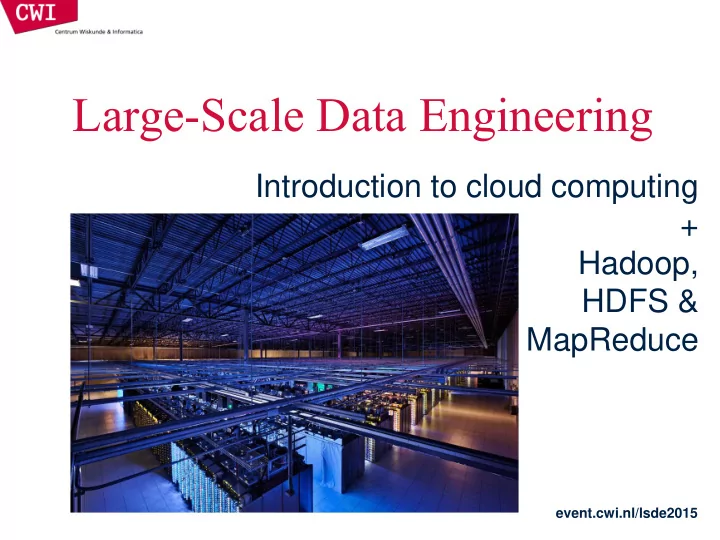
Large-Scale Data Engineering Introduction to cloud computing + - - PowerPoint PPT Presentation
Large-Scale Data Engineering Introduction to cloud computing + Hadoop, HDFS & MapReduce event.cwi.nl/lsde2015 COMPUTING AS A SERVICE event.cwi.nl/lsde2015 Utility computing What? Computing resources as a metered service (pay
event.cwi.nl/lsde2015
event.cwi.nl/lsde2015
event.cwi.nl/lsde2015
– Computing resources as a metered service (“pay as you go”) – Ability to dynamically provision virtual machines
– Cost: capital vs. operating expenses – Scalability: “infinite” capacity – Elasticity: scale up or down on demand
– Benefits to cloud users – Business case for cloud providers
event.cwi.nl/lsde2015
Hardware Operating System App App App
Traditional Stack
Hardware OS App App App Hypervisor OS OS
Virtualized Stack
event.cwi.nl/lsde2015
– Why buy machines when you can rent cycles? – Examples: Amazon’s EC2, Rackspace
– Give me nice API and take care of the maintenance, upgrades – Example: Google App Engine
– Just run it for me! – Example: Gmail, Salesforce
event.cwi.nl/lsde2015
– 1960s – MULTICS – Concept of a Shared Computing Utility – 1970s – IBM Mainframes – rent by the CPU-hour. (Fast/slow switch.)
– 1990s-2000s – Rent machines for months/years, keep them close to the network access point and pay a flat rate. Avoid running your own building with utilities!
– Early 2000s - Submit jobs to a remote service provider where they run on the raw hardware. Sun Cloud ($1/CPU-hour, Solaris +SGE) IBM Deep Capacity Computing on Demand (50 cents/hour)
– 1960s – OS-VM, VM-360 – Used to split mainframes into logical partitions. – 1998 – VMWare – First practical implementation on X86, but at significant performance hit. – 2003 – Xen paravirtualization provides much perf, but kernel must assist. – Late 2000s – Intel and AMD add hardware support for virtualization.
event.cwi.nl/lsde2015
ethernet cable – Physical vs. virtual (or logical) resource management – Interface?
– Connectivity, concurrency, replication, fault tolerance, file access, node access, capabilities, services, …
– The problems are nothing new – Solutions have existed for a long time – However, it's the first time we have the challenge of applying them all in a single massively accessible infrastructure
event.cwi.nl/lsde2015
– But this only gets us to the outer “skin” of the cloud data center, not the interior – Consider Amazon: it can host entire company web sites (like Target.com or Netflix.com), data (S3), servers (EC2) and even user- provided virtual machines!
event.cwi.nl/lsde2015
handled in the first tier by – PHP or ASP pages – Associated logic
services are fast and very nimble
the second tier
event.cwi.nl/lsde2015
response
asynchronously
– Scheduled to share resources – Run applications like MapReduce (Hadoop) are very popular – Perform the heavy lifting
event.cwi.nl/lsde2015
– Processing
little while) – Data
without any delay at all – Control information
decentralised cloud management infrastructure
event.cwi.nl/lsde2015
– Request has reached some service instance X – Will it be faster
the job?
– Werner Vogels, CTO at Amazon, commented in one talk that many Amazon pages have content from 50 or more parallel subservices that run, in real-time, on the request!
event.cwi.nl/lsde2015
components to be run in parallel, how long do we need to wait? – Answer: as long as the slowest read
– Duh… we still wait till the slowest write finishes
same resource? – Also known as replicas – We wait the same time, but when do we make the individual writes visible?
Replication solves one problem but introduces another
event.cwi.nl/lsde2015
– Are all the replicas applying updates in the same order?
– What if the leader replies to the end user but then crashes and it turns
16
event.cwi.nl/lsde2015
– “You can have just two from Consistency, Availability and Partition Tolerance”
paramount
reach some service
cannot be validated and might be stale!
event.cwi.nl/lsde2015
– Think about YouTube videos. Would consistency be an issue here? – What about the Amazon “number of units available” counters. Will people notice if those are a bit off?
event.cwi.nl/lsde2015
event.cwi.nl/lsde2015
standard configurations for its own business.
virtualization to perform “server consolidation”
service for the world.”
event.cwi.nl/lsde2015
event.cwi.nl/lsde2015
event.cwi.nl/lsde2015
Instance Instance Instance
Private IP Private IP Public IP snapshot
Manager
SSH
event.cwi.nl/lsde2015
event.cwi.nl/lsde2015
–Start and stop instances whenever you like, costs are rounded up to the nearest hour. (Worst price)
–Pay up front for one/three years in advance. (Best price) –Unused instances can be sold on a secondary market.
–Specify the price you are willing to pay, and instances get started and stopped without any warning as the marked
event.cwi.nl/lsde2015
usage
Purpose (SSD) or Magnetic, plus 2 million I/Os (with Magnetic) and 1 GB
event.cwi.nl/lsde2015
event.cwi.nl/lsde2015
accounting, and access control. A bucket can hold any number of objects, which are files of up to 5TB. A bucket has a name that must be globally unique.
– http://bucket.s3.amazonaws.com/object – POST a new object or update an existing object. – GET an existing object from a bucket. – DELETE an object from the bucket – LIST keys present in a bucket, with a filter.
the interactive web interface.)
event.cwi.nl/lsde2015
Direct quote from the Amazon developer API: “Updates to a single key are atomic….” “Amazon S3 achieves high availability by replicating data across multiple servers within Amazon's data centers. If a PUT request is successful, your data is safely
S3, which can take some time, and so you might observe the following behaviors:
– A process writes a new object to Amazon S3 and immediately attempts to read it. Until the change is fully propagated, Amazon S3 might report "key does not exist." – A process writes a new object to Amazon S3 and immediately lists keys within its
– A process replaces an existing object and immediately attempts to read it. Until the change is fully propagated, Amazon S3 might return the prior data. – A process deletes an existing object and immediately attempts to read it. Until the deletion is fully propagated, Amazon S3 might return the deleted data.”
event.cwi.nl/lsde2015
event.cwi.nl/lsde2015
event.cwi.nl/lsde2015
event.cwi.nl/lsde2015
where it can be updated incrementally. Unlike an instance store, an EBS volume is persistent.
accessed in its entirety.)
– CREATE a new volume (1GB-1TB) – COPY a volume from an existing EBS volume or S3 object. – MOUNT on one instance at a time. – SNAPSHOT current state to an S3 object.
event.cwi.nl/lsde2015
event.cwi.nl/lsde2015
event.cwi.nl/lsde2015
vaults, while an archive is a single object.
– All operations are asynchronous and notified via SNS. – Vault listings are updated once per day. – Archive downloads may take up to four hours. – Only 5% of total data can be accessed in a given month.
– Storage: $0.01 per GB-month – Operations: $0.05 per 1000 requests – Data Transfer: Like S3, free within AWS.
event.cwi.nl/lsde2015
event.cwi.nl/lsde2015
event.cwi.nl/lsde2015
scale factors – SF100 for quick testing – SF3000 the real deal
– Power laws (e.g. degree) – Huge Connected Component – Small diameter – Data correlations Chinese have more Chinese names – Structure correlations Chinese have more Chinese friends
event.cwi.nl/lsde2015
event.cwi.nl/lsde2015
preferences of their users. They have built statistical models which predict given an interest in say artists A2 and A3, that the person would also like A1 (i.e. rules of the form: A2 and A3 A1). Now, they are commercially exploiting this knowledge by selling targeted ads to the management of artists who, in turn, want to sell concert tickets to the public but in the process also want to expand their artists' fanbase.
concert tickets of artist A1 (with a discount!) as a birthday present for a friend ("who we know will love it" - the social network says) who lives in the same city, who is not yet interested in A1 yet, but is interested in other artists A2, A3 and A4 that the data mining model predicts to be correlated with A1.
event.cwi.nl/lsde2015
For all persons P :
we give a score of – 1 for liking any of the artists A2, A3 and A4 and – 0 if not the final score, the sum, hence is a number between 0 and 3. Further, we look for friends F: – Where P and F who know each other mutually – Where P and F live in the same city and – Where F already likes A1 The answer of the query is a table (score, P, F) with only scores > 0
event.cwi.nl/lsde2015
event.cwi.nl/lsde2015
knows_first knows_n
event.cwi.nl/lsde2015
The “cruncher” program Go through the persons P sequentially
for those with score>0: – visit all persons F known to P. For each F:
if all this succeeds (score,P,F) is added to a result table.
event.cwi.nl/lsde2015
knows_first knows_n
event.cwi.nl/lsde2015
knows_first knows_n
event.cwi.nl/lsde2015
knows_first knows_n
event.cwi.nl/lsde2015
knows_first knows_n
event.cwi.nl/lsde2015
– Apply filters first. Less accesses is better.
– Remove joins/lookups, add looked up stuff to the table (but.. makes it bigger)
– perform a 100K random key lookups in a large table put 100K keys in a hash table, then scan table and lookup keys in hash table
– Remove unused data from the structure – Apply data compression – Cluster or Partition the data (improve locality) …hard for social graphs
– Use a Bloom Filter
event.cwi.nl/lsde2015
event.cwi.nl/lsde2015
work w1 w2 w3 r1 r2 r3 result worker worker worker
partition combine
event.cwi.nl/lsde2015
What’s the common theme of all of these problems?
event.cwi.nl/lsde2015
– Communication between workers (e.g., to exchange state) – Access to shared resources (e.g., data)
event.cwi.nl/lsde2015
– We don’t know the order in which workers run – We don’t know when workers interrupt each other – We don’t know when workers need to communicate partial results – We don’t know the order in which workers access shared data
– Semaphores (lock, unlock) – Conditional variables (wait, notify, broadcast) – Barriers
– Deadlock, livelock, race conditions... – Dining philosophers, sleeping barbers, cigarette smokers...
event.cwi.nl/lsde2015
– Shared memory (pthreads) – Message passing (MPI)
– Master-slaves – Producer-consumer flows – Shared work queues
message passing
P1 P2 P3 P4 P5
shared memory
P1 P2 P3 P4 P5
memory
master slaves producer consumer producer consumer work queue
event.cwi.nl/lsde2015
– At the scale of datacenters and across datacenters – In the presence of failures – In terms of multiple interacting services
– Lots of one-off solutions, custom code – Write you own dedicated library, then program with it – Burden on the programmer to explicitly manage everything – The MapReduce runtime alleviates this
event.cwi.nl/lsde2015
– Moving beyond the von Neumann architecture – We need better programming models
– No more race conditions, lock contention, etc.
– Developer specifies the computation that needs to be performed – Execution framework (aka runtime) handles actual execution
The data centre is the computer!
event.cwi.nl/lsde2015
Source: Google
event.cwi.nl/lsde2015
event.cwi.nl/lsde2015
– Limits of SMP and large shared-memory machines
– Cluster has limited bandwidth, cannot waste it shipping data around
– Seeks are expensive, disk throughput is reasonable, memory throughput is even better
– From the mythical man-month to the tradable machine-hour
– But if efficiently scheduled and executed to solve bigger problems we can throw more hardware at the problem and use the same code – Remember, the datacentre is the computer
event.cwi.nl/lsde2015
Key idea: provide a functional abstraction for these two operations
event.cwi.nl/lsde2015
map (k1, v1) → [<k2, v2>] reduce (k2, [v2]) → [<k3, v3>] – All values with the same key are sent to the same reducer shuffle and sort: aggregate values by keys reduce reduce reduce map map map map
a 1 b 2 c 6 c 3 a 5 c 2 a 1 b 2 6 3 5 c 2 k1 v1 k2 v2 k3 v3 k4 v4 k5 v5 k6 v6 k7 v7 k8 v8 b 7 c 8 8 7 r1 s1 r2 s2 r3 s3
event.cwi.nl/lsde2015
– Assigns workers to map and reduce tasks
– Moves processes to data
– Gathers, sorts, and shuffles intermediate data
– Detects worker failures and restarts
later)
event.cwi.nl/lsde2015
map (k, v) → <k’, v’>* reduce (k’, v’) → <k’, v’>* – All values with the same key are reduced together
partition (k’, number of partitions) → partition for k’ – Often a simple hash of the key, e.g., hash(k’) mod n – Divides up key space for parallel reduce operations combine (k’, v’) → <k’, v’>* – Mini-reducers that run in memory after the map phase – Used as an optimization to reduce network traffic
event.cwi.nl/lsde2015
shuffle and sort: aggregate values by keys reduce reduce reduce map map map map
a 1 b 2 c 6 c 3 a 5 c 2 a 1 b 2 9 8 5 c 2 k1 v1 k2 v2 k3 v3 k4 v4 k5 v5 k6 v6 k7 v7 k8 v8 b 7 c 8 7 r1 s1 r2 s2 r3 s3
combine combine combine combine
a 1 b 2 c 9 a 5 c 2 b 7 c 8
partition partition partition partition
event.cwi.nl/lsde2015
– But we can begin copying intermediate data earlier
– No enforced ordering across reducers
event.cwi.nl/lsde2015
Map(String docid, String text): for each word w in text: Emit(w, 1); Reduce(String term, Iterator<Int> values): int sum = 0; for each v in values: sum += v; Emit(term, sum);
event.cwi.nl/lsde2015
– Bindings in Java, Python
– Development led by Yahoo, now an Apache project – Used in production at Yahoo, Facebook, Twitter, LinkedIn, Netflix, … – The de facto big data processing platform – Rapidly expanding software ecosystem
– For GPUs, cell processors, etc.
event.cwi.nl/lsde2015
split 0 split 1 split 2 split 3 split 4 worker worker worker worker worker master user program
file 0
file 1
(1) submit (2) schedule map (2) schedule reduce (3) read (4) local write (5) remote read (6) write
Input files Map phase Intermediate files (on local disk) Reduce phase Output files
Adapted from (Dean and Ghemawat, OSDI 2004)
event.cwi.nl/lsde2015
event.cwi.nl/lsde2015
– Store data on the local disks of nodes in the cluster – Start up the workers on the node that has the data local
– Not enough RAM to hold all the data in memory – Disk access is slow, but disk throughput is reasonable
– GFS (Google File System) for Google’s MapReduce – HDFS (Hadoop Distributed File System) for Hadoop
event.cwi.nl/lsde2015
– Scale out, not up
– Inexpensive commodity components fail all the time
– Multi-gigabyte files are common, if not encouraged
– Perhaps concurrently
– High sustained throughput over low latency
GFS slides adapted from material by (Ghemawat et al., SOSP 2003)
event.cwi.nl/lsde2015
– Fixed size (64MB)
– Each chunk replicated across 3+ chunkservers
– Simple centralized management
– Little benefit due to large datasets, streaming reads
– Push some of the issues onto the client (e.g., data layout)
HDFS = GFS clone (same basic ideas)
event.cwi.nl/lsde2015
– GFS master = Hadoop namenode – GFS chunkservers = Hadoop datanodes
– Different consistency model for file appends – Implementation – Performance
For the most part, we’ll use Hadoop terminology
event.cwi.nl/lsde2015
Adapted from (Ghemawat et al., SOSP 2003)
(file name, block id) (block id, block location) instructions to datanode datanode state (block id, byte range) block data
HDFS namenode HDFS datanode Linux file system
HDFS datanode Linux file system
File namespace /foo/bar
block 3df2
Application HDFS Client
event.cwi.nl/lsde2015
– Holds file/directory structure, metadata, file-to-block mapping, access permissions, etc.
– Directs clients to datanodes for reads and writes – No data is moved through the namenode
– Periodic communication with the datanodes – Block re-replication and rebalancing – Garbage collection
event.cwi.nl/lsde2015
datanode daemon Linux file system
tasktracker slave node datanode daemon Linux file system
tasktracker slave node datanode daemon Linux file system
tasktracker slave node namenode namenode daemon job submission node jobtracker
event.cwi.nl/lsde2015