
SLIDE 1
Laos
Presented by: Thipphaphone Douangsila
1
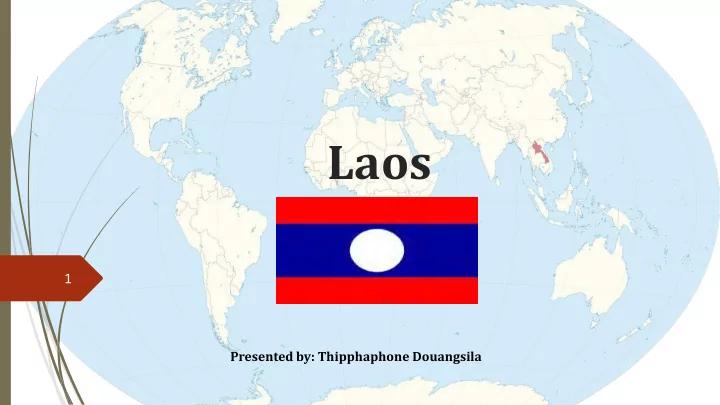
Laos 1 Presented by: Thipphaphone Douangsila 1. General - - PowerPoint PPT Presentation
Laos 1 Presented by: Thipphaphone Douangsila 1. General Information 2 Capital city: Vientiane capital Population : 6.8 million (2015) Areas: 236,800 km 2 Ethnicity : 49 ethnic groups (4 language groups: Lao-Tai (majority),
Presented by: Thipphaphone Douangsila
1
language groups: Lao-Tai (majority), Mon-Khmer, Hmong-Iu Mien, and Chine-Tibetan)
provinces, 141 districts, and villages.
2
Legislative Branch National Assembly Local People Assembly (Provincial, district, village levels) Executive Branch Head of the State (president) Head of the government (Prime Ministers) Judiciary Branch The People’s Court People’s Supreme Court, Local People's courts
3
Prime Minister Ministers/Provincial Governor District Chief Village Chief
Prime Minister Office
4
5
mountainous slope, especially in the Northern and Eastern part.
population live in rural areas.
sector for sustainable development and poverty reduction
% of GDP
depend on agriculture, mainly rice cultivation, and raising livestock
53
22.8 23.6 0.6 45 29 25 1 27.4 27.3 39.1 6.2
10 20 30 40 50 60 Agriculture Industry Service Import duties Percentage
Agriculture’s share in GDP
2000 2005 2011
6
15% 40% 45%
Agricultural Land Use
Grass Land Cash Crop/Annual Crop Rice Field
2. Maize
About 4.5 million ha (19% of the total land area) are allocated for agriculture Of these, 2.5 million ha (10%) have been used for agriculture
7
Agricultural land is allocated by basing
main areas : 1) Low land: about 100-300 m above the sea level 2) Upland: higher than 500 m from the sea level. 3) High land: about 500 m from the sea level 4.1 Land allocation for agriculture
8
About 100 – 300 above the sea level
Rain-fed lowland
ha
Constraints:
Irrigated lowland 1. Total areas: 112,365 ha 2. Yield : 4.82 ton/ha Constraints:
water
1.5 million ha used for Agriculture
9
About 300 – 500 m from the sea level Field preparation March to April Planting in May
Constraints:
Production:
0.74 million ha used for Agriculture
10
Above 500 m from the sea level 0.17 million ha used for Agriculture Coffee
Production:
and Arabica
11
Ministry of Agriculture and Forestry (MAF) Several departments Provincial Agricultural and Forestry office District Agricultural and Forestry office
Village levels
12
13
Planning Work.
Development of Work.
Development Work.
Major Works
Management (DALaM)
Participatory process Online accessible information Learning places for students
14
Partnership with all sectors and surrounding cities Partnership with surrounding cities Active volunteering citizen for the community
15
16
17