Knowledge Partnership Da y Industry Perspectives: Strengthening - - PowerPoint PPT Presentation

knowledge partnership da y
SMART_READER_LITE
LIVE PREVIEW

Knowledge Partnership Da y Industry Perspectives: Strengthening - - PowerPoint PPT Presentation

FDA OAGS Knowledge Partnership Da y Industry Perspectives: Strengthening Acquisition Planning Through Proactive Industry Engagement December 12, 2018 @PSCspeaks About t th the Professional Se Servic ices Council il The Professional

slide-1
SLIDE 1

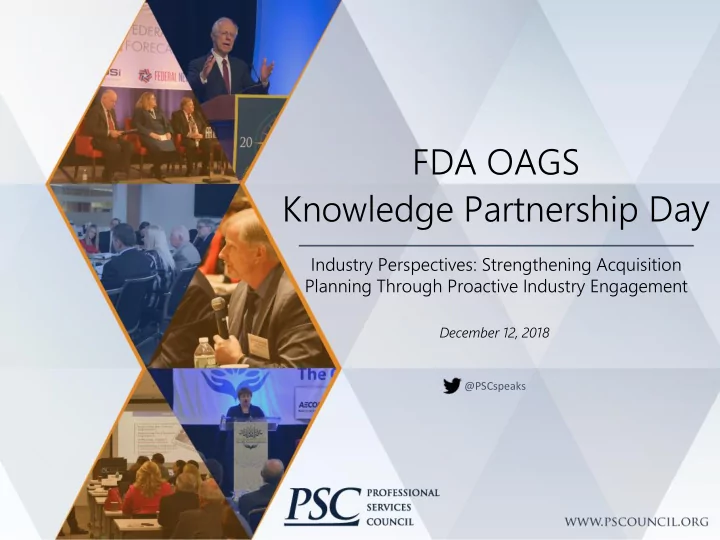
FDA OAGS Knowledge Partnership Day

Industry Perspectives: Strengthening Acquisition Planning Through Proactive Industry Engagement

December 12, 2018

@PSCspeaks

slide-2
SLIDE 2

About t th the Professional Se Servic ices Council il

2

The Professional Services Council (PSC) is the voice of the government technology and professional services industry, representing the full range and diversity of the government services sector. PSC is the most respected industry leader on legislative and regulatory issues related to government acquisition, business and technology. PSC helps shape public policy, leads strategic coalitions, and works to build consensus between government and industry. PSC’s more than 400 member companies represent small, medium, and large businesses that provide federal agencies with services of all kinds, including information technology, engineering, logistics, facilities management, operations and maintenance, consulting, international development, scientific, healthcare, environmental services, and more. Together, the trade association’s members employ hundreds of thousands of Americans in all 50 states.

  • Founded in 1972
  • Five Councils
  • Acquisition Business Policy
  • Technology
  • Defense & Intelligence
  • Civilian
  • International Development
  • Three Core Functions
  • Advocate
  • Educate
  • Facilitate

Technology Defense & Intelligence Acquisition Business Policy Civilian Agencies International Development

slide-3
SLIDE 3

In Industry ry Panelis ists

3

  • John Larkin, Atlas Research, LLC (Small - SDVOSB)
  • Kathy Taylor, DRT Strategies (Woman-Owned)
  • Andy Cohen, Salient CRGT (Mid-Tier)
  • Julie Hunter, IBM (Large)
  • Moderator: Bradley Saull, PSC
slide-4
SLIDE 4
  • What is the brand or reputation among industry about

FDA?

  • How can FDA reach out to industry within the allowable

rules?

  • What are the rules of engagement?
  • What is GovWin / Bloomberg Government?
  • Should I talk with them if they call me?
  • What is the role of forecasts in industry planning?
  • How can we better market to small business and other

set-asides to meet our goals?

Topics Requested from FDA Staff

Federal employees and contractors must work together to best support healthy outcomes.

4

slide-5
SLIDE 5

Choic ice of In Instrument – Contract or Grant?

  • The Federal Grant and Cooperative Agreement Act of 1977 (41 USC

501) guides government agencies in their use of federal funds to distinguish between contracts, grants, and cooperative agreements.

  • The central issue is the “principal purpose” of the action or relationship.
  • Principal Purpose
  • For federal grants, the principal purpose is to transfer something to “carry
  • ut a public purpose of support or stimulation authorized by a law.”
  • For federal contracts, the principal purpose is “to acquire . . . property or

services for the direct benefit or use of the United States Government.”

  • Contract Type
  • PSC Taxonomy for Services Contracts
  • Different Tools = Different Partners
  • Some private sector companies bid on both grants & contracts; however,

many companies do not compete for work when a grant mechanism is used instead of a contract.

5

Be the Trusted Business Advisor to Program Offices on which Tool is Appropriate

slide-6
SLIDE 6

Government/I /Industry ry Actio ions Alo long Program Li Lifecycle

Government/Buyer Industry/Seller

6

slide-7
SLIDE 7

In Industry ry Pre-Award Actions Alo long Program Lif ifecycle

1. Understand the Need 2. Define Requirements 3. Market Research/RFI Response 4. Formulate Team 5. Industry Day/Objective 6. Prepare Proposal 7. Debriefing

7

Government/Buyer Industry/Seller

slide-8
SLIDE 8

Post-Award Actio ions Alo long Program Lif ifecycle

  • 1. Onboard Staff
  • 2. Program Execution
  • 3. Contract Administration
  • 4. Invoice/Payment
  • 5. Recompetition/Exercise

Options

  • 6. Contract Closeout

8

Industry/Seller Government/Buyer

slide-9
SLIDE 9

Capture Team & Management Lead Evolu lution

“Corporate” Staff

Contracts Subcontracts Pricing Accounting Talent Acquisition

Business Development

Marketing Manager Marketing Analyst Sales Manager Capture Manager

Proposal Development

Technical Proposal Manager Production Manager Writing Graphics

Line Operations

Solution Architect Proposal Authors Program Manager Capture Team

Capture Manager Marketing Manager Proposal Manager Program Manager Solution Architect

Long-Term Positioning Identification & Assessment Strategy Proposal Performance 9

slide-10
SLIDE 10

What’s With All of the Colors?

  • Most companies use a structured business development process
  • Designed to increase win probability and keep bid and proposal costs down
  • Systematic gate reviews along acquisition lifecycle based on known info
  • Color reviews* occur during the proposal development process; early

reviews can occur before RFP is released

Gate Reviews Exist at Multiple Points

10

*Drawn from Shipley Associates as one example

slide-11
SLIDE 11

Competing for Resources Wit ithin the Company

11

Opportunity Name Pipeline Priority RFP Release Date RFP Due Date Expected Award Date Expected Value

HHS Do Cool Things BAA

1 10/10/2018 12/7/2018 9/30/2019 $10M

CMS Agile Work

2 3/29/2019 4/29/2019 5/31/2019 $700K

CDC Pandemic Modeling

3 1/15/2019 3/1/2019 6/28/2018 $1.5M

NIH NCI Research Support Services

4 6/10/2019 7/10/2019 9/30/2019 $1M

DHA Wellness Program

5 3/15/2019 4/29/2019 9/30/2019 $3M

FDA Tobacco Control

6 12/15/2018 1/15/2019 4/30/2019 $500K Generally, higher priority items have more insight into scope and customer needs, but could also be strategic. Does the timing conflict with our other priorities? What if the timeline of your opportunity slips one or two months?

slide-12
SLIDE 12

Analy lyzing the Competit itiv ive Landscape

12

Evaluation Factors Innovate R Us Cheap Cheap The Big Dog Ol’ Faithful Our Company

Technical Understanding & Capability

4 3 4 4 4

Technical Experience

3 3 4 5 3

Management Approach

3 3 4 3 3

Past Performance

2 3 4 5 4

SB Utilization

5 5 5 5 5

Price

2 5 3 4 4

Total 19 22 24 26 23

While this company is 3rd on the list competitively, they want to increase their technical

understanding and management approach with a further customer conversation to validate and vet some of their ideas on the solution to see if they are on the right track.

FDA Tobacco Control Support Services

slide-13
SLIDE 13

In Industry ry Vie iew of FDA Acquisit ition Envir ironment

13

▪ About $1.6 billion in obligations annually; small business set-aside goal of 40% and achieved goal for each of the past seven years; FDA is small business friendly ▪ Top priorities for Office of Acquisition & Grants Services (OAGS) include: ▪ Greater adoption of Category Management; this is a Department mandate ▪ Ensuring contracting officers and specialists have necessary skills and tools; turnover drives need for new hiring and training ▪ The following vehicles will help industry compete at the FDA: NITAAC, SEWP, IT 70, OASIS, MOBIS

▪ FDA may employ more GWACs as Agency multi-award BPAs expire in the near future

▪ Acquisition planning occurring earlier in cycle. Centers/Offices increasingly need to backwards plan to achieve timely acquisition. ▪ FDA forecast part of HHS forecast - https://procurementforecast.hhs.gov/Contract - not current ▪ FDA does not have OTA (other transaction authority) at this time.

slide-14
SLIDE 14

FDA’s Perceived Messages to Industry

14

▪ If you promise something in your proposal, be prepared to deliver. ▪ Don’t forget to focus on change management. Rolling out new or enhanced software requires time and energy to convert users. ▪ Understand the customer. Please don’t come to the government to get educated on what the FDA does. ▪ For incumbents: Train your delivery staff. They should keep learning and bringing new skills and ideas to the government. ▪ Share innovations. Show how new technologies can work for the

  • government. Combining your value proposition with successful past

performance is more meaningful. ▪ Ask questions of the government. An industry forum may be a more powerful way to ask a question than as an individual firm.

slide-15
SLIDE 15

Se Sele lect FD FDA Contr tract Vehicle Use FY FY2015-17 17

15

slide-16
SLIDE 16

FDA: FY18 Spending by Top 10 Professional Service Categories

16

slide-17
SLIDE 17

Evalu luation Crit iteria ia (Section M)

  • Evaluation criteria has a significant impact on competition and

acquisition outcomes

  • Order of factors is important
  • Use a meaningful rating system that justifies decisions
  • Use criteria that matter for execution not just for source selection
  • Identify the discriminators
  • What would you be willing to pay more for, if anything?
  • Does the evaluation criteria reflect those discriminators?
  • If innovation is desired, is innovation addressed in requirements and in

evaluation criteria?

  • Trade Offs
  • Best Value vs. LPTA
  • Past Performance/Experience
  • Management vs. Technical Excellence
  • Does small business utilization matter? Does the solicitation describes how

this will be evaluated?

  • Who you have on source selection committee is key
  • Make sure they understand the mission impact of program
  • Should not simply be who is available to work on a source selection

17

slide-18
SLIDE 18

Understandin ing the Need (Section C)

Conduct Robust Market Research

  • Appropriate Use of RFIs and draft RFPs
  • Pre-RFP meet with leading vendors to better communicate the

need and learn about industry trends

  • “Free ideas” as part of market research
  • It’s allowed

Define Requirements

  • Engage and collaborate with all internal agency stakeholders
  • Conduct industry exchanges
  • Consider using a Statement of Objectives vs. Statement of Work

18

slide-19
SLIDE 19

Pric icin ing (Section B)

  • Providing Section B in advance will allow comments from industry that give

insight into the best way to provide pricing

  • Does Section B align with Section C?
  • Understanding Importance
  • Services vs. Products; Contract Type; Period of Performance; Risk Assessment
  • The more complete and exact the requirement is written, the more confidence in

the price and the lower the price contingencies

  • Innovative Pricing Willingness & Strategies
  • Does the solicitation require innovative pricing? e.g. consumption-based buying
  • Program managers want mission outcomes
  • Pricing can align program managers, contracting officers, and industry to mission
  • Innovative pricing requires flexibility in RFP pricing requirements
  • Some in industry like innovative pricing; others do not
  • Understanding Industry Price-To-Win Strategies & Probability of Win (PWIN)

formula

  • Price to Win vs. Price to Execute
  • Price to Win is an Art
  • When done right, both government & industry win
  • Need/requirements drive price
  • Price to Win is developed very early in acquisition (way before the RFP is out)

19

slide-20
SLIDE 20

Organizing & Formatting a Solicitation (Section L)

  • Sections B & C must align with sections L & M
  • For more consistently organized proposals, Sections L & M must directly

align.

  • Consider page count requirements when mapping Sections C and L
  • Request only what you will evaluate and expect to execute
  • Industry notices the copy/paste instructions (and will therefore also copy

and paste)

  • The more specific the instructions, the more specific content you may expect

to receive

  • Therefore, the more likely contractors will adhere to the instructions
  • Break apart large factors into sub-factors
  • During Q&A on any section, please answer questions in detail and avoid

cross-referencing to other questions that have boilerplate answers or refer to the solicitation

20

slide-21
SLIDE 21

Recommendations

  • Communication
  • Don’t be afraid to pick up the phone
  • Follow-up on the outcome of an RFI
  • Provide Section B in advance to allow comments from industry

that give insight into innovative pricing strategies

  • Include sections B, C, L & M in draft RFPs as soon as possible
  • More information is better than less – even if it changes
  • Use evaluation criteria that matters for execution not just for

source selection

  • Identify source selection committee evaluators who

understand the mission impact of program

  • Consistency across FDA on communication & small business

policies would be appreciated.

21

slide-22
SLIDE 22

Key y In Industry ry Messages

  • Industry has an acquisition process that parallels government
  • Significant government & industry work occurs before the RFP is released
  • Timelines impact quality of response; neither side has unlimited time or

resources

  • A Bid or No-Bid determination involves multiple company

stakeholders

  • Business units within companies vie for proposal resources
  • Early, accurate, and robust communication = Better teaming, better

proposals, better solutions, and better execution

Federal employees and contractors must work together to best support healthy outcomes.

22

slide-23
SLIDE 23

Cont

  • ntact

ct Us Bradley Saull

Vice President for Civilian Agencies Saull@pscouncil.org

23

slide-24
SLIDE 24

Ap Appendix pendix

24

slide-25
SLIDE 25

Addit itional Resources

  • OMB
  • Mythbusters Memo #1, February 2011
  • Mythbusters Memo #2, May 2012
  • Mythbusters Memo #3, January 2017
  • Professional Services Council
  • Government Resources
  • PSC Taxonomy for Services Contracts
  • Standardized Past Performance Information Collection Forms
  • Independent Government Cost Estimate Matrix
  • Innovation Template
  • PSC Acquisition Policy Survey & PSC CIO Survey
  • Delivering Results: A Framework for Federal Government Technology

Access & Acquisition

  • PSC Acquisition and Technology Policy Agenda

Visit - https://www.pscouncil.org/govresources

25

slide-26
SLIDE 26

@PSCspeaks