Knowledge base for the wumpus world Perception b, g, t Percept ([ - - PowerPoint PPT Presentation

knowledge base for the wumpus world
SMART_READER_LITE
LIVE PREVIEW

Knowledge base for the wumpus world Perception b, g, t Percept ([ - - PowerPoint PPT Presentation

Knowledge base for the wumpus world Perception b, g, t Percept ([ Smell, b, g ] , t ) Smelt ( t ) s, b, t Percept ([ s, b, Glitter ] , t ) AtGold ( t ) Reflex: t AtGold ( t ) Action ( Grab, t ) Reflex with internal


slide-1
SLIDE 1

Knowledge base for the wumpus world

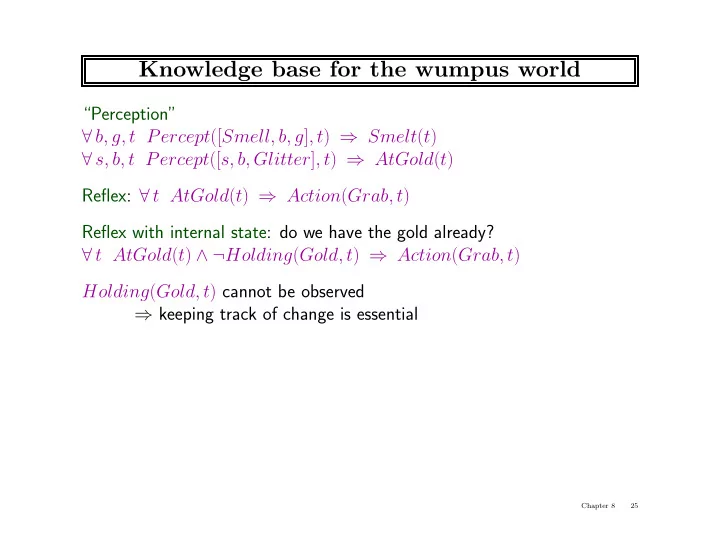
“Perception” ∀ b, g, t Percept([Smell, b, g], t) ⇒ Smelt(t) ∀ s, b, t Percept([s, b, Glitter], t) ⇒ AtGold(t) Reflex: ∀ t AtGold(t) ⇒ Action(Grab, t) Reflex with internal state: do we have the gold already? ∀ t AtGold(t) ∧ ¬Holding(Gold, t) ⇒ Action(Grab, t) Holding(Gold, t) cannot be observed ⇒ keeping track of change is essential

Chapter 8 25

slide-2
SLIDE 2

Deducing hidden properties

Properties of locations: ∀ x, t At(Agent, x, t) ∧ Smelt(t) ⇒ Smelly(x) ∀ x, t At(Agent, x, t) ∧ Breeze(t) ⇒ Breezy(x) Squares are breezy near a pit: Diagnostic rule—infer cause from effect ∀ y Breezy(y) ⇒ ∃ x Pit(x) ∧ Adjacent(x, y) Causal rule—infer effect from cause ∀ x, y Pit(x) ∧ Adjacent(x, y) ⇒ Breezy(y) Neither of these is complete—e.g., the causal rule doesn’t say whether squares far away from pits can be breezy Definition for the Breezy predicate: ∀ y Breezy(y) ⇔ [∃ x Pit(x) ∧ Adjacent(x, y)]

Chapter 8 26

slide-3
SLIDE 3

Keeping track of change

Facts hold in situations, rather than eternally E.g., Holding(Gold, Now) rather than just Holding(Gold) Situation calculus is one way to represent change in FOL: Adds a situation argument to each non-eternal predicate E.g., Now in Holding(Gold, Now) denotes a situation Situations are connected by the Result function Result(a, s) is the situation that results from doing a in s

PIT PIT PIT

Gold

PIT PIT PIT

Gold

S0 Forward S1

Chapter 8 27

slide-4
SLIDE 4

Describing actions I

“Effect” axiom—describe changes due to action ∀ s AtGold(s) ⇒ Holding(Gold, Result(Grab, s)) “Frame” axiom—describe non-changes due to action ∀ s HaveArrow(s) ⇒ HaveArrow(Result(Grab, s)) Frame problem: find an elegant way to handle non-change (a) representation—avoid frame axioms (b) inference—avoid repeated “copy-overs” to keep track of state Qualification problem: true descriptions of real actions require endless caveats— what if gold is slippery or nailed down or . . . Ramification problem: real actions have many secondary consequences— what about the dust on the gold, wear and tear on gloves, . . .

Chapter 8 28

slide-5
SLIDE 5

Describing actions II

Successor-state axioms solve the representational frame problem Each axiom is “about” a predicate (not an action per se): P true afterwards ⇔ [an action made P true ∨ P true already and no action made P false] For holding the gold: ∀ a, s Holding(Gold, Result(a, s)) ⇔ [(a = Grab ∧ AtGold(s)) ∨ (Holding(Gold, s) ∧ a = Release)]

Chapter 8 29

slide-6
SLIDE 6

Making plans

Initial condition in KB: At(Agent, [1, 1], S0) At(Gold, [1, 2], S0) Query: Ask(KB, ∃ s Holding(Gold, s)) i.e., in what situation will I be holding the gold? Answer: {s/Result(Grab, Result(Forward, S0))} i.e., go forward and then grab the gold This assumes that the agent is interested in plans starting at S0 and that S0 is the only situation described in the KB

Chapter 8 30

slide-7
SLIDE 7

Making plans: A better way

Represent plans as action sequences [a1, a2, . . . , an] PlanResult(p, s) is the result of executing p in s Then the query Ask(KB, ∃ p Holding(Gold, PlanResult(p, S0))) has the solution {p/[Forward, Grab]} Definition of PlanResult in terms of Result: ∀ s PlanResult([ ], s) = s ∀ a, p, s PlanResult([a|p], s) = PlanResult(p, Result(a, s)) Planning systems are special-purpose reasoners designed to do this type of inference more efficiently than a general-purpose reasoner

Chapter 8 31

slide-8
SLIDE 8

Summary

First-order logic: – objects and relations are semantic primitives – syntax: constants, functions, predicates, equality, quantifiers Increased expressive power: sufficient to define wumpus world Situation calculus: – conventions for describing actions and change in FOL – can formulate planning as inference on a situation calculus KB

Chapter 8 32