Key Legal Considerations Navigating Corporate Practice of Medicine - - PowerPoint PPT Presentation

key legal considerations
SMART_READER_LITE
LIVE PREVIEW

Key Legal Considerations Navigating Corporate Practice of Medicine - - PowerPoint PPT Presentation

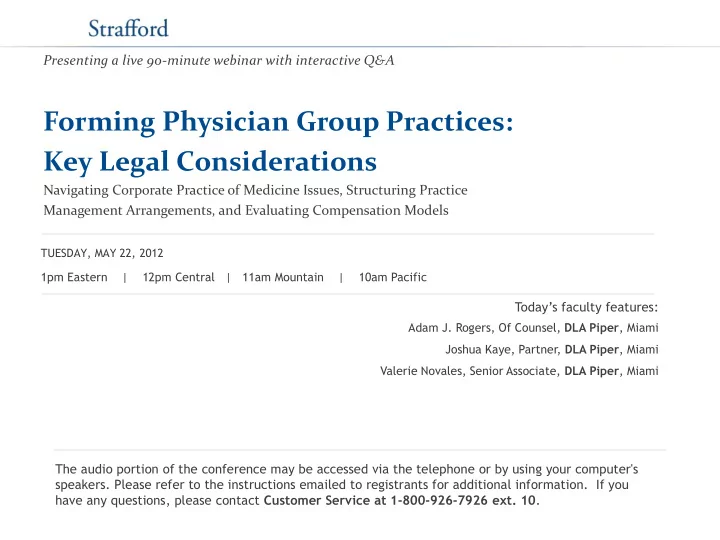
Presenting a live 90-minute webinar with interactive Q&A Forming Physician Group Practices: Key Legal Considerations Navigating Corporate Practice of Medicine Issues, Structuring Practice Management Arrangements, and Evaluating Compensation


slide-1
SLIDE 1

Forming Physician Group Practices: Key Legal Considerations

Navigating Corporate Practice of Medicine Issues, Structuring Practice Management Arrangements, and Evaluating Compensation Models

Today’s faculty features:

1pm Eastern | 12pm Central | 11am Mountain | 10am Pacific

The audio portion of the conference may be accessed via the telephone or by using your computer's

  • speakers. Please refer to the instructions emailed to registrants for additional information. If you

have any questions, please contact Customer Service at 1-800-926-7926 ext. 10.

TUESDAY, MAY 22, 2012

Presenting a live 90-minute webinar with interactive Q&A

Adam J. Rogers, Of Counsel, DLA Piper, Miami Joshua Kaye, Partner, DLA Piper, Miami Valerie Novales, Senior Associate, DLA Piper, Miami

slide-2
SLIDE 2

Conference Materials

If you have not printed the conference materials for this program, please complete the following steps:

  • Click on the + sign next to “Conference Materials” in the middle of the left-

hand column on your screen.

  • Click on the tab labeled “Handouts” that appears, and there you will see a

PDF of the slides for today's program.

  • Double click on the PDF and a separate page will open.
  • Print the slides by clicking on the printer icon.
slide-3
SLIDE 3

Continuing Education Credits

For CLE purposes, please let us know how many people are listening at your location by completing each of the following steps:

  • In the chat box, type (1) your company name and (2) the number of

attendees at your location

  • Click the SEND button beside the box

FOR LIVE EVENT ONLY

slide-4
SLIDE 4

Tips for Optimal Quality

Sound Quality If you are listening via your computer speakers, please note that the quality of your sound will vary depending on the speed and quality of your internet connection. If the sound quality is not satisfactory and you are listening via your computer speakers, you may listen via the phone: dial 1-866-927-5568 and enter your PIN -when prompted. Otherwise, please send us a chat or e-mail sound@straffordpub.com immediately so we can address the problem. If you dialed in and have any difficulties during the call, press *0 for assistance. Viewing Quality To maximize your screen, press the F11 key on your keyboard. To exit full screen, press the F11 key again.

slide-5
SLIDE 5

Forming Physician Group Practices: Key Legal Considerations

  • Na

Navi viga gating ting Corp

  • rpora
  • rate

te Prac Practice of tice of Me Medicine dicine Iss Issue ues

  • Str

Structuring Pr ucturing Practice actice Ma Manag nagement ement Arrangemen rrangements ts

  • Evaluating

Evaluating C Comp

  • mpen

ensation sation Mod

  • dels

els Joshua M. Kaye Adam J. Rogers Valerie Novales joshua.kaye@dlapiper.com adam.rogers@dlapiper.com valerie.novales@dlapiper.com DLA Piper (US) LLP 200 S. Biscayne Boulevard, Suite 2300 Miami, FL 33131 305.423.8500

slide-6
SLIDE 6

6

  • Group Formation
  • Selecting appropriate legal entity
  • Tax issues
  • Physician Compensation In Group Practices
  • Professional compensation
  • Compensation for ancillary services
  • Mergers and Acquisitions
  • Determining purchase price
  • Key deal terms
  • Physician employment contract issues
  • Hospital, Private Equity and Other Non-Physician

Participation

  • Corporate practice of medicine and fee splitting
  • Management agreements
  • Impact of health reform
  • Q&A

Overview

slide-7
SLIDE 7

7

Group Formation

slide-8
SLIDE 8

8

Group Formation Considerations

  • Reasons For Forming or Joining a Physician Group Practice
  • Ancillary Services
  • Economies of Scale
  • Ensure patient coverage, sharing call responsibilities
  • Increased leverage in negotiating contracts
  • Lower risk for new physicians
slide-9
SLIDE 9

9

Group Formation Considerations

  • Preliminary Considerations
  • Partners, Specialties, Level of Integration
  • Choice of Entity
  • Tax Issues
  • Initial Election
  • Transaction Considerations
  • Governing Documents
  • Benefits Issues
  • EHR
slide-10
SLIDE 10

10

Group Formation Considerations

  • Professional Compensation Structuring
  • Personally performed services
  • Ancillary Services
  • Challenges of Non-Physician Ownership
  • Corporate Practice of Medicine
  • Fee Splitting
  • Others
slide-11
SLIDE 11

11

Physician Compensation In Group Practices

slide-12
SLIDE 12

12

Physician Compensation in Group Practices

  • Personally Performed
  • “eat what you kill” – revenue from personally performed services

less overhead

  • Methodologies for allocating overhead are key:
  • Pro rata
  • Direct expenses plus share of fixed costs
  • Base salary or draw with productivity bonuses (or downward

adjustments for low productivity)

  • Guaranteed salaries (typically only found in recruitment

arrangements or hospital affiliated groups)

  • Ancillary
  • Stark Law State “baby Stark” laws Fee Splitting (e.g. Florida’s

Crow decision)

slide-13
SLIDE 13

13

Determination of Compensation

  • Percentage of collections (minus overhead) (i.e. “eat what you

kill” or some portion therof)

  • Based on survey or market information for physician’s

specialty in the locality and anticipated productivity (wRVU’s)

  • Base compensation is often set by the physician’s historic production

and supplemented by bonus for meeting personal productivity targets.

  • Group should also retain right to adjust compensation for productivity

that falls significantly below expectations

  • Other factors:
  • “Incident to” services and supervision of MLPs
  • Quality measures
  • Patient satisfaction
slide-14
SLIDE 14

14

Physician Compensation and the Stark Law

  • Stark Law General Prohibition – Physician may not make a referral

to an entity for the furnishing of designated health services (“DHS”) that may be covered by Medicare if the physician (or an immediate family member of the physician) has a direct or indirect financial relationship with the entity (such entity is the “DHS Entity”)

  • Strict liability – if financial relationship exists, then must meet an

exception

  • Exceptions most relevant to group practices:
  • In-Office Ancillary Services Exception
  • Bona Fide Employment Relationships
  • Personal Services Arrangements
  • Potential sanctions: Recoupment, Civil monetary fines, federal

program exclusion, False Claims Act Liability

slide-15
SLIDE 15

15

Stark Law’s In-Office Ancillary Services Exception – Elements

  • Performance/Supervision
  • Location
  • Same Building
  • Centralized Building
  • Billing
slide-16
SLIDE 16

16

Stark Law’s In-Office Ancillary Services Exception – Group Practice Defined

  • Meeting Stark’s “Group Practice” definition critical for group

practices to qualify for the In-Office Ancillary Services exception and to be able to pay physicians productivity bonuses that include DHS profits

  • A group of physicians practicing together does not necessarily

qualify as a “Group Practice” under Stark

  • Single legal entity operating a unified business
  • 2 or more “members”
  • “Members” furnish substantially all services through group (HPSA exceptions)
  • Income and Expense allocation determined prospectively
  • Others (range of services, patient encounters, volume/value)
  • Productivity Bonuses and Profit Shares paid in accordance

with 42 CFR § 411.352(i)

slide-17
SLIDE 17

17

Group Practice Productivity Bonuses and Profit Shares

  • A physician may be paid:
  • a share of the practice’s overall profits; and
  • a productivity bonus for services personally performed or for

services incident to personally performed services

  • neither profit share nor productivity bonus can be determined in

any manner that is directly related to the volume or value of the physician’s referrals for DHS (other than DHS referrals “incident to” a physician’s personally performed services)

slide-18
SLIDE 18

18

Productivity Bonuses

  • Personal services or services incident to the physician’s

services

  • Calculated using a reasonable and verifiable methodology

unrelated to the volume or value of the physician’s DHS referrals

  • 3 enumerated methodologies for productivity bonuses
  • Based on patient encounters or wRVUs
  • Based on allocation of physician’s compensation attributable to

non-DHS services

  • Revenues from DHS are less than 5% of Group’s total

revenues and each physician’s allocation is less than 5% of total compensation

  • Be prepared to show your math (to the Secretary)
slide-19
SLIDE 19

19

Profit Shares

  • The Group’s entire profits derived from DHS payable by

Medicare or Medicaid; or

  • The profits from DHS from any component of the group that

consists of at least 5 physicians

  • Must be a verifiable and reasonable methodology for the

division that is not related to the volume or value of DHS referrals

  • 3 enumerated methodologies for profit shares
  • per capita
  • Based on allocation of physician’s compensation attributable to

non-DHS services

  • 5% tests
slide-20
SLIDE 20

20

Stark Law’s Personal Services Arrangements and Employment Relationships Exceptions

  • Employment Exception:
  • bona fide employment for identifiable services compensated at FMV
  • does not take into account (directly or indirectly) the volume/value of any

referrals by the employed physician (productivity bonus excepted)

  • compensation provided pursuant to agreement that would be commercially

reasonable in the absence of referrals

  • Personal Services Arrangements:
  • signed writing specifying the services (and all services between parties) required
  • term of at least 1 year
  • compensation set in advance at FMV, not taking into account the volume/value
  • f referrals by the contracted physician or other business generated between

the parties

  • aggregate services contracted for do not exceed what is reasonable and

necessary for the legitimate business purposes of the arrangement and do not involve the promotion of a business that violates any law

  • holdovers okay (up to 6 months)
slide-21
SLIDE 21

21

Physician Compensation: One-Size Does Not Fit All

  • Group preferences for methodologies and structure of

compensation vary

  • Business objectives and legal compliance often at odds
  • As reimbursement and regulation continues to change and

evolve, compensation should be reviewed frequently to ensure viability of Group’s methodology

slide-22
SLIDE 22

22

Mergers & Acquisitions

slide-23
SLIDE 23

23

Determining Determining Pu Purch rchase ase Price Price

  • Roll-Up
  • Typically, no consideration paid to physicians/practices that join

the group

  • Might be reimbursed at book value
  • Goodwill payment?
  • True M&A (private equity, strategic, or hospital buyer)
  • EBITDA multiple
  • Physician buy-out events & unwinding
  • “For Cause” vs. “without cause” vs. disability/retirement
  • Importance of clarity in governing document
  • Terms (staggered payout, life insurance, price)
slide-24
SLIDE 24

24

Determining Determining Pu Purch rchase ase Price Price

  • Valuation Methodologies:
  • Discounted Cash Flow (ancillaries only?)
  • Net Book value (more common for roll-ups or in physician-to-

physician deals)

  • Appraised value
  • Physician compensation package can be a significant factor
slide-25
SLIDE 25

25

Key D Key Dea eal T l Terms & erms & Issu Issues es

  • Confidentiality Agreement
  • Exclusivity/“No shop” clause
  • Termination
  • Letter of Intent/Term Sheet
  • Representations and Warranties
  • Condition of practice
  • Corporate and regulatory housekeeping
  • Restrictive Covenants
  • Non-compete
  • Non-solicit
  • Non-disparagement
slide-26
SLIDE 26

26

Key D Key Dea eal T l Terms & erms & Issu Issues es

  • Structure considerations
  • What will the new group look like?
  • Financial arrangements
  • Ancillary services – sharing of revenue/expenses
  • Personnel
  • Reducing/compensating staff
  • Single administrator
  • Employee benefits/policies
slide-27
SLIDE 27

27

Key D Key Dea eal T l Terms & erms & Issu Issues es

  • Plan for post-closing issues
  • Regulatory consents & approvals
  • Medicare/Medicaid provider numbers
  • Notice to third party payors
  • Retain insurance coverage
  • Integration of practice management & EMR systems
slide-28
SLIDE 28

28

Deal Structure Particulars

  • Asset Purchase
  • Physician Employee Model
  • Foundation Model
  • Stock Purchase
  • Merger
slide-29
SLIDE 29

29

HAPG Health Care System Hospital Multispecialty Physician Practice Employees

FMV Purchase Price Assets

Physicians Become Employees of Hospital Affiliated Physician Group

Direct Practice Acquisition (Asset Deal)

slide-30
SLIDE 30

30

Foundation Model Schematic

Affiliated Hospital

100% Membership PSA

Medical Foundation

Multispecialty Group Practice

Third Party Payors

Managed Care Contracts

Group Practice Group Practice

PSA PSA

slide-31
SLIDE 31

31

Foundation Model (Cont.)

  • Pros:
  • Retention of provider billing numbers & key relationships
  • Foundation handles billing for the Professional Services
  • Foundation pays the Physician Practice pursuant to an agreed

compensation formula

  • Cons:
  • May be difficult to return practice to its status quo
  • Less complete integration (compared to other JV structures or the

employment model)

slide-32
SLIDE 32

32

Physician Employment Contracts

  • Key Terms:
  • Terms and renewal period (is the a probation period?)
  • Duties: On-call terms, supervision or admin tasks
  • Compensation package (& path to ownership?)
  • Vacation/sick/CME time
  • Professional liability insurance
  • Patient records (maintenance and access)
  • Termination events
  • Restrictive Covenants
slide-33
SLIDE 33

33

Hospital, Private Equity and Other Non-Physician Participation

slide-34
SLIDE 34

34

  • Confluence of Events Have Led to a Surge in Healthcare

Investments and M&A Generally

  • Multispecialty Group Practices Can Position Themselves Well

as the Landscape of Healthcare Changes

  • State of the (U.S. Healthcare) Union:
  • In 2009 Total Health Expenditures Reached $2.5 Trillion, Which

Translates to 17.6 Percent of the Nation's Gross Domestic Product*

  • According to a June 2010 Commonwealth Fund Report, Americans

Spend Twice as Much as Residents of Other Developed Countries on Healthcare, but Get Lower Quality and Less Efficiency

  • Providers Will Be Asked to “Do More With Less”
  • Multispecialty Physician Practices and Their Investors Can Benefit

from Shift Toward Greater Clinical Integration

*http://www.cms.gov/NationalHealthExpendData/02_NationalHealthAccountsHistorical.asp#TopOfPage

Hospital, Private Equity and Other Non-Physician Participation

slide-35
SLIDE 35

35

  • Hospitals
  • Currently, the Most Active Player in Multispecialty Physician

Practice Mergers, Acquisitions and Affiliations/Investments

  • Not Limited to For Profit Hospitals/Systems
  • Potential Antitrust Issues
  • Private Equity
  • Physician Practice Investments Have Generally Been Focused on

Hospital (or Facility)-Based Physicians (e.g., Anesthesia, Radiology, Hospitalists)

  • Focus on Healthcare Increasing and Uptick in Hospital Investment

Will Expose Investors to More Practice Acquisitions and Opportunities

  • Other Investors

Hospital, Private Equity and Other Non-Physician Participation

slide-36
SLIDE 36

36

  • Corporate Practice of Medicine
  • Most States Still Have Laws Prohibiting, to Varying Degrees, the

“Corporate Practice of Medicine” (“CPOM”)

  • CPOM States Generally Prevent Unlicensed Lay Entities from

Employing Physicians or Otherwise Contracting with Physicians to Furnish Medical Care

  • CPOM Laws May Limit the Flexibility of Physicians and Non-

Physicians to Structure Ownership and Employment Arrangements

  • Some States with Strong CPOM Laws (e.g., California,

Nevada, and Texas) Even Prohibit Hospitals from Employing Physicians, but Have Laws Permitting Nonprofit “medical foundations” to Engage Physicians (e.g., Through Their Existing Medical Group) Indirectly to Provide Medical Care

Regulatory Barriers to Non-Physician Participation

slide-37
SLIDE 37

37

Regulatory Barriers to Non-Physician Participation

  • Fee-Splitting
  • Typically Defined to Include Unearned Division of Professional

Medical Fee with Layperson/Lay Entity and/or Payment for Referrals

  • Some States Without CPOM Prohibition Still Have Fee-Splitting

Limitations that Can be Triggered by Certain Non-Physician Participation Models (e.g. Florida)

  • Documentation of Fair Market Value of Services is Key
  • Others
  • Investments and Business Models in States with These

Barriers Will Require Careful Regulatory Analysis to Minimize Regulatory Risk

slide-38
SLIDE 38

38 100% ownership

1 Physician licensed in applicable state, generally will enter into a stock transfer restriction agreement (or have same incorporated into MSC), but stock transfer

restrictions are prohibited in some jurisdictions (e.g., New York)

2 Management Company is typically either the former practice entity (and medical assets are spun out into new practice entity), which is acquired by the non-

physician investor(s) or is a NEWCO that acquires the non-medical assets. It then provides the Mutlispecialty Physician Practice with use of those assets (typically including real estate – whether owner or leased) and turnkey management and administrative services

3 Has provider number(s), payor contracts, employs and/or contracts with physicians

Fair Market Value Management Fee Long-Term Management Services Contract (“MSC”) 2

Non-Physician Investor(s) Management Company Friendly Physician1 Multispecialty Physician Practice3

100% ownership

Management Model

slide-39
SLIDE 39

39

Management Model (Cont.)

  • Management Agreement Terms are Key to Success of

Arrangement

  • Pros
  • In CPOM States, Allows for Non-Physician “Ownership” of Practice
  • Subsequent Transactions at Management Company Level Have

Minimal Impact on Practice

  • Cons
  • Risks of Friendly Physician
  • Can Be Limitations On Management Fees
slide-40
SLIDE 40

Forming Physician Group Practices: Key Legal Considerations

  • Na

Navi viga gating ting Corp

  • rpora
  • rate

te Prac Practice of tice of Me Medicine dicine Iss Issue ues

  • Str

Structuring Pr ucturing Practice actice Ma Manag nagement ement Arrangemen rrangements ts

  • Evaluating

Evaluating C Comp

  • mpen

ensation sation Mod

  • dels

els Joshua M. Kaye Adam J. Rogers Valerie Novales joshua.kaye@dlapiper.com adam.rogers@dlapiper.com valerie.novales@dlapiper.com DLA Piper (US) LLP 200 S. Biscayne Boulevard, Suite 2300 Miami, FL 33131 305.423.8500