KEY DATES 28 th NOVEMBER 11 th JANUARY POETRY REVISION THURSDAY - - PowerPoint PPT Presentation

key dates
SMART_READER_LITE
LIVE PREVIEW

KEY DATES 28 th NOVEMBER 11 th JANUARY POETRY REVISION THURSDAY - - PowerPoint PPT Presentation

KEY DATES 28 th NOVEMBER 11 th JANUARY POETRY REVISION THURSDAY 12 TH JANUARY (5.45PM) Y10 ENGLISH LITERATURE REVISION INFORMATION WEEK COMMENCING 6 TH FEBRUARY PARENT/STUDENT WALKING TALKING MOCK WEDNESDAY 15 TH


slide-1
SLIDE 1

KEY DATES

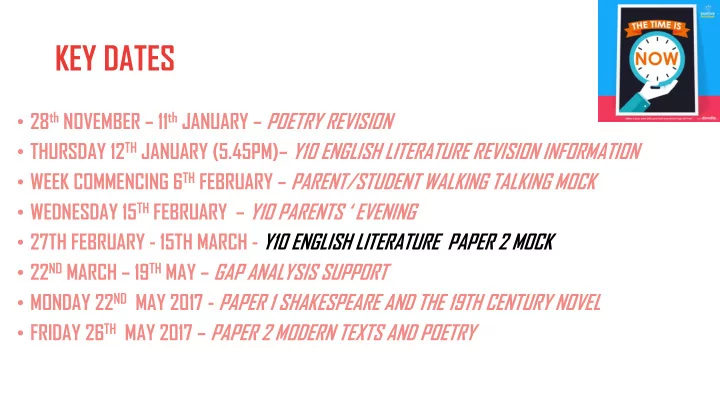
  • 28th NOVEMBER – 11th JANUARY – POETRY REVISION
  • THURSDAY 12TH JANUARY (5.45PM)– Y10 ENGLISH LITERATURE REVISION INFORMATION
  • WEEK COMMENCING 6TH FEBRUARY – PARENT/STUDENT WALKING TALKING MOCK
  • WEDNESDAY 15TH FEBRUARY – Y10 PARENTS ‘ EVENING
  • 27TH FEBRUARY - 15TH MARCH - Y10 ENGLISH LITERATURE PAPER 2 MOCK
  • 22ND MARCH – 19TH MAY – GAP ANALYSIS SUPPORT
  • MONDAY 22ND MAY 2017 - PAPER 1 SHAKESPEARE AND THE 19TH CENTURY NOVEL
  • FRIDAY 26TH MAY 2017 – PAPER 2 MODERN TEXTS AND POETRY
slide-2
SLIDE 2

How can you support your child with planning a response to an exam question

  • n Romeo and Juliet?
  • Your child should spend 45 minutes on this question in the exam.

Starting with the extract, explain how Shakespeare presents conflict in the play. (30 marks + 4marks for SPaG) Write about:

  • How Shakespeare presents conflict in the extract.
  • How Shakespeare presents conflict throughout the play.

Students should aim to write between 4-5 detailed paragraphs.

  • At least three paragraphs should be about where we see the theme of conflict in

the extract only. Students should analyse the language in detail and explain the language techniques Shakespeare has used.

5 minutes planning 40 minutes writing

slide-3
SLIDE 3

How can you support your child with planning a response to an exam question

  • n Romeo and Juliet?
  • Identify the key scenes where we see the theme of conflict. Students should

aim to refer to at least two other parts of the play.

  • Act 1 scene 1: The play begins with the conflict between the Montagues and

Capulets.

  • Act 3 scene 5: We see the conflict between a father and daughter. When

Juliet refuses to follow her father’s orders, he becomes very aggressive and violent.

  • Act 5 scene 3: We see the catastrophic results of the ongoing conflict

between the Montagues and Capulets. Romeo and Juliet take their own lives.

slide-4
SLIDE 4
  • Step 2: Explain how we see this theme. Who is the conflict between?

How does Shakespeare show the conflict to the audience? How can you support your child with planning a response to an exam question

  • n Romeo and Juliet?
slide-5
SLIDE 5

Example of a plan

Conflict

  • Act 1 scene 1:Conflict introduced at the beginning . Immediate - hatred between

the two rival families.

  • Audience aware of rivalry, Montagues and Capulets use insulting language: “Do

you bite your thumb at us sir?”

  • Shakespeare emphasises hatred and conflict - Tybalt’s character: “I hate hell, all

Montagues and thee.”

  • Act 3 scene 5: Conflict between father and daughter - Juliet refuses to follow her

father’s orders.

  • He refers to her as “baggage” and “a disobedient wretch”
  • Shakespeare emphasises conflict through Lord Capulet’s he controls and threatens

his daughter. She will “die in the streets”

  • Link to context: during the Elizabethan period, men had complete control and

authority over women. It was considered “normal” for your father to select your husband.

slide-6
SLIDE 6

On-going Revision

  • Your child will need plans/cue cards for the following themes:

 Love Hate Conflict Fate Parent and child relationships

slide-7
SLIDE 7

Checklist for Parents

  • Your child’s plans need to include:

 Key scenes where we see the theme.  The characters involved with the theme.  What happens in the scene and how the writer shows this theme to the audience.  Key quotes which link to the theme.  Link to context.

This is the same for the novel and An Inspector Calls.

slide-8
SLIDE 8

Revising the anthology poems

  • English Literature Paper 2 Section B
  • Compare one named poem from the anthology with a poem of your choice.
  • Students will have a copy of the named poem in the exam.

5 minutes planning 40 minutes writing

slide-9
SLIDE 9