
SLIDE 1
Le Coroller H. (LAM), OHP2015
/10 1
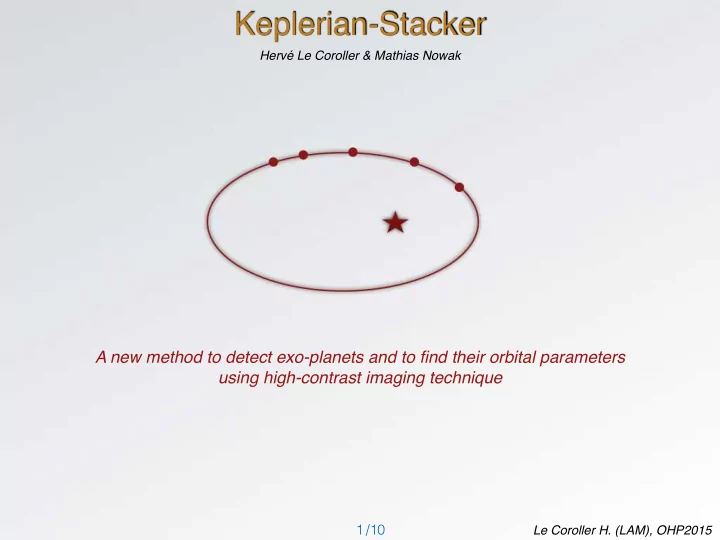
Keplerian-Stacker
Hervé Le Coroller & Mathias Nowak
A new method to detect exo-planets and to find their orbital parameters using high-contrast imaging technique
/ 0 1
Le Coroller H. (LAM), OHP2015
Keplerian-Stacker Herv Le Coroller & Mathias Nowak A new method - - PowerPoint PPT Presentation
Keplerian-Stacker Herv Le Coroller & Mathias Nowak A new method to detect exo-planets and to find their orbital parameters using high-contrast imaging technique 1 / 0 1 /10 Le Coroller H. (LAM), OHP2015 Le Coroller H. (LAM), OHP2015
Le Coroller H. (LAM), OHP2015
/10 1
Hervé Le Coroller & Mathias Nowak
A new method to detect exo-planets and to find their orbital parameters using high-contrast imaging technique
/ 0 1
Le Coroller H. (LAM), OHP2015
Le Coroller H. (LAM), OHP2015
/10
2 Telescope Mask Lyot Stop Coronagraphy image
With atmospheric turbulence
CCD
With atmospheric turbulence + AO correction
Phase masks generated by LAM/ONERA code (Fusco et al Optics Express 14, 7515-7534,2006)
Le Coroller H. (LAM), OHP2015
/10
3 Simulation of SPHERE/IRDIS images r0=0.8 arcseconde 100 exposures of few millisecondes (frozen atmosphere) ⋋=1.6μm The static defaults follow an 1/f^2 law σ_mirror = 30 nm
Mathias Nowak simulations
800 mas 800 mas
Le Coroller H. (LAM), OHP2015
/10
4 RAW IRDIS image t = 32s Filter obs = DBH23 cADI Reduced with the DC and
Background 10 -3
!
Background 10 -5
!
Le Coroller H. (LAM), OHP2015
/10 5
Le Coroller H. (LAM), OHP2015
/10 6
Center Star Planet E θ 2a X Y 2a(1-e2)1/2 Perihelion Aphelion
E(t) − esin[E(t)] =
a3 (t − t0)
7 parameters to describe the orbit: e = eccentricity [0-1] t0 = time at the perihelion passage a = semi-major axis θ0 = argument of periapsis 2 Euler angles (Omega=i=0 to begin) M* = Star Mass
E N
θ0
Earth
Transendante equation resolved by a Newton-Krylov method
Le Coroller H. (LAM), OHP2015
/10
7
i=1 Fi
i=1 σ2 i
t0 t1 t2 t3 t1 t2 t3 t1 t2 t3 t1 t2 t3 t1 t2 t3
Le Coroller H. (LAM), OHP2015
/10 8
Nowak, M. & Le Coroller, H.,A&A, in preparation
S/N=8
a = 5.24 ua e = 0.25 t0 = -2.13 years θ0 = -6.66 rad
Brute-Force + Gradiant
a (Semi-major axis) = 5.27 ua e (eccentricity) = 0.248 t0 (Perihelion time) = -2.07 years θ0 (Argument of periapsis) = -6.608 rad i = 0 Ω = 0 d = 10 pc M = 1M⊙
Observation conditions r0=0.8 arcsec; mR=8 100 images regularly spaced on 3 years S/N≃0.8 in each image
λ = 1.6µm
Le Coroller H. (LAM), OHP2015
/10 9
a = 6.59 au e = 0.05 t0 = -0.9 years θ0 = 1.66 rad i=1.06 rad Ω= 1.18 rad
Brute-Force + Gradiant
a (Semi-major axis) = 6.80 au e (eccentricity) = 0.06 t0 (Perihelion time) = 0.89 year θ0 (Argument of periapsis) = 1.63 rad i = 1.07 rad Ω = 1.92 rad d = 10 pc M = 1M⊙
S/N=10
Observation conditions r0=0.8 arcsec; mR=8 25 images regularly spaced on 3 years S/N≃2.2 in each image
λ = 1.6µm
Nowak, M. & Le Coroller, H.,A&A, in preparation
Le Coroller H. (LAM), OHP2015
/10
10
S/N<1 on individual frames !
by integrating on longer time : 10^-8 with SPHERE
The K-Stacker method could be used to minimize the time that we should spend
Ex: If 1h of ADI observation allows to detect a planet at S/N=10, a K-Stacker observation of 6x10 min (ADI) spread over several months will allow to detect the same planet at the same S/N=10 level but will provide the
accuracy on the planet position = 0.1 pixel on individual images of S/N<1 !!!
Le Coroller H. (LAM), OHP2015
/10 11
Le Coroller H. (LAM), OHP2015
/10
12
Le Coroller H. (LAM), OHP2015
/10 13
25 images réparties régulièrement sur 3 ans Seeing de 0.8’’, étoile guide de mag 8 (R) Planète à SNR=2.0 dans chaque image, injectée sur une orbite au hasard (6 paramètres), avec restriction des intervalles On ne s’intéresse qu’à la zone corrigée Paramètres de l’algorithme : Paramètre Valeur min Valeur max Nombre de points a 4 ua 7.5 ua 10 e 0.6 8 t0
1 ans 10 i 0 rad 2.0 rad 12 Ω 0 rad 2.0 rad 5 θ0 0 rad 2.0 rad 12 Total de 576 000 orbites a essayer Les 20 meilleures sont retenues, et reoptimisées (BFGS, descente en gradient sous contraintes)
a (ua) e t0 (an) Ω (rad) i (rad) θ0 (rad) Orbite réelle 6.80 0.06 0.89 1.92 1.07 1.63 Orbite trouvée 6.59 0.05
1.18 1.06 1.66
Avec 20 cœurs de 16 processeurs chacun (LAM) : une dizaine d’heures
16 12
Le Coroller H. (LAM), OHP2015
/10 14
Recherche par force brute (on essaie « toutes les possibilités ») combinée avec une méthode de descente en gradient Grille d’échantillonage force brute déterminée empiriquement (à partir de la largeur attendue du maximum) 108 possibilités environ Les quelques meilleures solutions de la grille sont réoptimisées avec une descente en gradient
Le Coroller H. (LAM), OHP2015
/10 15 S’il n’y a pas de planète, la sommation correspond à une sommation au hasard : 𝑇𝑂𝑆 = 𝑂(0, 𝜏𝑗) 𝜏𝑗2 = 𝑂(0,1) Si l’orbite tombe sur celle d’une planète : 𝑇𝑂𝑆 = 𝑂 0, 1 + 𝑜×𝑇𝑞
𝜏𝑗2
On s’attend donc a des fluctuations d′écart type 1, et à la présence d’un pic détectable si 𝑇𝑞 > 5 𝜏/ 𝑜
Le Coroller H. (LAM), OHP2015
/10
16 Simulation Mathias Nowak Orbital parameters: 3 years of observation(Full orbit : 11.2 years). a=5; e=0.2 ; t0=3 years M=1M distance = 10Pc
⊙
Observation conditions: r0=0.8 arcsec mR=8 (étoile guide pour OA) Wind speed =10-15 m/s
λ = 1.6µm
S/N per image 1.5
Le Coroller H. (LAM), OHP2015
/10
17 S/N total= 17 Simulation Mathias Nowak
Le Coroller H. (LAM), OHP2015
/10 18