Agent-Based Systems Bargaining Alternating offers Michael Rovatsos - - PowerPoint PPT Presentation

agent based systems
SMART_READER_LITE
LIVE PREVIEW

Agent-Based Systems Bargaining Alternating offers Michael Rovatsos - - PowerPoint PPT Presentation

Agent-Based Systems Agent-Based Systems Where are we? Last time . . . Agent-Based Systems Bargaining Alternating offers Michael Rovatsos Negotiation decision functions mrovatso@inf.ed.ac.uk Task-oriented domains Bargaining


slide-1
SLIDE 1

Agent-Based Systems

Agent-Based Systems

Michael Rovatsos

mrovatso@inf.ed.ac.uk

Lecture 13 – Argumentation in Multiagent Systems

1 / 18

Agent-Based Systems Where are we?

Last time . . .

  • Bargaining
  • Alternating offers
  • Negotiation decision functions
  • Task-oriented domains
  • Bargaining for resource allocation

Today . . .

  • Argumentation in Multiagent Systems

2 / 18

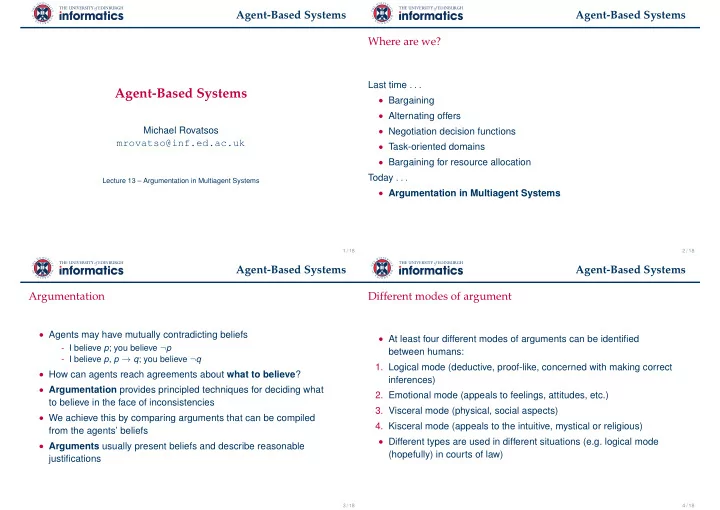
Agent-Based Systems Argumentation

  • Agents may have mutually contradicting beliefs
  • I believe p; you believe ¬p
  • I believe p, p → q; you believe ¬q
  • How can agents reach agreements about what to believe?
  • Argumentation provides principled techniques for deciding what

to believe in the face of inconsistencies

  • We achieve this by comparing arguments that can be compiled

from the agents’ beliefs

  • Arguments usually present beliefs and describe reasonable

justifications

3 / 18

Agent-Based Systems Different modes of argument

  • At least four different modes of arguments can be identified

between humans:

  • 1. Logical mode (deductive, proof-like, concerned with making correct

inferences)

  • 2. Emotional mode (appeals to feelings, attitudes, etc.)
  • 3. Visceral mode (physical, social aspects)
  • 4. Kisceral mode (appeals to the intuitive, mystical or religious)
  • Different types are used in different situations (e.g. logical mode

(hopefully) in courts of law)

4 / 18

slide-2
SLIDE 2

Agent-Based Systems Abstract Argumentation

  • We can decide what to believe while looking at arguments at the

abstract level (Dung, 1995):

  • Disregarding their internal structures, e.g. arguments a, b, c, d
  • Focus on the attack relation, e.g. a attacks b or a → b
  • Not concerned with the origin of arguments or the attack relation
  • An abstract argumentation system A = X, → is defined by
  • a set of arguments X (just a collection of objects),
  • →⊆ X × X a binary attack relation on arguments
  • Example: {p, q, r, s}, {(r, q), (s, q), (q, p)}

r s q p

Arguments: p, q, r, s Attacks: r → q, s → q, q → p

  • Which arguments can we consider to be rationally justified?

There is no universal definition for acceptability

5 / 18

Agent-Based Systems Terminology

  • Lets consider some meaningful properties for rationally justified

sets of arguments

  • A set of arguments S is conflict-free if if there are no arguments a,

b in S such that a attacks b, e.g.

r s q p

∅, {p}, {q}, {r}, {s}, {r, s}, {p, r}, {p, s}, {p, r, s}

  • An argument a is acceptable with respect to a set S of arguments

iff for each argument a′: if a′ attacks a then a′ is attacked by some argument in S

  • A conflict-free set of arguments S is admissible iff each argument

in S is acceptable w.r.t. S

e.g. ∅, {r}, {s}, {r, s}, {p, r}, {p, s}, {p, r, s}

6 / 18

Agent-Based Systems Preferred Extensions

  • Preferred extensions are maximal (w.r.t. set inclusion) admissible

sets, e.g. {p, r, s} is a preferred extension, but not ∅ or {p}

  • Preferred extensions help determine which arguments should be

accepted but are not always useful:

a b

Preferred extensions are not necessarily unique e.g. {a} and {b} here

a b c

The only preferred extension may be the empty set

  • An argument is sceptically accepted if it is a member of every

preferred extension

  • An argument is credulously accepted if it is a member of at least
  • ne preferred extension

7 / 18

Agent-Based Systems Grounded Extensions (I)

  • An alternative notion of acceptability is provided by the notion of

grounded extension

  • The (unique) grounded extension can be built incrementally:

1 Arguments that are not attacked are “in” 2 Delete from the graph every argument that is attacked by an

argument that is in the grounded extension and go to Step 1

  • Iterate until there are no more changes to the argument graph
  • The grounded extension
  • always exists and
  • is guaranteed to be unique, but
  • may be empty (if no arguments are free of attackers initially)

8 / 18

slide-3
SLIDE 3

Agent-Based Systems Grounded Extensions (II)

  • The characteristic function of an argumentation system

A = X, →, is the function F : 2X → 2X, which is defined as

follows:

F(S) = {a | a is acceptable w.r.t. S}

  • The grounded extension of an argumentation system is the least

fixed point of the characteristic function F

  • Consider the sequence:
  • F 0 = ∅,
  • F i+1 = {a ∈ X | a is acceptable

w.r.t. F i}

  • · · · (until no arguments are added to the set)

9 / 18

Agent-Based Systems Example

m k l p q c a d g b e i j h n f

  • Argument h has no attackers

“in”

  • Because of this, a is not acceptable

“out”

  • For same reason p is out
  • p only attacker of q, thus q is

“in”

  • · · ·

10 / 18

Agent-Based Systems Deductive Argumentation Systems

  • “Purest”, most rational kind of argument: in classical logic,

argument = sequence of inferences leading to a conclusion

  • Write Γ ⊢ ϕ to denote that sequence of inference steps from

premises Γ will allow us to establish proposition ϕ, where Γ is part

  • f our overall knowledge base ∆

Example: Γ ⊢ mortal(Socrates) where

Γ = {human(Socrates), human(X) ⇒ mortal(X)}

  • A deductive argument is a pair Γ, ϕ with support Γ and

conclusion ϕ where:

  • i. Γ ⊂ ∆, Γ ⊢ ϕ
  • ii. Γ is logically consistent
  • iii. Γ is minimal (i.e. none of its subsets satisfies the above)
  • Two important classes of arguments:
  • Tautological arguments: Γ, ϕ where Γ = ∅
  • Non-trivial arguments: Γ, ϕ where Γ is consistent

11 / 18

Agent-Based Systems Example: Arguments

human(X) ⇒ mortal(X) human(Hercules) father(Heracles, Zeus) father(Apollo, Zeus) divine(X) ⇒ ¬mortal(X) father(X, Zeus) ⇒ divine(X)

¬(father(X, Zeus) ⇒ divine(X))

Examples of arguments:

Arg1 ={human(Heracles), human(X) ⇒ mortal(X)}, mortal(Heracles) Arg2 ={father(Heracles, Zeus), father(X, Zeus) ⇒ divine(X), divine(X) ⇒ ¬mortal(X)}, ¬mortal(Heracles) Arg3 ={¬(father(X, Zeus) ⇒ divine(X))}, ¬(father(X, Zeus) ⇒ divine(X))

12 / 18

slide-4
SLIDE 4

Agent-Based Systems The Attack Relation

The attack relation is defined as follows

  • For any propositions ϕ and ψ, ϕ attacks ψ iff ϕ ≡ ¬ψ
  • Γ1, ϕ1 rebuts Γ2, ϕ2 if ϕ1 attacks ϕ2
  • Γ1, ϕ1 undercuts Γ2, ϕ2 if ϕ1 attacks some ψ ∈ Γ2
  • Γ1, ϕ1 attacks Γ2, ϕ2 if it undercuts or rebuts it

Example:

Arg1 ={human(Heracles), human(X) ⇒ mortal(X)}, mortal(Heracles) Arg2 ={father(Heracles, Zeus), father(X, Zeus) ⇒ divine(X), divine(X) ⇒ ¬mortal(X)}, ¬mortal(Heracles) Arg3 ={¬(father(X, Zeus) ⇒ divine(X))}, ¬(father(X, Zeus) ⇒ divine(X))

  • Arguments Arg1 and Arg2 are mutually rebutting
  • Argument Arg3 undercuts argument Arg2

13 / 18

Agent-Based Systems Argument Classes

We can identify five classes of argument type in order of increasing acceptability A1: The class of all arguments that can be constructed A2: The class of all non-trivial arguments that can be constructed A3: The class of all arguments that can be constructed with no rebutting arguments A4: The class of all arguments that can be constructed with no undercutting arguments A5: The class of all tautological arguments that can be constructed

14 / 18

Agent-Based Systems Example: Argument Classes

Arg1 ={human(Heracles), human(X) ⇒ mortal(X)}, mortal(Heracles) Arg2 ={father(Heracles, Zeus), father(X, Zeus) ⇒ divine(X), divine(X) ⇒ ¬mortal(X)}, ¬mortal(Heracles) Arg3 ={¬(father(X, Zeus) ⇒ divine(X))}, ¬(father(X, Zeus) ⇒ divine(X))

  • Arg1 and Arg2 are mutually rebutting and thus in A2
  • ∅, divine(Heracles) ∨ ¬divine(Heracles) is in A5
  • {father(apollo, Zeus), father(X, Zeus) ⇒ divine(X), divine(X) ⇒

¬mortal(X)}, ¬mortal(apollo) is in A4

15 / 18

Agent-Based Systems Argumentation dialogue systems

  • Agents engage in dialogue to convince other agents of some state
  • f affairs
  • Consider two agents 0 and 1 engaging in the following dialogue:
  • Agent 0 attempts to convince 1 of some argument
  • Agent 1 attempts to rebut or undercut it
  • Agent 0 in turn attempts to defeat 1’s argument
  • And so on . . .
  • Moves Player, Arg are steps in such a dialogue, Player ∈ {0, 1},

Arg ∈ A(∆) (the set of all arguments constructed from ∆)

  • A sequence m0, . . . mk is a dialogue history if
  • Player2i = 0, Player2i+1 = 1 for all i ≥ 0
  • If Playeri = Playerj and i = j, then Argi = Argj,
  • Argi+1 defeats Argi for all i ≥ 0
  • A dialogue ends if no further moves are possible, the winner is

Playerk

16 / 18

slide-5
SLIDE 5

Agent-Based Systems Types of dialogue

Typology due to Walton and Krabbe (1995):

Type Initial situation Main goal Participants’ aim Persuasion conflict of opinion resolve the issue persuade other Negotiation conflict of interest make a deal get best deal Inquiry general ignorance growth of knowledge find a proof Deliberation need for action reach a decision influence outcome Information seeking personal ignorance spread knowledge gain

  • r

pass

  • n

knowledge Eristics conflict/antagonism reaching an strike other party accommodation

17 / 18

Agent-Based Systems Summary

  • Argumentation
  • Abstract argumentation systems
  • Deductive argumentation systems
  • Argumentation-based dialogue
  • Next time: Logics for Multiagent Systems

18 / 18