KASIKORNBANK Investor Presentation as of 3Q18 October 2018 For - - PDF document

kasikornbank
SMART_READER_LITE
LIVE PREVIEW

KASIKORNBANK Investor Presentation as of 3Q18 October 2018 For - - PDF document

KASIKORNBANK Investor Presentation as of 3Q18 October 2018 For further information, please contact the Investor Relations Unit or visit our website at www.kasikornbank.com 1 KASIKORNBANK at a Glance Established on June 8, 1945 with


slide-1
SLIDE 1

1 For further information, please contact the Investor Relations Unit or visit our website at www.kasikornbank.com

KASIKORNBANK

Investor Presentation as of 3Q18

October 2018

2

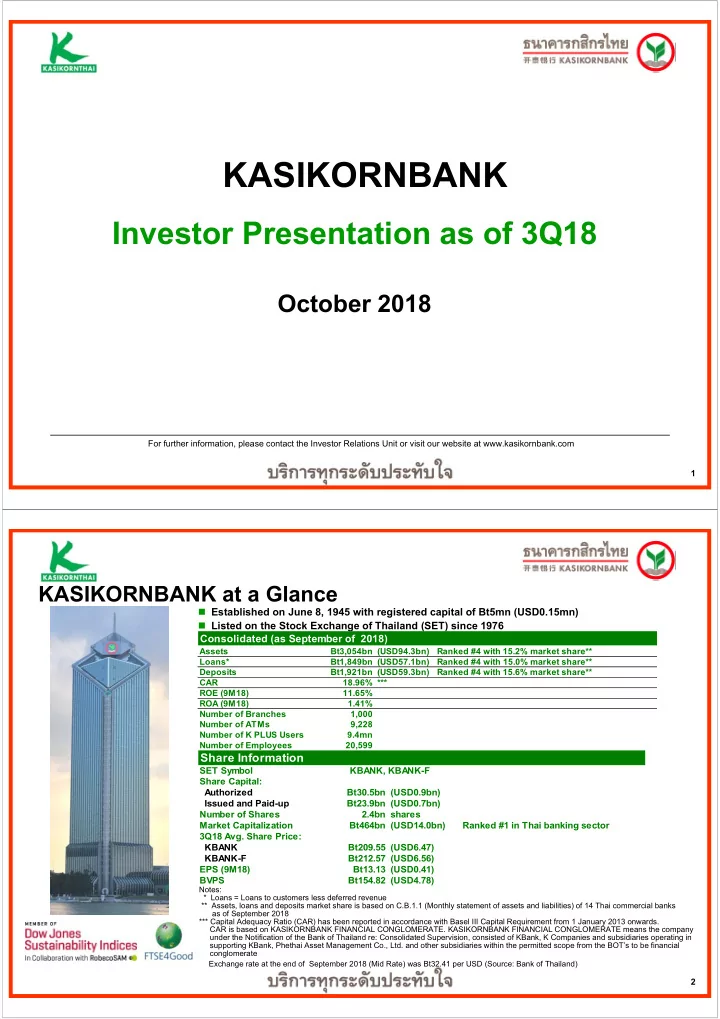
KASIKORNBANK at a Glance

 Established on June 8, 1945 with registered capital of Bt5mn (USD0.15mn)  Listed on the Stock Exchange of Thailand (SET) since 1976

Notes: * Loans = Loans to customers less deferred revenue ** Assets, loans and deposits market share is based on C.B.1.1 (Monthly statement of assets and liabilities) of 14 Thai commercial banks as of September 2018 *** Capital Adequacy Ratio (CAR) has been reported in accordance with Basel III Capital Requirement from 1 January 2013 onwards. CAR is based on KASIKORNBANK FINANCIAL CONGLOMERATE. KASIKORNBANK FINANCIAL CONGLOMERATE means the company under the Notification of the Bank of Thailand re: Consolidated Supervision, consisted of KBank, K Companies and subsidiaries operating in supporting KBank, Phethai Asset Management Co., Ltd. and other subsidiaries within the permitted scope from the BOT’s to be financial conglomerate Exchange rate at the end of September 2018 (Mid Rate) was Bt32.41 per USD (Source: Bank of Thailand)

Share Information

SET Symbol Share Capital: Authorized Bt30.5bn (USD0.9bn) Issued and Paid-up Bt23.9bn (USD0.7bn) Number of Shares 2.4bn shares Market Capitalization Bt464bn (USD14.0bn) Ranked #1 in Thai banking sector 3Q18 Avg. Share Price: KBANK Bt209.55 (USD6.47) KBANK-F Bt212.57 (USD6.56) EPS (9M18) Bt13.13 (USD0.41) BVPS Bt154.82 (USD4.78) KBANK, KBANK-F

Consolidated (as September of 2018)

Assets Bt3,054bn (USD94.3bn) Ranked #4 with 15.2% market share** Loans* Bt1,849bn (USD57.1bn) Ranked #4 with 15.0% market share** Deposits Bt1,921bn (USD59.3bn) Ranked #4 with 15.6% market share** CAR 18.96% *** ROE (9M18) 11.65% ROA (9M18) 1.41% Number of Branches 1,000 Number of ATMs 9,228 Number of K PLUS Users 9.4mn Number of Employees 20,599

slide-2
SLIDE 2

3

Table of Contents

Topic Slide Page

 Operating Environment 5 - 6  2019 Financial Targets 7  Composition of Growth 8 - 10  The K-Strategy 11 - 14  Financial Performance 15 - 17  Capital and Dividend 18 - 19  Summary 20  Appendix 21 - 159

4

Topic Slide Page

 KBank

  • Strategic Issues
  • Strategy and Segment Highlights
  • Risk and Credit Management
  • Financial Performance

22-35 36-45 46-54 55-78

  • 9M18 Highlights
  • Interest Income - net
  • Non-interest Income
  • Net Fee Income
  • Net Premium Earned - net
  • Other Operating Expenses
  • Loan
  • Asset Quality
  • Investment in Securities and Funding Structure

56-58 59 60-61 62-63 64 65 66-68 69-74 75-78

  • The Wholly-owned Subsidiaries
  • Muang Thai Life Assurance (MTL)
  • Other Information

79-86 87-95 96-104  Banking System and Regulations Update 105-114  Government Policy 115-135  Thai Economic Figures 136-157  IR Contact Information and Disclaimer 158-159

Appendix

slide-3
SLIDE 3

5 % YoY Range Base Case GDP 3.9 4.6 4.1-4.6 4.3 Private Consumption 3.2 4.2 3.3-3.9 3.6 Government Consumption 0.5 2.5 2.4-2.9 2.7 Total Investment 0.9 4.1 4.1-5.7 5.0

  • Public investment
  • 1.2

6.0 5.0-9.0 7.0

  • Private investment

1.7 3.5 3.8-4.5 4.2

Gov't Budget Deficit (% of GDP)

  • 3.5
  • 3.0
  • 3.2 to -2.5
  • 2.7

Exports (Customs Basis) 14.7 8.8 4.5-6.8 5.0 Imports (Customs Basis) 49.3 16.5 4.0-8.0 6.9 Current Account (USD bn) 0.7 36.4 30.0-38.0 35.2 Headline Inflation 1.5 1.1 0.7-1.5 1.1 Policy Interest Rate** 1.50 1.50 2.00 2018F* 2019F* 2017

Key Points: Risk Factors:

Operating Environment: Economic Outlook for 2019

Key GDP Forecasts and Assumptions

Notes: MPC’s policy rate is at 1.50% (as of September 19, 2018), Source: * KResearch (as of October 17, 2018) ** KBank Capital Markets Research (as of October 22, 2018)

 Continued US-China trade dispute  Vulnerability in emerging market countries amidst

tightening US monetary policy

 High household debt amidst looming interest rate

up-cycle

 The projected base case for 2019 GDP growth is 4.3%

(range 4.1-4.6%) supported by domestic demand

 Progress from public infrastructure investment will

provide a crowding in effect to private investment

 Exports and tourism will contribute growth, but to a

lesser extent, from a high base effect and trade dispute

3.9 4.6 4.3 0.0 3.0 6.0 2017 2018F 2019F % YoY 6

Outlook Possible Impacts to Thai Economy

Global Economy

 Global economy: economic growth faces headwinds amid heightened trade dispute risk  US: economic recovery continues; Fed will continue to tighten monetary policy  Eurozone: mild to moderate economic growth as ECB provides less support. Moreover,

BREXIT may pose moderate risk to near-term prospects

 China: decreasing economic growth foreseeable, but a hard-landing situation can be

  • avoided. Economic stimuli are expected if trade dispute between US and China

worsens

 ASEAN economies: Repercussions from US-China trade dispute may become

headwinds for economic growth. However, some countries may gain benefits from inward supply chain relocation

 Export growth will be moderate, due to a rather high

base effect as well as strain in China-US trade dispute

 Diminishing reflation trade will become a challenge for

Thai exports

 Increased interest rates in the US may cause fund

  • utflow from emerging market countries, including

Thailand

 Repercussions from BREXIT and US protectionist

policy may lead to fragility in global financial and capital markets; Thailand may encounter some volatility

 Government Stimulus Plan

(App. pages 115-130)

 Accelerating investment in transport infrastructure projects and initiatives in the Eastern

Economic Corridor (EEC); this will be a key driver for the new S-curve

 Possible pick up in growth momentum  Improvement in private consumption and investment

stimuli

 Inflation

(App. pages 138 and 140)

 Inflation remains restricted, due to stickiness of core inflation. Downside risk from rising

global crude prices may push headline inflation to above the base case, depending on whether government measure on energy price subsidy program will be extended to 2019

 Policy rate expected to remain rather accommodative

to economic growth throughout 2019, despite a few interest rate increases

Exports and Tourism

(App. pages 138, 141-143)

 Moderate export performance due to worsening global trade prospects  Tourist arrivals will continue to grow in 2019, albeit at a slower rate  Export and tourism sectors remain contributors of

economic growth, albeit to a lesser extent

 Fed Policy Normalization

(App. pages 149)

 Fed is expected to have four rate hikes in 2018 and keep to its balance sheet reduction

  • plan. In 2019, the Fed may deliver additional three rate hikes

 US economy is expected to grow at a solid pace despite US-China trade dispute, due to

the positive impact of US tax reform and fiscal boosting of economic growth

 Expect Thai MPC to have two rate hikes in 2019 to

catch up with the Fed’s move and demand-driven inflation

 However, strong Thai current account surplus is to

keep external stability intact

 Baht (App. pages 137)

 Thai rate rise coupled with low external financial vulnerability will attract capital inflow;

the rate is expected to rise two times, in 1H19 and 2H19, from 1.50% to 2.00%

 However, trade uncertainty and risks surrounding emerging markets could result in

capital outflows and weakening Baht

 Thai policy rate hike in 1H19 will attract money inflow  Gradual Fed fund rate hikes and external risks will put

pressure on Thai Baht depreciation afterward

Operating Environment: Economic Outlook for 2019

Source: KResearch and KBank Capital Markets Research (as of October 22, 2018)

slide-4
SLIDE 4

7

Consolidated 2017 Actual 9M18 Actual 2018 Targets 2019 Targets Notes ROE 10.24% 11.65% N/A N/A ROA 1.20% 1.41% N/A N/A NIM 3.44% 3.41% 3.2-3.4% 3.3-3.5%

Improving from rising interest rate and retail lending despite rising long term deposit rate (Page 16)

Loan Growth 6.20% YoY 2.56% YTD 5.51% YoY 5-7% 5-7%

Sensible loan growth in line with economic growth; increase in retail lending using data analytics capability (Page 8 and 66-68)

Non-Interest Income Growth*

  • 1.62% YoY
  • 7.34% YoY
  • 6% to -8%
  • 5% to -7%

Under pressure from full year effect of fee waiver through digital channels; one-time gain on investment sales last year; insurance business remains slow

(Page 9 and 60-64)

Non-Interest Income Ratio 39.97% 37.80% About 40% About 35% Cost to Income Ratio** 42.31% 41.60% Mid-40s Low to Mid-40s

Focus on cost management; under pressure due to slower growth in income and new investments

(Page 17)

Credit Cost per year (bps) 239 bps 175 bps Up to 185 bps Up to 165 bps

Credit cost peaked in 2017; maintain prudence

  • nward.

Reversed our decision to sell some NPLs due to a revised outlook for the economy and a recent bottom- up review of the NPL portfolio. As a result, the NPL ratio will rise slightly with no further reserves required. We avoid an immediate loss on these loans, and we expect a greater recovery rate in the long-term.

(Page 10, 49-50, 69-70, and 74)

NPL Ratio (Gross)*** 3.30% 3.30% 3.3-3.4% 3.3-3.7%

* Non-Interest Income includes Net Premium Earned - net (Net Premium Earned less Underwriting Expenses) from Muang Thai Life Assurance PCL (MTL); KBank has a 38.25% economic interest in MTL; on the consolidated basis, Bancassurance fees are not included in net fee income, due to the elimination of inter-company transactions (the accounting treatment from the Muang Thai Group Holding consolidation); Non-Interest Income = Total Operating Income – net less Interest Income – net ** Cost to Income Ratio = Total Other Operating Expenses to Total Operating Income – net (Total Operating income less Underwriting Expenses) *** NPL Ratio (Gross) = NPL (gross) to total loans; NPL (gross) used in the calculation are loans to general customers and loans to financial institutions that are non-performing loans; total loans used in the calculation are loans to general customers and loans to financial institutions

2019 Financial Targets

Note:

8

Composition of Growth: Loans by Business

Note: Since 1Q13, as per the Bank of Thailand’s requirement, the Bank has complied with TFRS 8 (Operating Segments) to present operating results for each key segment in financial reports

 Moderate loan growth momentum in line with full-year target

Loan Definition (more details on loans can be found in App. page 66-68) Corporate Loans: Loans of KBank and KBank’s Subsidiaries in Corporate Segments (annual sales turnover > Bt400mn) SME Loans: Loans of KBank and KBank’s Subsidiaries in SME Segments (annual sales turnover ≤ Bt400mn) Retail Loans: Loans of KBank and KBank’s Subsidiaries in Retail Segments Other Loans: Loans in Enterprise Risk Management Division (NPL + Performing Restructured Loans) and other loan types

9M18 2019 Outlook Corporate Loans

  • Mainly from both short term and long term credit in Chemical

and Chemical Products, Commerce Consumer, and Petroleum and Petrochemical Products industries

  • Growth target related to large public/private investment projects, mostly in

infrastructure, power plant generation, and urbanization

  • Focus industries: Utilities, Construction, and Real Estate

SME Loans

  • Mainly from both short term and long term credit from

Commerce Consumer, Construction and Construction Materials, and Automotive and Parts

  • Growth target reflects domestic consumption demand, government stimulus

measures, and AEC international trade benefits

  • Focus industries: Construction, Construction Materials, Tourism, and Export related

Retail Loans

  • Mainly from mortgage loans; seasonal growth in line with

industry; expanding to new groups of high potential customers, building strong relationships with strategic partners, presenting concrete machine lending with consumer loan offerings via digital channel (K PLUS). Proactively monitoring loan portfolio quality led to steady growth

  • Organic growth target in line with industry; applying machine lending and artificial

intelligence (AI) technology to initiate financial and life solutions related to customers’ lifestyles and needs; maintain lead market position in key products

  • Focus on new potential target customers with acceptable risk; predictive monitoring

and strict control of loan portfolio quality

6% 6% 6% 5% 4% 27% 26% 25% 24% 25% 37% 39% 39% 37% 37% 30% 29% 30% 33% 34% 400 800 1,200 1,600 2,000 2014 2015 2016 2017 9M18 Corporate SME Retail Others 1,610 1,527 1,698 1,803 1,849

Loan Portfolio Loan Portfolio Structure

Bt bn Note: * From time to time, the Bank has adjusted loan definitions based on loan portfolio management; thus, the December 2017 loan base is not comparable with previous reports

Consolidated 9M18 9M18 Dec17* Sep18 Loan Growth Yield Range 2018 2019 (%YTD) (%) Corporate Loans 600 625 4.3% 3-5% 6-8% 3-5% SME Loans 672 683 1.7% 5-7% 4-6% 2-4% Retail Loans 444 458 3.2% 5-7% 5-7% 9-12% Other Loans 88 82 (6.4%) Total Loans 1,803 1,849 2.6% 5.3% 5-7% 5-7% Amount (Bt bn) Loan Growth Target (%)

slide-5
SLIDE 5

9 33.94 37.53 38.94 41.31 29.13

10 20 30 40 2014 2015 2016 2017 9M18

(Bt bn) 58% 60% 58% 60% 62% 42% 40% 42% 40% 38%

50 100 150 200

2014 2015 2016 2017 9M18

Non-interest Income Net Interest Income

(Bt bn) (Bt bn) (Bt bn) (Bt bn)

Note:

September 2018 (Consolidated) Total Operating Income - net Non-interest Income Net Fee Income

Non-interest Income Ratio and Net Fee Income Ratio

  • Non-interest Income Ratio = Non-interest Income/Total Operating Income - net
  • Net Fee Income Ratio = Net Fee Income / Total Operating Income - net
  • Net Premium Earned - net = Net Premium Earned less Underwriting Expense

(%) (+18%)

Composition of Growth: Net Fees and Non-interest Income

  • The Bank and its subsidiaries have adopted TFRIC13: Customer Loyalty Programmes since January 1, 2014 onwards and

restated the comparative financial statements and financial ratios. There is no effect on net profit of the Bank and its subsidiaries

138.66

(+15%)

153.40

(+11%) (+6%)

147.52

(+4%) (+4%) (+2%)

156.86

(+6%)

6%

9M18 non-interest income accounted for 38% of total net

  • perating income and net fee

income accounted for 25%; non-interest income decreased 7% YoY, due mostly to a decrease in insurance business, waiving fees for money transfers via digital channels

Net fee income dropped 6% YoY, mainly due to waiving fees for money transfers through digital channels

2018 non-interest income will drop from slow growth in insurance business; drop will also come from waiving transaction service fees via digital money transfers, bill payments, and top ups

26% 24% 25% 25% 25% 40% 42% 42% 40% 38% 10 20 30 40 50 2014 2015 2016 2017 9M18

Non-interest Income Ratio Net Fee Income Ratio

(-0.5%YoY) 117.47

2% 66% 6% 4% 6% 16%

(-6%YoY)

10

2.3 16.8 44.1 50.6 0.7 5.9 7.8 9.4 6.7 7.3 8.4 11.7 14.2 26.4 33.8 41.8 24.0 6 12 18 24 30 36 42 48 54 1996 1997 1998 1999 2000 2007 2008 2009 2010 2011 2012 2013 2014 2015 2016 2017 9M18 34.7 25.4 30.0 34.2 48.8 73.9 88.4 91.6 111.0 127.1 131.8 134.5 141.4 130.0 130.9 148.5 156.0 50 100 150 1996 1997 1998 1999 2000 2007 2008 2009 2010 2011 2012 2013 2014 2015 2016 2017 9M18

5.1 15.9 42.0 31.7 23.5 4.44 3.09 3.76 2.91 2.45 2.16 2.11 2.24 2.70 3.32 3.30 3.30 44 287 723 888 14 82 93 102 66 64 66 85 96 168 204 239 175 5 10 15 20 25 30 35 40 45 1996 1997 1998 1999 2000 2007 2008 2009 2010 2011 2012 2013 2014 2015 2016 2017 9M18

  • 100

100 300 500 700 900 NPL ratio Credit Cost

Asset Quality and Impairment Loss on Loans and Debt Securities (Provision)

(bps) (%) Notes: * Data in 1996-1997 is KBank only; ** NPL ratio in retail business, excluding 180 dpd (days past due) of credit card and consumer loans for peer comparison

(%)

Coverage Ratio Provision NPL Ratio and Credit Cost

(Bt bn) During 1997 Asian Crisis* During 1997 Asian Crisis* During 1997 Asian Crisis* NPL was peak at 42.3% in 1Q99

 Asset quality remains manageable  NPL ratio in 9M18 was at 3.30% with a coverage ratio of 155.95%  9M18 credit cost was 175 bps, prudent and aligned with the credit cycle  Credit cost peaked in 2017; prudence to be maintained going

  • forward. NPL ratio stabilized and

moving within a narrow range in 2018

September 2018 (Consolidated)

NPL Ratio by Business 2014 2015 2016 2017 9M18 Corporate Business <2% <2% <2% <2% <2% SME Business <3% ~3% ~5% ~5% ~5% Retail Business** <2% ~2% ~4% ~4% ~4%

slide-6
SLIDE 6

11

Long-Term Risk-Adjusted Sustainable Profitability Customer Centricity

TO BE CUSTOMERS’ LIFE PLATFORM OF CHOICE

BEYOND BANKING EMBEDDED TRUST EVERYONE, EVERYDAY EVERY WAY& EVERYWHERE KASIKORNBANK and Beyond Segment of One Financial and Life Solution

I N T E G R A T I O N

Real Time Data & Insights Innovation and Solution Management Customer Journey Excellence Predictive Risk Management

Customer Strategy The Way We Work Strategic Capabilities

PARTNERS

BANK OF SUSTAINABILITY

Foundation

Financial & IT Resilience Intelligent Operation

 Customer Centricity remains core philosophy, while extending beyond conventional territory, and

redefining “banking” concept in order to stay relevant, valuable, and indispensable to customers

The Extended K-Strategy

Note: K KASIKORNTHAI includes KASIKORNBANK and its wholly-owned subsidiaries 12

Value Value

Payment Lifestyle Platform Trial Prove Expand Accelerate

New Lending Model

Payment Fee Data NPL Cost to Income RAROC

Higher Return Lower Fee More Data Lower Cost

Customer Strategy

Beyond Banking Embedded Trust Everyone, Everyday, Every Way, Everywhere Lifestyle & Platform Data Driven Ecosystem Mobile-led O2O* Experience

The Extended K-Strategy: Benefits

* O2O = Online to Offline

slide-7
SLIDE 7

13 Old Definition

New Definition***

Segment Performance

Successful performance driven by continued customer-centric strategy and IT capabilities enhancement

2.89 2.96 3.10 3.01 2.15 2.89 2.63 2.78 2.81 2.71 2.80

1 2 3

2008 2009 2010 2011 2011 (New) 2012 (New) 2013 (New) 2014 (New) 2015 (New) 2016 (New) 2017

Average Product Holdings per Customer Main Bank Status*

*** In 2012, the Average Product Holding calculation is adjusted in all eight customer segments to align with our better understanding of customer behavior; 2011 numbers were restated for comparison purposes

(Overall) (By Business Division)

 Main Bank Status and Market

Penetration on track with our customer segment aspirations

 Average product holdings per customer

increasing as a result of enhanced cross-selling capabilities

 Overall average product holding rose to

3.10 in 2017, from 2.71 in 2011

2.66 2.82 2.86 2.72 3.27 3.12 3.11 3.30 3.54 4.41 4.69 4.71 4.51 5.33 3.08 2.97 2.91 2.88 2.78 2.87 2.17 3.65 3.64 3.02 3.12 3.05 2.56 2.14 2.12 2.10 1.83 4.59 4.67

5 10

2008 2009 2010 2011 2011 (New) 2012 (New) 2013 (New) 2014 (New) 2015 (New) 2016 (New) 2017

Retail Business SME Business Corporate Business * Main Bank Status = % of customers in the market who use KBank and its wholly-owned subsidiaries as their main

  • perating bank and/or main savings and investment bank

and/or main borrowing bank; Main Bank Status for Retail Business from 2013 to 2017 includes two out of four retail customer segments (Middle Income and Mass), which account for 99% of retail customers ** Since 2014, Corporate and SME Business main bank status is reported every two years 7.5 8.0 9.0 10.0 10.9 11.65 12.6 13.1 14.0 15.1 15.0 15.3 15.7 88 88 88 88 89 89 89 90 91 90

20 40 60 80 100 5 10 15 2008 2009 2010 2011 2012 2013 2014 2015 2016 2017 1Q18 2Q188M18

  • No. of Customers (mn)

Branch Customer Satisfaction

Branch Customer Satisfaction

**** Customers in Retail Business account for 94%, SME Business 6%, and Corporate Business less than 1% of customer portfolio

  • No. of Customers (mn) ****

 Branch Customer Satisfaction was at 90% in

Y2017

 No. of customers was 15.7 million as of 8M18

***** Branch Customer Satisfaction Index by Nielsen (Retail Business 90%, SME Business 10%, and Corporate Business less than 1%). Note: Branch Customer Satisfaction in 2017 was at 90%, ranking in the top percentile at a global level for all industry and financial industry Branch Customer Satisfaction*****

24% 23% 17% 24% 25% 26% 26% 27% 25% 29% 28% 27% 27% 24% 29% 31% 30% 10% 11% 12% 14% 18% 26% 27% 24% 20%

5% 10% 15% 20% 25% 30% 35% 2008 2009 2010 2011 2012 2013 2014 2015 2016 2017

CBS SME RBS

14

(+189% YoY) (+130% YoY) (+138% YoY) KBank Digital Strategy

Customer Experience Operational Processes Business Model

  • Customer Understanding
  • Customer Offering & Interaction
  • Sales & Service Channels
  • Process Digitization
  • Worker Enablement
  • Data-driven Execution
  • Digitally-enabled Products &

Services

  • New Digital Business

KBank Digital Strategy

Sample of Digital Channels

K PLUS Number of Transactions** K PLUS Number of Users

** Number of transactions includes payments and funds transfers via mobile banking and account inquiry via mobile banking

(+74% YoY) (+59% YoY) (+50% YoY) (+29% YoY) (+42% YoY) (Million Users) (Million Transactions)

(+189% YoY) (+130% YoY) (+132% YoY)

3,052

(+85% YoY) (+73% YoY) (+88% YoY)

KBank’s Mobile Banking Platform KBank’s Mobile Banking Application for Merchants KBank’s Mobile Banking Application for SMEs KBank’s Mobile Banking Application for Visually Impaired

To use digital technology and data to enhance business performance by transforming customer experience,

  • perational process, and business mode to offer data-driven products & services at moments of need and to

become embedded in customers’ daily lives

slide-8
SLIDE 8

15

19.38 14.54 13.23 10.24 11.65

4 8 12 16 20 24 2014 2015 2016 2017 9M18

(%)

1.97 1.20 1.49 1.60 1.41 0.0 0.5 1.0 1.5 2.0 2.5 2014 2015 2016 2017 9M18

(%)

ROA and ROE

ROA ROE

September 2018 (Consolidated)

2014 2015 2016 2017 9M17 9M18 1Q18 2Q18 3Q18 ROA (%) 1.97 1.60 1.49 1.20 1.34 1.41 1.46 1.45 1.28 ROE (%) 19.38 14.54 13.23 10.24 11.49 11.65 12.14 12.10 10.65

16

3.80 3.67 3.52 3.44 3.41 1 2 3 4 5 2014 2015 2016 2017 9M18

(%)

Net Interest Margin

NIM

Note: Cost of deposits including contributions to the Financial Institutions Development Fund (FIDF) and Deposit Protection Agency (DPA)

Yield on Earnings Assets and Cost of Funds

September 2018 (Consolidated)

Yield on Loans Yield on Earnings Assets Cost of Fund Cost of Deposit*

 NIM was 3.41% in 9M18, remaining the highest level among four large commercial banks  High portion of CASA (78%) helped support low cost of funds

2014 2015 2016 2017 9M17 9M18 1Q18 2Q18 3Q18 NIM (%) 3.80 3.67 3.52 3.44 3.44 3.41 3.37 3.39 3.43 Yield on Earnings Assets (%) 5.19 4.94 4.55 4.37 4.37 4.30 4.26 4.28 4.29 Yield on Loans (%) 6.33 6.06 5.73 5.45 5.51 5.34 5.24 5.30 5.39 Cost of Fund (%) 1.63 1.59 1.32 1.22 1.23 1.20 1.20 1.21 1.18 Cost of Deposit (%), incl DPA 1.63 1.47 1.18 1.11 1.12 1.11 1.08 1.13 1.12

5.19 4.94 4.55 4.37 4.30 6.33 6.06 5.73 5.45 5.34 1.69 1.59 1.32 1.22 1.20 1.63 1.47 1.18 1.11 1.11

2 4 6 8 2014 2015 2016 2017 9M18

slide-9
SLIDE 9

17

2.63 2.70 2.36 2.31 2.19

2 4 6 2014 2015 2016 2017 9M18 44.30 45.19 41.63 42.31 41.60 10 20 30 40 50 2014 2015 2016 2017 9M18

Cost to Income Ratio

(%)

Cost to Income Ratio Cost to Average Assets Ratio

(%)

* * *

Note: The Bank and its subsidiaries have adopted TFRIC 13: Customer Loyalty Programmes since January 1, 2014 onwards and restated the comparative financial statements and financial ratios. There is no effect on net profit of the Bank and its subsidiaries

 9M18 cost to income ratio was 41.60%; cost to income ratio will be seasonally higher in 4Q  2018 cost to income ratio will be in mid-40s range, with focus on cost management under pressure from income slowdown and new investments

September 2018 (Consolidated)

2014 2015 2016 2017 9M17 9M18 1Q18 2Q18 3Q18 Cost to Income Ratio (%) 44.30 45.19 41.63 42.31 40.16 41.60 41.20 41.07 42.58 Cost to Average Assets Ratio (%) 2.63 2.70 2.36 2.31 2.22 2.19 2.17 2.22 2.13 18

13.49 14.53 15.16 15.66 16.50 3.82 3.47 3.68 2.30 2.46

3 6 9 12 15 18 2014 2015 2016 2017 9M18

Tier2 Tier1

(%)

12.88 13.79 14.27 14.62 15.26 3.88 3.60 3.90 2.58 2.55

3 6 9 12 15 18 2014 2015 2016 2017 9M18

Tier2 Tier1

(%)

Bank only KASIKORNBANK FINANCIAL CONGLOMERATE*

Capital (Reported Number: Excluding Net Profit of Each Period)

 Capital adequacy remains sufficient to support business growth; maintained adequate Tier 1 ratio, as required under the Basel III**

Under Bank of Thailand regulations, net profit in the first half of the year is to be counted as capital after approval by the Board of Directors as per the Bank’s regulations. Net profit in the second half of the year is also counted as capital after approval of the General Meeting of Shareholders. However, whenever a net loss occurs, the capital must be immediately reduced accordingly. Note: * KASIKORNBANK FINANCIAL CONGLOMERATE means the company under the Notification of the Bank of Thailand re: Consolidated Supervision, consisted of KBank, K Companies and subsidiaries

  • perating in supporting KBank, Phethai Asset Management Co., Ltd. and other subsidiaries within the permitted scope from the BOT’s to be financial conglomerate.

Basel III Basel III 16.76 17.39

September 2018 (Consolidated)

18.17 17.20 17.31 18.00 18.84 17.96 2014 2015 2016 2017 1Q18 2Q18 3Q18 Bank only CAR (%), excluding net profit of each period 16.76 17.39 18.17 17.20 16.95 16.99 17.81 Tier 1 (%), excluding net profit of each period 12.88 13.79 14.27 14.62 14.38 14.43 15.26 KASIKORNBANK FINANCIAL CONGLOMERATE* CAR (%), excluding net profit of each period 17.31 18.00 18.84 17.96 17.70 18.05 18.96 Tier 1 (%), excluding net profit of each period 13.49 14.53 15.16 15.66 15.41 15.57 16.50 Basel III 17.81 18.96

** The details on Basel III regulations can be found in App. Page 111-112

slide-10
SLIDE 10

19

0.0 1.0 2.0 3.0 4.0

2006 2007 2008 2009 2010 2011 2012 2013 2014 2015 2016 2017 2018

(Bt)

21.36 30.55 31.88 32.33 42.49 32.14 27.00 22.12 22.32 22.51 27.83 26.96 32.80

10 20 30 40 50

2005 2006 2007 2008 2009 2010 2011 2012 2013 2014 2015 2016 2017 (%)

Dividend

 Dividend policy: both operating results and long-term returns to shareholders are taken into consideration in determining dividend payments, in order to ensure a sustainable and adequate capital level through the changing economic environment, the ongoing adoption of Basel III and new requirements

Dividend Payout Ratio Dividend Per Share

1.75 2.00 2.00 2.50

Interim Dividend

2.50 2.50 3.00 3.50 4.00 4.00 0.5 4.00 2006 2007 2008 2009 2010 2011 2012 2013 2014 2015 2016 2017 1H18 Dividend Per Share (Bt) 1.75 2.00 2.00 2.50 2.50 2.50 3.00 3.50 4.00 4.00 4.00 4.00 0.50 Dividend Payout Ratio (%) 30.55 31.88 32.33 42.49 32.14 27.00 22.12 22.32 22.51 27.83 26.96 32.80 n.a. 4.00

20

Summary

 Customer Centricity Strategy Effectively Executed: Customer Centricity

remains our core philosophy with an aspiration to be “Customers’ Life Platform of Choice”, staying relevant, valuable, and indispensable to our customers

 Balanced Growth: loans to grow carefully in line with economic conditions;

appropriate liquidity maintained; manageable asset quality supported by strong risk management capabilities; appropriate loan loss reserves; sensible non-interest income growth; manageable cost to income ratio; appropriate ROE maintained

 Adequate Capital: maintained adequate Tier 1 ratio, as required under

Basel III and new requirements

 Sustainable Development: conduct business on the foundation of being a

“Bank of Sustainability” with appropriate risk management and good corporate governance principles, balancing economic, social, and environmental dimensions to achieve goals and create long-term, sustainable returns

slide-11
SLIDE 11

21

Appendix

22

KBank: Strategic Issues

slide-12
SLIDE 12

23

Cost Effectiveness

  • Dynamic and flexible resource allocation to support new businesses e.g.

digital, AEC+3, and data-driven bank

  • Increasing spending effectiveness aligned with business priorities and

desired value

  • Cost and productivity improvements focusing on lean processes and

waste management will be addressed in:

  • Focusing on lean organization with organization design,

workforce management and agile way of working

  • Creating organization infrastructure for productivity

improvement

Human resources optimization

  • Improve asset utilization and optimize

maintenance service /licenses costs

  • Resolution IT operating model to reduce costs

IT investment and procurement effectiveness

  • Revisit branch & ATM optimization and profitability,

including account planning, area planning, and branch & ATM relocation

  • Migration and on-boarding to digital channels

Channel optimization

  • Utilize data analytics to increase credit process

efficiency

  • Onboarding process redesign and automation
  • Back office process improvement and digitization

Operational process improvement

24

Analytics Strategy The Way We Work Strategic Capabilities

Customer Centricity

TO PROVIDE DATA DRIVEN SOLUTIONS OF CHOICE FOR CUSTOMERS WITH OPTIMAL COST TO SERVE Talent Data Process Right Organization Structure/ Governance/Policy & Process Data Driven Culture & Communication (Internal & External)

  • Ask the Right Questions
  • Believe in Data Not Opinion
  • Learn Fast, Fail Cheap

Infrastructure & Tools INTEGRATION One Agile Execution Team Customer Life’s Data PROLIFERATE USE CASES ANALYTICS AS-A-SERVICE ACQUIRE NON-FINANCIAL DATA & DIGITAL FOOTPRINT GET EVERYONE INVOLVED

Data-driven organization framework

slide-13
SLIDE 13

25

Credit Offering Process

  • Offering Feed
  • Select loan limit &

term

  • Consent for credit

bureau checking

  • Loan set-up in 3

minutes

Data & Analytics

Feedback Offering

Fully Automate Approval & Disbursement

K-Personal Loan & Commercial Loan

Bt1,504mn

New Booking

Process Automation Data Driven Credit Offering

Sample of Data and Analytics: Machine Lending and AI

New K-Personal Loan Customers 300% from BAU

Data from November 2017 to August 2018

Alternative data

  • Customer data from

application form

  • Credit Bureau data,

etc.

  • Deposit transaction
  • Credit card spending,

etc.

  • Location
  • Social Network
  • Mobile, etc.

Credit Quality Credit Needs

Machine Learning / AI

Other internal data Traditional data

Consumer Credit Commercial (SME) Credit

26

Establishment of KASIKORN BUSINESS – TECHNOLOGY GROUP

Note:

  • KASIKORN BUSINESS – TECHNOLOGY GROUP established with 5 companies, as a wholly-owned subsidiary of KASIKORNBANK; included in the KASIKORNBANK FINANICIAL CONGLOMERATE, as approved by the BOT in October 2015
  • Registered capital in each company at Bt5mn, except for KASIKORN SERVE at Bt10mn
  • KASIKORN SERVE changed names from PROGRESS SOFTWARE COMPANY LIMITED; established in March 1993
  • Idea Creation
  • Software Development to

Support Innovation and Business Requirements

  • Control Infrastructure

Resources for the Change, the Run, and the Gone

  • Center of Excellence for

Technical Resource Pool and Service*

  • A Bridge between KBank and KASIKORN BUSINESS – TECHNOLOGY GROUP
  • Group’s Control Structure

Enable Seamless Integration

Create the Future

Generate Business Value Ensure Service Continuity Deliver Service Excellence

  • Technology Research

and Innovation Labs

Technology Research and Innovation Labs

slide-14
SLIDE 14

27

Customer Centric Technology

Towards a Sustainable Society: Paperless and Cashless

BLOCKCHAIN BIOMETRICS

MACHINE LENDING

PLATFORM BUSINESS UX DESIGN MOBILE PAYMENT OPEN API

Blockchain L/G on Hyperledger Platform by KBTG OriginCert: the trusted platform to ensure integrity of paperless document, initially to certify documents on Letter of Guarantee (L/G), including request, issuing, and notice of expiration Set Up World-class UX Design Company, Beacon Interface, to create Mobile Banking Application for the Visually Impaired enabling them to conduct financial transactions with ease and security Open API Access to Support FinTech and Startups: To open connection to create extensive innovative services for customers e.g. launching API linkage to FlowAccount on K PLUS SME mobile application Mobile Banking: platform for easy financial transaction, mobile payment, and lifestyle banking; K Plus platform is capable of having add on service from external parties via open API and offer promotions, privileges, and deals for K PLUS customers Machine Commerce: leverage customer data understanding and machine learning techniques to tailor personalized product

  • ffering/recommendations to target groups via K Plus Platform

Technology Progress..

MACHINE COMMERCE Note: UX = User Experience; API = Application Programming Interface

28

Personalization Functions Single Transaction Button New Functions New Logo

New version of K PLUS Powered by KADE

  • Served by KADE (K PLUS AI-Driven Experience) innovation, where AI is fully integrated to better understand users’

behaviors and personalize the right experience.

  • Based on a “With change, we understand you better” concept, aimed at making technology easy, simple, and

accessible for everyone, enabling KBank to know customers well in order to fulfill their wishes

Rearrangement of Menus

  • Account Inquiry
  • Transfer
  • Payment
  • Withdraw
  • Top up
  • Statement
  • Loan
  • Investment
  • Other services
  • K PLUS Today
  • My Favorites
  • Notification

Note: AI = Artificial Intelligence; KADE = K PLUS AI-Driven Experience

Cardless Cash Withdrawal Transaction Slip Verification Account Transaction Notification Point Redemption Change K PLUS Transaction Limit Scheduled Money Transfer Setting Expense Summary Loan Investment

Sample of Customer Centric Technology

Loyalty Card K PLUS Market

slide-15
SLIDE 15

29

  • 9.4 millions users with

expectation to reach 11.8 mn users by 2019; target to reach 100mn users globally in the future

  • Most active mobile banking

applications in South East Asia

  • Over 4,000 transactions per

second during peak periods

  • 24/7 application
  • Design for physical and online shop payment
  • Real-time notification/ fully reconciled/ support pre-order
  • Support beyond QR payment/ support online & offline/

support machine commerce

Sample of Customer Centric Technology

K PLUS Market

Machine Commerce

  • K PLUS Market will

recommend products or promotions that match customers’ lifestyles

  • K PLUS with machine lending

technology will enable KBank to leverage customer data and analytics to offer the right personal and business loans that match their demands and debt capacity

K PLUS BEACON

UX Design: Mobile Banking application for the visually impaired

  • Designed for physical

and online shop payment

  • Real-time notification/

fully reconciled/ support pre-order

  • Support beyond QR

payment/ support online & offline/ support machine commerce

K PLUS Machine Lending

Machine Lending

K PLUS Intelligence Platform

Platform Business: Mobile Banking

K PLUS Shop

Mobile Payment

New version of K PLUS Powered by KADE

30

BLOCKCHAIN

Trust Platform to Ensure Authenticity, Traceability, and Enforcement

OPEN API

Integration to Expand Innovations

Sample of Customer Centric Technology

Note: current business partners are the Metropolitan Electricity Authority, Provincial Electricity Authority, PTT Global Chemical PCL., and PTT Polymer Marketing Co., LTD.

BIOMETRICS*

Security process that relies

  • n unique biological

authentication

  • Face ID
  • Voice Command
  • Finger Print

Note: *Future Development

slide-16
SLIDE 16

31

Real Digital Partnership

A wholly-owned venture capital fund

  • f KBank, with initial funding of Bt1bn

to invest in early to growth-stage technology startups. Aim is to quickly develop innovative products and access world-class innovative concepts:

  • Direct Investments: to enhance

lifestyle banking and SME integrated services

  • FlowAccount: online accounting SaaS
  • EventPop: event management platform
  • Ookbee and C Channel Japan: offer
  • nline lifestyle content
  • Invest through VC Funds: partnered

as an LP with VC funds managed by Dymon Asia Capital and Vertex Ventures to enable KBank to leapfrog into the world arena and stay abreast of innovative technologies and business models in other regions

Sample of Real Digital Partnership

KBTG Beacon Venture Capital

KBank

Mobile Payment Platform

  • Alipay
  • WeChat
  • JCB
  • Thailand Post
  • Amway (Thailand)
  • State Railway of Thailand

Online Payment on Social Media Platforms

  • Facebook Thailand

e-Wallet

  • PTT

Blockchain Technoogy

  • IBM

Digital Workplace

  • Microsoft

University Application

  • CU NEX at Chulalongkorn

University

  • iTunes U Application at UTCC
  • SU CHANGE Project at

Silpakorn University

Collaborating to co-innovate

Startups & FinTech Ecosystem Partners Tech Giants

Real Digital Partnership

Note: LP = Limited Partner; UTCC = University of the Thai Chamber of Commerce QR Code Payment via K PLUS includes CP Fresh Mart, Major Cineplex, LAWSON108, Siam Park Bangkok, THAI Smile, DTAC, Poh Teck Tung Foundation, and Boonterm vending machines

32

KBTG: K-Stadium and Innovation Center

slide-17
SLIDE 17

33

Asset-Light Regional Expansion into

Strategically focusing on AEC+3 markets, KBank pursues an integrated regional operating model: physical footprint, digital platform, and regional partnerships.

Partnership Digital Platform

X-Border Retail Payment X-Border THB Direct Settlement X-Border Multi-Currency Settlement

…and others

Physical Footprint

Lao PDR. Cambodia Myanmar Vietnam Indonesia Japan China

AEC

Note:

  • Two subsidiary banks: KASIKORNTHAI BANK (Lao PDR) with two branches in Ponesinuan and Lane Xang,

KASIKORNBANK (CHINA) with three branches in Shenzhen, Chengdu, Shanghai and one sub-branch in Long Gang.

  • Three international branches: Cayman Islands, Hong Kong, and Phnom Penh
  • Eight representative offices: Los Angeles, Beijing, Kunming, Tokyo, Yangon, Ho Chi Minh, Hanoi, and Jakarta
  • One strategic partner in Indonesia: Maspion Bank
  • Global partners with 75 banks in 13 countries: 51 Japanese partner banks; 2 Korean partner banks; 4 European regional

banks (in Germany, Italy and Russia); 7 ASEAN partner banks (in Lao PDR, Vietnam, Cambodia, Indonesia, Malaysia, and Philippines); 10 Chinese partner banks and 1 Indian Bank (as of September 2018)

34

Frontier Strategic Direction Channels Channel Expansion ROC

(Regional Operating Center)

  • 1. Host Country

Host Country

  • 2. Thai Direct

Investment

Regional Investment

  • 3. Foreign Direct

Investment

  • 4. Trade Finance

Regional Settlement

  • 5. Border Trade
  • 6. Retail Business

I IV III II V Country Y2013

to

Y2015 Y2016 Y2017 Y2018 Y2019

  • nwards

Physical Digital

FBB Multi-Branch LII Preparation LII Multi-Branch Profitability Enhancement Regional Operating Center (ROC) Regional Digital Payment & Settlement AEC+ Connectivity through Digitization LII LII Multi-Branch Revenue Enhancement

  • Rep. Office

Branch Portfolio Expansion

  • Rep. Office

Strategic Partner B/S Growth & Capability Enhancement

  • Rep. Office

Banking License Acquisition

  • Rep. Office
  • Rep. Office & Partner Banks

Partner Banks

Five Strategic Capabilities: The Bedrock of KBank Regionalization

Most of KBank presences in AEC+ will be upgraded to LII or FBB based on regulatory requirements and economic value. For other countries, KBank will leverage partnerships to capture business opportunities.

China Korea Laos Cambodia Indonesia Vietnam Myanmar Japan Note: - Regional Operating Center (ROC) is established to handle the higher degree of operational complexity to create cost efficiency in long term as KBank expands its regional business

  • FBB = Foreign Bank Branch; LII = Locally Incorporates Institution

& Other Counties

slide-18
SLIDE 18

35

“KASIKORN Vision Company Limited or KVision” is an investment holding company under KBank KVision’s Mission:

 Scouting tech communities to find innovative ideas and tech talents from all corners of the world  Expand businesses especially in AEC+3 via direct investment and through CVC (Corporate Venture Capital)

KASIKORN VISION COMPANY

KVision Presences

KASIKORN VISION COMPANY LIMITED Country of Registration Thailand Geographical Coverage Thailand, Indonesia, Vietnam, Israel and China

36

KBank: Strategy and Segment Highlights

slide-19
SLIDE 19

37

Customer Segments

Multi-Corporate Business Large Corporate Business

Corporate Business SME Business

Retail Business

Retail Business

Company with annual sales >Bt5,000mn Company with annual sales >Bt400mn to Bt5,000mn Individual or company with annual sales >Bt50mn to Bt400mn Individual or company with annual sales ≤ Bt50mn, and with commercial credit limit ≤ Bt15mn Individual wealth with KBank and its wholly-owned subsidiaries* ≥ Bt50mn Individual wealth with KBank and its wholly-owned subsidiaries* ≥ Bt15,000 to < Bt10mn Individual wealth with KBank and its wholly-owned subsidiaries* < Bt15,000

Note: * Wealth with KBank and its wholly-owned subsidiaries is defined as savings and investments, such as deposit products with KBank, mutual funds with KAsset; or the monthly income

  • f an individual customer

Individual wealth with KBank and its wholly-owned subsidiaries* ≥ Bt10mn to < Bt50mn

Customer-centric strategy: offering a full array of financial solutions and a satisfying experience to our customers

  • Synergistic portfolio management by monitoring eight customer segments
  • Offer financial solutions from among KBank, its wholly-owned subsidiaries, and the insurance company
  • Make significant progress towards long-term aspirations; performance on track

Medium Business Small & Micro Business High Net Worth Individual Affluent Middle Income Mass

38

35.3% 39.5% 25.1%

CBS SME RBS

Revenue by Business

Note: Loan portion and loan yield of each customer segment includes loans from the Enterprise Risk Management Division (NPL + Performing Restructured Loans); figures are not comparable with loan data in other pages

September 2018 (Consolidated)

Non-interest Income *

* Non-interest income excludes capital market business, treasury business and others

Loans Portfolio structure

Average yield port RBS: 3% ‒ 7% Average yield port SME: 5% ‒ 7% Average yield port CBS: 3% ‒ 5%

27.4% 20.7% 51.9%

CBS SME RBS

slide-20
SLIDE 20

39

Business Direction in 2018

Corporate Business SME Business World Business Private Banking Group Retail Business

Note: * CLMVI = Cambodia, Laos, Myanmar, Vietnam, and Indonesia

  • Strategy
  • To be customers’ life platform of choice
  • To maintain leadership position in digital banking
  • To affirm commitment to service excellence in business operations and enhance market position
  • To become “AEC+3 Bank” to capture AEC growth opportunities plus China, Japan, and South Korea

Best Customer-Driven Retail Bank with Personalized Solutions

  • Best digital banking and mobile banking platforms
  • Best integration of sales and services channels
  • Capture new business operations through

collaboration with partners

Dual-Track Regional Digital Expansion towards “The Bank of AEC+3”

  • Conventional banking: leverage headquarter expertise for

regional synergy through value chain business connections and infrastructure investment in CLMVI

  • Digital banking: capture regional domestic payment and

become a regional settlement hub

Bank for SME Customers

  • Financial Solutions
  • Digital banking
  • Data Analytic Lending
  • Beyond Banking

Most Trusted Bank for Corporate Customers

  • Best funding solutions
  • Best transaction banking and

breakthrough initiator

International Comprehensive Wealth Management Services

  • Cooperate with Lombard Odier to raise service & product

standards to international levels

  • Provide integrated wealth planning services, advising families
  • n wealth management, continuity, and growth
  • Enhance use of technology to improve client experience
  • Build comprehensive client insights from data-mining

40

19% 21% 23% 23% 26% 24% 25% 0% 10% 20% 30%

2009 2010 2011 2012 2013 2014 2016

18% 15% 14% 17% 11% 14% 16% 17% 17% 23% 0% 10% 20% 30%

2009 2010 2011 2012 2013 2014 2015 2016 2017 9M18

Performance and Market Position

 Main Bank Status: maintained #1 ranking in 2016  Corporate Bond Underwriting: ranked #1 with 22.74% market share in 9M18  Transaction Services: top player in transactional banking services

  • Security Services (MFS): #1 ranking with 41.69% market share, as of Jul 2018
  • Cash Management Services: 25% market share in 2016 (#2)
  • Trade Finance: 28% market share in 2016 (#1)

 Industrial Expertise: leverage capability in Utility, Real Estate, Transportation, Communication, and Commerce 23% 24% 25% 26% 26% 27% 25% 0% 10% 20% 30%

2009 2010 2011 2012 2013 2014 2016

Corporate Business: Performance and Market Position

Multi-Corporate Business Large Corporate Business Medium Business Small and Micro Business High Net Worth Individual Middle Income Mass

Corporate Bond Underwriting

Affluent

Source: The Thai Bond Market Association (ThaiBMA)

Main Bank Status* Cash Management Services

(#1) (#1) (#1) (#2) (#2) (#3) (#4) (#2) (#2) (#2) (#2) (#1) (#2) (#1) (#1) (#2) (#2) (#2) (#2) Source: KBank Customer Survey Source: KBank Customer Survey (#2) (#1) (#2) Note: * Since 2014, Corporate and SME Business main bank status is reported every two years Main Bank Status = % of customers in the market who use KBank and its wholly-owned subsidiaries as their main operating bank and/or main savings and investment bank and/or main borrowing bank (#1) (#3)

slide-21
SLIDE 21

41

27% 28% 29% 29% 30% 31% 0% 10% 20% 30% 40% 2010 2011 2012 2013 2014 2016 29% 30% 30% 30% 30% 28% 0% 10% 20% 30% 2010 2011 2012 2013 2014 2016

Multi-Corporate Business Large Corporate Business Medium Business Small and Micro Business High Net Worth Individual Middle Income Mass Affluent

SME Business: Performance and Market Position

Performance and Market Position

  • Main Bank Status: improved main bank status and strengthened #1 position
  • Market Share: 28% market share; maintained #1 position
  • Market Position: strengthened #1 position in SME market – “Bank for SMEs”; targeted to be SME market leader in all areas
  • Only bank to offer comprehensive solutions to SMEs through K SME program (launched in 2006, with a total of 24 classes and about

13,000 participants so far) and K SME Knowledge Center (established in 2009)

#1 in Market Share by Value* #1 in Main Bank Status*

Source: KBank Customer Survey

(#1)

Source: KBank Customer Survey (#1)

(#1) (#1) (#1) (#1) (#1) (#1) Note: - SME Business in Thailand accounts for 42.4% of Thailand’s GDP, or Bt6.55trn (as of December 2016); supported by the government to become a key factor in economic and social growth (Source: The Office of Small and Medium Enterprises Promotion or OSMEP)

  • Market Share by Value = share of revenue (derived from both credit and non-credit products) that each bank gains from the market
  • Main Bank Status = % of customers in the market who use KBank and its wholly-owned subsidiaries as their main operating bank and/or main savings and investment bank and/or

main borrowing bank (#1) (#1) (#1) (#1) * Since 2014, corporate and SME business main bank status and market share are reported every two years ** Market share by value and main bank status in 2016 may not be comparable with those in previous years due to a new SME population base covering more SMEs with better data availability

42 Multi-Corporate Business Large Corporate Business Medium Business Small and Micro Business High Net Worth Individual Middle Income Mass Affluent

Retail Business: Performance and Market Position

19.8%

22.7% 23.1% 22.9% 21.2% 20.1% 0% 10% 20% 30%

2013 2014 2015 2016 2017 9M18

Performance and Market Position

  • Market Penetration**: strong market penetration to affluent customers and maintaining top tier market penetration to middle income customers
  • Bancassurance: MTL ranked #1 in Bancassurance for 1H18 in terms of total and renewal premiums, with market share of 24.9% and 30.7%, respectively. Moreover, MTL is

focused on all Bancassurance process improvements to align with BOT regulations on market conduct together with balancing First Year Premium and Single Premium to create a sustainable portfolio

  • Fund Management Services:
  • Mutual Funds: KAsset maintaining #1 position since 2010, with highest market share at 19.8% in 9M18; received Editors’ Triple Star for K-My Funds application from The

Asset Triple A Asset Servicing, Institution Investor and Insurance Awards 2018 by The Asset magazine

  • Mutual Funds and Provident Funds: ranked #1 in 8M18 with market share of 19.8% and 17.4%, respectively; KAsset’s total AUM ranked #2 with market share of 18.7%
  • Mortgage Loans: ranked in top 3, with 7.4% market share in 1H18; conservative growth together with building stronger partner relationships and maintaining good quality portfolio
  • Credit Cards:
  • Total spending: ranked #1, with 20.2% market share in 8M18
  • Number of cards: ranked #2, with 11.2% market share in 8M18
  • Card-accepting merchant services (online & offline platforms): ranked #1, with 36.3% market share by sales volume in 8M18
  • Debit Cards:
  • #1 in total debit card spending with 37% market share in 1Q18; maintaining top position by providing functions, features, security, and benefits to match customer lifestyles;

continuing to offer new variety of cards (i.e., 8 themes of K-Provincial debit card via branch, and K-Shopee debit card via K PLUS), together with enhanced security in a chip debit card under the Thai Standard Format, apart from marketing campaigns to stimulate card spending related to National e-Payment Project

7.4% 7.4% 7.8% 8.1% 7.4% 0% 5% 10%

2014 2015 2016 2017 1H18

#1 in Mutual Fund (KAsset)

Mortgage Loan

(% Market Share) (% Market Share) (% Market Share)

Bancassurance*

(New Business, Total and Renewal Premium)

Ranked #1 in Bancassurance (Total & Renewal premiums) Ranked #1 in Mutual Fund AUM (KAsset)

( #1) (#3) (#3) (#3) (#3)

Maintaining Top 3 with good quality portfolio

Note: * Total Premium = New Business Premium (NBP) + Renewal Premium; New Business Premium = First Year Premium (FYP) + Single Premium (SP) ** Market penetration = % of customers in the market who use at least

  • ne of the products of KBank and its wholly-owned subsidiaries

(#1) (#1) (#1) (#1) (#3) ( #1)

27.6% 29.6% 28.6% 24.9% 24.4% 25.1% 27.4% 28.1% 14.5% 27.8% 22.8% 25.7% 27.8% 30.7% 29.7%

0% 5% 10% 15% 20% 25% 30% 35%

2014 2015 2016 2017 1H18

New Business Total Premium Renewal Premium

slide-22
SLIDE 22

43

Channels: Corporate and SME Business

Cheque Direct Service

  • Customer facilitation in areas with good potential via opening financial service centers and cheque points

Reduction in the number of centers was a result of consolidation of some centers * Name changed from Corporate & SME Service Center to International Trade Service Center ** Excluding International Trade Service Centers; there could be more than one SME Business Center per branch Note:

SME Business Center** International Trade Service Center *

44 9,349 8,973 9,302 9,228 9,180 9,183 2,706 2,710 2,589 2,618 2,650 2,850 5,000 10,000 15,000

2015 2016 2017 9M18 2018F* 2019T** 400 600 800 1,000 1,200 2015 2016 2017 9M18 2018F* 2019T**

Branch

Channels: Retail Business

Self-Service Channel (ATM + CDM ) 1

3 K-Lobby is an electronic banking service with multiple functions such as K-ATM,

K-CDM (Cash Deposit Machines), and K-PUM (Passbook Update Machine). K-Lobby is available to serve customers both outside of branch offices and as stand-alone machines in areas without branches

1,000 Key Strategies in Channel Expansion

  • Branch:
  • Variety of branch formats providing better service experience to customers
  • Improving branch efficiency through technology integration and cost opportunities
  • Focus on branch service coverage and migrating branch footprint to e-channel
  • Enhance staff skills/ knowledge to provide better financial consulting services at branches
  • Self-Service Channel:
  • Total number of self-service channels expected to be no more than 11,830 at the end of 2018, after

removal of outdated and low transaction machines. Despite an increase in number of transactions, this is sufficient to meet customer need

  • Relocate some channels to higher potential areas in order to improve efficiency and service availability
  • Enhance self-service channels to support debit chip card
  • Digital Banking:

Transforming acquisition and engagement in the following areas;

  • Transforming K PLUS from an application into “K PLUS Intelligence Platform” to present the right

experience for each customer by using K PLUS AI-Driven Experience (KADE)

  • Acquire new potential customers, such as those using e-wallet
  • Engage existing K PLUS customers with lifestyle functions to increase transactions and customer

stickiness thru lifestyle loyalty platform

  • Promote K PLUS as a channel for the customers to use our financial products and services more

conveniently; for examples, cardless cash withdrawal, and investment

  • THE WISDOM Corner, Center, Lounge, and Lounge@:
  • THE WISDOM Channels strengthen top positioning, available in all key flagship department stores,

iconic locations, and Thailand’s Suvarnabhumi international airport

CDM (Deposit) and CDM (Duo- Function)

1,107

1 Self-Service Channels include ATMs and all types of CDM machines providing

24 hour cash deposit, withdrawal, or money transfer services throughout the country

ATM

11,846 12,055

2 Branch: Excludes 8 THE WISDOM channel models and 1 K-Express Credit Center

which BOT’s adjusted definition now defines as branches, as they are physically located separately from regular branches

11,891 1,120 11,683 956 11,830 1,026

Note: * Forecast number at the end of year 2018 ** 2019 Preliminary Targets

901 12,033 2014 2015 2016 2017 9M18 Branch 2 1,124 1,120 1,107 1,026 1,000

  • Bangkok and Metro

39% 38% 38% 39% 39%

  • Upcountry

61% 62% 62% 61% 61% ATM 9,853 9,349 8,973 9,302 9,228

  • Bangkok and Metro

44% 44% 45% 46% 47%

  • Upcountry

56% 56% 55% 54% 53% CDM 2,775 2,706 2,710 2,589 2,618

  • CDM (Deposit)

46% 47% 46% 32% 30%

  • CDM (Duo-Function)

54% 53% 54% 68% 70% K-Lobby 3 238 238 238 232 229

THE WISDOM Corner, Center, Lounge and Lounge@

100 105 105 105 107

slide-23
SLIDE 23

45

Branch

Sample of Channels

Community Branch (K Park) THE WISDOM Corner, Center and Lounge

An exclusive center providing a full range of services and facilities to High Net Worth Individuals and Affluent segments

K-Lobby

An electronic banking service with multiple functions such as K-ATM, K-CDM (Cash Deposit Machines), and PUM (Passbook Update Machine). K-Lobby is available to serve customers both in front of branch offices and as stand-alone machines

Digital Banking

Branch @ Department Stores K Park provides meeting space, a kid zone, parcel delivery, and banking services all in one place. It is designed to be welcoming and match the everyday lifestyle of customers in each community area THE WISDOM Lounge @ Suvarnabhumi Airport K Park @ PTT Station Digital Banking : includes:

  • K PLUS (Mobile

Banking Application )

  • K PLUS SHOP
  • K-Cyber Service

(K-Cyber, K-Cyber Trade and K-Cyber Invest)

  • K-Payment Gateway
  • K-PowerP@y (mPOS)

46

KBank: Risk and Credit Management

slide-24
SLIDE 24

47

Business Units CBS/ SME/ RBS/ CMB/ WBS/ CSP/ TS Risk Management and Control Function ERM/ CSF/ KBTG Internal Audit CAT

KBank Risk Management Structure

 The Bank’s organization is structured to facilitate all aspects of risk management; each business unit’s

responsibilities and segregation of duties are clearly identified in accordance with good internal-control practices Board of Directors Management Committee

Credit Risk Management Sub-committee Credit Process Management Sub-committee Asset and Liabilities Management Sub-committee Market Risk Management Sub-committee Capital Management Sub-committee Operational Risk Sub-committee Business Continuity Management Sub-committee Information Technology Strategy Sub-committee Digital Oriented Risk, Data and Cyber Security - and IT Risk Management Sub-committee Business Units CBS/ SME/ RBS/ CSP/ PBG/ CMB/ IBB/ WBG/ TS Risk Management and Control Function ERM/ CSF/ KBTG

 Approve risk appetite and all risk management policies and guidelines  Oversee effectiveness of consolidated risk management framework  Endorse consolidated risk oversight framework before proposing to ROC  Formulate strategy for the organization and resources to be used for the

risk management operation, in line with the risk management policy. This strategy must enable the effective analysis, assessment, evaluation, and monitoring of the risk management system

 Risk management is responsible for providing independent and objective

views on specific risk-bearing activities to safeguard the integrity of the entire risk process. Control units are set to ensure that risk levels are in line with our risk appetite

 Business units are responsible for continuous and active management of

all relevant risk exposure, to be in line with its returns and risk appetite

CBS = Corporate Business Division, SME = SME Business Division, RBS = Retail Business Division, CSP = Corporate and SME Products Division, PBG = Private Banking Group, CMB = Capital Markets Business Division, IBB= Investment Banking Business Division, WBG = World Business Group, TS = Central Treasury Department, ERM = Enterprise Risk Management Division, CSF=Customer Service Fulfillment Division, KTBG = KASIKORN BUSINESS - TECHNOLOGY GROUP, including only IT risk management, IA = Internal Audit Department, CAT=Compliance and Audit Division

Internal Audit IA - CAT

 Internal Audit is independent and responsible for evaluation to add value

and improve the effectiveness of risk management, control, and governance processes of the Bank and its subsidiaries

 Establish risk management policies and risk appetites. Set risk limits for

significant aspects of the various risks

 Credit Risk Management Sub-committee and Corporate Governance

Committee oversee project financing requests that could have adverse impacts on the environment and society

Risk Oversight Committee Operating Committee Audit Committee

48

KBank Credit Risk Management Process

 Efficient collection and

follow-up of customers with late payments

 Restructure viable customers

to prevent NPLs

 Foreclose pledged assets to

recover loan loss

 Enhance decision

making/support tools for more efficient return and risk evaluation

 Setup specific prescreening

criteria for potential industries

 Enhance customer income

validation process

Monitoring

Collection & Recovery Collection & Recovery

Origination Portfolio Management

 Determine portfolio-by-design i.e., portfolio target setting by key credit concentration dimensions (Country, Industry,

Large Customer Group) and other sub portfolio dimensions based on value-based analysis

 Manage portfolio according to the Bank’s risk appetite and concentration  Perform stress testing to identify portfolio weaknesses and proactively prepare appropriate management actions

The Bank continues to enhance credit risk management processes to promote risk strategies with justified risk-return tradeoff within the rapidly changing economic environment

 Monitor customer behavior and

detect early warning signs

 Leverage National Credit Bureau

information for effective credit monitoring

 Ensure credit condition compliance

(e.g. insurance, capital injection, project progress)

 Take prompt action to prevent

credit deterioration

slide-25
SLIDE 25

49

Debt Resolutions Debt Resolutions Performing Loans*

NPL**

Litigation Process

(More information on Page 54)

Debt Collections Repayment of Rescheduled/ Restructured Term NPL Sales Write-off

 Efficient collection and follow-up of customers with late payments  Restructure viable customers to prevent NPLs  Foreclose pledged assets to recover loan loss

Collection & Recovery Flow

Rescheduled Loans*

(Currently, No Major Financial Aid Program)

Restructured Loans

(Not classified as NPL)

Performing Loans Process Non-Performing Loans Move to Better Status Move to Worsen Status

Note: * Rescheduled Loans are loans (no passed due date) that have changed payment conditions and not incurred losses. (Loans in the Financial Aid Program is a part of Rescheduled Loans) * Financial Aid Program helps customers during the bad macro business condition such as the big flood in 2011 and the political unrest in 2014 * Performing loans = Pass Loans (loans passing the due date by less than 1 month) and Special Mention Loans (loans passing the due date by more than 1 month but not over 3 months) ** NPLs = Non-performing Loans = loans passing the due date by more than 3 months = Sub-standard Loans, Doubtful Loans, Doubtful of Loss Loans, and restructured loans classified as NPL

Loans with DPD > 1 day go to debt collection stage

KBank Credit Risk Management Process: Collection and Recovery

Relapsed NPL 50

KBank Credit Cost Calculation

Credit Cost

  • Credit Cost

= Provisioning Expense Average Loans

  • Provisioning Expense

= (Probability of Default (PD), Loss Given Default (LGD), Exposure at Default (EAD))

  • Provisioning expense

largely depends on PD, which is driven by the stage

  • f the economy

PDT = (Historical Default Rates (DRT-1 , DRT-2 , … , DRT-N), Other Factors) Probability of Default (PD) Model Calibration  High historical default rate in bad year  higher provision in following year

1) Observe Historical Default Rates: Historical default rates over business cycle are observed 2) Calibrate PD Model The PDs are calibrated based on historical default rates 3) Apply PDs to Calculate Provisioning Expense Provisioning Expense = (PD, LGD, EAD)

Actual Default Rate (LHS) 2017 2016

% Credit Cost

2012 2013 2014 2015 Forecast Default Rate (LHS) Credit Cost (RHS) 204bps

% Default Rates

239 bps 2018F Up to 185bps 2019F Up to 165bps

slide-26
SLIDE 26

51

  • Automated collection system
  • Efficiently utilize available behavior scoring and collection tools i.e. SMS, automated letter

generation, phone

Payment Service Fulfillment Department

Policy Lending

  • Sufficiency of cash flow
  • Growth trends and ability to compete
  • Management experience and depth
  • Leverage, Liquidity, and Asset Quality
  • Credit Risk Mitigation
  • Facilities Structure

Formula Lending

Corporate SME (Medium) Retails (Housing)

Post Approval

  • Legal document
  • Limit set up

Credit Service Fulfillment Dept.

Bank-wide Risk Asset Review

  • Customer Review by Relationship Manager (RM)
  • Credit Portfolio Monitoring Unit to facilitate RM in

customer monitoring

  • Credit Clinic

Asset Quality Management Operation Dept.

Approval Process

  • Legal document
  • Limit set up
  • Application Score
  • FICO Score
  • Bureau information/Credit history
  • Debt service capacity
  • LTV

KBank Credit Approval Process

Note: FICO = Fair Isaac Corporation

Formula Lending

  • Application Score
  • FICO Score
  • Bureau information/Credit history
  • Debt service capacity

SME Credit and Housing Loan Approval Dept. Credit Underwriting Dept.

Payment Service Fulfillment Department

SME (Small & Micro) Retail (Unsecured Loans)

52

Environmental, Social and Governance Risk Management

 KBank has integrated ESG considerations into the risk management framework, with particular attention

given to risks related to lending, investment, products, and services At the management level

Lending activities are structured so as to demonstrate environmental and social responsibility as follows Credit Risk Management Sub-committee Risk Oversight Committee Corporate Governance Committee Monitoring and Controlling Units

 Approving risk management policy,

frameworks, risk limits and risk appetites

 Risk Oversight Committee

 Overseeing effectiveness of consolidated

risk management framework

 Corporate Governance Committee

 Overseeing and providing recommendation

concerning sustainable development

 Endorsing credit policy addressing

environmental and social impact management in lending and investment activities

 Ensuring effective practice of environmental

and social risk management

 Business units

 Screening environmental and social risks of

projects to be supported

 Ensuring and monitoring projects’

compliance with regulations/ environmental and social management plans

 Monitoring and Controlling units

 Ensuring credit policy and procedure

compliance

 Reporting project finances and concerning

environmental and social issues to the Corporate Governance Committee Board of Directors Business Units

At the transaction level

The Bank ensures that lending transactions violate neither the law nor social ethics

Environmental and Social Assessment

Classify project finance type and conduct environmental and social impact assessment (ESIA) Request Management approval to conduct project feasibility study

(If not approved, the project is terminated)

Consider all details and initiate negotiations on environmental and social issues as well as on credit possibility Approve/reject application within delegated lending authority along with designating environmental and social impact conditions

slide-27
SLIDE 27

53

Credit Bureau Summary

 Two Types of Credit Reports Offered by NCB:

  • Consumer credit report for individuals
  • Commercial credit report for businesses

 Credit report (monthly reported by members)

  • Customer information (Name, address, identification

number, birth date, occupation, etc.)

  • Credit information (History of application, approval

history, loan payment history, etc.)

 Data Record of Credit Report

  • Individuals: Credit report remains on file for 3 years
  • Businesses: Credit report remains on file for 3 years

 Members: Financial institutions including commercial

banks, specialized financial institutions (SFIs), non-bank financial institutions, finance companies, securities companies, insurance companies, etc.

KBank Practice National Credit Bureau (NCB)*

Note: * The concept of a credit bureau started in 1961 and central credit registration started in 1964. The Central Information Service was established in 1999 and its name was changed to Central Credit Information Service in 2000 and to the National Credit Bureau in 2005

KBank’s customers applying for loans

Corporate Business

Multi- Corporate Business Large Corporate Business

Required to

4 Customer Segments in Retail (HN, AF, MI and MA)

Retail Business

Reject application Sign agreement to allow the Bank to get credit report from NCB Good credit

Small & Micro Business Medium Business

SME Business

Reject application

Required to

(Large companies normally have reliable financial statements)

Optional to

Poor credit Good credit Poor credit KBank’s Policy Lending KBank’s Credit Scoring 54

Litigation Process

Litigation Process

Under Negotiation Negotiate, await approval, document preparation & lawyer process Pre-court (Notice) Issue notice & court filing In Court Trial / wait for court ruling Execution Collect payment ruled by court or foreclose Public Auction Liquidation process

 Litigation process in Thailand takes about 2-3 years

Period

Approximately 2 months Approximately 2 months Approximately 9-18 months Approximately 3 months Approximately 6-9 months

slide-28
SLIDE 28

55

KBank: Financial Performance

56

Consolidated 2016 2017 1Q18 2Q18 3Q18 9M18

Net Profit (Bt bn)

40.17 34.34 10.77 10.92 9.74 31.43

Profitability

  • NIM

3.52% 3.44% 3.37% 3.39% 3.43% 3.41%

  • ROE

13.23% 10.24% 12.14% 12.10% 10.65% 11.65%

  • ROA

1.49% 1.20% 1.46% 1.45% 1.28% 1.41%

  • YTD Loan growth

5.45% 6.20% 2.06% 1.98% 2.56% 2.56%

  • YoY Loan growth

5.45% 6.20% 8.12% 4.92% 5.51% 5.51%

  • YoY Net fee income growth

3.78% 6.07% 4.71% (9.74%) (12.12%) (5.85%)

  • YoY Non-interest income growth

1.96% (1.62%) (2.61%) 1.69% (20.60%) (7.34%) Cost control

  • Cost to income

41.63% 42.31% 41.20% 41.07% 42.58% 41.60% Asset quality

  • NPL ratio

3.32% 3.30% 3.30% 3.29% 3.30% 3.30%

  • Credit Cost

2.04% 2.39% 1.72% 1.74% 1.78% 1.75%

  • Coverage ratio

130.92% 148.45% 149.72% 150.08% 155.95% 155.95% Loans to Deposits 94.58% 95.96% 94.93% 96.63% 96.22% 96.22% Tier 1 Ratio 15.16% 15.66% 15.41% 15.57% 16.50% 16.50% CAR 18.84% 17.96% 17.70% 18.05% 18.96% 18.96%

9M18 Performance Highlights

Note: - Under Bank of Thailand regulations, net profit in the first half of the year is counted as capital after approval by the Board of Directors as per Bank regulations. Net profit in the second half of the year is counted as capital after approval of the General Meeting of Shareholders. However, when a net loss occurs, the capital must be reduced immediately

  • Capital Adequacy Ratio (CAR) has been reported in accordance with Basel III Capital Requirement from January 1, 2013 onwards.

CAR is based on KASIKORNBANK FINANCIAL CONGLOMERATE. KASIKORNBANK FINANCIAL CONGLOMERATE means the company under the Notification of the Bank of Thailand re: Consolidated Supervision, consisting of KBank, K Companies, and subsidiaries operating in supporting KBank, Phethai Asset Management Co., Ltd., and other subsidiaries within the permitted scope

  • f the BOT’s definition to be a financial conglomerate
  • The Bank and its subsidiaries have adopted TFRIC 13: Customer Loyalty Programmes from January 1, 2014 onwards

 9M18 net profit increased 9.76%

YoY, mainly from lower provisioning expense

 Loans grew 2.56% YTD and

5.51% YoY, led by corporate loans

 NIM was 3.41% in 9M18  Non-interest income decreased

7.34% YoY, due mostly to a decrease in insurance business; net fee income dropped 5.85% YoY, mainly due to fees waived for money transfers through digital channels

 9M18 cost to income ratio was

at 41.60%; cost to income ratio in 2018 will be in mid-40s

 NPL ratio was at 3.30% with

155.95% coverage ratio

 Capital base maintained

slide-29
SLIDE 29

57

Consolidated Financial Statements

  • KBank acquired additional ordinary shares in MTGH, to hold a 51% stake valued at Bt7,529mn; the MTGH Acquisition was completed on November 30, 2009. As the MTGH acquisition was completed on

November 30, 2009, the Bank’s consolidated financial statements from 2010 include the performance of companies in the MTGH Group for the whole year. Notes:

  • In accordance with the corporate income tax rate reduction from 30% of taxable profit to 23% in 2012 and 20% in 2013, KBank recognized a one-time Bt1.9bn impact to the 4Q11 income statement due to

deferred tax item adjustments; there was no effect on the business undertakings, profitability, or capital fund of the Bank and its subsidiaries

  • The Bank and its subsidiaries have adopted TFRIC 13: Customer Loyalty Programmes since January 1, 2014 onwards

Statements o f C o mprehensive Inco me (B t mn) 2016 2017 3Q17 4Q17 1Q18 2Q18 3Q18 9M 18 Interest income 1 1 5,873 1 1 9,337 29,957 30,283 29,897 30,754 31 ,291 91 ,942 Interest expenses 26,1 95 25,1 76 6,247 6,263 6,201 6,388 6,286 1 8,875 Interest inco me - net 89,678 94,161 23,710 24,020 23,696 24,367 25,004 73,067 Fee and service income 48,631 51 ,757 1 3,1 80 1 3,268 1 3,470 1 2,490 1 2,71 6 38,677 Fee and service expenses 9,688 1 0,451 2,538 2,904 2,91 1 3,270 3,364 9,545 F ee and service inco me - net 38,943 41,306 10,642 10,364 10,559 9,220 9,352 29,132 T o tal o perating inco me 237,584 250,707 58,841 61,733 62,442 63,287 56,748 182,476 Underwriting expenses 84,1 81 93,851 1 8,696 22,937 23,634 22,683 1 8,693 65,01 T o tal o perating inco me - net 153,403 156,856 40,145 38,796 38,808 40,604 38,055 117,466 T o tal o ther o perating expenses 63,854 66,372 16,338 18,959 15,989 16,675 16,204 48,869 Impairment loss of loans and debt securities 33,753 41 ,81 1 0,405 1 1 ,646 7,81 8 7,995 8,21 1 24,024 Operating profit before income tax expenses 55,796 48,674 1 3,402 8,1 91 1 5,000 1 5,934 1 3,640 44,573 Income tax expenses 1 0,456 9,028 2,580 1 ,275 2,842 3,083 2,660 8,586 Net profit attributable: Equity ho lders o f the B ank 40,174 34,338 9,474 5,707 10,766 10,917 9,744 31,426 Non-controlling interest 5,1 66 5,308 1 ,348 1 ,208 1 ,393 1 ,933 1 ,236 4,562 Statements o f F inancial P o sitio n (B t mn) 2016 2017 3Q17 4Q17 1Q18 2Q18 3Q18 9M 18 Loans to customers (less deferred revenue) 1 ,697,581 1 ,802,783 1 ,752,249 1 ,802,783 1 ,839,892 1 ,838,402 1 ,848,848 1 ,848,848 Total Assets 2,843,278 2,900,841 2,863,31 4 2,900,841 2,994,485 3,025,1 97 3,053,804 3,053,804 Deposits 1 ,794,835 1 ,878,672 1 ,844,427 1 ,878,672 1 ,938,1 71 1 ,902,535 1 ,921 ,446 1 ,921 ,446 Total Liabilities 2,489,367 2,51 3,01 9 2,483,603 2,51 3,01 9 2,593,730 2,624,01 2,640,480 2,640,480 Total Equity attributable to equity holders of the Bank 321 ,746 348,625 342,451 348,625 360,635 361 ,247 370,536 370,536 58

46.15 39.47 40.17 34.34 31.43

20 40 60 2014 2015 2016 2017 9M18 (Bt bn)

Earnings Before Provision and Tax (EBPT) and Net Profit

77.24 80.86 89.55 90.48 68.60

20 40 60 80 100 2014 2015 2016 2017 9M18 (Bt bn)

EBPT Net Profit

2014 2015 2016 2017 9M17 9M18 1Q18 2Q18 3Q18 EBPT (Bt bn) 77.24 80.86 89.55 90.48 70.65 68.60 22.82 23.93 21.85 EBPT Growth (% YoY) 13.50% 4.69% 10.75% 1.05% 2.39% (2.90%) (2.40%) 2.00% (8.22%) Net Profit (Bt bn) 46.15 39.47 40.17 34.34 28.63 31.43 10.77 10.92 9.74 Net Profit Growth (% YoY) 11.68% (14.47%) 1.77% (14.53%) (4.34%) 9.76% 5.84% 21.48% 2.85%

 9M18 net profit increased 9.76% YoY, mainly from lower provisioning expense

September 2018 (Consolidated)

slide-30
SLIDE 30

59 113.58 114.35 115.87 119.34 91.94 30.45 29.34 25.18 26.20 18.88 20 40 60 80 100 120 2014 2015 2016 2017 9M18 Interest Income Interest Expenses (Bt bn)

83.13 85.01 89.68 94.16 73.07 10 20 30 40 50 60 70 80 90 100 2014 2015 2016 2017 9M18

Interest Income - net

(Bt bn) (Bt bn)

Interest Income - net

Interest Income and Interest Expenses Interest Income - net

Note: KBank acquired additional ordinary shares in MTGH, to hold a 51% stake valued at Bt7,529mn; the MTGH Acquisition was completed on November 30, 2009. As the MTGH acquisition was completed on November 30, 2009, the Bank’s consolidated financial statements from 2010 include the performance of companies in the MTGH Group for the whole year

 9M18 net interest income grew 4.17% YoY

2014 2015 2016 2017 9M17 9M18 1Q18 2Q18 3Q18 Interest Income (Bt bn) 113.58 114.35 115.87 119.34 89.05 91.94 29.90 30.75 31.29 Interest Expenses (Bt bn) 30.45 29.34 26.20 25.18 18.91 18.88 6.20 6.39 6.29 Interest Income - net (Bt bn) 83.13 85.01 89.67 94.16 70.14 73.07 23.70 24.37 25.00 Interest Income - net (% Growth YoY) 14.20% 2.26% 5.49% 5.00% 5.20% 4.17% 2.63% 4.38% 5.46% September 2018 (Consolidated)

60

2% 2%

20% 21%

61% 61%

10 20 30 40 50 60 70 2014 2015 2016 2017 9M18

Other Operating Income Fee and Service Income - net Net Premium Earned - net Dividend Income Share of Profit from Investments on Equity Method Gain on Investment Gain on Trading and FX transactions 2%

0.4% 2% 14%

9% 60%

11% 0.2%

2% 2%

0.2% 1%

66% 16% 61% 4%

6% 2% 2% 13%

66%

2% 14% 0.3%

2% 6%

16% 6% 4% 0.1%

2.37 2.53 2.36 2.18 1.99 1 2 3 4 2014 2015 2016 2017 9M18

(%)

40 40 42 42 38 10 20 30 40 50 60 2014 2015 2016 2017 9M18

(%)

Non-interest Income and Structure

Non-interest Income to Average Assets

Non-interest Income Ratio

Non-interest Income Structure

2014 2015 2016 2017 9M17 9M18 1Q18 2Q18 3Q18 Non-interest Income (Bt bn) 55.52 62.50 63.73 62.70 47.92 44.40 15.11 16.24 13.05 Non-interest Income Growth (%YoY) 16.84% 12.57% 1.96% (1.62%) (1.34%) (7.34%) (2.61%) 1.69% (20.60%) Non-interest Income Ratio (%) 40.04 42.37 41.54 39.97 40.59 37.80 38.94 39.99 34.29

Note: - Non-interest Income Ratio = Non-interest Income/Total Operating Income - net

  • Net Premium Earned - net = Net Premium Earned less Underwriting Expense
  • The Bank and its subsidiaries have adopted TFRIC 13: Customer Loyalty Programmes since January 1, 2014 onwards

 9M18 non-interest income decreased 7.34% YoY, due mostly to a decrease in insurance business and waiving fees for money transfers through digital channels

(+17%)

55.52

(+13%)

62.50

September 2018 (Consolidated)

(+2%)

63.73 62.70

(-2%)

44.40

(-7%YoY)

slide-31
SLIDE 31

61

Net Fee Income by Product

Net Fee and Services Income (66%)

Commercial Credit (14%)

Non-interest Income

Others* (25%) Net Premium Earned - net (9%)

Credit Card Business (13%) Transaction Services (30%)

Exposure related to 1) PromptPay (Any ID): Money transfer fee via Mobile, Internet, and ATM; and bill payment 2) EDC and Card Acceptance Expansion: Debit card merchant fee Exposure related to PromptPay and EDC and Card Acceptance Expansion is 8%+

  • 8% of non-interest income
  • 0.5% of non-interest income

Y2017 (Consolidated)

Exposure related to PromptPay and EDC and Card Acceptance Expansion

  • 1. PromptPay

(Any ID)

  • 2. EDC and Card

Acceptance Expansion

  • 3. E-tax
  • 4. Government

e-Payment

  • 5. Market

Education Five projects of National e-Payment*

Note: * More details of National e-Payment can be found on Page 132-135

Others (33%) Trade Finance (5%)

Cash Management (5%)

62

33.94 37.53 38.94 41.31 29.13 10 20 30 40 50 2014 2015 2016 2017 9M18

(Bt bn) (Bt bn)

26% 24% 25% 25% 25%

10 20 30

2014 2015 2016 2017 9M18

(%)

Net Fee Income

Net Fee Income to Net Total Operating Income Net Fee Income

Note:

  • On the consolidated basis, Bancassurance fees are not included in net fee income since November 30, 2009, due to the elimination of inter-company transactions (the accounting treatment from the Muang Thai Group

Holding consolidation)

  • The Bank and its subsidiaries have adopted TFRIC 13: Customer Loyalty Programmes since January 1, 2014 onwards and restated the comparative financial statements and financial ratios. There is no effect on net

profit of the Bank and its subsidiaries

 9M18 net fee income decreased 5.85% YoY, mainly due to waiving fees for money transfers through

digital channels  Net fee income to net total operating income was 24.80% in 9M18

September 2018 (Consolidated)

2014 2015 2016 2017 9M17 9M18 1Q18 2Q18 3Q18 Fee Income (Bt bn) 42.69 46.41 48.63 51.76 38.49 38.68 13.47 12.49 12.72 Fee Income-net (Bt bn) 33.94 37.53 38.94 41.31 30.94 29.13 10.56 9.22 9.35 Fee Income Growth (%YoY) 16.60% 8.72% 4.78% 6.43% 6.31% 0.49% 6.87% (1.69%) (3.52%) Net Fee Income Growth (%YoY) 17.82% 10.55% 3.78% 6.07% 6.49% (5.85%) 4.71% (9.74%) (12.12%) Net Fee Income to Net Operating Income Ratio (%) 24.48 25.44 25.39 26.33 26.21 24.80 27.21 22.71 24.58

slide-32
SLIDE 32

63

Credit Card Business 13% Transaction Services 30% Commercial Credit 22% Bancassurance 10% Others 15% Trade Finance 6% Cash Management 4%

Credit Card Business Transaction Services Commercial Credit Cash Management Trade Finance Bancassurance Others

Net Fee Income Structure (Bank only)

Net Fee Income by Product

Loan Related and Non-loan Related Fees - net

(mainly from credit card merchant fees) (such as ATM & debit cards, bill payments, money transfers, etc.) (such as mutual funds, securities services, capital market business, etc.) (mainly from commercial credit related fees) (such as fees from payroll accounts) (fee income obtained from selling Bancassurance products)

Note:

  • On the consolidated basis, Bancassurance fees are not included, due to the

elimination of inter-company transactions (the accounting treatment from the Muang Thai Group Holding consolidation)

  • On the consolidated basis, Net Premium Earned - net (Net Premium Earned

Less Underwriting Expenses) from Muang Thai Life Assurance (MTL) is reported as a part of non-Interest Income; KBank has a 38.25% economic interest in MTL

September 2018

Loan- related 21% Non- loan related 79%

64

11.77 12.34 10.26 5.94 2.78

5 10 15 20 2014 2015 2016 2017 9M18

Net Premium Earned - net (Bt bn)

73.09 85.38 94.45 99.79 67.79 61.32 73.04 84.18 93.85 65.01

20 40 60 80 100 2014 2015 2016 2017 9M18 Net Premium Earned Underwriting Expenses (Bt bn)

Net Premium Earned - net

Net Premium Earned and Underwriting Expenses Net Premium Earned – net

Note:KBank acquired additional ordinary shares in MTGH, to hold a 51% stake valued at Bt7,529mn. As the MTGH Acquisition was completed on November 30, 2009. As the MTGH acquisition was completed on November 30, 2009, the Bank’s consolidated financial statements from 2010 include the performance of companies in the MTGH Group for the whole year. Net Premium Earned - net = Net Premium Earned less Underwriting Expense

September 2018 (Consolidated)

 Net premium earned-net dropped YoY, in line with pace of the economy

2015 2016 2017 9M17 9M18 1Q18 2Q18 3Q18

Net Premium Earned (Bt bn) 85.38 94.44 99.79 75.94 67.79 24.73 24.45 18.61 Underwriting Expenses (Bt bn) 73.04 84.18 93.85 70.91 65.01 23.63 22.68 18.69 Net Premium Earned - net (Bt bn) 12.34 10.26 5.94 5.03 2.78 1.10 1.76 (0.08) Net Premium Earned (% Growth YoY) 16.82% 10.62% 5.65% 7.13% (10.74%) (6.42%) (17.77%) (5.95%) Underwriting Expenses (% Growth YoY) 19.11% 15.26% 11.49% 14.28% (8.33%) (2.68%) (18.79%) (0.01%) Net Premium Earned - net (% Growth YoY) 4.86% (16.83%) (42.17%) (43.10%) (44.77%) (48.81%) (1.82%) (107.32%)

slide-33
SLIDE 33

65

Other Operating Expenses

Other Operating Expenses Structure

(Bt bn)

Note: The Bank and its subsidiaries have adopted TFRIC 13: Customer Loyalty Programmes since January 1, 2014 onwards

61.42 66.66

September 2018 (Consolidated)

66.37 63.85

 9M18 other operating expenses increased 3.07% YoY, resulting mainly from an increase in marketing expenses

47% 46% 20% 20%

6% 7%

0.2% 0.2% 27% 3%

10 20 30 40 50 60 70 2014 2015 2016 2017 9M18

Impairment on Application Software & Related Expenses Others Directors' remuneration Taxes & Duties Premises & Equipment Employee's expenses

43% 19%

7%

27% 26% 7% 19% 0.2% 47% 0.2% 27% 47% 8% 19% 26% 0.3%

48.87 2014 2015 2016 2017 9M17 9M18 1Q18 2Q18 3Q18 Other Operating Expenses (Bt bn) 61.42 66.66 63.85 66.37 47.41 48.87 15.99 16.68 16.20 Other Operating Expenses Growth (%YoY) 17.50% 8.53% (4.20%) 3.94% 2.52% 3.07% 5.03% 5.20% (0.82%)

66

6.12 5.42 5.45 6.20 5.51 5 10 2014 2015 2016 2017 9M18 (% )

Loan Growth

Loan Growth (% YoY)

 Loans grew sensibly at 2.56% YTD and 5.51% YoY, mainly from corporate loans

September 2018 (Consolidated) 2014 2015 2016 2017 9M17 9M18 1Q18 2Q18 3Q18 Loans (Bt bn) 1,527 1,610 1,698 1,803 1,752 1,849 1,840 1,838 1,849 Loan Growth (% YoY) 6.12% 5.42% 5.45% 6.20% 4.83% 5.51% 8.12% 4.92% 5.51% Loan Growth (% YTD) 6.12% 5.42% 5.45% 6.20% 3.22% 2.56% 2.06% 1.98% 2.56%

slide-34
SLIDE 34

67

Loan Structure and Loan Growth Targets

September 2018 (Consolidated, TFRS 8: Operating Segments*)

Loan Definition (TFRS 8: Operating Segments) Corporate Loans: Loans of KBank and KBank’s Subsidiaries in Corporate Segments (Annual sales turnover > Bt400mn) SME Loans: Loans of KBank and KBank’s Subsidiaries in SME Segments (Annual sales turnover ≤ Bt400mn) Retail Loans: Loans of KBank and KBank’s Subsidiaries in Retail Segments Other Loans: Loans in Enterprise Risk Management Division (NPL + Performing Restructured Loans), and other loan types Note: * Since 1Q13, as per the Bank of Thailand’s requirement, the Bank has complied with TFRS 8 (Operating Segments) to present operating results for each key segment in financial reports Y2017 Loan Growth Target (%): Corporate 4-6%; SME 4-6%; Retail 5-7%; Total Loans: 4-6% Y2016 Loan Growth Target (%): Corporate 4-6%; SME 5-7%; Retail 5-7%; Total Loans: 6-7% Y2015 Loan Growth Target (%): Corporate 3-5%; SME 6-8%; Retail 5-7%; Total Loans: around 6%

Loan Portfolio Loan Portfolio Structure

Note: * From time to time, the Bank has adjusted loan definitions based on loan portfolio management; thus, the December 2017 loan base is not comparable with previous reports

Loan Portfolio Loan Portfolio Structure

Bt bn 6% 6% 6% 5% 4% 27% 26% 25% 24% 25% 37% 39% 39% 37% 37% 30% 29% 30% 33% 34% 400 800 1,200 1,600 2,000 2014 2015 2016 2017 9M18 Corporate SME Retail Others 1,610 1,527 1,698 1,803 1,849

Consolidated 9M18 9M18 Dec17* Sep18 Loan Growth Yield Range 2018 2019 (%YTD) (%) Corporate Loans 600 625 4.3% 3-5% 6-8% 3-5% SME Loans 672 683 1.7% 5-7% 4-6% 2-4% Retail Loans 444 458 3.2% 5-7% 5-7% 9-12% Other Loans 88 82 (6.4%) Total Loans 1,803 1,849 2.6% 5.3% 5-7% 5-7% Amount (Bt bn) Loan Growth Target (%)

68

Loan by Retail Products (All Segments)

September 2018 (Consolidated, TFRS 8: Operating Segments*)

Loan Definition (TFRS 8: Operating Segments) Housing Loans: KBank’s housing loans to retail customer segments Credit Cards: KBank’s credit card loans to all eight customer segments Consumer Loans: KBank’s consumer loans to retail customer segments KLeasing: KLeasing’s loans to all eight customer segments Note: * Since 1Q13, as per the Bank of Thailand’s requirement, the Bank has complied with TFRS 8 (Operating Segments) to present operating results for each key segment in financial reports

Loan by Retail Products (Amount in Bt bn)

Dec17 Y2017 Sep18 9M18 % Portion Loan Loan to Growth Growth Total Loan (%) (%) Housing Loans

254 6.8 270 6.1 14.6

Credit Cards

79 (5.7) 70 (11.2) 3.8

Consumer Loans

56 4.8 59 5.3 3.2

KLeasing

97 7.0 103 6.0 5.6

slide-35
SLIDE 35

69

141.38 129.96 130.92 148.45 155.95

50 100 150 200 2014 2015 2016 2017 9M18

2.24 2.70 3.32 3.30 3.30

1 2 3 4 5 2014 2015 2016 2017 9M18

Asset Quality

NPL Ratio

(%)

Coverage Ratio

(%)

2014 2015 2016 2017 9M17 9M18 1Q18 2Q18 3Q18 NPL Ratio (%) 2.24 2.70 3.32 3.30 3.30 3.30 3.30 3.29 3.30 Coverage Ratio (%) 141.38 129.96 130.92 148.45 140.66 155.95 149.72 150.08 155.95 SML to Total Loans Ratio (%) 1.64 2.23 2.55 2.59 3.07 2.09 1.94 1.98 2.09 1.64 2.23 2.55 2.59 2.09

2 4 6 8 2014 2015 2016 2017 9M18

SML* to Total Loans

(%)

Note: * SML = Special Mention Loans are loans passing the due date by more than 1 month but not more than 3 months

 NPL ratio in 9M18 was at 3.30%  Coverage ratio was 155.95%

September 2018 (Consolidated)

70

96 168 204 239 175 50 100 150 200 250 300 2014 2015 2016 2017 9M18 14.24 26.38 33.75 41.81 24.02

10 20 30 40 50 2014 2015 2016 2017 9M18

Impairment Loss on Loans and Debt Securities (Provision) and Credit Cost

Impairment Loss of Loans and Debt Securities Credit Cost

2014 2015 2016 2017 9M17 9M18 1Q18 2Q18 3Q18 Impairment Loss of Loans and Debt Securities (Bt bn) 14.24 26.38 33.75 41.81 30.16 24.02 7.82 8.00 8.21 Credit Cost (bps) 96 168 204 239 233 175 172 174 178

(Bt bn) (bps)

 9M18 credit cost was 175bps, prudent and aligned with the credit cycle

September 2018 (Consolidated)

slide-36
SLIDE 36

71

Loan Portfolio Breakdown by Industry, Currencies, and Interest Rate

Loan Portfolio by Industry (June 2018)*

Definition of Loans 1) by industry = Gross loans = Loans to customers less deferred revenue 2) by currency = Loans to customers and AIR - net 3) by maturity of interest repricing = Loans to customers less deferred revenue

By Currencies (June 2018)**

Thai Baht 94.6% US Dollar*** 4.6% Other Currencies*** 0.8%

(Bt bn)

June 2018 (Consolidated)

*** Mainly trade finance products

Loans by Bangkok and Metropolitan vs. Upcountry

Note: Proportion of KBank's Outstanding Loans 2013 2014 2015 2016 2017 1H18 Bangkok and Metropolitan 65% 64% 64% 63% 64% 61% Upcountry 35% 36% 36% 37% 36% 39% 54.3% 51.2% 48.9% 48.9% 48.1% 49.1% 48.1% 47.3% 47.6% 5.7% 6.2% 6.5% 6.7% 6.9% 6.6% 6.8% 8.5% 8.8% 10.7% 12.4% 13.0% 13.0% 12.5% 13.2% 14.7% 13.7% 13.4% 15.5% 16.0% 16.0% 15.5% 14.8% 14.6% 14.1% 14.2% 14.3% 11.4% 11.6% 13.1% 13.6% 15.7% 14.5% 14.2% 14.3% 14.0%

200 400 600 800 1,000 1,200 1,400 1,600 1,800 2,000 2010 2011 2012 2013 2014 2015 2016 2017 1H18

Others Housing Loans Utilities & Services Real Estate & Construction Manufacturing & Commerce Agricultural and Mining 2.0% 1,527 1,439 1,327 1,211 1,077 2.3% 2.4% 2.5% 2.5% 1.9% 1,610 1,698 2.1% 1,803 2.0% 1,838 1.9%

By Maturity of Interest Repricing (June 2018)**

* The data as of September 2018 is not available until the release of the audited financial statements ** The information on loans breakdown by currencies and maturity of interest repricing are disclosed on half year basis

72

Proactive risk management to counter economic slowdown and high household debt

SME Business

 Selective on quality of customers  Proactive risk management by

visiting customers; raise productivity of sales teams and relationship managers

 Efficient collection process  Selective on quality of customers  Proactive and efficient collection

process

 Analyze behavior regularly to

identify weak spots

 Slow growth with focus on

high-value customers

 Continue to deploy proactive credit portfolio/ risk management/ asset quality management to mitigate an adverse impact from prolonged economic recovery and high household debt

Corporate Business Retail Business

 Focus on high potential industries

less impacted by economic slowdown

 Closely monitor customers in high

risk industries and supply chains

  • Actively monitor early warning

signs

  • Promptly respond to adverse

events

slide-37
SLIDE 37

73

Restructured Loans Incurred Losses

September 2018 (Consolidated)

% of Restructured Loans that Incurred Losses to Total Loans Restructured Loans that Incurred Losses Breakdown by NPL and Non-NPL

 Restructured loans that incurred losses determine from the loan that present value of expected future cash flow

to be received is less than the outstanding balance, where the present value is discounted by market rates; debt restructuring includes various forms i.e. reduction of principal and interest, transfer of assets, and change of repayment conditions

(Bt bn)

17.6 24.2 22.6 22.9 25.2 23.7 27.1 35.1 58.3 62.2 65.6

15% 11% 1% 2% 10% 10% 5% 4% 4% 7% 5% 85% 89% 99% 98% 90% 90% 95% 96% 96% 93% 95% 10 20 30 40 50 60 70 2008 2009 2010 2011 2012 2013 2014 2015 2016 2017 9M18

Non NPL NPL

1.9% 2.6% 2.1% 1.9% 1.9% 1.6% 1.8% 2.2% 3.4% 3.5% 3.5%

0% 1% 2% 3% 4% 5%

2008 2009 2010 2011 2012 2013 2014 2015 2016 2017 9M18

74

Bad Assets Resolution

(Bt bn)

Outstanding Foreclosed Properties

Note: * On September 11, 2013, the Bank was formally notified of its final loss sharing portion under the asset transfer agreement with TAMC established in October 2001. This amounted to Bt206mn. An amount of Bt1,159mn relating to the provision for losses recorded in prior years has been reversed through profit or loss in 2013 (Bt bn)

Write-offs NPL Portfolio Sales Sales of Foreclosed Properties September 2018 (Consolidated)

 2001-2004: KBank sold NPLs totaling Bt14.6bn to TAMC*  2007: KBank and Phethai AMC sold NPLs totaling Bt11.4bn to Standard Bank Asia Limited and Morgan Stanley Emerging Markets Inc. at Bt7.6bn and Bt3.8bn, respectively  2008-1Q16: NPLs continued to decline without bulk NPL sales  2016: KBank sold NPLs worth Bt6.4bn (Bt4.9bn in 2Q16 and Bt1.5bn in 4Q16) to JMT Network Services PCL  2017: KBank sold NPLs worth Bt8.4bn in 4Q17 to asset management companies  2018: KBank sold NPLs worth Bt7.3bn in 1Q18 and Bt5.45bn in 3Q18 to asset management companies

0.0 5.0 10.0 15.0 20.0

2006 2007 2008 2009 2010 2011 2012 2013 2014 2015 2016 2017 9M18

11.6 8.7 4.3 5.5 4.3 3.9 5.0 10.3 7.3 10.1 9.6 19.9 8.7 2.4 2.4 2.9 5.4 5.6 3.0 2.8 4.1 4.8 5.0 2 4 6 8 10 2009 2010 2011 2012 2013 2014 2015 2016 2017 9M18 18.7 17.3 16.1 16.7 15.9 15.1 12.5 13.4 16.1 17.4 19.6 23.5 5 10 15 20 2006 2007 2008 2009 2010 2011 2012 2013 2014 2015 2016 2017 9M18

(Bt bn)

12.1

slide-38
SLIDE 38

75

4% 2% 2% 4% 3% 60% 45% 52% 32% 42% 35% 52% 46% 63% 54% 0.3% 0.4% 0.3% 0.5% 0.7%

100 200 300 400 500 600 700 2014 2015 2016 2017 9M18

Trading Available-for-sales Held-to-maturity General Investment in Receivables Investments Subsidiaries

(Bt bn) 478 568 650 536

0.25% 0.08% 0.30% 0.14% 0.20% 0.12% 0.20% 0.16% 0.12% 0.14%

660

81% 69% 74% 64% 66% 10% 13% 10% 15% 16% 4% 9% 8% 9% 7% 5% 8% 8% 12% 11% 0.3% 0.4% 0.3% 0.4% 0.3% 100 200 300 400 500 600 700 2014 2015 2016 2017 9M18

Other Investment (Investments in Receivables, Investments in Subsidiaries and Other Investments) Equity Investment Foreign Bonds Corporate Bonds Government & State Enterprise Bonds

(Bt bn) 536 568 478 650 660

2014 2015 2016 2017 9M17 9M18 1Q18 2Q18 3Q18 Investment Portfolio (Bt bn) 568 478 650 536 530 660 523 609 660 Investment Portfolio (% Growth YoY) 14.24% (15.83%) 36.10% (17.52%) (9.25%) 24.50% (19.80%) 1.11% 24.50%

Investment in Securities Portfolio and Structure

Note: Accounting for investments 1) Trading: Stated at fair value (FV). Unrealized gains or losses arising from changes in FV are recognized in the income statement 2) AFS: Stated at FV. Unrealized gains or losses arising from revaluation are reflected in the equity 3) HTM: Stated at amortized cost, after deduction of any allowance for impairment

Instrument Type Holding Type

 KBank continues to manage its investment portfolio by focusing on ensuring sufficient liquidity at all times and adjusting investment position according to interest rate trend to enhance risk-adjusted return

September 2018 (Consolidated)

76

93.7% 94.4% 94.6% 96.0% 96.2% 93.2% 94.1% 94.6% 96.0% 96.2%

85% 90% 95% 100% 2014 2015 2016 2017 9M18

Loans to Deposits Loans to Deposits + B/E

Deposits Growth and Loans to Deposits Ratio

(Bt bn)

 Deposits and Loans to Deposits Ratio maintained at stable level

Deposits & B/E Loans to Deposits Ratio

September 2018 (Consolidated)

1,630 1,705 1,795 1,879 1,921 10 5 0.3 300 600 900 1,200 1,500 1,800 2,100 2014 2015 2016 2017 9M18

Deposits B/E

2014 2015 2016 2017 9M17 9M18 1Q18 2Q18 3Q18 Deposits (Bt bn) 1,630 1,705 1,795 1,879 1,844 1,921 1,938 1,903 1,921 Deposits (% YoY) 6.5% 4.6% 5.2% 4.7% 3.9% 4.2% 8.0% 3.5% 4.2% Deposits (% YTD) 6.5% 4.6% 5.2% 4.7% 2.8% 2.3% 3.2% 1.3% 2.3% Loans to Deposits Ratio (%) 93.7% 94.4% 94.6% 96.0% 95.0% 96.2% 94.9% 96.6% 96.2%

slide-39
SLIDE 39

77

91% 92% 87% 93% 91% 5% 5% 5% 4% 3% 4% 4% 8% 3% 6%

  • 100

100 300 500 700 900 1,100 1,300 1,500 1,700 1,900 2,100 2014 2015 2016 2017 9M18

Deposits ST and LT Borrowings Interbank and Money Market

1,793 1,862 2,051 2,019 2,111

6% 5% 5% 6% 6% 73% 61% 67% 72% 72% 21% 33% 28% 23% 22%

400 800 1,200 1,600 2014 2015 2016 2017 9M18

Current Savings Term

1,630 1,705

(Bt bn)

1,795 1,879 1,921

Funding Structure and Interest Rate Movement

Funding Structure KBank Interest Rate Movement (Retail customers)

Savings 0.50 Fixed 3M-12M 0.90-1.30 Fixed 24M-36M 1.45-1.60 MLR 6.25% MOR 7.12% MRR 7.12% Deposit Rates (Sep 26, 2018) Lending rates (Sep 21, 2018)

11% 13% 0.40% 0.38% 0.32% 89% 87% 100% 100% 100% 40 80 120

2014 2015 2016 2017 9M18

B/E & Others LT Borrowing

(Bt bn) 87 86 96 71 67 CASA = 78%

September 2018 (Consolidated)

ST and LT Borrowings Deposit Structure

2 4 6 8

2008 2009 2010 2011 2012 2013 2014 2015 2016 2017 3Q18 MLR Savings Fixed 3M

(%)

78

Long-term Senior/Subordinated Debentures

Issue Date Name Type Embedded Option Amount Maturity Years Call Date Interest Rate (Per annum) PP/PO Credit Rating

Thai Currency Long-term Senior/Subordinated Debentures

14/07/2016 Subordinated debentures

  • f

KASIKORNBANK PCL

  • No. 1/2016

(Basel III-complaint Tier 2) Unsecured Callable after 5.5 years Bt7,500mn 10.5 years (14/01/2027) First Call date : 14/01/2022 (then can call every interest payment date) 3.50% PP Quarterly AA (tha) by Fitch Ratings 09/10/2015 Subordinated debentures

  • f

KASIKORNBANK PCL

  • No. 1/2015

(Basel III-complaint Tier 2) Unsecured Callable after 5.5 years Bt6,500mn 10.5 years (09/04/2026) First Call date : 09/04/2021 (then can call every interest payment date) 3.95% PP Quarterly AA (tha) by Fitch Ratings 03/10/2014 Subordinated debentures

  • f

KASIKORNBANK PCL

  • No. 1/2014

(Basel III-complaint Tier 2) Unsecured Callable after 5.5 years 10.5 years (03/04/2025) First Call date : 03/04/2020 (then can call every interest payment date) 5.0% PP Quarterly AA (tha) by Fitch Ratings

Foreign Currency Long-term Senior/Subordinated Debentures*

30/10/2018 Senior Unsecured Debentures of KASIKORNBANK PCL** Unsecured (Sustainability Bond)

  • USD100mn

5 Years (30/10/2023)

  • 3m Libor+0.95%

N/A Quarterly

  • 12/01/2018

Senior Unsecured Debentures of KASIKORNBANK PCL** Unsecured

  • USD400mn

5.5 Years (12/07/2023)

  • 3.256%

N/A Semi- annually Baa1 by Moody’s BBB+ by S&P BBB+ by Fitch Ratings 06/10/2016 Senior Unsecured Debentures of KASIKORNBANK PCL** Unsecured

  • USD400mn

5.5 Years (06/04/2022)

  • 2.375%

N/A Semi- annually Baa1 by Moody’s BBB+ by S&P BBB+ by Fitch Ratings 26/08/2015 Senior Unsecured Debentures of KASIKORNBANK PCL** Unsecured

  • USD21mn

5.5 Years (26/02/2021)

  • 3m Libor+1.00%

N/A Quarterly

  • 25/04/2014

Senior Unsecured Debentures of KASIKORNBANK PCL** Unsecured

  • USD350mn

5.5 Years (25/10/2019)

  • 3.5%

N/A Semi- annually Baa1 by Moody’s BBB+ by S&P BBB+ by Fitch Ratings

slide-40
SLIDE 40

79

KBank: The wholly-owned subsidiaries, and Muang Thai Life Assurance

80

September 2018

KAsset

  • EST. 1992

KResearch

  • EST. 1995

KSecurities

  • EST. Jul 2005

KLeasing

  • EST. Aug 2005

KF&E EST.1990

Company Name

KASIKORN ASSET MANAGEMENT CO., LTD. KASIKORN RESEARCH CENTER CO., LTD. KASIKORN SECURITIES PCL KASIKORN LEASING CO., LTD. KASIKORN FACTORY AND EQUIPMENT CO., LTD.

Company Profile

A leader in fund management business (i.e. mutual funds, provident funds, and private funds)

Professional in providing

knowledge in economics, business, money, and banking

Only research house which

is an affiliate of a bank Professional in providing a complete range of excellent financial solutions and services, including investment banking, securities underwriting, and securities brokerage Professional in providing three core products: hire purchase, financial lease, and floor plan Professional in providing a complete range of machinery and equipment leasing services

Asset Size

Bt2.55bn Bt0.12bn Bt22.23 bn Bt102.58bn Bt19.71bn

Market Share

19% N/A 3% (#15) 8%* N/A

2018 Targets

Maintain top tier position Top of mind research house for media and for the clients

  • f KBank and its wholly-
  • wned subsidiaries

Maintain leading position in securities business under local bank parent Maintain a good asset quality portfolio 10-14% YoY growth on

  • utstanding loans

3-year Aspiration

Maintain top tier position Top of mind research house Top of mind securities firm Provide complete range

  • f financial solutions and

maintain good asset quality Maintain leading position in equipment leasing industry

The wholly-owned subsidiaries of KBank: Business Profile and Aspiration

* Data as of 1H18

slide-41
SLIDE 41

81

The wholly-owned subsidiaries of KBank: Net Profit  Net profit continues to rise, along with synergy among KBank and its wholly-owned subsidiaries

(Bt bn)

Since January 1, 2011, financial statements have been reclassified per the Bank of Thailand’s requirements; the 2010 financial statements were restated and adjusted for comparison purposes; in 4Q10, KBank early adopted TAS 19 (Employee Benefits) and TAS 12 (Income Taxes) to align with international practices and standards; 2009 financial statements were restated for comparison purposes Note:

KAsset

  • EST. 1992

KResearch

  • EST. 1995

KSecurities

  • EST. Jul 2005

KLeasing

  • EST. Aug 2005

KF&E EST.1990

9M18 Key Operating Performance

Assets Under Management (AUM): Bt1.35 trn (+3.53% YoY) Most quoted research house in the media

  • Trading volume: Bt590bn
  • Number of customers grew

8% YoY Outstanding loans: Bt102.90bn (+8.66% YoY) Outstanding loans: Bt19.51bn (+14.32% YoY)

The wholly-owned subsidiaries of KBank: 9M18 Key Operating Performance

September 2018

1.43 1.84 2.25 3.23 3.66 3.85 4.56 4.91 4.05 1 2 3 4 5 6 2010 2011 2012 2013 2014 2015 2016 2017 9M18

82

KAsset Highlights in 9M18

(Bt bn) (Bt bn)

KAsset AUM Breakdown by Type AUM (KAsset vs. Industry) Market Share by AUM

Industry Outlook:  9M18 industry AUM at Bt7.22trn, increasing 3.71% YoY  KAsset AUM at Bt1.35trn, growing 3.53% YoY KAsset Highlights:  Ranked #1 in Mutual Fund and Provident Fund with market share of 19.8% and 17.5%, respectively  Ranked #2 in total AUM with market share of 18.7%  Mutual fund accounts for 74% of KAsset AUM

(%) Mutual Fund 74% Private Fund 11% Provident Fund 15%

21.3 19.6 11.8 8.4 10.3 28.7 20.5 21.0 11.1 6.6 11.3 29.6 19.5 20.5 11.8 6.7 11.6 29.9 18.7 19.8 10.3 6.5 12.6 32.1

18.7 20.2 10.7 6.6 11.8 31.9

0.0 20.0 40.0

KAsset SCBAM KTAM MFC BBLAM Other 2014 2015 2016 2017 9M18

1,7562,228 2,167 2,576 2,883 3,015 3,633 4,2535,118 5,534 6,368 6,959 7,216

241 319 353 509 635 742 851 946 1,0901,1321,2401,3031,349

500 1,000 1,500 2,000 4,000 6,000 2006 2007 2008 2009 2010 2011 2012 2013 2014 2015 2016 20179M18

Total Industry AUM KAsset AUM

September 2018

slide-42
SLIDE 42

83

9,012 9,292 7,672 7,910 8,452 8,107

  • 1,000

2,000 3,000 4,000 5,000 6,000 7,000 8,000 9,000 10,000 2013 2014 2015 2016 2017 9M18

KResearch Highlights in 9M18

KResearch Highlights:  The most quoted private research house in Thailand  Top of mind research house for the public, including clients of KBank and its wholly-owned subsidiaries

Number of News Quotes

Source : News Center, isentia, IQnewsClip, etc. The number of quotes from the media newspapers online newspaper and other online news. (excluding magazines, TVs, and Radio)

September 2018

84

7,967 8,544 7,962 8,640 12,37712,486 13,772 21,551 20,345 19,549 22,937 21,899 19,845 41 91 117 207 430 411 817 1,296 1,251 860 868 812 590 200 400 600 800 1,000 1,200 1,400 5,000 10,000 15,000 20,000 25,000 2006 2007 2008 2009 2010 2011 2012 2013 2014 2015 2016 2017 9M18 Total Industry Trading Volume KS Trading Volume

KSecurities Highlights in 9M18

(Bt bn) (Bt bn)

KSecurities Revenue by Business Trading Volume (KSecurities vs. Industry) Market Share by Trading Volume

(%)

Investment Banking 5% Brokerage and other 95%

Industry Outlook:  9M18 industry trading volume* was Bt19.84trn, increasing 27% YoY  KS trading volume was Bt590bn KSecurities Highlights:  KS ranked #15, with 2.97% market share  Majority of revenue came from brokerage  Number of customers account grew 8% YoY, to 135,000 customers in 9M18

* Industry trading volume excluding proprietary trades

Note:

**

September 2018

*

4.4 4.0 2.8 5.0 4.1 8.7 3.8 3.6 2.6 4.6 4.2 8.2 3.7 4.1 2.3 4.7 3.8 6.8

3.0 3.6 2.1 4.7 3.2 6.2 5 10 15 KS SCBS KTZ BLS TNS MBKET 2015 2016 2017 9M18

slide-43
SLIDE 43

85

682 631 615 549 800 794 1,435 1,331 882 800 769 872 658 11.3 22.1 33.9 43.6 53.9 63.8 82.9 89.2 89.8 88.7 90.7 97.1 101.8 50 100 500 1,000 1,500 2006 2007 2008 2009 2010 2011 2012 2013 2014 2015 2016 2017 8M18 Total Car Sales in Thailand KLeasing Outstanding Loans

KLeasing Highlights in 9M18

(Thousand Units) (Bt bn)

KLeasing Outstanding Loans Breakdown KLeasing vs. Industry

KLeasing Highlights:  9M18 KLeasing loans totaled Bt102.90bn, increasing 8.66% YoY  9M18 KLeasing NPL ratio was 1.35%, lower than the Thai commercial bank average ratio

Note: * Excluding captive and non-bank leasing; Data as of 1H18

Market Share by Total Outstanding Loans (%)*

Industry Outlook:  8M18 industry car sales totaled 657,878 units, increasing 21.13% YoY

Floor Plan 9% Hire Purchase 65% Fleet / FL 27% Used Car and

  • thers

21%

September 2018

(%) New Car 79%

34 20 14 14 10 8 32 23 13 15 10 8 30 26 12 15 10 8 30 27 13 14 8 8

30 28 12 15 8 8

25 50 TBANK AYCAL TISCO SCB KK KLeasing 2014 2015 2016 2017 1H18 86

KF&E Outstanding Loans

(Bt bn)

Industry Outlook:  Growth in Equipment Leasing (EQL) business forecasted using numerous factors including total import volume of machinery and equipment, direction of government policy, domestic and international business growth opportunities, and Capital Investment Index KF&E Highlights:  KF&E outstanding loans were Bt19.51bn, rising 14.32% YoY  KF&E currently ranked #1; maintaining lead position in equipment leasing industry

KF&E Highlights in 9M18

Note: In 2010, KASIKORN FACTORING (KFactoring) was renamed KASIKORN FACTORY AND EQUIPMENT (KF&E) to better reflect their business, focusing on offering leasing services for machinery and equipment; the factoring business operation of KFactoring was transferred to KBank

September 2018

8.01 9.34 10.86 12.38 13.40 14.80 17.63 19.51 0.0 6.0 12.0 18.0 2011 2012 2013 2014 2015 2016 2017 9M18

slide-44
SLIDE 44

87

21.3 17.1 14.2 9.8 9.3 7.6 5.5 3.4 3.6 1.1 4.9 21.0 17.1 13.7 10.5 8.2 7.3 5.3 3.6 3.9 1.8 5.5 19.6 16.2 12.9 12.1 9.1 6.8 5.1 4.2 3.6 2.6 7.8

  • 5.0

10.0 15.0 20.0 25.0 30.0 AIA MTL TLI KTAL SCBLife BLA AZAY PLT FWD SELIC Others 2016 2017 1H18 202.5 222.0 259.2 296.3 328.6 391.4 442.5 503.9 537.5 568.3 601.7 312.5 20.0 40.0 60.0 80.0 100.0 120.0 140.0

  • 100.0

200.0 300.0 400.0 500.0 600.0 700.0

2007 2008 2009 2010 2011 2012 2013 2014 2015 2016 2017 1H18

Total Premium First Year Premium

Market Share by Total Premium in Life Insurance (%) Premium per % GDP by Country

(%)

Life Insurance Industry in Thailand

(%)

Size of Market by Premium(%)

Total Premium (Bt bn) First Year Premium (Bt bn)

Source: The Thai Life Assurance Association Source: The Thai Life Assurance Association Source: Swiss Reinsurance Note: Total Premium = New Business Premium + Renewal Premium; New Business Premium = First Year Premium + Single Premium

 In 2017, low penetration rate of 3.6% in Thailand with a high opportunity for growth  Muang Thai Life Assurance (MTL) ranked #2 in life insurance industry in Thailand, in 1H18

  • #2 in total premium with 16.2% market share
  • #4 in new business premium with 11.4% market

share

* First Year Premium in 1H18 = Bt46.34bn

15.7 7.3 5.6 3.5 2.7 3.4 2.0 3.7 1.3 1.4 0.8 16.7 7.4 5.5 3.0 2.7 3.2 2.3 3.7 1.6 1.2 1.0 17.9 6.6 6.6 2.3 2.8 3.3 2.7 3.6 1.9 1.2 1.3

  • 5.0

10.0 15.0 20.0 Taiwan South Korea Singapore Australia India Malaysia China Thailand Indonesia Philippines Vietnam Y2015 Y2016 Y2017

88

Bancassurance Highlights in 1H18

 The Bancassurance Life industry: total premium improved 9% YoY  MTL ranked #1 in Bancassurance market

  • #1 in Bancassurance total premium with

24.9% market share

  • #2 in Bancassurance new business

premium with 14.5% market share

(%)

Bancassurance Market Share by Total Premium (%) Bancassurance Market Share by New Business Premium (%)

27.8 16.4 13.2 10.5 7.0 5.9 5.5 2.5 4.2 2.0 4.8 24.9 17.3 16.0 9.0 7.8 5.8 4.8 3.9 3.7 2.1 4.7

10 20 30

MTL SCBLife KTAL BLA PLT TLI FWD SEIC AZAY DLA Others 2016 2017 1H18

Source: Muang Thai Life Assurance (MTL) Note: Bancassurance premium include all bank partners‘ premiums of MTL

11.0 24.4 9.0 8.3 7.0 9.8 5.8 5.7 5.7 5.0 8.5 21.4 14.5 12.6 11.4 6.8 6.3 5.9 5.3 4.6 3.9 7.3

10 20 30 40

KTAL MTL PLT SCBLife TLI BLA DLA AIA SEIC FWD Others 2016 2017 1H18 (%)

slide-45
SLIDE 45

89

Current KBank Economic Interests

Muangthai Group Holding Co. Ltd (MTGH) 51.0% Muang Thai Life Assurance PCL (MTL) 38.3% Muang Thai Insurance PCL (MTI) 10.1% Muangthai Broker Co, Ltd (MTB) 50.5% MT Insure Broker Co, Ltd (MTIB) 38.2% Fuchsia Venture Capital Co, Ltd (FVC) 38.3%

KBank’s Strategic Acquisition in Muangthai Group Holding (MTGH)

Note: OIC = Office of Insurance Commission

 Established April 6, 1951  First life insurance company to be granted Royal Patronage (since 1959)  Joined hands with Ageas in 2004 (formerly known as Fortis Insurance International NV) and joined hands with KBank in 2005  Credit Rating:

  • BBB+/Stable from S&P’s,
  • A-/Stable and AAA(tha)/Stable from Fitch Ratings

 Life Insurance Company with Outstanding Management Award from OIC eleven years in a row  Life Insurance Company of the Year 2017 Award from Asia Insurance Industry Awards 2017  Ageas holds 7.8% in MTGH and holds 25% in MTL

MTGH

MTL MTI MTB MTIB FVC 90

Statements of Comprehensive Income (Bt bn) 2016 2017 1H18 Net premiums earned 94.4 99.8 49.2 Net investment income 14.2 16.8 8.5 Total revenues 108.7 116.7 58.5 Life policy reserve increase from the previous period 54.1 57.3 25.9 Net benefit payments and insurance claims 25.4 32.1 18.6 Commissions and brokerages 13.3 10.6 4.4 Other underwriting expenses 0.9 0.9 0.4 Operating expenses & Other 4.7 5.1 2.6 Total Expenses 98.3 106.1 51.8 Profit before income tax expense 10.3 10.7 6.7 Income tax expense 2.0 2.0 1.3 Net profit (loss) 8.3 8.6 5.4 Statements of Financial Position (Bt bn) 2016 2017 1H18 Total Assets 362.3 426.9 455.4 Total Liabilities 317.8 372.6 400.0 Total Equities 44.6 54.3 55.3 2016 2017 1H18 ROE (%) 20.8% 17.4% 19.7% ROA (%) 2.5% 2.2% 2.4% Risk-Based Capital (RBC) 408.1% 397.7% 384.7%

Muang Thai Life Assurance (MTL) Information Summary

 Strong fundamentals and revenue generation, helped by process efficiency and service quality enhancements; platform and synergy alignment between MTL and KBank  Risk-Based Capital (RBC) remains strong, sufficient to support business growth and much higher than OIC minimum requirement

Source: Muang Thai Life Assurance, data based on book value except for RBC Note: OIC = Office of Insurance Commission

Strategy in 2018

To deliver sustainable satisfaction and happiness, MTL will reinforce the customer centric strategy by offering personalized life solutions through advice-based selling

  • model. MTL will lead the innovation with the advanced data analytics capabilities,

cutting-edge technology adoption to find novel ways to connect and engage with

  • ur customers. We will continue to establish a strong presence in the region by

building up solid business operation and exploring new expansion opportunity.

2018 Key Financial Targets

Bt bn 2013 2014 2015 2016 2017 2018T Total Premium (after refund) 60.2 75.2 87.9 97.0 102.7 >=Industry growth % Growth 23% 25% 17% 10% 6%

slide-46
SLIDE 46

91

0% 20% 40% 60% 80% 100% 2014 2015 2016 2017 1H18 Group Personal Accident Industrial Ordinary 0% 20% 40% 60% 80% 100% 2014 2015 2016 2017 1H18 Other Direct Marketing Bancassurance Agents

35.3 37.9 33.8 31.1 10.3 40.0 49.9 63.2 71.6 40.3 75.2 87.9 97.0 102.7 50.6

20 40 60 80 100 120 2014 2015 2016 2017 1H18

First Year and Single Premium Renewal Premium Total Premium

MTL Investment Portfolio and Insurance Premium

Total Premium by Products: Ordinary product accounted for around 92% MTL Total Premium MTL Investment Portfolio: Fixed Income accounted for around 85%

Source: The Thai Life Assurance Association Total Premium Growth MTL Industry (%YOY) Y2013 Y2014 Y2015 Y2016 Y2017 1H18 23% 25% 17% 10% 6%

  • 13%

13% 14% 7% 6% 6% 5% (bn) Assets Under Management (AUM)* (1H18): Bt 437.6 bn

Total Premium by Channels: Bancassurance accounted for about 75% in 1H18

*Remark: Invested Assets + Investment Property

92

MTL International Business Expansion

MTL Current International Business Project (On-going) Cambodia Lao PDR Vietnam Myanmar Company Name Sovannaphum Life Assurance Plc. ST-Muang Thai Insurance Co., Ltd. MB Ageas Life Insurance Co., Ltd.

  • Entry Strategy

Joint Venture with Canadia Investment Holding Plc. Joint Venture with ST Group Co., Ltd Joint Venture with Military Bank and Ageas

  • Ownership by MTL

49% 10% 10%

  • Year of Establishment

2015 2016 2016 2014 Business Operation Life Insurance Composite Insurance (Life & Non-Life) Life Insurance Representative Office

slide-47
SLIDE 47

93

MTL’s Life Insurance Product Profile

Four Major Types of Life Insurance Product

 Ordinary Life Insurance Products: Provide life protection for a fixed amount to an insured person

Can be further classified into four sub-categories;

  • Endowment Life Insurance: Savings type product; insured person receives an amount at the certain period of

time or a designated beneficiary receives death benefits upon the death of the insured person within the insured period (e.g. Pro Saving products)

  • Term Life Insurance: Provides temporary protection with no savings component. Claim can be made upon death

within the stated term period (e.g. MRTA products)

  • Whole Life Insurance: Provides life time protection (to the age of 90 or 99) with the death benefit paid to the

beneficiary upon the death of the insured (e.g. Pro Life products)

  • Rider: Additional coverage desired by the insured (sample of additional coverage: medical expense, accident)

 Group Life Insurance Products: Term insurance covering a group of people, usually employees of a company or

members of a union or association

 Industrial Insurance Products: Life insurance with a modest amount of coverage, low premium, and no health check

requirement

 Personal Accident : A limited life insurance designed to cover the insured in case of personal accident

94

Life Coverage at 100% of the sum insured amount End of Policy Year Premium Payment at the Beginning of Policy year Maturity Benefit 100% Maturity Benefit 100% End of Policy Year Premium Payment at the Beginning of Policy year Life Coverage at 100% of the sum insured amount

Sample of K-Bancassurance and MTL Products

Pro-Savings 615 Life insurance with a premium payment of only 6 years, but the coverage continues for 15 years MRTA-Home (Mortgage Reducing Term Assurance) Ormsap 20/14 Pay premium for only 14 years, but the coverage continues for 20 years Healthy Value 1 year coverage period, covered medical expenses up to Bt2mn

Endowment Life Insurance

K-Bancassurance Products1 Muang Thai Life Assurance Products2

Endowment Life Insurance Term Life Insurance Term Life Insurance

1) K-Bancassurance products are MTL’s life insurance products selling through KBank 2) Muang Thai Life Assurance products are MTL’s life insurance products selling through MTL sales agents, and/or other channels

slide-48
SLIDE 48

95

Sample of K-Bancassurance and MTL Products

Pro Life 80/4 Life insurance that provides coverage up to the age of 80 with term of premium payment only 4 years while receiving cash bonus every 2 year from the end of policy year 2 and onwards as well as life coverage at 100% of the sum insured throughout the contract Kumkrong Talodcheep Saving plan with whole life coverage: pay premium for only 20 years and get coverage to the age of 99 Pure Cancer Additional cancer insurance which provides cash benefits up to Bt1mn PA Plus Accident coverage Health Care Plus Hospital and surgery benefit rider

Whole Life Insurance Whole Life Insurance Rider Rider

1) K-Bancassurance products are MTL’s life insurance products selling through KBank 2) Muang Thai Life Assurance products are MTL’s life insurance products selling through MTL sales agents, and/or other channels

K-Bancassurance Products1 Muang Thai Life Assurance Products2

96

KBank: Other Information

slide-49
SLIDE 49

97

September 13, 2018 (Record Date)

Shareholder Structure

Top 10 Shareholders*

%

Shareholder Structure

  • 1. THAI NVDR CO., LTD**
  • 2. STATE STREET EUROPE LIMITED
  • 3. SOUTH EAST ASIA UK (TYPE C) NOMINEES

LIMITED

  • 4. STATE STREET BANK AND TRUST COMPANY

5. SOCIAL SECURITY OFFICE

  • 6. BNY MELLON NOMINEES LIMITED
  • 7. THE BANK OF NEW YORK MELLON
  • 8. GIC PRIVATE LIMITED
  • 9. SOUTH EAST ASIA UK (TYPE A) NOMINEES

LIMITED

  • 10. HSBC BANK PLC-PRUDENTIAL ASSURANCE

COMPANY OBA ESI Other Shareholders

Total

26.574 12.394 5.259 3.770 2.282 2.034 1.808 1.649 1.414 0.852 41.964 100.000

Foreign Shareholders 49% Thai Shareholders 51%

(NVDR = 26.574%**)

Thai Shareholding Limit 51% Foreign Shareholding Limit 49% Note:

Source: Thailand Securities Depository Company Limited (TSD), the Stock Exchange of Thailand website (www.set.or.th), and KBank Note: * The Top 10 Shareholders are based on individual accounts ** Thai NVDR Co., Ltd (Thai NVDR) is responsible for issuing and selling Non-Voting Depository Receipts (NVDRs) to investors. The Stock Exchange of Thailand (SET) is the major shareholder, holding 99.99%

  • f the total shares, of Thai NVDR. The NVDR limit for KBank is 35%.

*** Thailand Securities Depository Company Limited (TSD), a subsidiary of the Stock Exchange of Thailand, provides three types of securities post trade services: securities depository services, securities registration services, and provident fund registration services; the shareholders booked under TSD are those who are not eligible for dividend payments as their investment is not aligned with their citizenship (i.e. foreign investors buying KBank shares on the local board or Thai investors buying KBank shares on the foreign board)

98

Credit Ratings

As of October 25, 2018 Outlook Outlook Long-term * Senior Unsecured Notes Subordinated Debts Long-term Subordinated Debts Foreign Currency Local Currency

Moody's

Baa1 Baa1 N/A Baa1 N/A Stable Baa1 Baa1 Stable

S&P's

BBB+ BBB+ N/A N/A N/A Stable BBB+ A- Stable

Fitch

BBB+ BBB+ N/A AA+ (tha) *** AA (tha) *** Stable BBB+ BBB+** Stable

KBank

Local Currency/ National Foreign Currency Government

Thailand

Note: * Moody's: Foreign Currency Long-term Deposit Rating; S&P's: Long-term Counterparty Credit Rating; Fitch Ratings: Foreign Currency Long-term Issuer Default Rating ** July 22, 2016: Fitch downgraded Thailand's Long-Term Local Currency Issuer Default Rating (LTLC IDR) to 'BBB+' from 'A-,’ in line with updated guidance contained in Fitch's revised Sovereign Rating Criteria dated July 18, 2016; Fitch concluded that Thailand's credit profile no longer supports a notching up of the LTLC IDR above the LTFC IDR *** August 2, 2016: Fitch upgraded the National Long-Term Ratings of nine financial institutions in Thailand (including KBank); KBank’s National Rating of KBank reflects its standalone credit strengths; the standalone profile has remained unchanged despite the Thai sovereign rating action, which has led to a narrowing of the gap relative to the sovereign on the national scale ratings

slide-50
SLIDE 50

99

Organization Chart

Risk Oversight Committee

Shareholders

Auditor

Corporate Secretary

Board of Directors

Management Committee

Corporate Governance Committee Human Resources and Remuneration Committee Audit Committee Advisory Council to the Board of Directors/ Legal Adviser

Corporate Secretariat Division Corporate Strategy Management Division Corporate Business Division Corporate and SME Products Division SME Business Division Compliance and Audit Division Retail Business Division Private Banking Group Capital Markets Business Division

Independent Directors Committee

Investment Banking Business Division World Business Group

Customer and Enterprise Service Fulfillment Division

Enterprise Risk Management Division Finance and Control Division Human Resource Division

Operating Committee

100

Board of Directors Structure

  • Ms. Kobkarn Wattanavrangkul

(Vice Chairperson, Lead Independent Director, and Chairperson of the Human Resources and Remuneration Committee and the Risk Oversight Committee)

  • Sqn.Ldr. Nalinee Paiboon, M.D.

(Chairperson of the Corporate Governance Committee)

  • Mr. Saravoot Yoovidhya
  • Dr. Piyasvasti Amranand

(Chairman of the Audit Committee)

  • Mr. Kalin Sarasin
  • Ms. Puntip Surathin
  • Mr. Wiboon Khusakul
  • Ms. Suphajee Suthumpun
  • Mr. Chanin Donavanik

Executive Directors (5)

  • Ms. Sujitpan Lamsam

(Vice Chairperson)

  • Dr. Abhijai Chandrasen

(Legal Adviser)

  • Mr. Sara Lamsam

 17 board members: 9 Independent Directors, 5 Executive Directors, and 3 Non-Executive Directors  Director age limit is 72 years old  Term limit of directorship for Independent directors shall not exceed nine consecutive years  Lead Independent Director and Independent Directors Committee were appointed in order to ensure proper

checks and balances Independent Directors (9) Non-Executive Directors (3)

  • Mr. Banthoon Lamsam

(Chairman of the Board and Chief Executive Officer)

  • Mr. Predee Daochai

(President)

  • Ms. Kattiya Indaravijaya

(President)

  • Mr. Pipit Aneaknithi

(President)

  • Mr. Patchara Samalapa

(President)

Note: More information on the Board of Directors biographies can be found on our website https://www.kasikornbank.com/EN/about/Pages/board-of-directors.aspx

slide-51
SLIDE 51

101

Sustainable Development

Note: More information on our Sustainable Development can be found on our website and KBank’s Sustainability Report 2017

  • Environmentally Friendly Business

Operation

  • Conservation and reduction of use of

natural resources and waste reduction Environmental Aspect Social Aspect

  • Labor Relations Management and

Employee Caring

  • Employee Development
  • Occupational Health and Safety
  • Youth education development and

community and social development Economic Aspect

  • Corporate Governance
  • Customer Centricity
  • Innovation
  • Financial Knowledge
  • Risk Management
  • Customer Data Security and Privacy

BANK OF SUSTAINABILITY

KASIKORNBANK embraces sustainable development in the economy, society and environment as the foundation of our operations. This guiding concept enhances our business innovation and ensures the maximum benefit to all stakeholders, thus paving the way towards being a “Bank of Sustainability” for our society and nation.

PRIDE OF KBank 2017-2018

The first and only commercial bank in Thailand and ASEAN selected as a member of the DJSI World Index and DJSI Emerging Markets Index for the three consecutive years (2016-present). A member of the FSTE4Good Emerging Index for the three consecutive years (2016-present).

ESG 100 company 2018 (Certified by Thaipat)

KBank has been classified as a member in the BRONZE CLASS of the banking industry category by RobecoSAM – an international sustainability investment specialist. The assessment results are published in RobecoSAM Sustainability Yearbook.

INTERNATIONAL NATIONAL

Thailand Sustainability Investment (THSI) Award for 2018 – Awarded by the Stock Exchange

  • f Thailand (SET)

Sustainability Report Award 2017 (Outstanding) Granted by the Securities and Exchange Commission (SEC), Thai Listed Companies Association and Thaipat SET Sustainability Award 2017 – Outstanding To be included in the Thailand Sustainability Investment (THSI) for the three consecutive years (2016-present) The first and only commercial bank in Thailand granted the Carbon Neutral Certification (2018)

102

Key Corporate Governance Highlights

  • Reviewing KBank practices under Thai IOD, ASEAN CG Scorecard, and Dow Jones Sustainability

Indices (DJSI) CG criteria, e.g.,

  • Corporate Sustainability Target in accordance with the Bank’s operational guidelines and

approving action plans for sustainable development and corporate social responsibility activities

  • Environmental and Energy Conservation Policy in alignment with international standards,

reaffirming the Bank’s intention to reduce greenhouse gas emissions from our operations

  • Implementing a strategic plan for CG activities to enhance compliance by directors, executives,

and staff with CG principles, Code of Conduct, and Anti-Corruption Policy through

  • Organizing training courses
  • Continual disseminating knowledge on the Code of Conduct and Anti-Corruption Policy via

e-Learning system

  • Communicating with companies within KASIKORNBANK FINANCIAL CONGLOMERATE to

ensure consistency of operations

  • Reviewing Vision, Mission and Core Values, CG Policy, and related Charters; keeping them up-to-

date in accordance with

  • Ongoing business operations and Bank Sustainability
  • Compliance with the laws, international practices, and best practices as prescribed by

regulatory agencies and competent agencies

Note: Thai IOD = Thai Institute of Directors

slide-52
SLIDE 52

103

Anti-corruption

 KBank, KAsset, and KSecurities co-signed a declaration of the “Private Sector Collective Action Coalition Against Corruption (CAC)” project and have been recognized as CAC certified companies since 2013; CAC approval has been received for recertification in 2016  BOD approved the Anti-Corruption Policy, including issues such as bribes and inducements, gifts and benefits, charitable contributions and sponsorships, and political participation. The policy is reviewed annually.  KBank recognizes the importance of communications on the Anti-Corruption Policy for proper practices and actions within the organization

  • Organize training courses for executives and employees to equip them with knowledge on the Anti-

Corruption Policy

  • Communicate the Anti-Corruption Policy with all directors, executives, and employees via KBank electronic

networks and website  KBank has extended its operational direction to all suppliers, including

  • Communication with suppliers on the guidelines related to business ethics, human rights, labor,
  • ccupational health and safety, and environment for their acknowledgement and compliance
  • Establishment of guidelines to inform suppliers about the Bank’s Code of Conduct before participating in

the bidding process

  • Communication with suppliers on business operations with no involvement with corruption and

encouragement of suppliers to comply with anti-corruption policy and practices

  • Arrangement of supplier meetings on the Bank’s procurement procedures and encouragement of suppliers

to comply with anti-corruption policy and practices

104

Public Recognition Highlight: 2017- 9M18

9M18

  • Best Trade Finance Provider 2018 in Thailand
  • Dynamic Third Party Collaboration
  • Highly Commended: Excellence in Service Innovation
  • Highly Commended: Best Social Media Marketing

2017

  • Best Retail Bank in Thailand
  • SME Bank of the Year
  • Mobile Payment Product of the Year
  • Best Private Wealth Bank in Thailand
  • Best Data & Analytics Project
  • Best Private Bank for Ultra High Net Worth Clients in Thailand 2017
  • Excellence in Mass Affluent Banking
  • Best Social Media Marketing Campaign
  • Best Service Provider-Cash Management,Thailand
  • Best Cash Management Solution, Thailand

for Thai Union

  • An index component of the Dow Jones Sustainability Indices (DJSI) 2017,

including the DJSI World Index and the DJSI Emerging Markets Index

  • Best DCM House in Thailand
  • Thailand Domestic Cash Management Bank of the Year
  • Domestic Retail Bank of the Year in Thailand
  • Mobile Banking Initiative of the Year in Thailand
  • Credit Card Initiative of the Year in Thailand
  • Project Finance House of the Year, Thailand
  • Project Finance House of the Year, Laos
  • Power Deal of the Year, Thailand
  • Power Deal of the Year, Laos
  • Renewable Energy Deal of the Year, Thailand
  • Best Bank in Thailand 2017
  • Best Merchant Product Offering
  • Best Merchant Acquiring Technology Solution, Highly Commended
  • Best Debit Card Product for Asia-Pacific and Highly Commended
  • Best Marketing Campaign - Overall
  • Outstanding Sustainability Report Award 2017
  • Most Honored Companies (Rank 2nd)
  • Best IR Professionals Emerging (Rank 2nd)
  • Best IR Companies Emerging
  • Best Analyst Days Emerging (Rank 2nd)
  • Best Websites Emerging (Rank 3rd)
  • Asia’s Best CEO (Investor Relations)
  • Best Investor Relations Company (Thailand)
  • Best Investor Relations Professional (Thailand)
  • IR Magazine Global Top 50
  • Best IPO Deal of the Year in Southeast Asia for Banpu Power
  • Best IPO Deal for Retail Investors in Southeast Asia
  • Best FX Bank for Corporates & FIs in Thailand
  • Top Bank Arrangers Investors’ Choices

for Corporate Primary Issues, Thailand

  • Top Bank in the Secondary Market

Government Bonds, Thailand

  • Best Individual Research, Thailand
  • Top Bank in the Secondary Market

Corporate Bonds, Thailand (Rank 3rd)

  • Best IPO, Thailand
  • Best Mid-Cap Equity

ThaiBMA Best Bond Awards

  • Best Bond House
  • Best Bond Dealer
  • Best Bank for Research and Asset Allocation Advice, Thailand
  • Best Bank for Succession Planning Advice and Trusts, Thailand
  • Best Private Bank in Thailand
  • Best Retail Bank in Thailand 2018
  • Best Cash Management in Thailand 2018
  • Best Credit Evaluation Initiative 2018
  • Best Frictionless Mobile Initiative 2018
  • Best Service Provider Cash Management, Thailand
  • Best Service Provider: E-Solutions Partner, Thailand
  • Best in Treasury and Working Capital-LLCs
  • No.1 Brand Thailand 2017 – 2018
  • Thailand Sustainability Investment (THSI) Award for 2018
  • ESG 100 company 2018 (Certified by Thaipat)
  • Thailand Domestic Cash Management Bank of the Year
  • Domestic Retail Bank of the Year in Thailand
  • Credit Card Initiative of the Year in Thailand
  • Financial Inclusion Initiative of the Year in Thailand
  • Best DCM House in Thailand 2018
slide-53
SLIDE 53

105

Banking System and Regulations Update

106

Thai Commercial Banks and Specialized Financial Institutions (SFIs)

Market Share (% of Total Loans) Market Share (% of Total Deposits)

6 SFIs

Note: 6 SFIs include Government Saving Bank (GSB), Government Housing Bank (GHB), Export-Import Bank of Thailand (EXIM Bank), Bank for Agriculture and Agricultural Co-operatives (BAAC), Small and Medium Enterprise Development Bank of Thailand (SME Bank), and Islamic Bank of Thailand (IBank)

14 Commercial Banks

13,573 14,917 15,866 16,680 17,004 17,765 18,343 29.0% 28.3% 29.4% 29.9% 29.9% 29.9%30.0% 71.0% 71.7% 70.6% 70.1% 70.1% 70.1% 70.0% 4,000 8,000 12,000 16,000 20,000 2012 2013 2014 2015 2016 2017 Aug-18 Bt Billion SFIs Commercial Banks 13,439 14,708 15,651 16,296 16,843 17,707 17,945 25.6% 25.7% 25.3% 26.2% 26.7% 26.8%26.7% 74.4% 74.3% 74.7% 73.8% 73.3% 73.2% 73.3% 4,000 8,000 12,000 16,000 20,000 2012 2013 2014 2015 2016 2017 Aug-18 Bt Billion SFIs Commercial Banks

9,315 10,352 11,035 11,196 11,359 12,099 12,276 17.3% 17.6% 17.1% 16.8% 17.8% 17.3% 17.3% 19.0% 18.1% 18.1% 18.2% 18.6% 18.6% 18.2% 17.9% 18.2% 19.5% 19.1% 17.4% 17.1% 16.4% 15.0% 14.8% 14.8% 15.3% 15.8% 15.5% 15.6% 7.4% 8.7% 9.0% 9.4% 9.7% 10.9% 11.2% 23.3% 22.7% 21.5% 21.2% 20.6% 20.6% 21.3% 2,500 5,000 7,500 10,000 12,500 2012 2013 2014 2015 2016 2017 3Q18 Bt Billion Other BAY KBank KTB BBL SCB Deposits 8,591 9,724 10,122 10,470 10,602 11,061 11,345 17.3% 17.2% 16.9% 16.8% 17.5% 17.5% 17.5% 17.2% 16.6% 16.2% 16.4% 16.8% 16.4% 16.0% 17.2% 17.0% 18.1% 18.1% 16.4% 15.8% 15.8% 14.8% 14.2% 14.4% 14.6% 15.0% 15.0% 14.9% 8.3% 10.6% 10.9% 11.3% 12.3% 12.5% 13.0% 25.1% 24.4% 23.5% 22.8% 22.1% 22.7% 22.8% 2,000 4,000 6,000 8,000 10,000 12,000 2012 2013 2014 2015 2016 2017 3Q18 Bt Billion Other BAY KBank KTB BBL SCB Net Loans

slide-54
SLIDE 54

107

Thailand’s Digital Readiness: Number of Users

PromptPay

(Total registration)

e-Money

(No. of accounts/ cards)

Internet Banking

(No. of accounts)

Mobile Banking

(No. of accounts)

Mobile Internet

(No. of users using internet via smart devices)

Social Media

(No. of Facebook users)

 High adoption of digital lifestyle in Thai market; high penetration in smart devices and internet users in

preparation toward a cashless society (Mobile Banking & e-Money )

Fixed Internet

(No. of households using internet via fixed line)

Source: The Bank of Thailand (BOT), National Statistical Office of Thailand (NSO), Thai Banker Association (TBA), Ministry of Interior (MOI), ThothZocial and KResearch Notes:

  • 1. All data as of 2017 (except social media data as of February 2018, and PromptPay as of August 2018)
  • 2. Denominator for all penetration ratio is number of population age six and above as of December 2017. Denominator for fixed internet penetration is number of household.

67.4%

Penetration

81.1%

Penetration

38.4%

Penetration

44.5

Million

52.4%

Penetration

33.9%

Penetration

88.0%

Penetration

108

Banking Institutions are Main Intermediaries for Transactions in Thailand

E-payment Volume: Bank vs Non-Bank E-payment Value: Bank vs Non-Bank

Notes: Volume of electronic payment transactions reported by e-Payment service providers, including banks and non-banks, under the Royal Decree Regulating on Electronic Payment Services B.E. 2551 (2008). Channels shown in graphs are; 1) Counter: payments or funds transfers at service providers’ counters or Inter-bank retail payments via ORFT (On-line Retail Funds Transfer) 2) ATM: payments or funds transfers via Automated Teller Machine (ATM) 3) EDC/EFTPOS: terminals used for processing payment transactions at merchant point of sale using debit card, credit card, or other plastic cards 4) Internet: payments or funds transfers via Internet network 5) Mobile: payments or funds transfers via mobile phone 6) Leased line: payments or funds transfers via private network service or connection between two locations for private data telecommunication service 7) Telephone: payments or funds transfers via fixed network telephone 8) Others such as payment transactions via Cash Deposit Machine (CDM), payment for personal loan, or payment for goods and services through credit card agreement

Million Transactions

Sources: BOT and KResearch

74% 74% 75% 73% 74% 73% 74% 74% 26% 26% 25% 27% 26% 27% 26% 26%

  • 200

300 800 1,300 1,800 2,300 2,800 3,300

2012 2013 2014 2015 2016 2017 1Q17 1Q18 Bank Non-bank

98% 99% 99% 99% 99% 98% 99% 98% 2% 1% 1% 1% 1% 2% 1% 2% 5 10 15 20 25 30 35 40 45 50

2012 2013 2014 2015 2016 2017 1Q17 1Q18 Bank Non-Bank

Trillion Baht 977

(+52%)

1,068

(+14%)

1,191

(+12% )

1,385

(+16%)

1,670

(+21%)

2,180

(+31%)

12.2

(+14%)

24.3

(+28%)

33.8

(+39% )

34.4

(+2%)

37.6

(+9%)

46.8

(+25%)

3,111

(+43%)

44.3

(-5%)

643

(+35%)

10.6

(+3%)

slide-55
SLIDE 55

109

Regulations Update

Financial Sector Master Plan II (FSMP II) Capital (Basel III)

 Year 2010 - 2014: BOT’s FSMP II consists of three key policies: 1) Reducing system-wide operating costs; 2) Promoting competition and access to financial services; and 3) Strengthening financial infrastructure, including market liberalization, which will increase access by foreign financial institutions via granting licenses in some business areas as well as permission to increase number of branches and ATMs  Year 2014-2015: BOT established a licensing framework for new types of business operations for specific underserved markets, i.e. Nano-finance  22 Mar 2016: Cabinet approved FSMP III (2016 – 2020), with aims to establish strategic framework for continuous financial sector development and ensure challenges arising from the changing environment will be effectively managed  Overall: FSMP III comprises four main initiatives: 1) Promote electronic financial and payment services as well as enhance efficiency of Thai financial system; 2) Support regional trade and investment linkage; 3) Promote financial access; and 4) Develop relevant infrastructure  1Q17: BOT adopted the ‘regulatory sandbox’ which allowed regulatory flexibilities to be granted to financial institutions and FinTech companies to experiment with FinTech businesses with plans to grant a new license for P2P lending players

  • Expected impacts on Thai banks: Move toward further liberalization and digitalization, along with enhanced competition from FinTech and non-bank companies
  • Expected impacts on KBank: Ability to maintain competitiveness over both existing and new players, helped by an effective customer-centric strategy and

preparation for a changing environment

Thai and International Financial Reporting Standards (TFRSs / IFRSs) Financial Sector Master Plan III (FSMP III)

 January 2019 onwards: D-SIBs* are required to maintain an additional capital buffer (D-SIBs Buffer) on a phase-in basis, increasing from 0.5% in 2019 to 1% in 2020  BCBS has finalized the new requirements on risk weighted asset (RWA) calculations including credit risk, operational risk, and CVA risk. The main objectives of the revision are to reduce variability in RWA across banks and jurisdictions and to balance simplicity and risk sensitivity of capital requirements

*Note: D-SIBs = Domestic Systemically Important Banks Source: The Bank of Thailand, KResearch

 Year 2019 onwards: Time frame is specified by the Federation of Accounting Professions (FAP). TFRS 15 (Revenue from Contracts with Customers) will be effective in 2019. TFRS 9 (Financial Instrument) and TFRS 16 (Leases) will be effective in 2020. TFRS 4 (Insurance Contracts) will be changed to TFRS 17 and will be effective in 2022

  • Expected impacts on Thai banks: More logical and transparent presentation and disclosure, with different impacts on each bank
  • Expected impacts on KBank: Manageable impacts expected, as early adopted some IAS and IFRS policies and preparing for full implementation

110

  • For households: encouraging development of financial products and

services appropriate for changing customer demands

  • For SMEs: improving necessary SME database within the financial institution

system and supporting credit extension to SMEs

  • For Corporate: promoting and facilitating suitable environment for private

sector’s raising of capital

Financial Sector Master Plan (FSMP) Implementation Stages

FSMP III (Y2016-2020) competitive, inclusive, connected, and sustainable FSMP II (Y2010-2014) Looking forward to liberalization FSMP I (Y2004-2009)

  • Increase efficiency of

the financial institutions system

  • ‘One Presence’ policy
  • Expand scope of

business: ‘Universal Banking’

  • New licenses for retail

banks and foreign bank subsidiaries

  • Promote financial

inclusion

  • Strengthen financial

institutions (FIs) by promoting voluntary mergers

  • Protect customers

Source: BOT and KResearch

Reducing system-wide operating costs

Note: There are four types of Commercial banks in Thailand; Full service banks; Foreign bank branches; Retail banks; and Subsidiaries GMS = Greater Mekong Subregion = Cambodia, China, Lao PDR, Myanmar, Thailand, and Vietnam

  • Streamlining regulations
  • Tackling remaining NPLs and NPAs
  • Promote competition
  • Promote financial access
  • Promote development of financial

products that help support risk management

  • Enhance information systems for

risk management

  • Push for draft/review of necessary

financial laws to support risk management and an expedited resolution to NPLs

  • Promote information technology

utilization

  • Develop human resources in the

financial sector Promoting competition and access to financial services

  • Promote the adoption of digital banking & electronic payment services

in the government, business, and retail sectors

  • Enhance operational efficiency of financial institutions and other service

providers

  • Evaluate future financial landscape to promote operational efficiency of

financial institutions and other service providers

  • Facilitating and reducing obstacles for banks’ international expansion,

including

  • The establishment of Qualified ASEAN Bank (QAB)
  • The development of cross-border financial infrastructures
  • The creation of suitable financial environments among neighboring

countries to foster international trade and investment in the GMS 2) Support regional trade and investment linkages 1) Promote electronic financial and payment services, as well as enhance efficiency of the financial system Strengthening financial infrastructure

  • Developing key infrastructures in the financial system
  • Strengthening regulations and supervision in line with international standards

to ensure stability of the overall financial system 4) Develop relevant infrastructure (Enablers) 3) Promote financial access

slide-56
SLIDE 56

111

Transitional Arrangement for Capital Requirement

All dates are as of 1 January 2015 2016 2017 2018 2019 2020 2021 2022 Conservation Buffer*

  • 0.625%

1.25% 1.875% 2.5% 2.5% 2.5% 2.5% D-SIBs Buffer**

  • 0.5%

1.0% 1.0% 1.0% CET1: Min. Common Equity Tier 1 Ratio (after conservation buffer and D-SIBs buffer) 4.5% 5.125%

(4.5%+0.625%)

5.75%

(4.5%+1.25%)

6.375%

(4.5%+1.875%)

7.5%

(4.5%+2.5%+0.5%)

8.0%

(4.5%+2.5%+1%)

8.0%

(4.5%+2.5%+1%)

8.0%

(4.5%+2.5%+1%)

Tier 1: Min. Tier 1 Ratio (after conservation buffer and D-SIBs buffer) 6.0% 6.625%

(6.0%+0.625%)

7.25%

(6.0%+1.25%)

7.875%

(6.0%+1.875%)

9.0%

(6.0%+2.5%+0.5%)

9.5%

(6.0%+2.5%+1%)

9.5%

(6.0%+2.5%+1%)

9.5%

(6.0%+2.5%+1%)

CAR: Min. Total Capital Ratio (after conservation buffer and D-SIBs buffer) 8.5% 9.125%

(8.5%+0.625%)

9.75%

(8.5%+1.25%)

10.375%

(8.5%+1.875%)

11.5%

(8.5%+2.5%+0.5%)

12.0%

(8.5%+2.5%+1%)

12.0%

(8.5%+2.5%+1%)

12.0%

(8.5%+2.5%+1%)

Countercyclical Buffer (Subject to the BOT consideration)***

  • 0.0-2.5%

0.0-2.5% 0.0-2.5% 0.0-2.5%

Basel III: BOT minimum capital requirement

Source: Bank of Thailand (BOT) * Conservation Buffer is to ensure adequate capital to absorb losses during periods of financial and economic stress ** D-SIBs (Domestic Systemically Important Banks) Buffer is to limit negative impact associated with the distress or failure of banks on domestic financial system and economy *** In periods of excess aggregate credit growth, BOT may require banks to set a Countercyclical Buffer up to 2.5% to achieve the broader macro-prudential goal of protecting the banking sector

Net Stable Funding Ratio (NSFR)

(Available Stable Funding / Required Stable Funding)  100%

NSFR  100% NSFR 100% NSFR  100% NSFR  100% NSFR  100%

Leverage Ratio (Tier 1 / Exposure)  3%

Effective in 2022 (Tentative)

Liquidity Coverage Ratio (LCR) (Liquid Assets / Net Cash Outflows within 30 days)  100%

LCR  60% LCR  70% LCR  80% LCR  90% LCR 100% LCR  100% LCR  100%

Effective (Phase-in)

Remark: Banks with a capital ratio less than the required regulatory buffers will face various degrees of constraint on earning distribution

Effective in Jul-18 Parallel run period 112

Tier 1

  • Issued and paid-up share capital
  • Premium on ordinary shares
  • Legal reserve and Retained earnings
  • Hybrid Tier 1 (<15% of total Tier 1)
  • Minority interest, Preferred stock

Common Equity Tier 1

  • Issued and paid-up share capital
  • Premium on ordinary shares
  • Legal reserve and Retained earnings
  • Other comprehensive income (OCI)

e.g. surplus on AFS bond and equity (100%), surplus on land & premises (100%) Additional Tier 1

  • Hybrid Tier 1 with loss absorbency feature*
  • Minority interest, Preferred stock*

Deduction of Tier 1

  • Goodwill, Treasury stock, Deferred tax asset
  • Investment in insurance

(50% Tier 1 and 50% Tier 2) Deduction of Common Equity Tier 1

  • Goodwill, Treasury stock*, Deferred tax asset
  • Intangible assets (new item: gradually deduct CET1, since 2014)
  • Investment in insurance (Threshold Deduction)
  • Amount ≤ 10% of CET1, %RW = 250% (KBank’s Case)
  • Amount > 10% of CET1, deduct CET1
  • Long-term subordinated debt
  • Hybrid Tier 1 (exceeds from Tier 1 limit)
  • General Provision
  • Surplus on AFS equity (45%)
  • Surplus on land & premises (70% and 50%)
  • Long-term sub-debt with loss absorbency feature**
  • General Provision

Tier 1 capital

Capital Definition Change (Consolidated)

Tier 2 capital

Basel II Basel III

1 3

* Currently, KBank has no Hybrid Tier 1, Preferred Stock, or Treasury Stock ** Long-term subordinated debentures must have loss absorbency feature, if issued since 1 January 2013

2 1

slide-57
SLIDE 57

113 TAS 19: Employee Benefits

  • Use actuarial

techniques to determine retirement reserve for eligible staff TAS 12: Income Taxes (KBank early adopted) Use deferred income tax concept to record tax asset/ liability 1 Jan 2011 BOT’s New Financial Statement Presentation/Convent ion

  • New and

reclassified presentation lines in financial statement in order to align with revised TAS

TFRS 9 (IAS 39), TFRS 7 & TAS 32: Financial Instruments

  • Thai banks have

implemented a new provisioning rule under IAS 39, since December 2006

  • Thai banks have

complied with IAS 39 when reporting embedded derivatives, since 2008.

4Q10 2013 2014

TFRIC 13: Customer Loyalty Programmes

  • Deferred portion
  • f income for

reward credit granted

TAS 21: Effects of Changes in Foreign Exchange Rates

  • Translate ‘Functional

Currency’ to ‘Presentation Currency’ TFRS 8: Operating Segments

  • Disclose operating

results for each key segment

2015

TFRS 13: Fair value Measurement

  • Clear required

factors and disclosure about fair valuation

2016

TFRS 4: Insurance Contracts

  • Measure

insurance liability based on cash flow estimation

  • Additional

disclosure regarding risk exposure

TFRS and IFRS Implementation*

Note: TAS = Thai Accounting Standard; TFRS = Thai Financial Reporting Standard; TFRIC = Thai Financial Reporting Interpretations Committee * Only financial and disclosure impact to Thai Banks

2020

TFRS 16 (Leases)

  • There is a single,
  • n-balance sheet

accounting model that is similar to current finance lease accounting.

114

Updates on the Deposit Protection Agency (DPA)

Insured Deposit Under the amending the Deposit Protection Agency Act

11 August 2012 – 10 August 2015 Up to Bt50mn 11 August 2015 – 10 August 2016 Up to Bt25mn 11 August 2016 - 10 August 2018 Up to Bt15mn 11 August 2018 - 10 August 2019 Up to Bt10mn 11 August 2019 - 10 August 2020 Up to Bt5mn 11 August 2020, onwards Up to Bt1mn

DPA Objectives and Missions Amount of Insured Deposits

 Insured deposits include deposits and accrued interest denominated in Thai Baht accounts, excluding non-resident Thai Baht accounts  Blanket guarantee will be gradually phased-out to a limited coverage of Bt1mn per depositor per institution Until 2011, Thai banks paid 0.40% per year of the daily average deposit amount (paid in June and December), excluding deposits in foreign currencies and deposits from financial institutions not insured by the DPA  Since January 27, 2012, the contribution rate has increased from 0.40% to 0.47%, of which 0.46% is paid to the BOT to manage FIDF debts* and 0.01% is paid to the DPA  Royal Decree on an extension of deposit protection coverage was announced in the Royal Gazette

  • n September 24, 2012

 The Cabinet approved an amendment to the Deposit Protection Agency Act to reduce the deposit insurance scheme in 4 steps, from Bt25 million to Bt1 million in August 2020

Deposit Accounts in Thailand (as of Aug 2018)

 Enhanced understanding of the deposit protection scheme  Close cooperation with related authorities to maintain stability of the financial institution system  Establishment of an appropriate system for premium collection and sound management of the Deposit Protection Fund  Development of an effective information system to ensure fairness of the deposit protection scheme, with accurate and rapid reimbursement  Management according to Good Governance Principles and in compliance with international standards established by the International Association of Deposit Insurers

Source: Deposit Protection Agency (DPA), Bank of Thailand (BOT), KBank, KResearch * According to the BOT announcement in the Royal Gazette, per the authority of the emergency decree dated May 11, 2012, financial institutions are required to pay 0.46% of the average deposit amount, B/Es, debt instrument (excluding the amount counted as capital), borrowings, and securities transactions under repurchase agreements, beginning January 27, 2012

Deposits # of Accounts % Amount (Bt mn) % Less than Bt1mn 96,279,338 98.47 2,882,226 21.71 More than Bt1mn, but less than Bt10mn 1,363,783 1.39 3,415,513 25.73 More than Bt10mn, but less than Bt25mn 83,089 0.08 1,234,775 9.30 More than Bt25mn, but less than Bt50mn 24,560 0.03 866,946 6.53 More than Bt50mn 21,809 0.02 4,877,078 36.73 Total 97,772,579 100.00 13,276,539 100.00

slide-58
SLIDE 58

115

Government Policy

116

Sources and Uses of Public Funds

Tax Revenue + Non-Tax Revenue (Bt2.55trn) Borrowing under FY2019 Budget Act (Bt450bn)

+

Budget Planning

FY2019 Budget (Bt3.00trn) = General Budget (Bt2.26trn or 75%) + Investment Budget (Bt0.66trn or 22%) + Principal Repayments (Bt0.08trn or 3%)

Budget Execution

Budget Disbursement (96% target disbursement rate + carry-over)

FY2019 Budget Extra-Budget Borrowing Quasi-Fiscal Instrument

Extra-Budget Borrowing under Special Act/Decree Government has no policy for using extra-budget borrowing to finance investment projects; however, the PPP and IFF are preferable choices for funding SFIs taking deposits, borrowing, as well as government subsidy Quasi-fiscal activities (e.g Soft Loan Program)

General Administration (Bt1.06trn or 35%)

  • Defense
  • Debt services

Economic Affairs (Bt656bn or 22%)

  • Development of the country’s

competiveness

  • Subsidize SOEs

(e.g. Infrastructure project, free bus and train service policy)

  • Infrastructure/Agricultural

Development Social and Community Services (Bt1.32trn or 43%)

  • Education
  • Universal Healthcare

Notes: Thai government's fiscal year (FY) begins on 1 October and ends on 30 September of the following year. IFF = Infrastructure Fund, PPP = Public-Private Partnership, SFIs = Specialized Financial Institutions

slide-59
SLIDE 59

117

Government Fiscal Budget

Economic Policies Key Points Implementation Process Possible Impacts/ Expected Budget

 2018 Budget Act  2018 Additional

Budget Act

 2019 Budget Act  FY2018 budget at Bt2.90trn with

a deficit of Bt450bn

 Additional central budget of

Bt190bn

 FY2019 budget at Bt3.00trn with

a deficit of Bt450bn FY2018

 Effective date: October 1, 2017

Additional central budget for FY2018

 Effective date: March 2018

FY2019

 Effective date: October 1, 2018  Government spending will help

maintain economic momentum

 Fiscal sustainability to remain

manageable in the near-term; however, continued debt creation, both from budget deficit and other borrowings, may impact long-term fiscal sustainability

Note: - FY2015, FY2016, FY2017, FY2018, and FY2019 budget deficits are based on budget documentation, whereas extra-budget borrowing is projected by KResearch

  • Thai government's fiscal year (FY) begins on 1 October and ends on 30 September of the following year
  • NLA = National Legislative Assembly; PPP = Public-Private Partnership

Sources: MOF, KResearch (as of October 22, 2018)

NLA passed FY2019 budget worth Bt3.00tn

Government plans to use PPP as well as Thailand Future Fund as alternative funding sources for infrastructure projects to alleviate fiscal burden

In addition to growth in commercial bank loans, government funding activities may affect system liquidity

250 390 390 450 450

200 400 600 800 1,000 FY2015 FY2016 FY2017 FY2018 FY2019F Billion Baht

Budget Deficit Financing Extra-budget borrowing

118

FY18 Budget FY18 target 11M FY18 actual Unused FY18 Budget Total Budget Bt3.05trn Bt2.93trn (96%) Bt2.54trn (83%) Bt0.51trn (17%)

  • General Budget

Bt2.41trn Bt2.39trn (99%) Bt2.20trn (91%) Bt0.21trn (9%)

  • Investment Budget

Bt0.64trn Bt0.56trn (87%) Bt0.33trn (53%) Bt0.31trn (47%)

Note: Public Debt to GDP has declined since January 2015, due to a change in GDP computation by using CVM method *The disbursement rate included Bt150bn supplementary budget since May 2018 Source: Ministry of Finance (MOF), Fiscal Policy Office (FPO), and Public Debt Management Office (PDMO)

Public Debt to GDP and Fiscal Budget

 Public debt to GDP ratio was 41.32%, as of August

2018, still under the 60% limit set under the fiscal sustainability framework

 Thai government is committed to keep the ratio of

public debt to GDP not exceed 60%

Public Debt  Government budget disbursement rate for 11MFY2018 is

83.1%*, decreased by 2% from the 85.1% in 11MFY2017

 FY2018 budget disbursement target is 96%, unchanged

from FY2017

Budget Disbursement Rate

14.3 21.9 31.0 38.8 43.9 50.7 58.9 61.6 71.0 77.7 83.1 15.5 20.9 32.1 40.5 45.7 53.2 56.9 63.8 71.1 79.7 85.1 88.5 10 20 30 40 50 60 70 80 90 100 Oct Nov Dec Jan Feb Mar Apr May Jun Jul Aug Sep % Cumulative Budget Disbursement Rate (%) FY 2018 FY 2017 FY 2016

41.32

40 42 44 46 5,500 6,000 6,500 7,000 Jan-17 Jul-17 Jan-18 Jul-18

% to GDP Billion Baht

Public Debt % to GDP

slide-60
SLIDE 60

119

20-Year National Strategy (2017-2036)

Jun17: NLA passed the law Aug17: Cabinet appointed committees Jun18: Cabinet endorsed the plan Jul18: NLA approved the plan

(As defined in Section 65 of the Constitution of the Kingdom of Thailand and passed by the NLA in June 2017)

The 12th National Economic and Social Development Plan (2017-2021)

2017 2036 2022

The 13th National Economic and Social Development Plan (2022-2026) The 14th National Economic and Social Development Plan (2027-2031) The 15th National Economic and Social Development Plan (2032-2036)

2027 2032 The National Economic and Social Development Plan (5-year plan) aligned with the 20-year National Strategy

 To achieve the vision “Security, Prosperity, Sustainability”, to become a high-income country, to improve quality

  • f life, to generate high income, to escape the middle income trap, and to ensure well-being for all Thais

Key Strategies

  • High income country: 15,000 USD per capita by 2036 (2016 income per capita = 5,901 USD)
  • Economic growth around 5% per year (4-5% under 12th NESDB Social and Economic Development

Plan and 5% for the next three NESDB 5-Year Plans)

  • People of all ages healthy and with lifelong learning opportunities
  • Target Gini: <= 0.36 (inequity measurement: lower figure indicates better income distribution)
  • Forest area as percentage of total land area more than 40%
  • Fully implement Digital Government Services
  • Enhance Corruption Perceptions Index beyond 50Plus (the lower tier of least corrupt countries)

The Goals

  • 34 committee members
  • First 17 committee members are high-ranking state officials and leading industry experts such as the Prime Minister,

members of the top brass, National Police Chief, Permanent Secretary for Defense, President of the House of Representatives, Chairman of the Federation of Thai Industries, President of the National Farmers Council, President of the Thai Bankers' Association, Chairman of the Thai Chamber of Commerce, etc.

  • Second 17 Committee members are experts from various fields

National Strategy Committee: Chairman is the Prime Minister; Secretary is NESDB Secretary-General

120

Government Policy: Long-term and Short-term Policies

Long-term Policies

 Transport Infrastructure Development Plan:

  • Project will reduce logistical costs, increase transportation speed of goods and

people, as well as connect Thailand to neighbors along the East-West and North-South Economic Corridors

  • Transport Action Plan Year 2016, worth Bt1.796trn, approved by the Cabinet in

November 2015; Transport Action Plan Year 2017, worth Bt896bn, approved by the Cabinet in December 2016

 Digital Economy:

  • Cabinet approved the National e-Payment Master Plan; Bt15bn to be spent on

the expansion of broadband internet access

  • NBTC awarded 4G licenses in 1800 MHz and 900 MHz and plan to auction

additional spectrums for 5G in the near future

 BOI Measures for Supporting Private Investment: Cabinet approved tax and

non-tax incentive measures to support private investment, such as Special Economic Zones (SEZs) and ten targeted industries as new engines of growth

 Eastern Economic Corridor (EEC): Area for facilitating and attracting investment

in 10 innovative target industries to transform Thailand into Thailand 4.0

 Promote establishment of international headquarters (IHQ) and an

international trading center (ITC) in Thailand: help Thailand become a key trading nation in the region

 Join the Regional Comprehensive Economic Partnership (RCEP): deepen

economic cooperation among sixteen countries and promote export sector

 Energy Policy: reform petroleum concessions and energy price structures,

including an LPG subsidy

 Tax Reform: reform tax collection, generate sufficient revenue for the government,

and boost competitiveness for local businesses, especially SMEs

 Legislation overhaul: support social justice, consumer protection, anti-human-

trafficking, and business and financial laws

Short-term Policies

 Government Budget:

  • Fiscal budget deficit in FY2019: deficit of Bt450bn provide a continuity support

to Thai economy

 Short-term Stimuli:

  • Provide financial support and tax incentives for SMEs: special loan rates, lower

credit guarantee fees, and venture capital for SMEs

  • Farm aid for 2017/18 crop cycle: Bt87.2bn worth of measures to ensure farmer

income and stabilise rice prices, starting in November 2017

  • Measures to enhance SMEs competitiveness toward Thailand 4.0 (Bt20bn):

provide soft loans of up to 7 years with interest rate of 3%

  • Bt42bn welfare cards (the first phase) for 11.7 million registered as in poverty:

target people registered as earning below Bt100,000 annually to receive Bt1,700-1,800 monthly via welfare cards to cope with living costs

  • Measures to support consumption (Dec 2017): a shopping tax break for

consumers, for spending up to Bt15,000 (11 November - 3 December 2017)

  • Bt35.7bn welfare program (the second phase) for low-income earners: focusing
  • n job training and skill improvement
  • Financial measures to support SMEs by SME Development Bank: Bt50bn in

soft loans to support local economies, Bt8bn in soft loans for Micro SMEs, and Bt12bn in soft loans for invoice factoring

  • Measures to ease the impact of the wage hike and upgrade the competitiveness
  • f SMEs: allow SMEs to deduct tax expenses for minimum wage paid to

employees, up to 1.15 times, starting April 2018

  • ‘Thai Niyom’ funds (Bt20bn): allocate budget for sustainable development

projects for 83,151 commodities; each to be granted Bt200,000 to improve community welfare

  • 2018/2019 rice aid measure (Bt98bn): provide financial aid in the form of soft

loans and grants to help farmers enhance productivity and alleviate production costs

  • Welfare Card (Phase 2): monthly allowances and transportation subsidy for low

income earners

Note: NBTC = National Broadcasting and Telecommunications Commission Sources: Newspaper and KResearch (as of July 2018 2017) Note: SOE = State Owned Enterprise; GSB = Government Saving Bank

slide-61
SLIDE 61

121

Transport Infrastructure Development Plan

Project Details

  • 1. Bangkok and Vicinity Mass-Transit System (Bt368bn)
  • 3. Dual-Track Trains (Bt118bn)
  • 4. Rail Transportation Cooperation (Bt1,096bn)

2 Motorway (Bt160bn)

  • 5. Air Transport (Bt49bn)
  • 6. Marine Transport (Bt5bn)
  • 1. Bangkok and Vicinity Mass-Transit System (Bt248bn)
  • 3. Dual-Track Trains (Bt409bn)

2 Motorway & Expressway (Bt167bn)

  • 4. Air Transport (Bt301bn)
  • 5. Marine Transport (Bt168bn)
  • 7. Others (Bt25bn)

Transport Action Plan Year 2017 (Bt1.318trn) Transport Action Plan Year 2016 (Bt1.796trn)

Project Details

Type of Projects Type of Projects Source of Fund Source of Fund 

The Transport Infrastructure Development Plan is aimed at facilitating social stability and economic growth

  • Transport Action Plan Year 2016, worth Bt1.796trn*, approved by the Cabinet in 2015
  • Transport Action Plan Year 2017, worth Bt1.318trn, approved by the Cabinet in 2016

Notes: PPP = Public-Private Partnership; SOE = State of Enterprise; MRTA = Mass Rapid Transit Authority of Thailand; SRT = State Railway of Thailand ; TFFIF = Thailand Future Fund First round of Thailand Future Fund IPO (amount Bt45bn) to invest in the right to 45% of toll revenue of the Expressway Authority of Thailand on the Chalong Rat (Ram Intra - At Narong) Expressway and the Burapha Withi (Bang Na) Expressway Source : Office of Transport and Traffic Policy and Planning, Newspaper, KResearch (as of October, 2018) * Total investment may be reduced due to cutting the scope of work, especially the Rail Transportation Cooperation projects

PPP, 21.0% SOE, 3.1% Government Borrowing, 70.5% Motorway Fund, 0.8% Regular Investment Budget, 4.7% Government Borrowing 33.9% SOE's Revenue 3.0% Regular Investment Budget 5.6% TFFIF,3.4% PPP 54.1% Dual-Track Trains 31% Others 1.9% Bangkok and Vicinity mass Transit system 18.8% Motorway & Expressway 12.7% Air Transport 22.8% Marine Transport 12.8% Marine Transport, 0.3% Transportation Cooperation Plan 61% Dual-Track Trains, 6.6% Bangkok and Vicinity Mass-Transit System 20.5% Air Transport, 2.7% Motorway, 8.9%

122

24.5 19.1 36.8 49.4 56.5 54.1 78.3 136.6 160.9 186.7 195.1 146.0 81.2 62.6 65.7 69.0 63.2 15.3 16.1

15.7 35.8 61.9 96.3 101.9 81.0 55.8 27.6 7.1 7.4 7.8 8.2 8.6 9.1 9.5 10.0

0.0 50.0 100.0 150.0 200.0 250.0 300.0

2016 2017 2018 2019 2020 2021 2022 2023 2024 2025 2026 2027 2028 2029 2030 2031 2032 2033 2034

Action Plan 2016 Action Plan 2017

Transport Action Plan Year 2016 and 2017: Budget Disbursement

Budget Disbursement Schedule (FY2016-2034)*

Notes:

  • Thai government's fiscal year (FY) begins on 1 October and ends on 30 September of the following year
  • Included four high speed train lines
  • Transport Action Plan Year 2016 (More details can be found on App. Page 123)
  • Transport Action Plan Year 2017 (More details can be found on App. Page 124)

Source : Office of Transport and Traffic Policy and Planning * KResearch Projected (as of October, 2018)

Billion Baht

In 2016-2018, budget disbursement was only 2.58% of total investment value, but it will gradually increase as construction on many projects is expected to start in 1H19; larger disbursement on transport investment projects is expected in 2020

116.0 19.1 92.3 36.8 24.5 65.1 174.6 238.5 241.9 242.5 222.7 153.1 78.6 70.4 73.9 77.6 26.1 24.8 72.3

slide-62
SLIDE 62

123

Transport Action Plan Year 2016: Progress

Timeline of Transport Action Plan Year 2016 Projects Status in 2017

Notes: EIA = Environmental Impact Assessment Source: Office of Transport and Traffic Policy and Planning, Newspaper, KResearch (as of October 2017)

124

Transport Action Plan Year 2017: Progress

Timeline of Transport Action Plan Year 2017 Projects status in 2018

Notes: EIA = Environmental Impact Assessment Source: Office of Transport and Traffic Policy and Planning, Newspaper, KResearch (as of October 2017)

slide-63
SLIDE 63

125

Eastern Economic Corridor (EEC): Three eastern provinces: Chachoengsao, Chon Buri, and Rayong

 Objectives: To facilitate and attract investment in 10 innovative target industries aimed at achieving “Thailand 4.0”, an innovation driven society

(the 10 industries are Next-Generation Automotive, Smart Electronics, Medical and Wellness Tourism, Food for the Future, Robotics, Aviation, Agriculture & Biotechnology, Biofuels & Bio Chemicals, Digital, and Medical Hub)

 Key Development Plan: An expansion of existing transportation facilities, plus new investment in logistics systems to transform the EEC area

(13,266 square kilometer) into a regional center for trade, investment, and tourism

 Investment Amount: Bt1.7trn in the first five years (starting from 2019 onwards) from the government and private businesses (around 2/3 from

private sector); high-priority projects to start in 2019 are U-Tapao Airport, high speed railways from Bangkok to Rayong, the third phase of Laem Chabang Port and Map Ta Phut Port, and the maintenance repair and overhaul (MRO) campus.

 Investment Incentives: EEC privileges corporate income tax (CIT) exemption of up to 13 years and additional 50% CIT reduction for up to five

years for some projects; 15-year CIT exemption for qualified projects under Thailand Competitive Fund (R&D investment); a flat tax rate of 17% personal income tax (PIT) for experts/specialists; long-term land leases (up to 99 Years)

Source: The Board of Investment of Thailand (BOI), and The Eastern Economic Corridor Office of Thailand (EECO) presentation and KResearch projected (as of October 2018)

Four Core Areas - 15 Crucial Investment Projects* Investment Amount as Planned by EECO ( Bt1.7trn in the first five years)

752.2 947.8

Infrastructure Industries and others (Private)

Bt bn

126

EEC Progress

Expected disbursement of infrastructure project (FY2019-2027)* Expected private investment (FY2019-2027)*

Source : Newspaper, KResearch (as of October 18, 2018) Note: * Projects are under Transport Action Plan Year 2017, ** Most of Aviation City development comes from private sector, *** TOR = Term of Reference 50,000 100,000 150,000 200,000 250,000 2019 2020 2021 2022 2023 2024 2025 2026 2027 Bt mn 50,000 100,000 150,000 200,000 250,000 300,000 201920202021202220232024202520262027 Bt mn

10.8%

89.2 %

Infrastructure-related investment Target and non-target industries

Projects Amount Owner TOR Period*** Selecting of Joint Venture Company Expected Project Completion High-speed railway linking Don Mueang, Suvarnabhumi, and U-tapao Airports Bt224.5bn State Railway of Thailand June 2018 February 2019 2024 U-tapao Airport* and Aviation City** Bt290bn Royal Thai Navy October 2018 February 2019 2023 Maintenance, repair, and overhaul (MRO) centre* Bt10.6bn Thai Airways October 2018 November 2018 2021 Third phase of the Laem Chabang Seaport* Bt84.4bn Port Authority of Thailand October 2018 February 2019 2025 Third phase of the Map Ta Phut Seaport* Bt47.9bn Industrial Estate Authority of Thailand October 2018 January 2019 2024

Private Investment Breakdown by Business type (during the first 5 years)

slide-64
SLIDE 64

127

Cabinet approved measures for supporting private investment

Special economic zones (SEZs) (January 19, 2015) Targeted provinces

  • Launched a pilot project to set up 6 special economic zones in 5 provinces, namely Tak, Mukdahan, Sa Kaeo, Songkhla, and Trat
  • Second phase of special economic zones to be established in 5 additional provinces – Chiang Rai, Kanchanaburi, Nong Khai,

Nakhon Phanom, and Narathiwat Incentives

  • Projects in special economic zones: tax exemption for first 8 years and 50% tax reduction in following 5 years

Source : Newspaper, KResearch (as of August 2, 2017)

BOI Measures for Supporting Private Investment

10 targeted industries for new engines of growth (November 17, 2015) 10 targeted industries

  • First S-Curve (to enhance efficiency of existing production, boosting short and medium-term economic growth) consists of Next

Generation Automotive, Smart Electronics, Affluent Medical and Wellness Tourism, Agriculture and Biotechnology, and Food for the Future

  • New S-Curve (for new growth) consists of Robotics, Aviation and Logistics, Biofuels and Biochemicals, Digital, and Medical Hub

Incentives

  • Up to 15 years for tax exemption; personal income tax exemption for international qualified expertise
  • Tax deduction will be granted up to 3 times for expenses relating to technology R&D from 2015-2019

Additional Incentives under Revised Investment Promotion Act (February 14, 2017) Competitiveness Enhancement Act

  • Promote investment in line with Thailand 4.0, especially new technology and high-impact investment
  • Targeted Core Technologies consist of Biotechnology, Nanotechnology, Advanced Materials Technology, and Digital Technology

Incentives

  • Corporate income tax exemption for up to 13 years for businesses using advanced technology and R&D
  • 50% corporate income tax reduction for up to 10 years
  • Import duty exemption for machinery and raw materials for exports
  • Non-tax incentives such as up to 99 years ownership of land and imports of skilled-labor and foreigner specialists
  • Bt10bn grants for investment projects engaged in R&D, innovation, or human resource development in specific areas

128

Short-term Stimuli

Cabinet approved economic packages to stimulate the economy: village / district levels, SMEs, and property

Measures to help SMEs (September 8, 2015, July 25, 2017, and August 1, 2017) Loans guaranteed by TCG

(Bt100bn) (Expected B60bn used by Dec 17)

  • TCG will absorb the first 30% of NPLs as a loss
  • Guarantee fee will drop to 0% in 1st year, 0.5% in 2nd year, 1.5% in 3rd, and 1.75% in remaining years

Tax deduction on expenses

  • Two-fold corporate tax deduction on expenses for SMEs investing in computer programs for their management and

accounting (maximum Bt100,000); tax measure will last until December 2019 Venture capital fund for SMEs

  • GSB, KTB, and SME banks will provide Bt6bn in venture capital funding for start-up SMEs with insufficient capital

Note: GSB = Government Savings Bank; BACC = Bank of Agriculture and Agricultural Cooperatives; TCG = Thai Credit Guarantee Corporation; GHB = Government Housing Bank Source : Newspaper, KResearch (as of July 2018)

Measures to support economy (August 2018) Welfare Card (Phase 2)

  • Individuals earning less than Bt30,000 annually will receive government transfers of Bt200-300 a month to each

welfare smart card

  • Welfare cardholders will also receive a monthly subsidy for transportation expenses for inter-provincial public buses,

third-class trains, and local public buses and electric trains Tourism

  • Fee for single-entry tourist visas will be waived from Dec 2016 - Aug 2017

Measures to enhance SMEs competiveness toward Thailand 4.0 (March 21, 2017, December 19, 2017) SMEs Transformation Loan (Bt20bn)

  • Increase soft loans to Bt20bn with 3% interest rate per annum via SME bank
  • Collateral waiver as Thai Credit Guarantee Corporation (TCG) will act as guarantor

Measures to improve farmer productivity (July 25, 2018) 2018/2019 rice aid measure (Bt98bn)

  • Bt35bn loans by BACC to improve farmers’ production costs and enhance value-added to rice products
  • Soft loans with 3% interest rate subsidy program for farmers who agree to delay paddy sales and hold stocks
  • Bt1,500 per rai grant for harvesting and price-quality improvement costs (maximum Bt18,000 per family)
slide-65
SLIDE 65

129

Measures to SMEs to alleviate effects of minimal wage hike and increase competitiveness (January 31, 2018) Up to 1.15 times’ expenses for tax deduction

  • Allow SMEs to deduct tax expenses for minimum wage paid to employees, up to 1.15 times, starting from April 2018

SME relief plan (Bt5bn)

  • Bt5bn budget to increase productivity of more than 50,000 SMEs and reduce their costs by 10% over the next three

years (Fiscal Year 2018-2020) Upgrading competitiveness of SMEs

  • Corporate income tax exemptions for three years to SMEs to use for machinery and digital upgrades and Internet

presence

Short-term Stimuli (Con’t)

Financial supports by SME Development Bank (December 19, 2017) Local Economy Loan (Bt50bn)

  • Bt50bn in soft loans to support local economies, focusing on local tourism business and smart farming
  • TCG will provide loan guarantees; fixed rate at 3.0% per annum for the first three years; all fees waived for the first

four years Micro SMEs (Bt8n)

  • Financial support for SMEs in the form of loans totaling Bt8bn with a low 1% interest rate for qualified SMEs under

Ministry of Industry criteria Factoring Loan (Bt12bn)

  • Bt12bn in factoring loans for SMEs to provide cash flows from SMEs with low interest rate (4.99%) for invoice factoring

Measures to promote a community economy (March 27, 2018) Sustainable development funds (‘Thai Niyom’) for every community (Bt20bn)

  • Allocate Bt200,000 for every community across the country (83,151 communities) for sustainable development

projects

  • Funds will be dispersed based on project proposals from villages related to grassroots economic development,

improvements to quality of life, and King Rama IX’s Sufficiency Economy Philosophy

  • 7,800 teams will provide necessary assistance and learn what is needed to address community problems

Cabinet approved economic packages to stimulate the economy: village / district levels, SMEs, and property

130

Ongoing Government Measures to Assist Cost of Living

Source: KResearch

Measures Details Household Assistance Train and Bus Fares: Bt500 monthly allowance for welfare card holders to use for bus

and train service

Necessity Goods: A Bt300 grant per month in welfare card to purchase necessity

goods, products intended for education and farming materials from all Blue Flag shops

Cooking Gas: A Bt45 discount each quarter in welfare card for purchasing cooking gas Energy Prices Diesel Fuel: Government intends to restructure diesel fuel prices to reflect global prices NGV and LPG Price: Government lowered the NGV and LPG subsidy, allowing retail

selling prices to reflect global market prices

 NGV price rose to Bt14.06/kg since April 2018, align with global price  LPG prices are as follows:

  • Household sector: refrained from subsidizing general households. Current

household LPG price is Bt21.87/kg. However, the government is exempting the oil fund levy for low income households; LPG price for low income households is Bt18.13/kg

  • Transport sector: adjusted to market price at Bt21.87/kg
  • Industrial sector: adjusted in line with relevant production costs, currently at

Bt21.87/kg

FT Rate: Fuel Adjustment Tariff (FT) Rate for electricity is set to increase by less than the

actual cost (from September-December 2018, FT rate at Bt-0.1590/unit )

Value-added-tax (VAT) Rate

On July 3, 2018, the Government announced the following VAT Rates:

 Maintain the 7% value-added-tax (VAT) rate until September 30, 2019  After September 30, 2019, the VAT rate will be increased to 10%

29.99 19 21 23 25 27 29 31 33 35 Dec-10 Dec-11 Dec-12 Dec-13 Dec-14 Dec-15 Dec-16 Dec-17 Baht/Litre Diesel Price

Retail Price Price without Subsidy

Elimination of some Oil Fund levies (effective Pricemoves in accordance with global oil prices

slide-66
SLIDE 66

131

The Constitution and Election Roadmap

7 Aug 2016

National Referendum approved the constitution draft and the extra question*

6 Apr 2017

  • CDC amends the

constitution draft by adding provisional clauses in line with the extra question*

  • Constitutional Court

considers the adjusted constitution draft

  • Amendments to the

constitution (regarding King’s royal powers) made by a special 11-member committee in line with

  • bservations from the

Office of His Majesty's Principal Private Secretary General Election

3Q18

  • CDC drafts organic laws

regarding election

1H19

The King endorses to enforce the constitution Organic laws endorsed

  • The Election Commission

prepares to arrange the General Election

Notes: *If the Parliament - comprising 250 appointed Senators and 500 elected members of the House of Representatives - cannot select the Prime Minister from the list submitted by the political parties of the House of Representatives in the first round, the Constitution allows the Parliament to consider a qualified person to be appointed as the Prime Minister for the first five years after the Parliament is set up per the Constitution CDC = Constitution Drafting Committee

Oct 2017 4Q18

132

National e-Payment: Scope and Objectives

 Scope: Create an integrated e-payment infrastructure in Thailand for funds transfer and

payment for consumer, business, and government, with an integration of tax and social security disbursement systems

 Objectives and Benefits:

  • Aim for payment infrastructure development, e-tax system, e-social welfare, financial

inclusion, and cashless society

  • Reduce cash usage and payment costs throughout the system; save Bt75bn a year
  • r 0.8% of GDP in printing and transporting banknotes & cheques

 Five Projects under National e-Payment Master Plan:

1) PromptPay (Any ID), 2) EDC and Card Acceptance Expansion, 3) E-Tax, 4) Government e-Payment, 5) Market Education

  • Lower income population receives social welfare

faster and more accurately, reducing wealth disparities

  • More accurate identification of lower income

population, hence greater reach to support citizens in need

  • More transparent social welfare

disbursement, lowering corruption

  • More efficient and higher tax coverage

expansion for revenue department

  • Greater access to money transfer at more

reasonable cost

  • Rural consumers can use card for

purchases, less need to carry cash – more convenient and safe

  • More efficient to accept non-cash payment at

reasonable lower cost, enhancing customer service

  • Reduction of time, administrative labor, and

paper usage costs for business

  • Shorten execution time frame of invoicing and

payment settlement transactions

Benefits of the National e-Payment Master Plan

Source: National e-Payment Master Plan

slide-67
SLIDE 67

133

National e-Payment: Overview of Five Projects

  • 1. PromptPay (Any ID)
  • 2. EDC and Card

Acceptance Expansion

  • 3. E-tax
  • 4. Government

e-Payment

  • 5. Market

Education

Objective

  • More convenient money transfer
  • Expand card acceptance

network

  • Promote cashless payment

transaction

  • Integrate tax filing system
  • More accurate sales records
  • Expand tax coverage
  • More transparent and

accurate

  • More convenient
  • Promote cashless society
  • Promote

e-payment nationwide along with many benefits

Principle

  • Use registered ID

(e.g. national ID, mobile number for individual and Tax ID for juristic) as a virtual bank account number

  • Reduce merchant fee to

encourage usage and participating merchants

  • Set up new local switching

network

  • Electronic tax system
  • E-tax invoice system
  • Register citizen income
  • Manage social welfare

database

  • Direct social welfare payment

through PromptPay (Any ID)

Timeline

  • 1st Phase (P2P)
  • 1 Jul 16: pre-register
  • 15 Jul 16: register
  • 27 Jan 17: launch
  • 2nd Phase (B2C and B2B)
  • 27 Jan 17: register
  • 1 Mar 17: launch
  • 3rd Phase
  • 15 Sep 17: e-Wallet Service Provider
  • 4th Phase
  • Cross-bank bill payment:
  • 18 Nov 17: Batch
  • 19 Sep 18 : Online biller
  • 5th Phase :
  • Request to pay (RTP):
  • 17 Feb 18: RTP (P2P)
  • Bulk RTP (Bill payment)
  • 4Q 18: Increased Transaction Limit
  • 1Q17: two groups (seven

banks) won bid to install 550,000 EDCs nation-wide by 1Q18

  • 2016: gradually implement;

will launch by 1Q18

  • 19 Jul 17: e-Tax invoice

(Voluntary) is launched

  • Sep16: pilot project with

selected organizations

  • 4Q15 – 1Q17:

synchronized with other projects

Key Changes

New fee structure New merchant fee structure

  • Change paper based tax

document to e-tax document and info

  • Migrate cash and cheque tax

payment to e-Payment

  • Change government payment

to e-Payment

  • Integrate database for

government social payments Educate and communicate to public

Source: National e-Payment Master Plan, KBank

134

1) PromptPay (Any ID) Project :

Note: * The new money transfer fee will be based on transaction value, regardless of whether the money is being transferred to the same or different banks, to the same or cross-clearing zone Source: Bank of Thailand, InfoQuest Limited

 1.1 Individual : To develop more convenient money

transfer using registered ID (e.g. National ID and mobile number) to replace bank account number

  • Registration;

Channel: Internet banking, mobile banking, ATM, bank branches Date: from July 15, 2016 (pre-registration starts July 1, 2016)

  • Implementation

Channel: Mobile banking, internet banking, ATM Date: January 27, 2017  1.2 Juristic : To develop more convenient

money transfer using Tax ID to replace bank account number

  • Registration

Channel: Relationship Manager and bank branches Date: from January 27, 2017

  • Implementation

Channel: Bulk payment, mobile banking, internet banking Date: Mar 1, 2017 for Bulk payment May 25, 2017 for Mobile banking Jun 23, 2017 for Internet banking

Note: These fees apply for K PLUS, K-Cyber Banking and ATM Note: These fees apply for Bulk payment, K PLUS SME and K-Cyber for SME

Samples of Linking ID Cards and Mobile Phones with Bank Account New Money Transfer Fee via Electronic Channels* (Internet and Mobile Banking)

slide-68
SLIDE 68

135

2) EDC and Card Acceptance Expansion Project: EDC

 To expand card acceptance network and promote card adoption/usage

Local Switching Issuing Bank (Debit Card Issuer) Acquiring Bank (EDC Owner) Merchant

Merchant Discount Rate (x% of Debit Card Spending Amount) Paid to Acquiring Bank

  • Old = x%
  • New = 0.55%

Membership & License Fee for Debit Card (x% of Debit Card Spending Amount) Paid to VISA / Master Card* Servicing Fee (x Baht per Transaction) Paid to ITMX / TPN** Interchange (x% of Debit Card Spending Amount) Paid to Issuing Bank

Local Switching for Debit Card Spending: National ITMX and Thai Payment Network (TPN) (For Debit Card Issued by Local Banks)

Note: * For VISA/Master Card only ** ITMX = local switching for VISA and Master Card; TPN = local switching for TPN card

136

Thailand Economic Figures

slide-69
SLIDE 69

137

  • In 2018, Fed is expected to have four rate hikes and

keep to the balance sheet reduction plan, reducing USD liquidity, especially in 2H18

  • In 2019, the Fed may deliver additional three rate

hikes

  • Impact of trade tension between the US and its major

trade partners as well as the risks surrounding the emerging markets may cause THB to depreciate

  • THB could appreciate in 1Q19 due to an expected

Thai policy rate hike, shrinking US-Thai spread. However, THB appreciation will be limited on the back of further Fed rate hikes and external risks USD/THB: End Period Interest Rate Trend

Currency and Interest Rate Outlook

Bt

Note: F is estimated by KBank Capital Markets Research (as of October 22, 2018)

  • Thai economic expansion continues, fueled by both

domestic and external demands. However, domestic demand recovery is uneven and household debt is still high. External uncertainty remains, especially trade tension escalation

  • BOT is expected to raise interest rate as Thai

inflation, especially core inflation, begins to reflect more even growth of domestic demand and THB drops compared to regional currencies. The interest rate is expected to rise two times, in 1H19 and 2H19, from 1.50% to 2.00% 31.54 30.60 32.6832.91 35.97 35.84 32.66 33.00 32.50 30 32 34 36 38

4Q11 4Q12 4Q13 4Q14 4Q15 4Q16 4Q17 4Q18F 4Q19F

USD/THB

0-0.25 0-0.25 0-0.25 0-0.25 0-0.25 0.25-0.50 0.50-0.75 1.25-1.50 2.25-2.50 3.00-3.25

2.00 3.25 2.75 2.25 2.00 1.50 1.50 1.50 1.50 2.00 0.00 2.00 4.00 Dec-10 Dec-11 Dec-12 Dec-13 41974 Dec-15 Dec-16 Dec-17 Dec-18FDec-19F

% p.a. Fed Funds rate BOT's 1-Day Repurchase rate

138

Monthly Economic Conditions: August - September 2018

 Key figures for the Thai economy

in August 2018 suggested a rather broad-base expansion of economic activities

 Private consumption inched up,

led by durable items; private investment sprung up

 Exports softened due to a slump in

gold exports. Meanwhile, imports inched up due to a rise in energy prices

 Current account surplus narrowed

due to a trade deficit

 September 2018 headline inflation

cooled slightly, due to a fall in raw food prices amid rising crop

  • utputs during harvest season

Sources: Bank of Thailand (BOT), Ministry of Commerce (MOC), Office of Industrial Economics (OIE), and Office of Agricultural Economics (OAE) 2016 2017 YTD Units: YoY %, or indicated otherwise 1Q-18 2Q-18 Jun-18 Jul-18 Aug-18 Sep-18 2018 Private Consumption Index (PCI)

3.7 2.6 2.9 4.3 3.4 5.7 4.1 3.9

· Non-durables Index

2.2 0.5 0.5 0.2 0.2 0.6

  • 0.2

0.3

· Durables Index

  • 1.1

8.0 6.3 10.4 11.9 10.3 14.6 9.6

· Service Index

7.4 7.1 7.2 6.5 5.8 6.5 4.7 6.5

· Passenger Car Sales

  • 6.4

18.1 15.1 25.0 22.5 26.7 34.9 22.7

· Motorcycle Sales

5.0 5.2 1.0

  • 2.8

4.8

  • 4.8

6.2

  • 0.7

Private Investment Index (PII)

  • 0.1

1.6 2.2 5.3 6.0 4.0 6.4 4.2

· Construction Material Sales Index

1.1

  • 0.9
  • 1.8

0.5

  • 1.0

8.7 5.4 1.2

· Domestic Machinery Sales at constant prices

4.6 1.0 3.1 10.6 11.3 12.7 16.3 8.6

· Imports of Capital Goods at constant prices

  • 1.8

3.2 4.0 6.6 8.8

  • 2.5

2.2 3.9

· Newly Registered Motor Vehicles for

  • 6.0

5.7 3.0 6.8 5.2 14.6 18.4 8.0

Manufacturing Production Index

1.4 2.5 4.1 3.7 5.0 4.9 0.7 3.6

· Capacity Utilization

65.6 67.5 72.5 66.6 69.1 66.9 65.9 68.7

Agriculture Production Index

0.0 6.1 11.3 13.2 6.9 5.8 8.1 11.1

· Agriculture Price Index

3.2

  • 2.8
  • 12.3
  • 5.9
  • 3.6
  • 0.8
  • 3.0
  • 7.5
  • No. of Tourists

8.1 8.8 15.4 9.1 11.6 2.9 3.0 9.9

Exports (Custom basis)

0.5 9.9 12.0 12.0 8.2 8.3 6.7 10.0

Price

  • 0.4

3.6 4.7 4.5 4.2 3.7 3.0 4.3

Volume

0.9 6.0 6.4 5.8 3.8 4.4 3.6 5.5

Imports (Custom basis)

  • 3.9

14.7 16.2 16.2 10.8 10.5 22.8 15.9

Price

  • 2.7

5.5 6.6 7.2 7.8 6.9 6.0 6.8

Volume

  • 16

8.1 9.7 6.7 2.8 3.4 15.8 8.5

Trade Balance ($ millions) (Custom basis)

21,189 13,930 1,699 1,699 1,578 516

  • 588
  • 2,939

Current Account ($ millions)

48,237 49,278 14,959 6,406 4,084 1,086 752 23,566

Headline CPI

0.20 0.66 0.64 1.32 1.38 1.46 1.62 1.33 1.14

Core CPI

0.74 0.56 0.61 0.76 0.83 0.79 0.75 0.80 0.72

2017/2018

slide-70
SLIDE 70

139

 The 3-month expected KR-ECI remained static at 46.5 in September. Thai households were

more optimistic toward future income and employment, thought they viewed that expenses (excluding debt) may increase due to the holiday spending season during 4Q18, especially on raw foods and energy.

KR Household Economic Condition Index (KR-ECI)

KR Household Economic Condition Index (KR-ECI)

Components of 3-month Expected KR-ECI

Notes: - The KR Household Economic Condition Index (KR-ECI) has been devised by KResearch to monitor household sentiment toward economic conditions at the current level and over the next three months. Any reading above 50 reflects positive sentiment and below 50 negative sentiment.

  • Research sample includes households in Bangkok and Metropolitan Area (BMA).
  • KR-ECI consists of household savings, household income, household debt, household expenses excluding debt and prices of consumer goods.

39.5 38.7 47.6 52.6 49.1

39.2 36.7 48.0 54.8 49.5

5 10 15 20 25 30 35 40 45 50 55 60 Prices of consumer goods Household expenses excluding debt Household debt Household income Household savings Sep-18 Aug-18

3-month Expected KR-ECI

Source: KResearch

140

0.7 65.9 35 45 55 65 75 85

  • 4
  • 2

2 4 6 8 Jan-16 Jul-16 Jan-17 Jul-17 Jan-18 Jul-18 %Capacity Utilization Rate %YoY of MPI MPI (lhs) %Capacity Utilization SA (rhs) Aug18 MPI and CapU declined slightly, aligned with exports performance Property prices further increased in 2Q18, aligned with improving economic prospects

  • 1

1 2 3

  • 0.5

0.0 0.5 1.0 Jan-16 May-16 Sep-16 Jan-17 May-17 Sep-17 Jan-18 May-18 Sep-18

%YoY %MoM

Headline CPI (MoM-lhs) Core CPI (MoM-lhs) Headline CPI (YoY-rhs) Core CPI (YoY-rhs)

0.80% YoY 1.33% YoY

Economic Condition Highlights: August - September 2018

Sep18 Headline inflation declined, due to a fall in raw food items

Sources: BOT, MOC, OIE, and REIC (Real Estate Information Center)

Activities in the property market declined in 2Q18, as developers adopt cautious stance amid rising inventory

  • 15%

12%

  • 17%
  • 100%

0% 100% 200% 300% 400% 1Q09 1Q10 1Q11 1Q12 1Q13 1Q14 1Q15 1Q16 1Q17 1Q18

% YoY

Construction areas permitted Nationwide Condominium Registration Nationwide New Housing registered in BKK and Vicinity

6.3% 6.8% 7.9%

  • 10.0
  • 5.0

0.0 5.0 10.0 15.0 20.0

1Q09 1Q10 1Q11 1Q12 1Q13 1Q14 1Q15 1Q16 1Q17 1Q18

% YoY

Single House (With Land) Townhouse (With Land) Land

slide-71
SLIDE 71

141 26.5 24.8 29.9 32.6 35.4 25.9 3.2 18.7%

  • 6.7%

20.4% 9.1% 8.8% 9.9% 3.0%

  • 10%
  • 5%

0% 5% 10% 15% 20% 25% 0.00 5.00 10.00 15.00 20.00 25.00 30.00 35.00 40.00 2013 2014 2015 2016 2017 8M18 Aug 18

No of Foreign Tourist Arrival % Tourist Arrival YoY (RHS)

Million Person

Aug18 BSI edged downward,

  • n rising concern over US-China trade dispute

Aug18 Private consumption picked up, led by a rise in durable goods; private investment saw a broader expansion Aug18 Foreign tourist arrivals slowed to low growth after Phuket ferry disaster hurt Chinese tourists’ sentiment Aug18 Exports grew at a slower pace, due to a slump in gold exports

6.7 10.3

  • 15
  • 10
  • 5

5 10 15 20 25 4,000 8,000 12,000 16,000 20,000 Jan-16 Sep-16 May-17 Jan-18 % YoY

Export Value (USD Million)

Exports Exports excluding gold Exports % YoY Exports excluding gold % YoY

Sources: Bank of Thailand (BOT), Ministry of Commerce (MOC), University of the Thai Chamber of Commerce (UTCC), and Office of Industrial Economics (OIE)

4.1% 6.3% 5.4% 2.2% 14.5% 4.2%

  • 15%
  • 5%

5% 15%

PCI PII Registered Motor Vehicles Construction Materials Imports of Capital Goods Consumer's Durable Consumer's Service

%YoY

1Q18 2Q18 Jul-18 Aug-18

Economic Condition Highlights: August - September 2018

83.2 51.4

30 35 40 45 50 55 60 65 70 75 80 85

Jan-16 May-16 Sep-16 Jan-17 May-17 Sep-17 Jan-18 May-18

BSI CCI

Consumer Confidence Index (CCI) Business Sentiment Index (BSI)

142

Exports and Imports: 8M18

Japan 14.0% ASEAN 18.2% China 19.7% Middle East 9.8% EU 9.3% USA 5.9% Others 23.1% ASEAN 27.0% EU 10.1% China 11.9% Japan 9.8% USA 10.8% Hong Kong 4.9% Middle East 3.3% Others 22.2%

Imports, Custom Basis 8M 2018 USD Millions Weight %YoY Total Imports, 166,679 100.0% 15.9%

Crude oil

17,926 10.8% 54.1%

Machinery and parts

13,775 8.3% 8.6%

Electrical machinery and parts

12,578 7.5% 11.9%

Chemicals

11,270 6.8% 14.4%

Jewellery including silver bars and gold

10,797 6.5% 23.9%

Electrical, electronic equipment and parts thereof

10,610 6.4% 7.7%

Iron, steel and products

8,953 5.4% 21.3%

Parts and accessories of vehicles

7,994 4.8% 6.4%

Other metal ores, metal waste scrap, and products

6,861 4.1% 21.4%

Computers, parts and accessories

5,988 3.6% 26.0%

Exports by Country Top 10 Exports by Product (Custom Basis) Top 10 Imports by Product (Custom Basis) Imports by Country

Source: Ministry of Commerce CLMV 11.3% CLMV 4.8%

Exports, Custom Basis 8M 2018 USD Millions Weight %YoY Total Exports, 169,030 100.0% 10.0%

Motor cars, motor vehicles, parts and accessories

25,747 15.2% 18%

Electronic machines

25,739 15.2% 11%

Electrical equipment

16,494 9.8% 5%

Precious stones and jewellery

7,895 4.7%

  • 6%

Rubber products

7,263 4.3% 10%

Polymers of ethylene, propylene

6,998 4.1% 23%

Chemical products

6,062 3.6% 25%

Refine fuels

5,893 3.5% 37%

Machinery and parts thereof

5,378 3.2% 8%

Textiles

4,803 2.8% 9%

slide-72
SLIDE 72

143

50,000 100,000 150,000 200,000 250,000 2013 2014 2015 2016 2017 ASEAN EU China Japan USA Middle East Others

USD Million

50,000 100,000 150,000 200,000 250,000 2013 2014 2015 2016 2017 ASEAN EU China Japan USA Hong Kong Middle East Others

Export and Import Data: 2013 – 2017

Exports by Country

Source: Ministry of Commerce

Imports by Country 21.9% 5.1% 5.5% 9.6% 10.5% 11.0% 10.3% 26.1% 4.2% 5.4% 11.1% 22.8% 5.3% 11.4% 9.5% 10.2% 25.4% 18.0% 21.8% 6.4% 15.6% 16.9% 8.6% 12.9% 18.9% 9.3% 21.6% 15.8% 6.2% 7.7% 20.6% 16.2% 9.2% 19.9% 14.4% 6.7% 8.5% 22.8% 16.7% 8.8% 15.1% 16.4% 5.8% 14.4% 22.9% 19.0% 8.9% 20.3% 15.4% 6.8% 9.1% 20.5%

USD Million

5.2% 22.3% 11.2% 9.4% 11.1% 10.3% 25.7% 4.8% 26.0% 9.8% 11.9% 9.7% 10.0% 21.7% 5.1% 5.8% 3.6% 22.9% 11.2% 9.4% 12.4% 10.0% 25.2%

Import, Custom Basis 2017 USD Millions Weight %YoY Total Imports, 222,763 100.0% 14.7%

Crude oil

19,858 8.9% 35.1%

Machinery and parts

19,547 8.8% 2.6%

Electrical machinery and parts

17,308 7.8% 5.5%

Electrical, electronic equipment and parts thereof

14,908 6.7% 13.4%

Chemicals

14,755 6.6% 13.7%

Jewellery including silver bars and gold

14,314 6.4% 79.3%

Parts and accessories of vehicles

11,401 5.1% 7.5%

Iron, steel and products

11,392 5.1% 9.2%

Other metal ores, metal waste scrap, and products

8,645 3.9% 23.9%

Computers, parts and accessories

7,516 3.4% 13.3% Export, Custom Basis 2017 USD Millions Weight %YoY Total Exports, 236,694 100.0% 9.9%

Electronic machines

36,752 15.5% 13.7%

Motor cars, motor vehicles, parts

34,334 14.5% 5.6%

Electrical equipment

23,503 9.9% 6.5%

Precious stones and jewellery

12,842 5.4%

  • 9.9%

Rubber products

10,255 4.3% 55.9%

Polymers of ethylene, propylene, etc

8,652 3.7% 12.1%

Machinery and parts thereof

7,565 3.2% 8.8%

Chemical products

7,342 3.1% 20.5%

Refine fuels

7,185 3.0% 30.2%

Other industrial products

6,855 2.9% 0.5%

144 16.12 1.84 3.65 28.82 29.89 34.68 76.6 100 200 300 400 500 Investment Value (Bt bn) 2013 2014 2015 2016 2017 2018 1H 1,026.7 724.7 809.4 861.3 625.1 191.6

200 400 600 800 1,000 1,200

2013 2014 2015 2016 2017 2018 1H

Investment Value (Bt bn)

Source: The Bank of Thailand (BOT), The Ministry of Commerce (MOC), and Office of Industrial Economics (OIE) (Data as of Septembert 2018)

Capacity Utilization by Key Industries Investment value of BOI-approved applications (by Industry)*

Source: The Board of Investment of Thailand (BOI) Note: *Figures above indicate investments of approved projects requesting investment promotion benefits from BOI

Investment value of BOI-approved applications (Total)*

Economic Condition Highlights: CAPEX and Investment Cycle

50.28 57.36 64.71 48.90 72.79 85.98 57.96 53.37 89.80 76.33

20 40 60 80 100

Baverages Food Tobacco Textiles Paper and Paper Products Chemical & Chemical Products Rubber & Plastic Products Basic Metal Motor Vehicles Integrated Circuits & Parts 2015 2016 2017 8M2018 Avg 11-15 +12 %YoY

  • 29% YoY

+4% YoY +7%YoY

  • 27%YoY
  • 44%YoY
slide-73
SLIDE 73

145

10.4 4.1 16.8 22.3 5 10 15 20 25 1993 1997 2001 2005 2009 2013 2017

Loans to Property Developers Housing Loans

  • 15.0
  • 10.0
  • 5.0

0.0 5.0 10.0 15.0 20.0 25.0

Land Single House Townhouse 5.5

  • 0.4

2.6

1.1

  • 0.6

7.1

Supply Side: New Housing Completions and New Projects Launched in BMR*

1,000 Units

Demand Side: Transferred Properties in BMR* Price Growth of Properties

Sources : National Economic and Social Development Board (NESDB), BOT, Real Estate Information Center (REIC), Agency for Real Estate Affairs (AREA), and KResearch Note: * Including Condominium, Single House, and Townhouse; BMR = Bangkok and Metropolitan Area ** Measures to support property sector during October 2015 – April 2016, such as cutting transfer fees and mortgage fees and tax deduction for the first five years

% (YoY)

Property Market: Caution by property developers leads to stasis in new housing projects

Outstanding Mortgage Loans to Individuals and Property Developers to GDP

%

  • Avg. price growth in last 5-years (2011-2015):

Land 7.9%; Single House 4.7%; Townhouse 6.1% 1,000 Units 

Mortgage loans to GDP is higher than pre-crisis level due to factors such as changes in consumer behavior, intense competition among banks, and a more accessible credit market

Outstanding loans granted to property developers (including contractors) to GDP was 4.1% in 2Q18, still lower than pre-crisis level

Supply Side: overall new housing projects launched in H1/2018 was slow due to unsold units in some segments. However, developers refined their strategy by launching large amounts of single detached houses in 1H18

Demand Side: the number of property transactions in H1/2018 rose 33% from 1H17 because property developers launched marketing campaigns to sell unsold units. Majority of units sold are located in CBD and suburban areas

Prices: Single homes, townhouses, and land prices had remarkable growth rates due to increasing land prices and middle - high price projects from developers

Mortgage loan NPLs among Thai commercial banks rose to 3.39% in 2Q18, from 3.23% in 2017

136 145 135 125 43 16 20 13 20 37 49 46 51 50 62 75 84 62 101 132 133 124 127 115 59 284 190 132 44 3 4 9 14 31 52 68 64 66 81 68 58 117 86 102 130 118 105 106 105 44

50 100 150 200 250 300 New Housing Completions New Projects Launched

  • Avg. 5-year price growth before the crisis (1992-1996): Land 9.4%;

Single House 6.3%; Townhouse 6.3% 146 161 178 151 159 182 174 196 175 163 92 50 100 150 200 250

146

27.9% 28.1% 27.2% 28.4% 29.1% 0% 10% 20% 30% 40% 2009 2011 2013 2015 2017Source: BOT, Bank for International Settlements (BIS), National Statistical Office (NSO), CEIC

and KResearch

Household Borrowing to GDP

Old Definition: Data from 1991 – 1997: lending from commercial banks and SFIs to individual persons for consumption only New Definition: Data from 2010 onwards: takes into account individual persons’ outstanding loans from all types of financial institutions, including savings Co-ops and non-banks

Old Definition New Definition

Cross-Country Comparison

  • f Household Debt (as of 2017)

Debt Service Ratio of Thai households**

% NPL for Consumption Loans of Thai Commercial Banks

130.2% 97.5% 67.8% 84.3% 72.3% 78.0% 0% 30% 60% 90% 120% 150% Australia South Korea US Malaysia Singapore Thailand

 Household debt to GDP declined to 77.5 % at the end of

  • 2Q18. Preliminary expectations for 2018 call for a

decrease to 77.0 - 78.0%

 Household borrowing to GDP is higher than pre-crisis

level, due to factors such as changes in consumer behavior, intense competition among banks, and a more accessible credit market

 Thailand’s household debt to GDP is comparable to

  • ther countries*; debt service ratio of Thai households

is still well below 40%**, indicating the household debt situation is unlikely to trigger any problems in the foreseeable future

 NPL ratio for consumption loans of commercial banks

was at 2.72% in 2Q18

Household Borrowing

11.9 13.2 13.9 29.5 32.3 33.5 34.5 33.8 33.2 33.0 7.7 11.2 15.1 22.3 22.4 23.1 23.4 23.2 22.7 22.4 10.6 11.3 12.0 12.2 12.3 12.2 12.2 7.1 8.5 8.8 8.3 7.5 7.4 7.3 19.6 24.4 28.9 71.8 76.6 79.7 80.8 79.3 78.0 77.5 20 40 60 80 100 1994 1996 1997 2012 2013 2014 2015 2016 2017 2Q-18 Commercial Banks SFIs Saving Cooperatives Non-Bank FIs Others Total

% of GDP 19.39 2.72

5 10 15 20 25 2001 2004 2007 2010 2013 2016 2Q18 NPL for Consumption Loans % of Loans

slide-74
SLIDE 74

147

New Framework on Mortgage Loans (proposed by the BOT)

Source: The Bank of Thailand, KResearch

 To closely monitor systematic risk in the property market and implement preventive actions, the BOT

proposed a new framework on mortgage loans:

  • October 2018: BOT distributed consultation paper on macroprudential mortgage loan policy
  • 2019: new policy on mortgage loans will be effective

1) Risk weight is 35% if LTV does not exceed its threshold; however, risk weight will increase to 75% if LTV is higher than the threshold 2) Under the new framework, LTV limit will be capped at 100% for the first contract and 80% for additional contracts Notes: Year 2009: BOT announced revised criteria in 2009-2010 on mortgage loan risk weights with a different effective date Year 2008: Risk weights for mortgage loans dropped from 50% to 35% under Basel II

Price and Type of Properties Present New (BOT’s Consultation Paper ) Including Top-up loans

Any Contract First Contract Second Contract Onwards

Risk Weight by LTV (LTV threshold) Risk Weight by LTV (LTV threshold) LTV Limit < 10 Million Baht House ≤ 95% ≤ 95% 80% Condo. ≤ 90% ≤ 90% 80% 10 Million Baht House and Condo. ≤ 80% ≤ 80% 80%

148

High international reserve / Imports (Import Coverage) High international reserve ratio / External debts Low foreign holding ratio in Thai government bonds

Thailand’s external balances remain relatively strong compared to peers

10.3 8.3 9.3 9.4 6.2 10.9 9.9

0.0 2.0 4.0 6.0 8.0 10.0 12.0

India Indonesia Phillippines South Korea Malaysia Thailand Singapore Number of Month 76.7% 33.7% 105.9% 90.9% 144.1% 129.9%

0% 50% 100% 150% 200%

India Indonesia Phillippines South Korea Malaysia Thailand 39.3% 11.6% 28.9% 26.0% 15.8%

0% 10% 20% 30% 40% 50%

Indonesia South Korea Malaysia U.S. Thailand

 Thailand’s economy and financial markets are able to

withstand impacts from QE tapering and its aftermath due to:

 High import coverage (international reserves/monthly

imports) compared with the IMF’s three month import coverage guideline

 More than 100% of external debt covered by

international reserves

 Low portion of foreign holdings in Thai government

bonds compared with other countries

Notes: 1) Thailand‘s international reserve were USD203bn in December 2017

  • Thai bonds: Bt664bn or 6.4% of the total Bt10.3trn in Thai bond market size in December 2016
  • Thai bonds: Bt932bn or 8.2% of the total Bt11.4trn in Thai bond market size in December 2017

Source: Bloomberg, KResearch (data as of June 2018) Note: Retrieved from Asia Bond Online, based on March 2018 data Source: Asian Development Bank Source: Bloomberg, KResearch (data as of March 2018)

slide-75
SLIDE 75

149

32.8 203.2 50 100 150 200 250 $ Billion FX Reserves Net Forward Position 66.3 48.9 61.1 50 100 150 200 250 $ Billion 3 months of imports Reserves backing banknotes ST external debt $236.0 Billion $176.3 Billion

Source: BOT, KResearch Last Update: Oct 12, 2018

Challenges: Fed Policy Normalization

 Fed tapered QE program in January 2014; program

concluded in October 2014

 Fed has raised the interest rate eight times since

December 2015, from 0.0-0.25% to 2.00-2.25%

 In instances where QE tantrum results in drastic fund

  • utflows, Thailand’s external stability will likely be

maintained; FX reserves should be more than enough to meet all obligations

 Thai banking system excess liquidity increased due to

managing financial costs; CAR and NPL ratios were rather good (18.2% and 3.08% as of 2017, respectively), with net profit of Bt187.3bn in 2017

Fed has raised interest rates since Dec-15 Thailand has enough FX reserves to meet all internal and external obligations Excess liquid assets in Thai commercial banks slightly decreased

Source: KResearch, KBank Capital Markets Research (as of October 2018)

Note: BOT has imposed the Liquidity Coverage Ratio (LCR) Framework which replaces the maintenance 6% reserve

  • requirement. Regarding the LCR framework, all banks shall maintain high-quality liquid assets not less than net expected

cash outflow over the next 30 days. The LCR was implemented on January 1, 2016, with the minimum requirement set at 60%, rising in equal annual steps of 10 percentage points to reach 100% on January 1, 2020

173.8 175.5 160.6 169.1 177.0 186.7 174.5 174.0 140 150 160 170 180 190 1,000,000 2,000,000 3,000,000 4,000,000

Dec-16 Mar-17 Jun-17 Sep-17 Dec-17 Mar-18 Jun-18 Aug-18 %LCR Million Baht

Liquid Assets LCR (%)

0.0% 0.5% 1.0% 1.5% 2.0% 2.5% 3.0% Jan-15 Jul-15 Jan-16 Nov-16 Jul-17 Apr-18

Federal Funds Target Rate - Upper Bound Federal Funds Target Rate - Lower Bound 150

Exports

Short-term Challenges

 Political uncertainties in Western countries may pose risk toward global recovery  THB appreciation  US trade policy, e.g. measures to reduce trade deficit from 16 major countries  The trade conflict between US and China

Key Structural Problems

 High dependence on China’s market  Changing demand in electronic products and loss of competitiveness in some areas

(e.g., HDD)

 More effort needed to comply with global fishing standards  High crop surplus in major producers

Key Affected Products

 Electronics and Electrical Appliances (Structural Challenge)  Fishery and Agriculture Products (EU IUU and US SIMP)  Steel and Aluminum (US steel tariff)  Machinery and Electrical Equipment (US-China’ s trade dispute)

Short-term Measures from Authorities and Related Parties

 Extending products to catch up with changing consumer trends  Enhancing practices to comply with international standards regarding IUU fishing and

human trafficking issues

 Setting up export promotion board

Long-term Measures from Authorities and Related Parties

 Negotiating FTA and regional trade agreements  Relocating factories to GSP eligible countries  Promoting BOI’s privileges which grant merit based on competitiveness enhancements  Enhancing productivity

Challenges: Exports

Note: HDD = Hard Disk Drive; IUU fishing = Illegal Unreported and Unregulated fishing; FTA = Free Trade Area; GSP = Generalized System of Preferences; BOI = the Board of Investment of Thailand Source: KResearch, Data as of April 21, 2018

 Export recovery is expected in 2018, but many challenges might derail the pace of recovery

slide-76
SLIDE 76

151

Impact of the trade dispute between US and China

An immediate consequence of a trade war to the Thai economy would be lower Thai exports as supply chain linkage between the Sino-Thai manufacturing sector could be disrupted

Overall, Thai exports will face a detrimental impact of around USD280-420mn or less than 0.1% of GDP for 2018, and USD3,100-4,500mn or 0.6%-0.9% of GDP for 2019

USD3,100-4,500mn

(0.6%-0.9% of GDP)

Note: *Best case: Direct effect of trade war excludes US tariffs imposed on Chinese goods worth USD267bn (the possible third round of imposed tariffs) (the first round of imposed tariffs in August 2018 = USD50bn, the second round of imposed tariffs in September 2018 = USD200bn) Base case: Direct effect of trade war excludes US tariffs imposed on Chinese goods worth USD267bn plus indirect effect of a slowdown in global economic growth Worst case: Direct effect of trade war includes US tariffs imposed on Chinese goods worth USD267bn plus indirect effect of a slowdown in global economic growth

Trade war Slowdown in global economic growth

Total effect in 2019*

Over the long term, an ongoing trade war may accelerate the diversification of the MNEs’ labor-intensive industries out of China and will cover a wider range of industries, including sophisticated midstream and downstream production, due to a wider coverage of products exposed to additional tariffs under a trade war

Possible relocation will likely benefit Thailand in 2 ways:

  • Directly as a recipient of FDI in sophisticated and higher value-added goods, i.e., E&E and their parts,

processed rubber products, and high value-added chemical and plastic products

  • Indirectly as a provider of intermediate goods to countries in ASEAN receiving FDI relocation of low-cost

manufacturing sectors to meet the Rule of Origin criteria

USD2,900-3,500mn USD200-1,000mn

Indirect effect* Direct effect*

152

50,000 100,000 150,000 200,000 250,000

  • 20,000
  • 10,000

10,000 20,000 30,000 40,000 50,000 USD Million USD Million

Current Account (LHS) FX Reserves (RHS)

1.7 1.8 2.0 2.1 2.3 2.4 2.5 2.6 2.7 2.8 2.9 3.3 1.00 2.00 3.00 4.00

6M 1Y 2Y 3Y 4Y 5Y 6Y 7Y 8Y 9Y 10Y 15Y

Dec-15 Dec-16 Dec-17 10-Oct-18

Bond Yields Current Account and FX Reserve

Other Figures

Thai Bond Market Size (Gov't and Private bonds)

Foreign Holdings of Thai Bonds

4,888,177 5,085,980 6,118,237 6,962,136 7,327,100 8,579,957 8,991,819 9,287,288 9,824,840 10,341,071 11,403,138 12,275,887

57%56%63%64%65%69%70%71%74%76%79%79%

0% 10% 20% 30% 40% 50% 60% 70% 80% 90% 2,000,000 4,000,000 6,000,000 8,000,000 10,000,000 12,000,000 14,000,000

2007 2008 2009 2010 2011 2012 2013 2014 2015 2016 2017 3Q 18

Percent to GDP Million Baht

Thai Bond Outstanding (LHS) Bond Market Size to GDP (RHS) 49,015 76,455 65,892 280,459 418,549 710,467 707,902 683,214 571,019 664,014 932,474 952,852 1.0% 1.5% 1.1% 4.0% 5.9% 8.3% 8.4% 7.4% 6.0% 6.4% 8.2% 7.8%

0% 1% 2% 3% 4% 5% 6% 7% 8% 9%

  • 100,000

100,000 300,000 500,000 700,000 900,000

2007 2008 2009 2010 2011 2012 2013 2014 2015 2016 2017 3Q 18 %

  • f Total Bond Market

Million Baht

Foreign Holding Outstanding (LHS) % of Thai Bond Market (RHS) USD204bn (Sep 18) (+)USD24bn (Sep18)

slide-77
SLIDE 77

153

Other Figures

Housing Loans / GDP Credit Card Loans/GDP Personal Loans/GDP

Source: BOT, NESDB

Note : 1) Credit card loans represent outstanding credit card loans from commercial banks and non-banks, excluding SFIs, saving cooperatives and others financial Institutions

Note : 1) Personal Loans represent outstanding personal loans under supervision (including commercial banks and non-banks, excluding SFIs, saving cooperatives and others financial Institution)

.

Note : Housing loans represent outstanding housing loans for personal consumption granted to individuals of householders by financial institutions (including Commercial banks, Finance companies, Credit financiers, SFIs, and Insurance companies but excluding Saving Cooperatives and others financial Institution)

1,709,897 1,885,139 2,034,137 2,263,552 2,510,012 2,783,129 3,021,811 3,251,488 3,448,852 3,492,149 3,557,086 17.7 17.4 18.0 18.3 19.4 21.0 22.0 22.4 22.3 22.3 22.3 5 10 15 20 25 500,000 1,000,000 1,500,000 2,000,000 2,500,000 3,000,000 3,500,000 4,000,000 2009 2011 2013 2015 2017 2Q18 % to GDP Million Baht Housing Loans for Personal Consumption (LHS) % Housing Loans to GDP (RHS)

196,599 216,427 228,903 261,553 290,425 318,141 333,493 360,096 394,123 358,291 366,310

2.0 2.0 2.0 2.1 2.2 2.4 2.4 2.5 2.6 2.3 2.3 0.0 0.5 1.0 1.5 2.0 2.5 3.0 100,000 200,000 300,000 400,000 500,000 2009 2011 2013 2015 2017 2Q18 % to GDP Million Baht Credit Card Loan Outstanding (LHS) Credit Card Loan to GDP (RHS) 213,745 187,491 213,310 257,129 299,138 312,851 318,354 332,996 354,243 354,004 361,400 2.2 1.7 1.9 2.1 2.3 2.4 2.3 2.3 2.3 2.3 2.3 0.0 0.5 1.0 1.5 2.0 2.5 100,000 200,000 300,000 400,000 2009 2011 2013 2015 2017 2Q18 % to GDP Million Baht Personal Loan Outstanding (LHS) % Personal Loans to GDP (RHS) 154

109.5% 115.0% 145.2% 65.0% 149.5% 117.1% 76.0% 0.0% 50.0% 100.0% 150.0% 200.0% Japan Malaysia China USA Singapore Korea Thailand

Other Figures

Credit Card Statistics Loans to GDP as of 2017

Source: BOT, National Statistical Office (NSO), CEIC Data, and KResearch

Thai Banks’ Net Loan Growth and NPL Ratio

Note: Data on China, Korea and Japan include loans from commercial banks as well as financial institutions, the rest include loans only from commercial banks

Note: The credit card statistics number includes foreign bank and non-bank credit cards

GDP Per Capita

Note : %YoY Net loans represent growth of net loans in 14 Thai commercial banks from C.B.1.1 Latest %Gross NPL is as of 2016

3.9 10.1 5.8 14.3 11.0 9.5 4.8 8.0 9.4 7.5 8.6 6.3 15.7 12.8 19.9 11.1 9.7 6.7 7.2 6.0 10.4 11.0 5 10 15 20 25 2009 2011 2013 2015 2017 Aug-18 % YoY Credit Card Loan Growth Spending Growth

  • 0.5

12.5 15.1 14.0 10.5 4.2 3.4 1.3 4.3 4.6 5.0 5.2 3.9 2.9 2.4 2.3 2.3 2.7 3.0 3.1 3.1 3.1 1 2 3 4 5 6

  • 3

3 6 9 12 15 2009 2010 2011 2012 2013 2014 2015 2016 2017 1Q18 2Q18 % to Total Loans % YoY % YoY Net Loan % Gross NPL Ratio

118,877 130,398 140,079 148,952 147,364 163,956 170,763 185,847 193,471 197,458 204,459 215,454 228,412

8.9 9.7 7.4 6.3

  • 1.1

11.3 4.2 8.8 4.1 2.1 3.5 5.4 6.0

  • 12
  • 8
  • 4

4 8 12 50,000 100,000 150,000 200,000 250,000 2005 2007 2009 2011 2013 2015 2017 % YoY Baht GDP Per Capita % YoY

slide-78
SLIDE 78

155

Other Figures

Foreign Direct Investment Population and Labor force Unemployment Rate

Source: NESDB, National Statistical Office (NSO), and KResearch

Million

Foreign Direct Investment Position by Countries

Note:

  • FDI refers to equity investment, lending to affiliates, and reinvested earnings; investment in equity is treated as a direct investment when the direct investors own 10% or more of ordinary shares
  • FDI position by countries is an investment outstanding that nonresident investors have with resident enterprises as stock concept
  • Converted FDI US Dollar to Thai Baht by reference rate from the BOT

1.5 1.4 1.4 1.5 1.0 0.6 0.5 0.6 0.6 0.7 0.9 0.8 0.9

0.0 0.2 0.4 0.6 0.8 1.0 1.2 1.4 1.6 2006 2007 2008 2009 2010 2011 2012 2013 2014 2015 2016 2017 May-18 % of Unemployment 63.0 63.4 63.5 63.9 64.1 64.5 64.8 65.1 65.7 65.93 66.2 36.9 37.7 38.4 38.6 38.9 39.4 39.4 38.6 38.5 38.3 38.1

0.0 10.0 20.0 30.0 40.0 50.0 60.0 70.0 2007 2008 2009 2010 2011 2012 2013 2014 2015 2016 2017 Population Labour force

19.8 18.2 17.1 17.6 16.3 16.2 16.9 16.1 16.5 17.0 16.1 16.0 16.0 14.0 14.7 14.9 1.2 1.4 1.9 1.6 1.7 2.3 2.0 2.2 30.0 31.7 34.6 35.0 35.1 36.4 35.6 36.5 9.3 9.6 8.2 7.9 8.1 7.5 6.8 7.0 23.2 22.1 22.2 21.8 22.9 23.6 24.0 23.2

20 40 60 80 100 2011 2012 2013 2014 2015 2016 2017 2Q18

%

ASEAN EU China Japan US Others 4.9 5.6 5.8 6.6 6.5 7.0 7.9 7.3 7.5 15.2 2.8 13.9

  • 1.3

8.6 12.8

  • 1.4
  • 5

5 10 15 20 2 4 6 8 10 2011 2012 2013 2014 2015 2016 2017 2Q18 % YoY Trillion Baht FDI Position 156 Average Projected GDP Growth around 5.2%

Size of ASEAN Economy (USD Trillion)

Members of ASEAN Economic Community (AEC)

Source: The Association of Southeast Asian Nations and KResearch

A competitive, Innovative, and dynamic ASEAN Enhanced connectivity and sectoral cooperation A resilient, inclusive, and people-oriented, people-centred ASEAN A highly integrated and cohesive economy

AEC Blue print 2025 (2016-2025)

 Since December 31, 2015, ASEAN has transformed into the “ASEAN Economic Community,” with free movement of

goods, services, investment, and skilled labour, and a freer flow of capital

 Strategic measures under the five characteristics in the AEC Blueprint 2025 will be operationalised through sectoral

work plans and their implementation and monitored through the AEC 2025 Monitoring and Evaluation Framework

GDP Thailand ASEAN Size of Economy (GDP) in USD Trillion for 2018 0.5 2.9 2018 GDP Forecast 4.6% 5.2%

Note:

  • Size of economy from IMF and compiled by KResearch
  • 2018 GDP forecast is projected by KResearch

Source: IMF and KResearch (October, 2018)

A global ASEAN

slide-79
SLIDE 79

157

  • The materialization of regional

supply chain will help maintain the region’s competitiveness through labor division

  • The establishment of Thailand’s

SEZs along the border is to tap into plentiful resources of CLM

  • Consumer markets in CLMV will

grow along with GDP increase and urbanization

1) Regional Connectivity

  • The emergence of AEC and RCEP, as well as other

FTAs, will attract even more FDIs into the region, especially from the +3 countries

  • 2015 marks the completion of ASEAN Free Trade Zone

amidst CLMV lowering their import tariffs close to zero

  • Thailand will constitute the center of production in

Mainland South East Asia, while low-value, labor-intensive processes will be moved to CLMV

3) High Growth Environment 2) The Pluralism of Economic Integration

  • Strategically located, Thailand

is the most essential area for GMS connectivity

  • Physical connectivity and ease
  • f customs formalities will

spur regional trade and promote regional supply chain

Note: CLMV = Cambodia, Laos, Myanmar and Vietnam; GMS = Greater Mekong Subregion; SEZs = Special Economic Zones; RCEP = Regional Comprehensive Economic Partnership

AEC as a Growth Driver to Thailand

158

For Further Enquiries, Contact KASIKORNBANK Investor Relations:

Chief Investor Relations Officer Tel (66) 2470 2673 to 4 Fax (66) 2470 2680 Investor Relations Team Tel (66) 2470 6900 to 1 Tel (66) 2470 2660 to 1 Fax (66) 2470 2690 Email: IR@kasikornbank.com IR Website www.kasikornbank.com  Investor Relations

Disclosure Practice:

 Unreviewed/unaudited quarterly financial reports are released within 21 days from the end of each period  Reviewed financial reports are released within 45 days from the end of the period for 1Q and 3Q; Audited financial reports are released within 2 months from the end of the period for 2Q and 4Q  Following KASIKORNBANK Disclosure Policy and good governance practice, KBank maintains a "silent period" for 7 days prior to the unreviewed/unaudited earnings announcement. During this period, the Bank refrains from replying to questions or commenting on the earnings announcement and arranging one-on-one or group meetings with analysts and investors

slide-80
SLIDE 80

159 This document is intended to provide material information relating to investment or product in discussion and for reference during discussion, presentation or seminar only. It does not represent

  • r constitute an advice, offer, contract, recommendation or solicitation and should not be relied on

as such. In preparation of this document, KASIKORNBANK PUBLIC COMPANY LIMITED (“KBank”) has made several crucial assumptions and relied on the financial and other information made available from public sources, and thus KBank assumes no responsibility and makes no representations with respect to accuracy and/or completeness of the information described herein. Before making your own independent decision to invest or enter into transaction, the recipient of the information (“Recipient”) shall review information relating to service or products of KBank including economic and market situation and other factors pertaining to the transaction as posted in KBank’s website at URL www.kasikornbank.com and in other websites including to review all

  • ther information, documents prepared by other institutions and consult financial, legal or tax

advisors each time. The Recipient understands and acknowledges that the investment or execution of the transaction may be the transaction with low liquidity and that KBank shall assume no liability for any loss or damage incurred by the Recipient arising out of such investment or execution of the transaction. The Recipient also acknowledges and understands that the information so provided by KBank does not represent the expected yield or consideration to be received by the Recipient arising out

  • f the execution of the transaction. Further the Recipient should be aware that the transaction can

be highly risky as the markets are unpredictable and there may be inadequate regulations and safeguards available to the Recipient. KBank reserves the rights to amend either in whole or in part of information so provided herein at any time as it deems fit and the Recipient acknowledges and agrees with such amendment. Where there is any inquiry, the Recipient may seek further information from KBank or in case of making complaint, the Recipient can contact KBank at IR@kasikornbank.com or +(662) 470 6900 to 01, +(662) 470 2673 to 74. * The information herewith represents data in the Bank's consolidated financial statements, some

  • f the numbers and ratios are calculated before netting with KBank’s non-controlling interest.

DISCLAIMER:

160