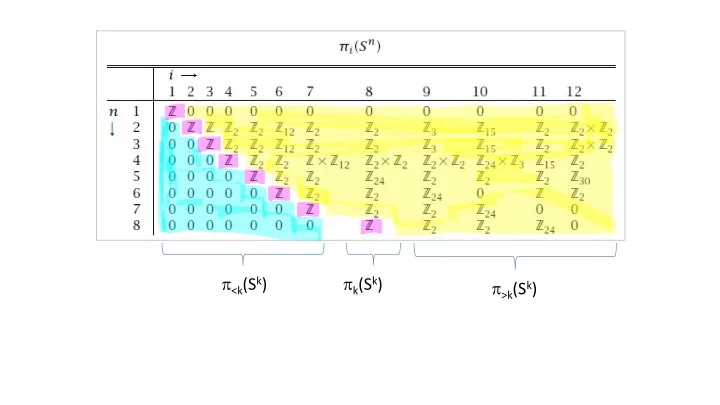
<k (S k ) k (S k ) >k (S k ) Infinite subgroups completely - - PowerPoint PPT Presentation

k s k k s k k s k infinite subgroups completely understood
SMART_READER_LITE
LIVE PREVIEW

<k (S k ) k (S k ) >k (S k ) Infinite subgroups completely - - PowerPoint PPT Presentation

<k (S k ) k (S k ) >k (S k ) Infinite subgroups completely understood Values stabilize along diagonals: n+k (S k ) = n+k+1 (S k+1 ) for k >> 0 Stable homotopy groups: s := lim n+k (S k ) k n


slide-1
SLIDE 1

<k(Sk) k(Sk) >k(Sk)

slide-2
SLIDE 2

Infinite subgroups completely understood

slide-3
SLIDE 3

Values stabilize along diagonals: n+k(Sk) = n+k+1(Sk+1) for k >> 0

slide-4
SLIDE 4

Stable homotopy groups: n

s := lim n+k(Sk) k

Primary decomposition: n

s =

(n

s)(p)

e.g.: 3

s = Z24 = z8 + Z3

p prime

slide-5
SLIDE 5
  • Each dot represents a factor of 2, vertical lines indicate additive extensions

e.g.: (𝜌3

𝑡)(2) = ℤ8,

(𝜌8

𝑡)(2) = ℤ2⨁ℤ2

  • Vertical arrangement of dots is arbitrary, but meant to suggest patterns

5

Computation: Mahowald-Tangora-Kochman Picture: A. Hatcher

slide-6
SLIDE 6

6

Computation: Nakamura -Tangora Picture: A. Hatcher

slide-7
SLIDE 7

(n

s)(5)

n Computation: D. Ravenel Picture: A. Hatcher

  • Each dot represents a factor of p

e.g.: (39

s)(5) = Z25

  • Vertical arrangement of dots is arbitrary, but meant to suggest patterns
slide-8
SLIDE 8
  • Each dot represents a factor of 2, vertical lines indicate additive extensions

e.g.: (𝜌3

𝑡)(2) = ℤ8,

(𝜌8

𝑡)(2) = ℤ2⨁ℤ2

  • Vertical arrangement of dots is arbitrary, but meant to suggest patterns

8

slide-9
SLIDE 9

9

Computation: Nakamura -Tangora Picture: A. Hatcher

slide-10
SLIDE 10

(n

s)(5)

n

10

Computation: D. Ravenel Picture: A. Hatcher

slide-11
SLIDE 11

(n

s)(5)

v1 - periodic layer

period = 2(p-1) = 8

11

slide-12
SLIDE 12

(n

s)(5)

v2 - periodic layer

period = 2(p2 - 1) = 48

12

slide-13
SLIDE 13

(n

s)(5)

period = 2(p3 - 1) = 248

v3 - periodic layer

13

slide-14
SLIDE 14

14

slide-15
SLIDE 15

Example: KO (real K-theory)

15

slide-16
SLIDE 16

16

slide-17
SLIDE 17

Hurewicz image of TMF (p = 2)

17