
SLIDE 1
January 2018
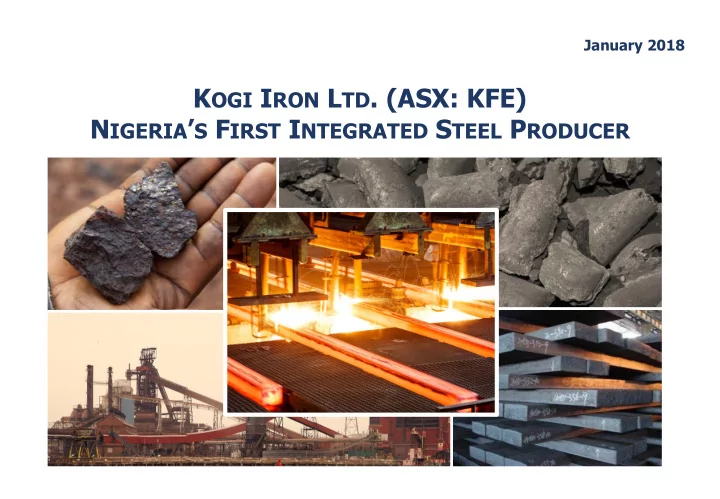
K OGI I RON L TD . (ASX: KFE) N IGERIA S F IRST I NTEGRATED S TEEL P - - PowerPoint PPT Presentation
January 2018 K OGI I RON L TD . (ASX: KFE) N IGERIA S F IRST I NTEGRATED S TEEL P RODUCER D ISCLAIMER Forward Looking Statements The purpose of this presentation is to provide general information about Kogi Iron Limited (Kogi or the
January 2018
Forward Looking Statements The purpose of this presentation is to provide general information about Kogi Iron Limited (“Kogi” or the “Company”). It is not recommended that any person makes any investment decision in relation to the Company based solely on this presentation. This presentation does not necessarily contain all information which may be material to the making of a decision in relation to the Company. Any investor should make their own independent assessment and determination as to the Company’s prospects prior to making any investment decision, and should not rely on the information in this presentation for that purpose. This presentation does not involve or imply a recommendation or a statement of opinion in respect of whether to buy, sell or hold securities in the
invested, that dividends will be paid on the shares or that there will be an increase in the value of the shares in the future. This presentation contains certain statements which may constitute “forward‐looking statements”. Such statements are only predictions and are subject to inherent risks and uncertainties which could cause actual values, results, performance or achievements to differ materially from those expressed, implied or projected in any forward‐looking statements. The Company does not purport to give financial or investment advice. No account has been taken of the objectives, financial situation or needs of any recipient of this document. Recipients of this document should carefully consider whether the securities issued by the Company are an appropriate investment for them in light of their personal circumstances, including their financial and taxation position. This presentation is presented for informational purposes only. It is not intended to be, and is not, a prospectus, product disclosure statement,
which cannot be excluded, the Company, its officers, employees and advisers expressly disclaim any responsibility for the accuracy or completeness
suffered by any person as a consequence of any information in this presentation or any error or omission there from. The Company accepts no responsibility to update any person regarding any inaccuracy, omission or change in information in this presentation or any other information made available to a person nor any obligation to furnish the person with any further information.
(scrap metal imports up >50% since 2013) ;
is low in regional terms.
plant.
to supply the Nigerian domestic market and substitute its reliance for imported scrap steel/billets.
high margins.
will be invoiced in USD and the proceeds held offshore. This will significantly reduce political and project risk.
Source: hammadsteel.com Source: KFE Source: google
3
www.kogiiron.com | ASK: KFE | 4
1) Mining Licenses granted including Community Development Agreement signed 2) Bulk sample mined and sent to Tenova/Mintek, testing underway 3) Financing progress: SD Capital/ GKB Ventures (London) appointed for debt sourcing 4) New London based director appointed Significant traction gained to advance and reposition project as steel plant with captive raw material supply
www.kogiiron.com | ASK: KFE | 5
1) Equity fund raising 2) Completion of MET testing end April followed by analysis and reporting 3) Completion of DFS 4th quarter 2018 4) Appointment of CEO completed - Martin Wood 5) Broker appointed for project major equity raise - RFC Ambrian 6) Completion of Export Credit Agency (ECA) debt funding package 2018 target to finalize DFS and Project Financing
production facilities in Nigeria
reduce Nigeria’s dependence on imported steel
to produce hot/cold rolled steel and wire coils.
associated derivatives, representing 80% of the US$5.2 Bn total metal products imported per year (29 Mt/annum).
capacity of 6.5 Mt/annum;
using 100% scrap steel/billets Regional Potential to Supply Billet Steel
further upside potential for customers
products
According to the Nigerian Ministry of Solid Minerals Development, an estimated US$3.3 Bn is spent on steel imports annually!
Source: World Steel Association Source: Ministry of Solid Minerals Development
True Steel Use (finished steel equiv.) (Kt)
Africa 2006 2014 Algeria 3,965 8,354 111% Angola 1,040 1,773 70% Cameroon 229 493 115% Egypt 4,942 11,281 128% Ethiopia 461 1,686 266% Ghana 640 1,204 88% Kenya 720 1,847 157% Morocco 2,028 3,139 55% Nigeria 2,090 3,601 72% RSA 6,280 5,172
Tanzania 451 1,201 166% Africa Total 22,846 39,751 74%
www.kogiiron.com | ASK: KFE | 6
Consumption of steel per capita p.a. (kg/yr)
1190 510 303 123 98 122 59 21 12 216
www.kogiiron.com | ASK: KFE | 7
Nigeria can expect an increase in demand for steel in the coming decade driven by industrialization
demand owing to increased industrialization
construction; power
construction; Agriculture
building, Military
and plastics, textiles, etc. Nigeria currently lags behind global benchmarks on steel consumption per capita with potential to grow
for the Nigerian domestic market
proximity to Kogi’s 100% owned captive raw material source at Agbaja
shelf equipment”
Mintek and Tenova has defined a well understood process pathway: beneficiation, melting and converting.
the required thresholds for potential ECA funding are met for six manufacturing countries.
(typical size of 200,000 tpa capacity per module)
Source: Pinterest Source: gepower.com
Power Station Steam Turbine (34 MW) Rotary Kiln Converters and Melter Vessel
www.kogiiron.com | ASK: KFE | 8
slide 22 for JORC statement)
channel iron deposit covering Kogi’s 233 km2 licence area
compared to traditional iron deposits (e.g. Banded Iron Formations (BIFs))
Source: KFE
Significant supply of good quality iron ore to feed the plant with coal and limestone available within 70 kms
www.kogiiron.com | ASK: KFE | 9
washing which removes alumina. The ore is then screened into coarse & fines.
are ball-milled and fed to a pellet plant before subsequently going to the rotary kilns.
turbines to power the plant. Any excess power generated will be supplied to the local grid. The waste gases are then scrubbed and filtered before being released.
going to a melter for further upgrading and reduction in impurities. The application of an oxygen lance drives off the phosphorous and allows the carbon content to be optimised.
as backfill.
Source: pishtazanmk.com Source: reuters.com Source: alibaba.com
www.kogiiron.com | ASK: KFE | 10
ROM IRON ORE COAL ROTARY SPONGE IRON KILN (DRI) BENEFICIATION PLANT
AND HIGH PRESSURE
WASHING PELLET PLANT ELECTRIC ARC FURNACE (CONVERTERS & MELTER VESSELS ) VACUUM DEGASSER CONTINUOUS CASTING OF BILLET STEEL STEAM TURBINE TAILINGS POND LIMESTONE TAILINGS RETURNED TO PIT SCRUBBED & FILTERED WASTE GASES NON-MAGNETIC WASTE (E.G. FOR BRICK MAKING) SLAG (E.G. FOR CEMENT FEED) OPEN-PIT MINING OXYGEN LANCE
11
produced in 150mm x 150mm x 1500mm billets (continuous casting length may vary)
Phosphorous < 0.03%, SiO2 <2%, Al2O <2% and Mn <0.01%.
melters using scrap and billet and are within trucking distance of the Agbaja Steel Project (See Map)
www.kogiiron.com | ASK: KFE | 12
Non-arable land unsuitable for crops and animal
Tailings from the initial washing impounded on the plateau. After drying returned to the pit for infilling. No toxic chemicals used in the production process Minimal dust during transport, as limited haulage of 5km and a limited number of truck movements daily. Dust suppressing measures will be in place. Negligible social impact due to remote location and no close settlements Waste heat recovery recycled to run steam turbine with excess power fed into the local grid Modern, cleaner steel production process with electric arc furnace instead of blast furnaces Slag and waste material containing principally silica and aluminium, to be used in brick making and local road production.
www.kogiiron.com | ASK: KFE | 13
MARKET INFORMATION
Selling Prices – Steel billet prices in Nigeria are currently in excess of US$660/t Cost, Freight and Insurance (‘CIF’) delivered to Lagos1. Further costs prior to delivery to steel fabricator include import duty, VAT and transportation. Competition: - In order to be competitive in the long term Kogi’s DRI plant must match or exceed the process and smelting costs of competing DRI steel plants around the world, which according to study conducted by US Department of Energy in 2000 and updated in 2012 range from2 US$180/t to US$240/t of steel billet
14 1 Steel Billet Price Sources: Metal Bulletin Global Billet Wrap, Spot Ocean Freight 2 Costs exclude construction costs, sustaining capex, royalties, non-site based overheads, taxes, etc
FINANCE STRUCTURE
70 % 30 % Debt Equity
Strong cash generation at an early stage of the project providing good credit metrics and debt service ratios. DSR initially at 12 month. Flexible equipment sourcing with import possible from a variety of sources ensuring local content criteria are met Steel project: Economically viable project along with diversification away from oil against the backdrop of a Nigerian development program ERGP High quality EPCM contractors being sought on a turnkey bonded contract Robust off-takers to be contracted Ring-fencing of hard currency revenue Equator compliant, Environmental & Social impact assessment completed, fully permitted Robust security package (share/ asset pledge etc.) and inter-creditor agreements
Project ideally positioned to take advantage of favourable, low-cost ECA Funding
15
Flexible equipment sourcing with import possible from a variety of sources ensuring local content criteria are met Steel: assists diversification away from oil High quality EPCM contractors being sought on a turnkey bonded contract In country off-takers to be contracted Reduces foreign currency requirement as it is an import substitution steel products Equator compliant, Environmental & Social impact assessment completed, fully permitted
Project ideally positioned to take advantage of favourable, low-cost ECA Funding
www.kogiiron.com | ASK: KFE | 16
www.kogiiron.com | ASK: KFE | 17
facilities:
principles etc
with hard currency reserves, and clarity on off-shore hard currency payment mechanics Our sourcing strategy will be influenced by the quality of the ECA support and the associated “All in Cost of Funding”
sourcing options
Mn and USD750 Mn
Based on initial ECA response we remain confident that our main funding will be ECA led
RISK MITIGANT
Political/Funding Securing ECA support, of which we are confident given responses so far, significantly reduces political and project funding risk – debt investors are covered through ECA insurances providing in addition a ‘halo effect’ for equity investors. Sovereign backed ECA funding is aligned with equity investors – all parties benefit if the project succeeds. Market Risk Historical demand for steel over the past two decades has increased 10x to 3,601kt in 2014, with resilient demand even in challenging geo-political times, implying that demand impairment through geo-political risk is low. Price/FX Pricing in USD occurs at import-parity levels and is supported by location and industry policy measures by the government. Sales receipts are held offshore and coupled with a local Naira cost base leads to low exposure to FX and remittance risks. Process Process risk is managed by the extensive test work program currently underway. The final plant design uses standard equipment such as kilns, melters, converters and casters which is already in use in similar plants globally. Volume Low risk, as project is import substitution, industrialization is supporting a continuous expansion of domestic demand and the steel sector is enjoying government support. Construction Low risk owing to modular off-the shelf equipment fabricated off-shore by reputable vendors and installed and commissioned by experienced international EPCM contractors. Raw Material Supply Captive iron ore source and advanced discussions with local providers of coal and limestone.
18
Greenwater Environmental Services Ltd
NPV Pty Ltd
Established Canadian full service mechanical consulting engineering firm specializing in sustainable mechanical design. Autonomous research and development
in all aspects of mineral processing, extractive metallurgy and related technology. Global experts with vast experience in geotechnical engineering, environmental services, testing and project management services. Global expert helping mining and metal companies reduce costs, save energy and limit environmental impact. Submerged electric arc and steel making experts. Well respected local Nigerian outfit. Past clients include World Bank funded projects. Award winning leading ECA finance experts. Independent engineering consultants specialising in the development, design and construction of new mining projects and the refurbishment of existing gold, base-metal and industrial mineral ore processing plants. ALS is a leading, global full-service provider of analytical geochemistry services to the global mining industry. Financial Modeling for Mineral Resource Developers Corporate Finance advisers with a focus on mining and infrastructure.
www.kogiiron.com | ASK: KFE | 19
Leading international resource sector finance houses.
Source: hammadsteel.com Source: KFE Source: google
The current state of play…
economy.
… and the plan to fuel growth and change
promoting industrialization Key government downstream actions to promote industrial development: 1) Support the steel sector through industry protection such as restrictions on the importation of Iron and Steel until self-sufficiency is attained 2) Enforce crude steel and specific finished steel quality limits (e.g. dimensional accuracy, brittleness, etc) through regulation 3) Ensure continued free trade agreements within the ECOWAS region 4) Promote backwards integration capabilities for current processing players through necessary incentives
www.kogiiron.com | ASK: KFE | 20
(scrap/billet metal imports up >50% since 2013) ;
is low in regional terms.
plant:
limestone enhances profitability;
high margins.
will be invoiced in USD and the proceeds held offshore. This will significantly reduce political and project risk.
Source: hammadsteel.com Source: KFE Source: google
21
22