Junior lawyers professional indemnity seminar 4 June 2015 Section - - PDF document

junior lawyers professional indemnity seminar 4 june 2015
SMART_READER_LITE
LIVE PREVIEW

Junior lawyers professional indemnity seminar 4 June 2015 Section - - PDF document

4/06/2015 Junior lawyers professional indemnity seminar 4 June 2015 Section 14A of the Limitation Act 1980 Theres No Limit? Niamh OReilly Extending the Limitation Period in Professional Negligence Claims Section 14A of the


slide-1
SLIDE 1

4/06/2015 Hailsham Chambers, 4 Paper Buildings, Temple, London, EC4Y 7EX T: 020 7643 5000 | E: clerks@hailshamchambers.com

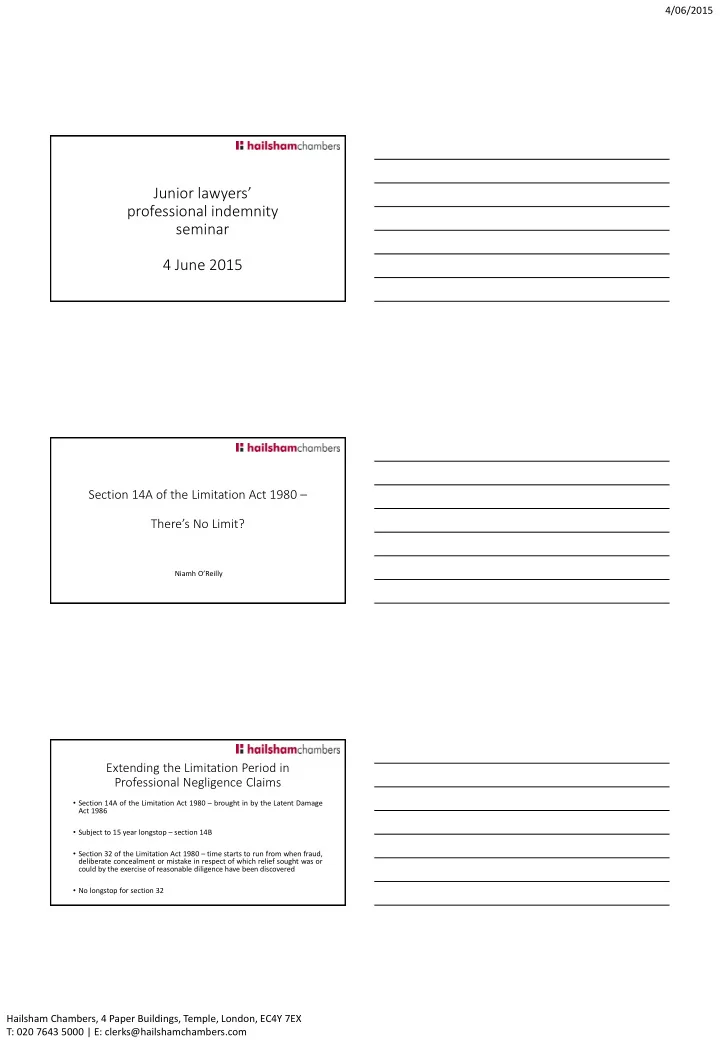
Junior lawyers’ professional indemnity seminar 4 June 2015

Section 14A of the Limitation Act 1980 – There’s No Limit?

Niamh O’Reilly

Extending the Limitation Period in Professional Negligence Claims

  • Section 14A of the Limitation Act 1980 – brought in by the Latent Damage

Act 1986

  • Subject to 15 year longstop – section 14B
  • Section 32 of the Limitation Act 1980 – time starts to run from when fraud,

deliberate concealment or mistake in respect of which relief sought was or could by the exercise of reasonable diligence have been discovered

  • No longstop for section 32
slide-2
SLIDE 2

4/06/2015 Hailsham Chambers, 4 Paper Buildings, Temple, London, EC4Y 7EX T: 020 7643 5000 | E: clerks@hailshamchambers.com

Section 14A Limitation Act 1980

14A (1)This section applies to any action for damages for negligence,

  • ther than one to which section 11 of this Act applies, where the

starting date for reckoning the period of limitation under subsection (4)(b) below falls after the date on which the cause of action accrued. (2)Section 2 of this Act shall not apply to an action to which this section applies. (3)An action to which this section applies shall not be brought after the expiration of the period applicable in accordance with subsection (4) below. (4)That period is either— (a)six years from the date on which the cause of action accrued; or (b)three years from the starting date as defined by subsection (5) below, if that period expires later than the period mentioned in paragraph (a) above. (5)For the purposes of this section, the starting date for reckoning the period of limitation under subsection (4)(b) above is the earliest date on which the plaintiff or any person in whom the cause of action was vested before him first had both the knowledge required for bringing an action for damages in respect of the relevant damage and a right to bring such an action.

Section 14A Limitation Act 1980 (continued)

(7)For the purposes of subsection (6)(a) above, the material facts about the damage are such facts about the damage as would lead a reasonable person who had suffered such damage to consider it sufficiently serious to justify his instituting proceedings for damages against a defendant who did not dispute liability and was able to satisfy a judgment.

slide-3
SLIDE 3

4/06/2015 Hailsham Chambers, 4 Paper Buildings, Temple, London, EC4Y 7EX T: 020 7643 5000 | E: clerks@hailshamchambers.com

(8)The other facts referred to in subsection (6)(b) above are— (a)that the damage was attributable in whole or in part to the act or

  • mission which is alleged to constitute negligence; and

(b)the identity of the defendant; and (c)if it is alleged that the act or omission was that of a person other than the defendant, the identity of that person and the additional facts supporting the bringing of an action against the defendant. (9)Knowledge that any acts or omissions did or did not, as a matter of law, involve negligence is irrelevant for the purposes of subsection (5) above.

Actual Knowledge – What is the Starting Date?

The earliest date on which the claimant or any person in whom the cause of action was vested before him first had both a right to bring an action and knowledge:

  • i. of the material facts about the damage in respect of

which damages are claimed (being such facts about the damage as would lead a reasonable person who had suffered such damage to consider it sufficiently serious to justify his instituting proceedings for damages against a defendant who did not dispute liability and was able to satisfy a judgment)

  • i. that the damage was attributable in whole or in

part to the act or omission which is alleged to constitute negligence;

  • ii. of the identity of the defendant; and
  • iii. if it is alleged that the act or omission was that
  • f a person other than the defendant, the

identity of that person and the additional facts supporting the bringing of an action against the defendant and a right to bring such an action.

slide-4
SLIDE 4

4/06/2015 Hailsham Chambers, 4 Paper Buildings, Temple, London, EC4Y 7EX T: 020 7643 5000 | E: clerks@hailshamchambers.com

What is Knowledge?

Haward v Fawcetts [2006] UKHL 9:

  • Knowledge does not mean knowing for certain and beyond possibility
  • f contradiction.
  • It means knowing with sufficient confidence to justify embarking on

the preliminaries to the issue of a writ. Per Lord Nicholls: “In other words, the claimant must know enough for it to be reasonable to begin to investigate further.” (at para 9)

Actual Knowledge – Material Facts About the Damage

  • Section 14A(7): [T]he material facts about the damage are such facts

about the damage as would lead a reasonable person who had suffered such damage to consider it sufficiently serious to justify his instituting proceedings for damages against a defendant who did not dispute liability and was able to satisfy a judgment.

  • Relates entirely to the question of the damage suffered
  • Need not be able to precisely quantify the damage for time to start

running

  • Haward v Fawcetts [2006] UKHL 9: Knowledge of the “essential

thrust” of the damage required.

Actual Knowledge – Attributability of Damage

Haward v Fawcetts [2006] UKHL 9:

  • Knowledge in broad terms of the facts on which the claimant's

complaint was based and of the defendant's acts or omissions and knowing that there was a real possibility that those acts or omissions had been a cause of the damage.

  • For time to run “there needs to have been something which would

reasonably cause [the claimant] to start asking questions about the advice he was given.” (per Lord Nicholls, para 21).

  • C believed that losses were to be explained by a variety of damaging

economic factors, rather than the bad advice of his advisers. Nonetheless, the attributability criterion was satisfied.

slide-5
SLIDE 5

4/06/2015 Hailsham Chambers, 4 Paper Buildings, Temple, London, EC4Y 7EX T: 020 7643 5000 | E: clerks@hailshamchambers.com

  • Haward v Fawcetts [2006] UKHL 9

What the claimant must know to set time running is the essence of the act or

  • mission to which his damage is attributable, the substance of what ultimately

comes to be pleaded as his case in negligence. That essence or substance here could no doubt be characterised in either of two ways: either as the act of recommending investment in the company (or omitting to caution against it-

  • n the particular parts of this case these are two sides of the same coin), or,

with greater particularity, the act of recommending investment without first carrying out the investigations necessary to justify such positive advice. Having at first preferred the latter characterisation, I have come to prefer the former. True, under the former the claimant knows nothing beyond the fact that his advisers led him into what turned out to be a bad investment; he does not know, as under the latter characterisation he would, that he has a justifiable complaint against his advisers. But he surely knows enough (constructive knowledge aside) to realise that there is a real possibility of his damage having been caused by some flaw or inadequacy in his advisers' investment advice, and enough therefore to start an investigation into that possibility, which section 14A then gives him three years to complete. (Per Lord Brown at 90)

Actual Knowledge – Attributability of Damage

  • C’s awareness of potential claim against D is entirely irrelevant

(Haward v Fawcetts [2006] UKHL 9; see also section 14A(9))

  • Chinnock v Veale Wasbrough [2015] EWCA Civ 441

Constructive Knowledge under Section 14A

14A (10)For the purposes of this section a person’s knowledge includes knowledge which he might reasonably have been expected to acquire— (a)from facts observable or ascertainable by him; or (b)from facts ascertainable by him with the help of appropriate expert advice which it is reasonable for him to seek; but a person shall not be taken by virtue of this subsection to have knowledge of a fact ascertainable only with the help of expert advice so long as he has taken all reasonable steps to obtain (and, where appropriate, to act on) that advice.

slide-6
SLIDE 6

4/06/2015 Hailsham Chambers, 4 Paper Buildings, Temple, London, EC4Y 7EX T: 020 7643 5000 | E: clerks@hailshamchambers.com Constructive Knowledge under Section 14A

  • Chinnock v Veale Wasbrough [2015] EWCA Civ 441
  • Forbes v Wandsworth Health Authority [1997] QB 402 (per Stuart-Smith

LJ at 412 D-F):

The real question is whether it was reasonable for him to seek that advice. If it was, he took no steps at all to do so. One of the problems with the language of section 14(3) (b) [the constructive knowledge provision as it then was] is that two alternative courses

  • f action

may be perfectly

  • reasonable. Thus, it may be perfectly reasonable for a person who is not

cured when he hoped to be to say, “Oh well, it is just one of those things. I expect the doctors did their best.” Alternatively, the explanation for the lack

  • f success may be due to want of care on the part of those in whose charge

he was, in which case it would be perfectly reasonable to take a second

  • pinion. And I do not think that the person who adopts the first alternative

can necessarily be said to be acting unreasonably. But he is in effect making a choice, either consciously by deciding to do nothing, or unconsciously by in fact doing nothing. Can a person who has effectively made this choice, many years later, and without any alteration of circumstances, change his mind and then seek advice which reveals that all along he had a claim? I think not.

Constructive Knowledge under Section 14A

  • Oakes v Hopcroft [2000] Lloyd's Rep PN 946
  • Chinnock v Veale Wasbrough [2015] EWCA Civ 441

Per Jackson LJ: 90 This case is conceptually similar to Forbes . Ms Chinnock was deeply unhappy with the legal advice which she received in 2001. According to her evidence she was dumbfounded. She therefore had a choice. She could either consult other lawyers or she could let matters rest. … 91 I do not think that it was open to Ms Chinnock to abstain from further inquiries for more than six years (in this case eight years) and then to seek legal advice. It is true that during 2009 a firm of solicitors acting in the divorce proceedings happened to ask the husband if advice was required on any other matter. That, however, is not a justification for waiting eight years before taking legal advice.

  • Jacobs v Sesame Ltd [2014] EWCA Civ 1410

The Burden is on the Claimant

  • C must plead and prove entitlement to rely on section 14A – potential

for slip-ups

  • Haward v Fawcetts [2006] UKHL 9
slide-7
SLIDE 7

4/06/2015 Hailsham Chambers, 4 Paper Buildings, Temple, London, EC4Y 7EX T: 020 7643 5000 | E: clerks@hailshamchambers.com

Causation and Remoteness

Nicholas Pilsbury

Introduction

“… the courts have moved away from characterising questions as to the measure of damages for the tort of negligence as questions of causation and remoteness… The courts now analyse such questions by enquiring whether the duty which the tortfeasor owed was a duty in respect of the kind of loss of which the victim complains … The same test applies whether the duty of care is contractual or tortious.” Arden LJ in Johnson v Gore Wood [2003] EWCA Civ 1728

SAAMCo (1)

  • Scope of Duty
  • “It is never sufficient to ask simply whether A owes B a duty of care. It is

always necessary to determine the scope of the duty by reference to the kind

  • f damage from which A must take care to hold B harmless” (Caparo v

Dickman)

  • A value judgment? (Kuwait Airways v Iraqi Airways (No 6) [2002] 2 AC 883)
  • Or “an intensively fact an sensitive exercise”? (Johnson v Gore Wood [2003]

EWCA Civ 1728)

  • E.g. Pearson v Sanders Witherspoon [2000] PNLR 110
slide-8
SLIDE 8

4/06/2015 Hailsham Chambers, 4 Paper Buildings, Temple, London, EC4Y 7EX T: 020 7643 5000 | E: clerks@hailshamchambers.com

SAAMCo (2)

  • The loss is not attributable to the information given by the

Defendant being wrong

  • Advice vs information cases
  • The mountaineer’s knee
  • E.g. Andrews v Barnett Waddingham LLP [2006] PNLR 24

SAAMCo and remoteness

  • Transfield Shipping Inc v Mercator Shipping Inc (The Achilleas) [2009]

1 AC 61

  • Rubenstein v HSBC Bank Plc [2013] PNLR 9
  • Henderson v Wotherspoon [2013] CSOH 113
  • John Grimes v Gubbins [2013] PNLR 17

Test of remoteness

  • Contract:
  • “Not unlikely” to arise from the breach (Hadley v

Baxendale; Victoria Laundry v Newman [1949] 2 KB 528; The Heron II [1969] 1 AC 350)

  • Type of loss: normal vs exceptional profits (Victoria

Laundry)

  • Date of contract
  • Tort:
  • “Foreseeable”: Wagon Mound (No 2) [1967] 1 AC 617
  • Eggshell skull (Smith v Leech Brain [1962] 2 QB 405
  • Type of damage (Hughes v Lord Advocate [1963] AC 837;

Page v Smith [1996] AC 155)

  • Date of breach
slide-9
SLIDE 9

4/06/2015 Hailsham Chambers, 4 Paper Buildings, Temple, London, EC4Y 7EX T: 020 7643 5000 | E: clerks@hailshamchambers.com

The right answer?

  • Paradigm case: contractual / quasi contractual, e.g. “assumption of

responsibility” (Hedley Byrne / Henderson v Merrett )

  • Cf. choice of limitation periods
  • Wellesley Partners LLP v Withers [2014] PNLR 22

Recent cases

Alicia Tew

Fraudulent device

The principle:

  • where an insured knowingly or recklessly mad an

untrue statement

  • in support of a claim which he honestly believed

was good (“a fraudulent device”)

  • the whole claim would be forfeited

Versloot Dredging BV v HDI Gerling Indutsrie Versicherung AG [2014] EWCA Civ 1349

slide-10
SLIDE 10

4/06/2015 Hailsham Chambers, 4 Paper Buildings, Temple, London, EC4Y 7EX T: 020 7643 5000 | E: clerks@hailshamchambers.com

Settlement on basis of fraudulent representations

  • EL: Insurer suspected fraud
  • Parties entered into settlement agreement in full and

final settlement of the claim

  • Two years later, employee’s neighbours alleged

employee’s statement about injuries was dishonest

  • Insurers pursued damages for deceit/ rescission

Hayward v Zurich [2015] EWCA Civ 327

Are Third Party Funder loans covered by Minimum Terms?

“part and parcel” of obligations incurred by a solicitor in respect of his professional duties to the client not excluded by clause 6.6 of Min Terms

Impact Funding Solutions Limited v Barrington Support Services Limited [2015] EWCA Civ 31

..but aren’t TPF loans trading debts?

Core risk insured: claims from clients TPF loans “do not arise out of claims made against him in his professional capacity” “trading or personal debt”  clause 6.6 excludes or limits liability

Sutherland Professional Funding Limited v Bakewells (a firm) [2011] EWHC 2658

slide-11
SLIDE 11

4/06/2015 Hailsham Chambers, 4 Paper Buildings, Temple, London, EC4Y 7EX T: 020 7643 5000 | E: clerks@hailshamchambers.com

BREACH OF TRUST: DAMAGES

Target Holdings v Redfern [1996] AC 421 “…I have no doubt that, until the underlying commercial transaction has been completed, the solicitor can be required to restore to client account monies wrongly paid away. But to import into such trust an obligation to restore the trust fund once the transaction has been completed would be entirely artificial.”

AIB v Redler [2014] UKSC 58 [62] “…it would not in my opinion be right to impose or maintain a rule that gives redress to a beneficiary for loss which would have been suffered if the trustee had properly performed its duties.”  Same result as tort and contract measure of loss

BREACH OF TRUST: DAMAGES

Greek drama

  • Findings of fact and inferences may only be challenged where “plainly

wrong”

  • Causation: even if the Greek lawyer had included further protection /

given further advice on use of existing protections in clauses, the client would have acted in the same way Watson Farley and Williams (a firm) v Itzhak Ostrovizky [2015] EWCA Civ 457

slide-12
SLIDE 12

4/06/2015 Hailsham Chambers, 4 Paper Buildings, Temple, London, EC4Y 7EX T: 020 7643 5000 | E: clerks@hailshamchambers.com

Questions?