Joint Finance-Appropriations Committee Idaho Department of Health - - PDF document

joint finance appropriations committee
SMART_READER_LITE
LIVE PREVIEW

Joint Finance-Appropriations Committee Idaho Department of Health - - PDF document

Joint Finance-Appropriations Committee Idaho Department of Health and Welfare Presentation by Richard Armstrong, Director January 19, 2010 W e prom ote and protect the health and safety of I dahoans. Joint Finance-Appropriations Committee I


slide-1
SLIDE 1

Joint Finance-Appropriations Committee

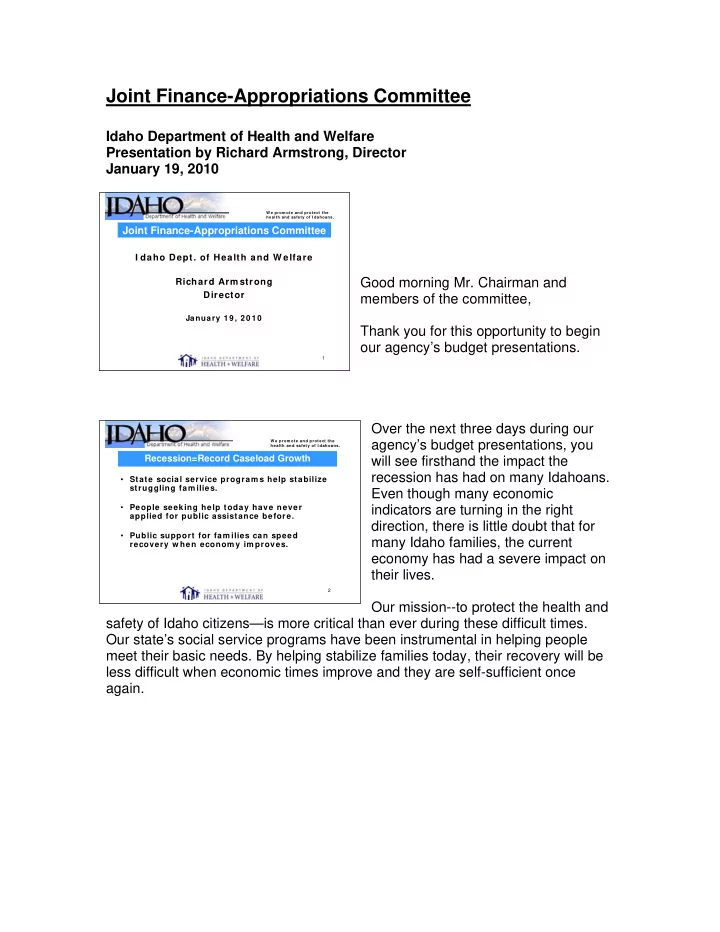
Idaho Department of Health and Welfare Presentation by Richard Armstrong, Director January 19, 2010 Good morning Mr. Chairman and members of the committee, Thank you for this opportunity to begin

  • ur agency’s budget presentations.

Over the next three days during our agency’s budget presentations, you will see firsthand the impact the recession has had on many Idahoans. Even though many economic indicators are turning in the right direction, there is little doubt that for many Idaho families, the current economy has had a severe impact on their lives. Our mission--to protect the health and safety of Idaho citizens—is more critical than ever during these difficult times. Our state’s social service programs have been instrumental in helping people meet their basic needs. By helping stabilize families today, their recovery will be less difficult when economic times improve and they are self-sufficient once again.

1

W e prom ote and protect the health and safety of I dahoans.

Joint Finance-Appropriations Committee

I daho Dept. of Health and W elfare Richard Arm strong Director

January 1 9 , 2 0 1 0

2

W e prom ote and protect the health and safety of I dahoans.

Recession=Record Caseload Growth

  • State social service program s help stabilize

struggling fam ilies.

  • People seeking help today have never

applied for public assistance before.

  • Public support for fam ilies can speed

recovery w hen econom y im proves.

slide-2
SLIDE 2

Our role in providing services is twofold. First, we all want people who have suffered a job loss or who cannot afford necessities to receive help before their situation deteriorates. We know from experience that if family situations unravel, the cost to the state, to counties and to our communities will be much greater in the long run. We are committed to providing good customer service so we can address issues before they develop into crises. Second, we have a responsibility to ensure the integrity of state programs. We know the economy has affected just about everyone in one respect or another. Our workers have to be very diligent as the gatekeepers to ensure only those who qualify for services receive them. We cannot sacrifice accuracy in the application process, for the costs in trustee and benefits would be much greater. You only have to look at our budget to realize how important a strong workforce

  • is. For SFY 2011, our budget

request is $2.1 billion. 86% of that figure, $1.8 billion, will pay for benefits for Idaho

  • citizens. Our employees, who

are less than 9% of the budget request, serve as the controllers—they determine eligibility, assure that quality and safety is maintained by private providers, and that adequate care is provided for the most vulnerable citizens, along with those committed to us from the courts. Our employees are the guardians of the budget— an invaluable ally in helping balance it. Dealing with record numbers of people has not been easy. Our office lobbies remain crowded with people looking for help. Most of the people coming in today are people who have never applied for public assistance before. In some of our

  • ffices, we have been forced to give out numbered tickets so people can be

assisted in the order they enter. At others, we have had to turn off the telephone

3

W e prom ote and protect the health and safety of I dahoans.

1 . Stabilize fam ilies:

  • Tim ely intervention prevents

hom elessness and reduces future costs to state, counties and com m unities. 2 . Ensure the integrity of program s:

  • Strong oversight provides tim ely

assistance to the m ost vulnerable;

  • Strict accountability so lim ited resources

are properly spent.

DHW’s Role in Providing Services

4

W e prom ote and protect the health and safety of I dahoans.

SFY 2011 Recommendation: 86% T&B

  • Greatest portion of

budget provides payments to Idaho businesses that provide services.

  • Strong employee base is

critical to provide oversight and accountability.

Trustee and Benefits $1,797.2 Million 85.8% Operating and Capital $120.1 Million 5.7% Personnel $176.8 Million 8.5%

slide-3
SLIDE 3

lines late in the afternoon just to clear the backlog of calls. And things are not slowing down. Until recently, I have been extremely proud of the huge gains we made in service quality over the last few years. Today, it saddens me to see the deterioration of customer service---our productivity gains simply cannot keep pace with the rapid increase in the number of citizens now eligible for services. To give you an idea of the growing workloads our staff are dealing with, here are some examples: Let’s begin with Food Stamps, which is a good barometer of the number of people living at or near poverty. Today, we are processing

  • ver 9,000 new Food Stamp

applications each month, a 55% increase in processing new applications since 2007. Over that same time period, the number of participants has grown from 87,000 in 2007, to 179,000 today. In Medicaid, the participants have grown from 184,000 to over 209,000 today, a 13% increase since 2007. Child Support caseloads are up 9% over the same time period. The Idaho 2-1-1 CareLine received 214,000 calls from people last fiscal year, up from 160,000 in 2008. Through the first six months of this fiscal year, they have already logged 109,000 calls, so you can see this record setting pace continues. In Service Integration, we have workers called Navigators who help people connect with state or community social services. In SFY 2008, Navigators answered 1,400 emergency assistance calls in which families were on the verge of becoming homeless or did not have sufficient food.

5

W e prom ote and protect the health and safety of I dahoans.

Economy Impacts on Caseloads/Workload

  • Food Stamps are a good barometer for the number of people living

near poverty.

SFY 2007 SFY 2008 SFY 2009 Today % change 2007-Today Food Stamp Monthly Applications 5,787 6,129 8,039 9,017 55% Food Stamp Enrollment 87,104 95,433 124,826 179,694 106% Medicaid Participants 184,475 185,039 192,006 209,641 13%

6

W e prom ote and protect the health and safety of I dahoans.

Economy Impacts on Workload/Caseloads

SFY 2007 SFY 2008 SFY 2009 % Change 2007-2009 Child Support Cases 114,789 120,888 124,690 9% Idaho Careline Calls 151,726 159,970 213,730 41% Adoptions 195 237 355 82% Substance Use Disorder Treatment 8,807 7,960 14,905 69% Navigation Emergency Cases N/A 1,393 1,605 15%

slide-4
SLIDE 4

From our experience so far this fiscal year, their work will help stabilize more than 2,500 families, 80% more than in 2008. And the list goes on. With this record caseload growth coupled with holdback actions, our workforce is in a fragile state. But at the same time, due to economic conditions, agencies such as ours are a last resort for many

  • people. Our workers realize this. I hear

reports daily of staff who are working after hours, weekends, or losing vacation time because of the need to help people who are casualties of the economy. With the 2% personnel holdback announced last week, our offices will close every other Friday afternoon and staff will take unpaid leave for the remainder of the fiscal year. We exempted direct care hospital staff and a few other positions which could result in the loss of accreditation or risk penalties for service failure. With the furlough we implemented last July, DHW staff will now be taking

  • ver nine days off without pay this

fiscal year. This is a 3.7% reduction in overall pay. If you recall, we also eliminated 23 full-time positions. Last year, this slide was in my budget

  • presentation. It outlined our strategy

then, and remains our guiding principle

  • today. However, this year we can no

longer guarantee changes will result in “good public policy” as we struggle with the enormity of the deficit. My job is to find the best balance in protecting the health and safety of Idahoans with the financial resources we are given.

7

W e prom ote and protect the health and safety of I dahoans.

Record Caseloads and Holdbacks Impact Workforce

  • Record caseloads and resulting w orkload
  • ccurs at a tim e governm ent m ust reduce

expenditures, including personnel budgets.

  • DHW holdbacks in personnel included

layoffs, furlough days and positions w hich have been held open.

  • Despite challenges, staff realize that DHW

services are a last resort for m any people.

8

W e prom ote and protect the health and safety of I dahoans.

Personnel Impacts SFY 2 0 1 0

  • 9 .5 days furlough= 3 .7 % annual pay

reduction

  • 2 3 layoffs
  • Vacant positions held open as long as

possible

9

W e prom ote and protect the health and safety of I dahoans.

Strategies for Holdbacks and SFY 2010 Budget

1 . Maintain good public policy, w hile protecting the m ost vulnerable people. 2 . Evaluate each program for savings and efficiencies. 3 . Preserve the infrastructure to m eet critical, increasing dem ands in service delivery.

slide-5
SLIDE 5

This is our dilemma: All reductions we make today are going to adversely affect both participants and Idaho businesses. On top of this, all reductions we make in state general funds are multiplied because of federal matching dollars tied to state spending. If you cut $1 in state general funds from Medicaid today, you also cut $3.75 in federal matching funds. That $1 reduction becomes a $4.75 cut. This is all money that is being paid to Idaho medical providers, disability agencies, nursing homes and hospitals. Reductions have a profound impact on Idaho businesses. As a result of budget reductions, the Department has not leveraged $54 million of federal funds in SFY 2009, and an estimated $68 million in the current fiscal year. Earlier this year I shared with you the FMAP history for Medicaid, which is the percentage of costs the federal government pays in the program. We were at a 69% FMAP rate before the American Recovery and Reinvestment Act funds kicked in a year ago October. The federal government then increased its share, picking up 79% of Medicaid costs, which reduced the state general fund

  • expenses. Today, we have no

guarantee of what the rate will be when the ARRA funds expire in January 2011. The Governor has generously committed $69.5 million in reserves to help us deal with this funding cliff if it becomes necessary. The best case scenario for our state is that the federal government continues with the enhanced FMAP rate of 79%. We believe this is what they will do. But even with this enhanced rate, we still need to trim approximately $24 million in general funds from the Medicaid budget for SFY 2011.

10

W e prom ote and protect the health and safety of I dahoans.

Dedicated Funds $0.3 Million Federal Funds $67.7 Million General Funds $51.8 Million

The Impact of Reductions

  • Reductions in State general

funds also reduces Federal m atching funds.

  • $ 5 2 m illion in holdbacks

have resulted in a total reduction of $ 1 1 9 .8 m illion.

  • This is all m oney that is

paid to I daho providers— hospitals, nursing hom es, disability agencies, and doctors.

Holdback Actions

11

W e prom ote and protect the health and safety of I dahoans.

FMAP Rate

  • FMAP rate w as increased w ith stim ulus

funding from 6 9 % to 7 9 % in October 2 0 0 8 .

  • FMAP rate is set to revert to 6 9 % on

January 1 , 2 0 1 1 . Gov. Otter recom m ends using reserve funds if that occurs.

  • W e believe the 7 9 % rate w ill be extended

for SFY 2 0 1 1 , but no guarantees.

slide-6
SLIDE 6

No matter what happens, I think it is evident that even in the best case scenario, our appropriations are going to be a challenge. This fiscal year, you allowed us to transfer money between

  • perating and personnel to meet critical
  • needs. Today, I ask your approval to

continue to allow us this flexibility to shift resources to meet the changing circumstances of our current budget dilemma. It also would also be helpful if we can carry over unspent funds from SFY 2010 to

  • 2011. We know SFY 2011 is going to be extremely difficult. Any flexibility you can

provide to help mitigate the impacts of reductions will be greatly appreciated. In return, my commitment to you is open and transparent reporting of all money spent by this Department—there will be no secrets. Over the next few days, you will hear budget recommendations from our division administrators, along with strategies for managing the ever-increasing workload. You will be dealing with a lot of difficult numbers to work out a balanced budget. I think we all realize that those budget figures are more than just numbers—they represent our core values as a state

  • government. And good government at its

core protects the most vulnerable among us. I know you are going to have to make some difficult decisions, and we hope to support you in this process to make the best choices for Idaho citizens. Thank you and I now stand for questions.

12

W e prom ote and protect the health and safety of I dahoans.

  • Allow transfers betw een Operating and

Personnel budgets to shore up shortfalls

  • Provide carry-over authority for unspent

funds from SFY 2 0 1 0 to 2 0 1 1 .

Flexibility Helps Meet Budget Dilemmas

13 W e prom ote and protect the health and safety of I dahoans.

Joint Finance-Appropriations Committee

I daho Dept. of Health and W elfare Richard Arm strong Director January 19 , 2 0 1 0