John D Alexander, PhD Forest Service Research and Development - - PowerPoint PPT Presentation

john d alexander phd
SMART_READER_LITE
LIVE PREVIEW

John D Alexander, PhD Forest Service Research and Development - - PowerPoint PPT Presentation

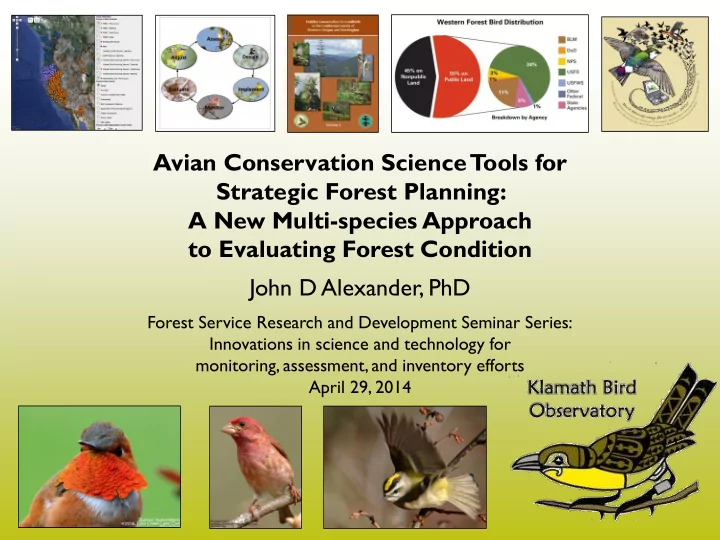
Avian Conservation Science T ools for Strategic Forest Planning: A New Multi-species Approach to Evaluating Forest Condition John D Alexander, PhD Forest Service Research and Development Seminar Series: Innovations in science and technology


slide-1
SLIDE 1

Avian Conservation Science T

  • ols for

Strategic Forest Planning: A New Multi-species Approach to Evaluating Forest Condition John D Alexander, PhD

Forest Service Research and Development Seminar Series: Innovations in science and technology for monitoring, assessment, and inventory efforts April 29, 2014

slide-2
SLIDE 2

Klamath Bird Observatory

(Alexander et al. 2004; KS Ecology Proceedings)

Advancing bird and habitat conservation through science, education, and partnerships.

slide-3
SLIDE 3

Outline

  • Challenges:
  • Science – Management Divide
  • Closing Adaptive Management Cycle
  • Learning communities for ecosystem management:
  • Participatory Social Science
  • Strategy for Applied Science and Delivery
  • Avian Conservation Science T
  • ols:
  • Adaptive Management Applied – beyond NEPA
  • Examples: Northwest Forest Management
  • Innovations:
  • Fine-scaled Modeling
  • Landscape Change
  • Conclusions:
  • Meeting IM&A Objectives
slide-4
SLIDE 4

J Stephens CJ Ralph B Bresson N Seavy B Altman M Betts S Veloz S Shirley K Halstead G Geupel M Pitkin S Cuenca D Clayton S Stresser A Marcus T Will V Sturtevant M Scott K Rosenberg D Jongsomjit N Elliot L Salas G Ballard Z Yang R Hutchinson K McGarigal J Rousseau J Livaudais

Acknowledgements

slide-5
SLIDE 5

Science-based T

  • ols
  • Species assessment database
  • Standard monitoring techniques
  • Conservation plans
  • Data-rich models
  • Conservation design process

(Alexander 2011; NABCI 2011)

Context

slide-6
SLIDE 6

Challenges

  • Science and Management
  • Separate Traditions
  • Compartmentalized
  • Ineffective Science

Delivery & Application

  • Community Learning
  • Collective Knowledge
  • Challenge Norms
  • Compartmentalized
  • Relevant Applied Science

& Tools

(Bliss1999; Smith 2000; Roux et al. 2006; Bormann et al. 2007; Scott et al. 2007; Graffy 2008; Hall & Fleishman 2010)

slide-7
SLIDE 7

Participatory Action Research

  • Degree of community control
  • Reciprocal production of knowledge
  • Utility and action of outcomes

Engage agency community for better understanding and change

(McIntyre 2008; Wulfhorst et al. 2008,; Alexander 2011)

Challenges:

Science Not Used Culture - When to engage? Consultants, Science-based NGOs, Environmental Advocates

ORWACA Meeting – April 2005

slide-8
SLIDE 8

Conservation Objectives Management Objectives

Monitoring & Research

  • Relationships
  • Early Collaboration
  • Applied Science
  • Delivery

(communications)

(Alexander 2011)

Science-based NGOs

Bridging the Science-Management Divide

slide-9
SLIDE 9

Avian Conservation Science T

  • ols Applied

Adaptive Management

  • Cost effective
  • Engage leadership
  • Consensus

Decision Support T

  • ols
  • Who is the audience?
  • What is the question?
  • What are the information gaps?
  • Where are the transfer points?

(Alexander et al. 2009; Williams et. al. 2009; Stephens et al. 2011)

slide-10
SLIDE 10

Catalyst for Adaptive Management

slide-11
SLIDE 11

Avian Knowledge Network

(Iliff 2009)

slide-12
SLIDE 12
slide-13
SLIDE 13

Stewardship Responsibility/Opportunity (NEPA)

(Rich et al. 2004; USFWS 2008; NABCI 2011; Panjabi et al., 2012)

slide-14
SLIDE 14

Quantitative Habitat and Population Objectives

Beyond NEPA

  • Align with broad objectives of RMPs/LMPs
  • Multiple species at multiple scales
slide-15
SLIDE 15

Focal Species – Habitat Attributes

(Altman and Alexander 2012; Chase and Geupel 2005)

Conservation Objectives

slide-16
SLIDE 16

Chapparal and Oak woodland Bewick's Wren Bullock's Oriole California Towhee Lesser Goldfinch Western Scrub-Jay Western Wood-pewee White-breasted Nuthatch Broadleaf-conifer mix Bushtit Lazuli Bunting Spotted Towhee Black-headed Grosbeak *Black-thr. Gray Warbler Nashville Warbler High volume conifer Golden-crowned Kinglet Townsend's Solitaire *Brown Creeper *Hermit Warbler *Pacific-slope Flycatcher *Winter Wren Low volume conifer Mountain Chickadee Green-tailed Towhee Conifer generalists Red-breasted Nuthatch Yellow-rumped Warbler (Betts et al. 2010; Seavy and Alexander 2011; Altman and Alexander 2012)

Forest Management Habitat Models

* Oregon-Washington PIF Focal Species (Western Coniferous Forests)

slide-17
SLIDE 17

Chapparal and Oak woodland Bewick's Wren Bullock's Oriole California Towhee Lesser Goldfinch Western Scrub-Jay Western Wood-pewee White-breasted Nuthatch Broadleaf-conifer mix Bushtit Lazuli Bunting Spotted Towhee Black-headed Grosbeak *Black-thr. Gray Warbler Nashville Warbler High volume conifer Golden-crowned Kinglet Townsend's Solitaire *Brown Creeper *Hermit Warbler *Pacific-slope Flycatcher *Winter Wren Low volume conifer Mountain Chickadee Green-tailed Towhee Conifer generalists Red-breasted Nuthatch Yellow-rumped Warbler (USDA 2008)

Ashland Forest Resiliency EIS

* Oregon-Washington PIF Focal Species (Western Coniferous Forests)

slide-18
SLIDE 18

Chapparal and Oak woodland Bewick's Wren Bullock's Oriole California Towhee Lesser Goldfinch Western Scrub-Jay Western Wood-pewee White-breasted Nuthatch Broadleaf-conifer mix Bushtit Lazuli Bunting Spotted Towhee Black-headed Grosbeak *Black-thr. Gray Warbler Nashville Warbler High volume conifer Golden-crowned Kinglet Townsend's Solitaire *Brown Creeper *Hermit Warbler *Pacific-slope Flycatcher *Winter Wren Low volume conifer Mountain Chickadee Green-tailed Towhee Conifer generalists Red-breasted Nuthatch Yellow-rumped Warbler (USDA 2008)

Ashland Forest Resiliency EIS

* Oregon-Washington PIF Focal Species (Western Coniferous Forests)

slide-19
SLIDE 19

Climate-wise Sceince

Rufous Hummingbird

(Veloz et al. 2013)

slide-20
SLIDE 20

(Veloz et al. 2013)

slide-21
SLIDE 21

Bird Conservation Hotspots (Zonation)

Conifer species Grassland species Oak woodland species Riparian species

(Veloz et al. 2013)

slide-22
SLIDE 22

Forest Restoration Priorities

slide-23
SLIDE 23

Forest Restoration Priorities

slide-24
SLIDE 24
slide-25
SLIDE 25

Focal Species Habitat Objectives

(Altman and Alexander 2012)

slide-26
SLIDE 26

Focal Species Habitat Objectives

(Altman and Alexander 2012)

slide-27
SLIDE 27

New Modeling Approach

  • High-resolution Predictions
  • Habitat Change Detection
  • Informed by Habitat Relationships
slide-28
SLIDE 28

Boosted Regression Tree Models Average AUC - 40 species 0.87 (SD = 0.067) 0.71 to 0.99 Band 1 + 2 + 3 etc. = Presence/Absence

(Shirley et al. 2013)

slide-29
SLIDE 29

Stacked Distribution Models

(Halstead 2013)

Etc… N = 48 species

Predicted species richness

  • r habitat suitability
slide-30
SLIDE 30

Chapparal and Oak woodland Bewick's Wren Bullock's Oriole California Towhee Lesser Goldfinch Western Scrub-Jay Western Wood-pewee White-breasted Nuthatch Broadleaf-conifer mix Bushtit Lazuli Bunting Spotted Towhee Black-headed Grosbeak *Black-thr. Gray Warbler Nashville Warbler High volume conifer Golden-crowned Kinglet Townsend's Solitaire *Brown Creeper *Hermit Warbler *Pacific-slope Flycatcher *Winter Wren Low volume conifer Mountain Chickadee Green-tailed Towhee Conifer generalists Red-breasted Nuthatch Yellow-rumped Warbler (Betts et al. 2010; Seavy and Alexander 2011; Altman and Alexander 2012)

Forest Management Habitat Models

* Oregon-Washington PIF Focal Species (Western Coniferous Forests)

slide-31
SLIDE 31

Chapparal and Oak woodland Bewick's Wren Bullock's Oriole California Towhee Lesser Goldfinch Western Scrub-Jay Western Wood-pewee White-breasted Nuthatch Broadleaf-conifer mix Bushtit Lazuli Bunting Spotted Towhee Black-headed Grosbeak *Black-thr. Gray Warbler Nashville Warbler High volume conifer Golden-crowned Kinglet Townsend's Solitaire *Brown Creeper *Hermit Warbler *Pacific-slope Flycatcher *Winter Wren Low volume conifer Mountain Chickadee Green-tailed Towhee Conifer generalists Red-breasted Nuthatch Yellow-rumped Warbler (Betts et al. 2010; Seavy and Alexander 2011; Altman and Alexander 2012)

Forest Management Habitat Models

* Oregon-Washington PIF Focal Species (Western Coniferous Forests)

slide-32
SLIDE 32

Chapparal and Oak woodland Bewick's Wren Bullock's Oriole California Towhee Lesser Goldfinch Western Scrub-Jay Western Wood-pewee White-breasted Nuthatch Broadleaf-conifer mix Bushtit Lazuli Bunting Spotted Towhee Black-headed Grosbeak *Black-thr. Gray Warbler Nashville Warbler High volume conifer Golden-crowned Kinglet Townsend's Solitaire *Brown Creeper *Hermit Warbler *Pacific-slope Flycatcher *Winter Wren Low volume conifer Mountain Chickadee Green-tailed Towhee Conifer generalists Red-breasted Nuthatch Yellow-rumped Warbler (Betts et al. 2010; Seavy and Alexander 2011; Altman and Alexander 2012)

Forest Management Habitat Models

* Oregon-Washington PIF Focal Species (Western Coniferous Forests)

slide-33
SLIDE 33

IM&A System Objectives

Goal 1: Support effective decision-making by providing relevant and credible information.  Objective 1: Priority management questions  Objective 2: Integration and scalability  Objective 3: Ensure relevant science.  Objective 4: Quality and consistency  Objective 5: Timely and accessible Goal 2: Ensure that all activities are inclusive and comprehensive.  Objective 1: Understand partner and stakeholder interests and address shared information needs  Objective 2: Address issues across boundaries Goal 3: Ensure system is responsive and adaptive to change  Objective 1: Supports management and is responsive to change  Objective 2: Responsive and adaptive to changing agency capacity

slide-34
SLIDE 34

T estimonial:

Barb Bresson

Service First: US Forest Service Region 6 Oregon Washington BLM Avian Conservation Program Coordinator

slide-35
SLIDE 35

Questions / Discussion John Alexander jda@KlamathBird.org