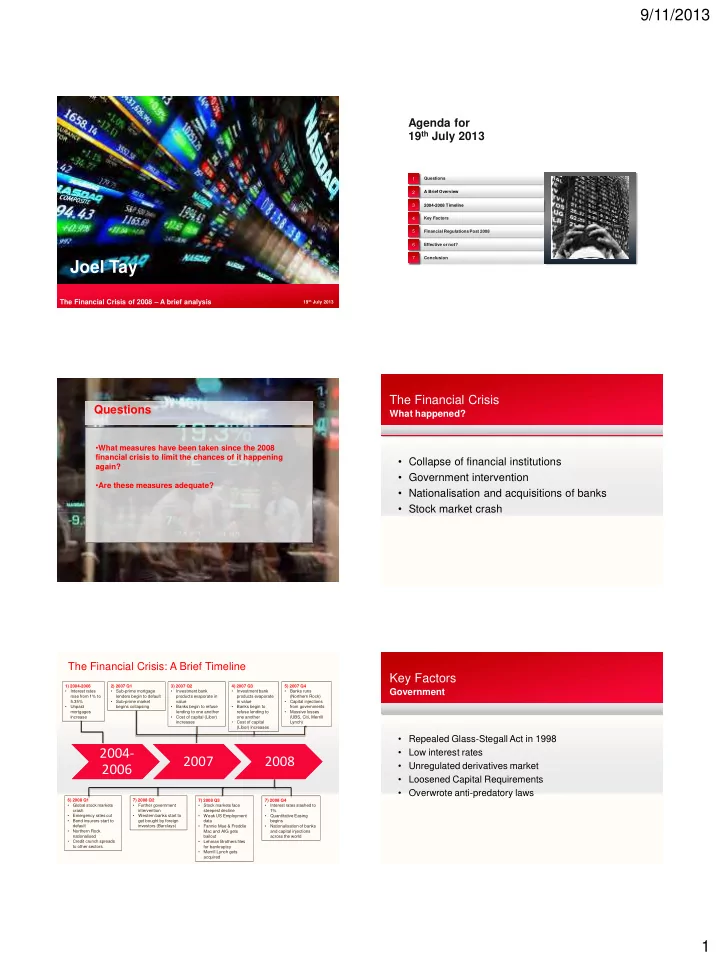
Joel Tay The Financial Crisis of 2008 A brief analysis 19 th July - - PDF document

joel tay
SMART_READER_LITE
LIVE PREVIEW

Joel Tay The Financial Crisis of 2008 A brief analysis 19 th July - - PDF document

9/11/2013 Agenda for 19 th July 2013 1 Questions 2 A Brief Overview 3 2004-2008 Timeline 4 Key Factors 5 Financial Regulations Post 2008 6 Effective or not? 7 Conclusion Joel Tay The Financial Crisis of 2008 A brief analysis 19


slide-1
SLIDE 1

9/11/2013 1

The Financial Crisis of 2008 – A brief analysis

Joel Tay

19th July 2013

Agenda for 19th July 2013

Questions Conclusion Financial Regulations Post 2008 A Brief Overview Key Factors Effective or not? 1 2 3 4 5 6 7 2004-2008 Timeline

  • What measures have been taken since the 2008

financial crisis to limit the chances of it happening again?

  • Are these measures adequate?

Questions

  • Collapse of financial institutions
  • Government intervention
  • Nationalisation and acquisitions of banks
  • Stock market crash

The Financial Crisis

What happened?

2004- 2006 2007 2008

1) 2004-2006

  • Interest rates

rose from 1% to 5.35%

  • Unpaid

mortgages increase 2) 2007 Q1

  • Sub-prime mortgage

lenders begin to default

  • Sub-prime market

begins collapsing 3) 2007 Q2

  • Investment bank

products evaporate in value

  • Banks begin to refuse

lending to one another

  • Cost of capital (Libor)

increases 5) 2007 Q4

  • Banks runs

(Northern Rock)

  • Capital injections

from governments

  • Massive losses

(UBS, Citi, Merrill Lynch) 4) 2007 Q3

  • Investment bank

products evaporate in value

  • Banks begin to

refuse lending to

  • ne another
  • Cost of capital

(Libor) increases 6) 2008 Q1

  • Global stock markets

crash

  • Emergency rates cut
  • Bond insurers start to

default

  • Northern Rock

nationalised

  • Credit crunch spreads

to other sectors 7) 2008 Q2

  • Further government

intervention

  • Western banks start to

get bought by foreign investors (Barclays) 7) 2008 Q3

  • Stock markets face

steepest decline

  • Weak US Employment

data

  • Fannie Mae & Freddie

Mac and AIG gets bailout

  • Lehman Brothers files

for bankruptcy

  • Merrill Lynch gets

acquired 7) 2008 Q4

  • Interest rates slashed to

1%

  • Quantitative Easing

begins

  • Nationalisation of banks

and capital injections across the world

The Financial Crisis: A Brief Timeline

  • Repealed Glass-Stegall Act in 1998
  • Low interest rates
  • Unregulated derivatives market
  • Loosened Capital Requirements
  • Overwrote anti-predatory laws

Key Factors

Government

slide-2
SLIDE 2

9/11/2013 2

  • Unattractive low yields, asset managers looked towards

high yield of MBS

  • Credit agencies rated junk bonds as AAA
  • Highly leveraged
  • Created new products such as MBS, CDOs, CDS
  • Commercial banks involved themselves with these

products as well

Key Factors

Banks

  • Mortgage lenders relaxing standards
  • Customers not doing their own due diligence
  • Customers purchasing what they cannot afford

Key Factors

Others

Financial Regulations

Post-2008

Aimed at reducing:

  • The chances of another financial collapse
  • The end of tax-payer bailouts
  • Better customer protection

Financial Regulations

Dodd-Frank Act of 2010

Analysing the Dodd-Frank Act

  • Increased capital

requirements for banks

  • Consent required for

acquisition of financial companies

  • Stricter leverage limits
  • Derivatives subject to

regulation through central channels

  • Volcker Rule: Ban on

proprietary trading Increased Limitations 1 Increased Oversight

  • Proper disclosures to

customers

  • Penalties for credit

agencies that rate financial instruments incorrectly

  • Increased insurance

limits

  • Establisment of Bureau
  • f Consumer Financial

Protecion Customer Protection

  • Establishment of an

Oversight committee

  • Identification of

systematically important financial institutions

  • Requires risk

committees

  • Stress tests

3 2

Other Changes

  • Largest 2 independent investment banking Goldman

Sachs and Morgan Stanley became bank holding companies

  • Subject to stricter regulations from government bodies
  • No longer able to take high-risk positions
  • No longer able to have high leverages
  • Higher capital requirements

Investment Banks

slide-3
SLIDE 3

9/11/2013 3

Effective or not?

  • 70.1% of the total 398 rulemaking

requirements missed

  • 99.6% of 280 rules requiring

specified deadlines missed

  • Proposals for 64 of missed 175

rules still missing

Implementation of rules

Effective or not?

  • Overlapping authority
  • Increased red-tape
  • Increased costs
  • Lack of clarity

Added Complexity

Effective or not?

  • Unclear rules and complexity
  • Opportunities to game the system
  • Nomenclature issues
  • Legal workarounds and loopholes

(cat-and-mouse game)

  • Regulations may take years to be

implemented

Gaming the system

Effective or not?

  • Short-term bias
  • Instant gratification
  • Greed

The Human Factor

  • BBC
  • Forbes
  • Wall Street Journal
  • Harvard Law School
  • London School of Economics Research
  • Congressional Research Services
  • Wall Street Prep
  • NY Times

Sources

  • Can just a set of rules prevent yet another

crisis?

  • Should there be any government bailouts

in the first place? Discussion Questions

slide-4
SLIDE 4

9/11/2013 4

Q&A

Appendix

Global Regulation Chart