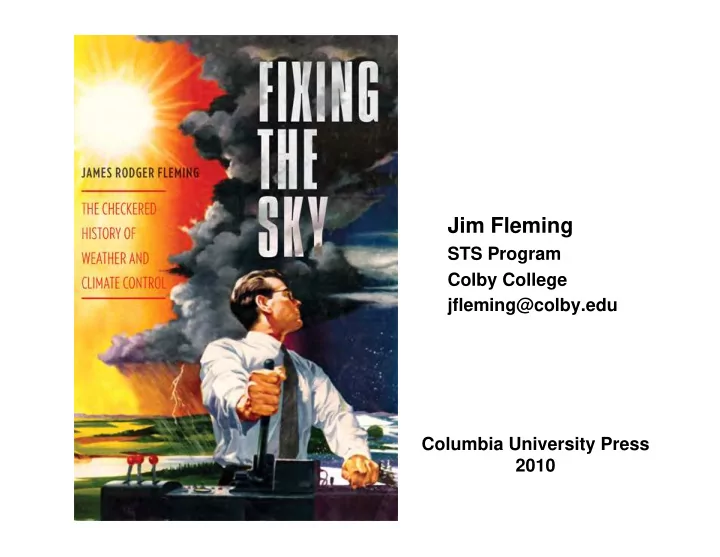
SLIDE 1 Columbia University Press 2010
Jim Fleming
STS Program Colby College jfleming@colby.edu
SLIDE 2 A male hand is on the thermostat The hand is god-like in scale Thermostat is “nowhere,” but perhaps in outer space Temperature is 73 F but is being turned back to 54 F or 5 degrees cooler than its long-term average The thermostat dial is centered on Roswell, NM
SLIDE 3
The “Tipping Point”
SLIDE 4
Where will it roll?
SLIDE 5 Tipping Points
- 1. Physical (Hansen)
- 2. Social (Gore)
- 3. Geo-engineering (Teller, et al.)
Doing too little Doing too much Making the middle path broader
SLIDE 6
Paul Crutzen
SLIDE 7 What’s wrong with climate engineering?
1. Who has the moral right? 2. What? A global thermostat! 3. Reduce incentives to mitigate? 4. Unknown side effects? 5. Could it be commercialized? 6. Once begun, can we ever stop? 7. Why is the military so interested? 8. What if nations or companies do it unilaterally? 9. Does it violate existing treaties?
- 10. Will it alter fundamental human relationships to nature?
SLIDE 8
WHAT ROLE FOR HISTORY?
SLIDE 9
In facing unprecedented challenges, it is good to seek historical precedents. History matters – it shapes identity and behavior; it is not just a celebratory record of inevitable progress. It should inform public policy. Students of climate dynamics would be well-served to study science dynamics (history). Weather and Climate Control have a long and checkered history.
SLIDE 10
Eliza Leslie James Espy
SLIDE 11 1947 military seeding of a hurricane by Project Cirrus
SLIDE 12 Vladimir Zworykin “Outline of Weather Proposal” 1945
Reprinted in History
http://www.meteohistory.org
SLIDE 13 Wexler (L) with Von Neumann, Charney, ENIAC and others, 1954
SLIDE 14 Soviet Macro-engineering Damming the Congo River at Stanley Hill to irrigate the Sahara with a “Second Nile” (after Sergel)
SLIDE 15
SLIDE 16
SLIDE 17
Wexler in the Oval Office
SLIDE 18
Wexler’s “Halloween Paper”
SLIDE 19
Wexler and V.A. Bugaev in Geneva, Mar. 1962
SLIDE 20
SLIDE 21
[Climate control] can best be classified as “interesting hypothetical exercises” until the consequences of tampering with large scale atmospheric events can be assessed in advance. Most such schemes that have been advanced would require colossal engineering feats and contain the inherent risk of irremediable harm to our planet or side effects counterbalancing the possible short- term benefits -- Harry Wexler 1962
SLIDE 22 Sulfate Cannon
Turning the Blue sky milky white SRM also attenuates starlight! End of ground-based astronomy and star gazing
Source: John Ireland
SLIDE 23
“Apprehending” Climate Change
Awareness and Understanding Anticipation and Dread — Fear Intervention and Control
SLIDE 24 HOW ARE PRIVILEGED POSITIONS ESTABLISHED?
- Authority / Prestige
- Data
- Experiment / Theory
- Models
- Technology
- Consensus
SLIDE 25
WHAT DO WE KNOW? WHAT DO WE FEAR? WHAT SHOULD WE DO?
(with apologies to Immanuel Kant, Critique of Pure Reason)
SLIDE 26 Climate Change is Simple
Study the historical, ethical, legal, political, and societal aspects of geoengineering -- American Meteorological Society, Policy Statement on Geoengineering IPCC WG4 – historical, social, cultural
SLIDE 27
SLIDE 28 Phaeton, from the series The Four Disgracers (1588) by Hendrick Goltzius (Netherlandish, 1558-1617).