Jerome Martin 0 a 2 t 0 2 1 V ( ) = M 4 ln 2 2 2 / 3 - - PowerPoint PPT Presentation

jerome martin
SMART_READER_LITE
LIVE PREVIEW

Jerome Martin 0 a 2 t 0 2 1 V ( ) = M 4 ln 2 2 2 / 3 - - PowerPoint PPT Presentation

l V ( ) = M 4 ln 2 P 0 0 M 1 sech 0 V ( ) = M 4 ln 2 2 / n l 1 sech q V ( ) = M 4 4 f M e 1 + cos


slide-1
SLIDE 1

V (φ) = M 4 ✓ 1 − α φ MPl e−φ/MPl ◆

V (φ) = M 4 φ2 M 2

Pl

1 + α φ2 MPl

2!

V (φ) = M 4 ⇣ 1 − e−√

2/3φ/MPl

⌘2

V ( φ ) = M

4

φ

2

M

2 P l

 1 − 2 α φ

2

M

2 P l

l n ✓ φ M

P l

  • V

( φ ) = M

4

 1 − 2 e

− 2 φ / ( √ 6 MPl )

+ A

I

1 6 π

2

φ √ 6 M

P l

  • V

( φ ) = M

4

✓ φ M

P l

4

 1 − α l n ✓ φ M

P l

  • V (φ) = M 4

 1 + cos ✓φ f ◆

V ( φ ) = M

4

⇣ 1 − e

− q φ / M

P l

V ( φ ) = M

4

e

− α φ / M

P l

V (φ) = M 4 " 1 + α ✓ φ Q ◆4 ln ✓ φ Q ◆#

V (φ) = M 4  1 + α ln ✓ φ MPl ◆

V (φ) = M 4 "✓ φ φ0 ◆2 − 1 #2

V ( φ ) = 1 2 m

2 φ

φ

2

+ A c

  • s

( n θ + θ ) λ

n

n φ

n

M

n − 3 P l

+ λ

2 n

φ

2 ( n − 1 )

M

2 ( n − 3 ) P l

V (φ) = M 4  3 −

  • 3 + α2

tanh2 ✓ α √ 2 φ MPl ◆ V ( φ ) = − M

4

✓ φ φ ◆

2

l n " ✓ φ φ ◆

2

#

V (φ) = M 4  1 − 2 π arctan ✓φ µ ◆

V ( φ ) = M

4

  • 3

− α

2

  • t

a n

2

✓ α √ 2 φ M

Pl

◆ − 3

  • V (φ) = M 4

(φ/MPl)2 α + (φ/MPl)2

V (φ) = M 4  1 − sech ✓φ µ ◆

V ( φ ) = M

4

l n

2

✓ φ φ ◆

V ( φ ) = M 4 " 1 + α ✓ φ Q ◆4 l n ✓ φ Q ◆ #

V (φ) = M

4

 1 + α ln ✓ φ M

P l

V (φ) = M 4  1 + α ln ✓ φ MPl ◆

V ( φ ) = M 4  1 + α l n ✓ φ MPl ◆

  • V (φ) = M 4

 1 + α ln ✓ φ MPl ◆

V (φ) = M 4 " 1 + α ✓ φ Q ◆4 ln ✓ φ Q ◆# V (φ) = M 4 " 1 + α ✓ φ Q ◆4 ln ✓ φ Q ◆#

V ( φ ) = M

4

 1 + α l n ✓ φ M

P l

  • V

( φ ) = M

4

 1 + α l n ✓ φ M

P l

  • V (φ) = M 4

 1 + α ln ✓ φ MPl ◆

V ( φ ) = M 4 

  • 3

− α2

  • t

a n2 ✓ α √ 2 φ MPl ◆ − 3

  • V

( φ ) = M

4

  • 3

− α

2
  • t

a n

2

✓ α √ 2 φ M

P l

◆ − 3

  • V (φ) = M 4

 3 − α2 tan2 ✓ α √ 2 φ MPl ◆ − 3

  • V (φ) = M 4 ln2

✓ φ φ0 ◆ V (φ) = M 4 ln2 ✓ φ φ0 ◆

V (φ) = M 4 ln2 ✓ φ φ0 ◆

V (φ) = M 4 ln2 ✓ φ φ0 ◆

V ( φ ) = M

4

 1 − s e c h ✓ φ µ ◆

  • V (φ) = M 4

 1 − sech ✓φ µ ◆

V (φ) = M 4 ln2 ✓ φ φ0 ◆

V (φ) = M

4

ln

2

✓ φ φ ◆

V (φ) = M 4  1 − sech ✓φ µ ◆

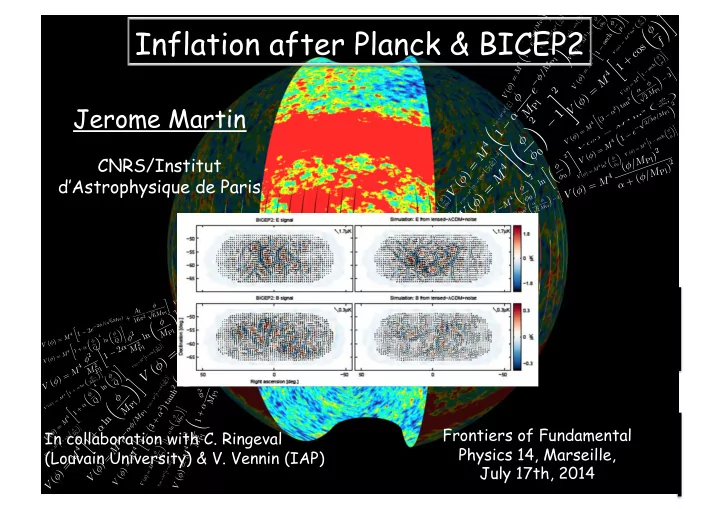
Frontiers of Fundamental Physics 14, Marseille, July 17th, 2014

Jerome Martin

CNRS/Institut d’Astrophysique de Paris

In collaboration with C. Ringeval (Louvain University) & V. Vennin (IAP)

slide-2
SLIDE 2

The talk

Outline Planck results and their implications for inflation Are the Planck and BICEP2 results compatible (given slow-roll inflation)?? Looking beyond Planck & BICEP2: how well can the future CMB missions constrain inflation? Conclusions & summary

slide-3
SLIDE 3

The talk

Outline Planck results and their implications for inflation Are the Planck and BICEP2 results compatible (given slow-roll inflation)?? Looking beyond Planck & BICEP2: how well can the future CMB missions constrain inflation? Conclusions & summary

slide-4
SLIDE 4

4

Planck (2013)

Planck results in brief: Flat universe with adiabatic, Gaussian and almost scale invariant fluctuations: The simplest models are the best ones!

slide-5
SLIDE 5

Encyclopædia Inflationaris

J´ erˆ

  • me Martin,a Christophe Ringevalb and Vincent Vennina

aInstitut d’Astrophysique de Paris, UMR 7095-CNRS, Universit´

e Pierre et Marie Curie, 98bis boulevard Arago, 75014 Paris (France)

bCentre for Cosmology, Particle Physics and Phenomenology, Institute of Mathematics and

Physics, Louvain University, 2 Chemin du Cyclotron, 1348 Louvain-la-Neuve (Belgium) E-mail: jmartin@iap.fr, christophe.ringeval@uclouvain.be, vennin@iap.fr

Keywords: Cosmic Inflation, Slow-Roll, Reheating, Cosmic Microwave Background, Aspic

arXiv:1303.3787

  • One only needs to analyze single

field slow-roll inflation : still a very populated landscape …

  • Among these favored scenarios,

what are the best ones, what is the best model according to Planck?

  • We have carried out a survey of

all models invented since 1979

  • This complete survey includes

≈ 200 scenarios ≈ 700 slow roll formulas ≈ 365 pages ≈ 74 potentials ≈ 30 000 lines of code

slide-6
SLIDE 6

Inflation is an accelerated, quasi-exponential, phase of expansion

φ V (φ)

Slow-roll Reheating ✏1 ' 1 2M 2

Pl

✓Vφ V ◆2

✏2 ' 2 M 2

Pl

"✓Vφ V ◆2 Vφφ V #

The energy scale of inflation is, a priori, not fixed In the early Universe, field theory is the relevant framework for matter

slide-7
SLIDE 7

Consistency relation:

Gravitational waves are subdominant The spectral indices are given by The running, i.e. the scale dependence of the spectral indices, of dp and gw are

  • The amplitude is controlled by H
  • For the scalar modes, the amplitude also

depends on ε 1

  • The power spectra are scale-invariant plus

logarithmic corrections the amplitude of which depend on the sr parameters, ie on the microphysics of inflation

C~ -0.7

7

slide-8
SLIDE 8

φ V (φ) φ V (φ) φ V (φ)

slide-9
SLIDE 9
slide-10
SLIDE 10
slide-11
SLIDE 11

φ V (φ)

slide-12
SLIDE 12

12

The CMB can constrain the end of inflation!

slide-13
SLIDE 13

Thus, for model comparison, we compute the Bayesian evidence (integral of the likelihood over all parameter priors~probability of a model), ie the probability

  • f a model, for each inflationary scenario

Bayesian evidence of the reference model Bayesian evidence

  • f the model “i”

posterior odds

Model “i” is better than REF REF is better than model “i”

Bayesian evidence: quantify statistically whether a model is “better” than

  • another. One can rank inflationary models according to their “performance”

and find the “best model” of inflation

slide-14
SLIDE 14

Bayesian evidences for all models (Planck data)

Model “i” is better than REF REF is better than model “i”

Bad Good

Best model Different models

slide-15
SLIDE 15

Planck: and the winners are …

Conclusion: plateau inflation are the winners! KMIII HI (Starobinsky model) ESI

slide-16
SLIDE 16

16

Detection of B-mode polarization of the CMB Detection of primordial gravity waves

slide-17
SLIDE 17

17

Here we assumed that the BICEP2 result is correct!! Of course, it needs to be confirmed by other experiments to see if it stands the time.

slide-18
SLIDE 18

18

Message 1: the energy scale of inflation measured: GUT scale

slide-19
SLIDE 19

19

Message 1: the energy scale of inflation measured: GUT scale Message 2: derivatives of the potential measured

slide-20
SLIDE 20

20

Message 1: the energy scale of inflation measured: GUT scale Message 2: derivatives of the potential measured Message 3: more complicated class of models? Before BICEP2 Simplest models favored (ie more complicated not needed) because no isocurvature modes, no NG etc … After BICEP2: still true!!

  • K-inflation
  • Multiple field inflation
slide-21
SLIDE 21

21

Message 1: the energy scale of inflation measured: GUT scale Message 2: derivatives of the potential measured Message 3: more complicated class of models? Message 4: model building issues?

  • Difficult because of the Lyth bound:
  • Break-down of EFT??
slide-22
SLIDE 22

22

LFI2

Bayesian evidences for all models (BICEP2 data)

Conclusion: large fields are the winners

Best models

slide-23
SLIDE 23

The Jeffreys’ scale: constraining power of an experiment

NB: Here, the reference is the best model!!

slide-24
SLIDE 24

24

Have we finally proven inflation???? r is a powerful observable!

slide-25
SLIDE 25

25

The compatibility between to data sets can be estimated by means of the following factor

slide-26
SLIDE 26

26

Compatibility Performance

slide-27
SLIDE 27

The talk

Outline Planck results and their implications for inflation Are the Planck and BICEP2 results compatible (given slow-roll inflation)?? Looking beyond Planck & BICEP2: how well can the future CMB missions constrain inflation? Conclusions & summary

slide-28
SLIDE 28

28

The future: EPIC, LiteBIRD, PRISM, COrE …

  • Simulate 5 models with different tensor to scalar ratio r
  • Study how this would be seen by PRISM & LiteBIRD
slide-29
SLIDE 29

29

Three quarters of the models are ruled out with certainty, compared to

  • ne third with Planck
slide-30
SLIDE 30

The talk

Outline Planck results and their implications for inflation Are the Planck and BICEP2 results compatible (given slow-roll inflation)?? Looking beyond Planck & BICEP2: how well can the future CMB missions constrain inflation? Conclusions & summary

slide-31
SLIDE 31

Recap & Conclusions

1- Planck data clearly favors the simplest class of models: single field slow-roll scenarios with standard kinetic term. Caution: does not mean that more complicated models are ruled out. Just means that, for the moment, there are not needed. 2- BICEP2, if confirmed, is a situational turnaround for inflation. Now, large field models are favored and the energy scale of inflation has been measured! 3- Given slow-roll inflation, however, there is a tension between these two sets

  • f data. Possible resolution: role of polarized foregrounds in BICEP2 data …

waiting for Planck2014. 4- Future CMB missions will significantly improve our knowledge of inflation. One should be able to exclude 3/4 of the models (compared to 1/3 with Planck) 5- Important: we can learn about reheating!

slide-32
SLIDE 32

32

Recap & Conclusions “Encyclopedia Inflationaris”, arXiv:13033787 “The Best models after Planck”, arXiv:1312.3529 “Compatibility of Planck and BICEP2 in light of Inflation”, arXiv:1405.7272 “How well can future CMB missions can constrain cosmic inflation”, arXiv:1407.4034

Thank you!

slide-33
SLIDE 33

33

slide-34
SLIDE 34

34

slide-35
SLIDE 35

35

Have we finally proven inflation???? NO! We need to check the consistency relations We need to measure the tensor spectral index; since r is large, this seems feasible

slide-36
SLIDE 36

36