JC Virus and The Risk of PML PML is a rare disease of CNS that - - PDF document

jc virus and the risk of pml
SMART_READER_LITE
LIVE PREVIEW

JC Virus and The Risk of PML PML is a rare disease of CNS that - - PDF document

Discovery and Development of PML treatments Teresa Compton Vice President, PML and Virology Research Biogen Idec JC Virus and The Risk of PML PML is a rare disease of CNS that occurs in patients immunosuppressed and in patients taking


slide-1
SLIDE 1

Discovery and Development of PML treatments

Teresa Compton Vice President, PML and Virology Research Biogen Idec

CONFIDENTIAL

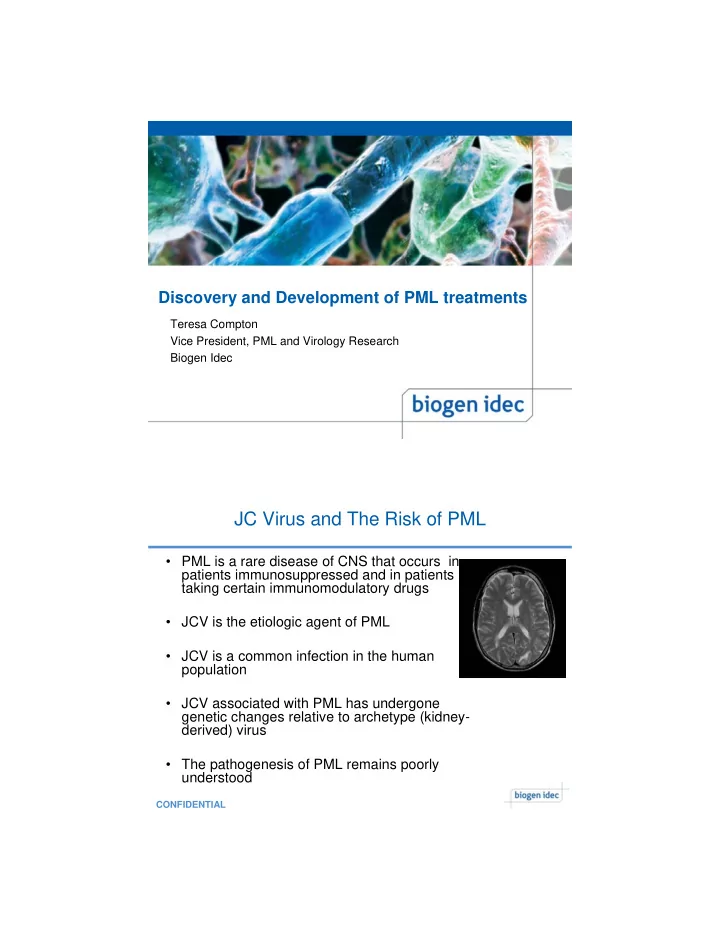
JC Virus and The Risk of PML

  • PML is a rare disease of CNS that occurs in

patients immunosuppressed and in patients taking certain immunomodulatory drugs

  • JCV is the etiologic agent of PML
  • JCV is a common infection in the human

population

  • JCV associated with PML has undergone

genetic changes relative to archetype (kidney- derived) virus

  • The pathogenesis of PML remains poorly

understood

slide-2
SLIDE 2

CONFIDENTIAL

Pillars of JCV/PML Research

Basic biology Approaches to Therapy Risk Stratification and Diagnostics

Biogen Idec has a comprehensive research program integrating knowledge and resources

  • internal research programs
  • worldwide academic collaborations
  • participation in the PML Consortium

CONFIDENTIAL

Goals of PML Research at Biogen Idec

Prediction/ Prevention Detection/ Treatment Restore Immune Function Stop PML Progression Viral Factors Patient Factors PML Mitigation

Provide physician’s and patients with tools to:

  • Assess the risk of PML
  • Diagnose PML early
  • Improve PML outcomes

Assays Therapies

slide-3
SLIDE 3

CONFIDENTIAL

Basic Biology Questions

Research on JCV/PML is challenging

  • Relevant cell culture systems;

difficulty to grow pathogenic forms

  • f JCV
  • No animal model
  • What is the reservoir(s)?
  • Circumstances supporting

transmission to the brain is not known

  • When/how do mutant virus strains

arise

CONFIDENTIAL

Present Status of Risk Stratification Knowledge with Tysabri-associated PML

  • Duration of Tysabri treatment more than 2 years
  • Prior Immunosuppressant Use
  • Exposed to JCV (Anti-JCV positive)

PML

Immune function Host genetic factors NCCR rearrangements VP1 mutations Co-infections

slide-4
SLIDE 4

CONFIDENTIAL

Current Standard of Care for Tysabri-associated PML

The majority of patients who developed PML in the post- marketing setting received plasma exchange (PLEX) and/or immunoadsorption (IA) to accelerate removal of TYSABRI IRIS has occurred after discontinuation or removal (by PLEX) of Tysabri IRIS has occurred within days to several weeks (steroids). Indicates reconstitution of cellular immune response

Anti-JCV Tysabri

nOD Tysabri Conc (  g/mL) 0.00 0.05 0.10 0.15 0.20 0.25 5 10 15 20 25 Day 1 Pre PLEX Day 1 Post PLEX Day 2 Post PLEX Day 3 Pre PLEX Day 3 Post PLEX Day 3 Post PLEX + 2Hr Follow Up 1 week post PLEX 3 Follow Up 2 weeks post PLEX 3 1 2 3 80% 70% 70% 70%

CONFIDENTIAL

Efforts and Trials in JCV/PML Treatment

Marketed drugs for other indications Cytarabine

  • no effect on

mortality

Mefloquine

  • no effect on

JCV load in CSF

  • r clinical

endpoints

Related to JCV lifecycle 5HT2a Inhibitors

  • In vitro data

difficult to reproduce, no proven efficacy

Immune Modulators IFN-

  • Results

Inconclusive

IL-7; IL-2

  • No clinical

data, no proven efficacy

Broad spectrum antivirals Cidofovir

  • no specific

effect on mortality

CMX001

  • no proven

efficacy

slide-5
SLIDE 5

CONFIDENTIAL

Challenges for JCV/PML Drug Development

  • Preclinical –Limited tools

– No robust inhibition assay for PMLgenic strains – No in vivo POC before moving into patients – Dose estimations be based on in vitro data, assumptions about BBB penetration

  • Clinical - Challenging indication

– Acute, life-threatening infection with undefined window for intervention – Variability of disease course depending on underlying condition, status of immune reconsititution, IRIS, and standard-of-care – Rarity of disease affects feasibility and design of clinical trials

  • Limited patients across broad geographic region
  • Logistical challenges associated with pre-identification of sites and protocol

approvals

  • Regulatory – no established path for approval

– No established endpoints or precedents for registrational trial

CONFIDENTIAL

Multiple Steps of the JC Lifecycle are Potential Targets for Drug Discovery

EMA meeting, July 25, 2011

10

Successes in Antivirals Entry: HIV (host) RSV (MoAb) Uncoating: Influenza Protein Processing: HIV HCV Genome Replication: HIV, CMV, HSV, HBV Maturation/Egress: Influenza

slide-6
SLIDE 6

CONFIDENTIAL

Approaches to Discover Antiviral Drugs

  • Small molecule screens for target-based

enzymatic activity

  • Small molecule screens for target-based

cellular reporter assays

  • Phenotypic infectivity screens
  • Monoclonal antibody discovery for

exposed virion proteins, cellular receptors, intact virions

CONFIDENTIAL

Cell

Sialic acid

Capsid Top view SA binding site

Anti-JCV Neutralizing Antibody as a Potential Therapeutic Agent

Molecular Hypothesis

A high affinity/potency anti-JCV neutralizing monoclonal antibody, at sufficient concentration in the brain of a PML patient, will slow viral spread and reduce viral burden in the CNS

Therapeutic Hypothesis

Slowing JC-viral replication during PML, until the immune system is restored and normal immune function clears the virus, will reduce neurological damage and improve PML prognosis

slide-7
SLIDE 7

CONFIDENTIAL

Anti-JCV Neutralizing Antibody as a Potential Therapeutic Agent

  • A collection of fully human neutralizing MoAbs with excellent biochemical

properties has been developed

  • Affinity threshold for inhibition, potentially different for each antibody class
  • Mechanism of action can impact potency
  • Must neutralize viral mutants

0.1 1 10 100 1000 25 50 75 100 ng/ml % Inhibition of Infectivity 85 pM 14.0 300 pM 20.8 13 nM 1742.0 50 pM 3.5 ELISA EC50 Inhibition IC50 ng/ml Mab 2 Engineered Variants Mab 1

CONFIDENTIAL

T Ag as a Potential Target for Small Molecule Therapy

Molecular Hypothesis

The helicase or ATPase activities

  • f T Ag may be targets for small

molecule inhibitors. Inhibition of these activities of T Ag will block virus replication.

Therapeutic Hypothesis

Slowing JC-viral replication during PML, until the immune system is restored and normal immune function clears the virus, will reduce neurological damage and improve PML prognosis

5 ’ 3 ’

slide-8
SLIDE 8

CONFIDENTIAL

T Ag Target Validation and Flow Chart

5 10 15 20 25 30 35 40 pcDNA Wt TAg Mut TAg

Fold increase over control FFL/RL

24 hours 72 hours pcDNA Wt TAg Mut TAg 10 0 10 1 10 2 10 3 10 4 10 5 10 6 10 7 10 8 10 9 10 10 2 4 6 8 10

Average VP1 + JCV copy number/well %VP1+ cells

  • TAg Helicase assay
  • TAg ATPase assay
  • Tag reporter assay
  • JCV infectivity assay
  • Cytotoxicity
  • BKV reporter
  • ADME profiling
  • MOA
  • Structural data

SAR

Virtual screening, HTS

CONFIDENTIAL

Summary of JCV/PML Therapy

  • Biogen Idec is committed to comprehensive, collaborative research

program for PML, although both biological and clinical challenges exist for identifying and advancing new therapies

  • Currently, immune reconstitution remains the standard approach in

the treatment of PML

– Active drug removal for agents such as Tysabri

  • Ongoing efforts continue with broad spectrum antivirals
  • Specific anti-JCV therapy is targeted to identify potential therapeutic

agents

– Biogen is currently working on two novel JCV treatment options

  • Significant challenges exist with regard to clinical trial design and

logistics

  • Addressing these challenges is a global problem

– Requires focused concerted effort – Consortia of academia and industry – Guidance from regulatory agencies