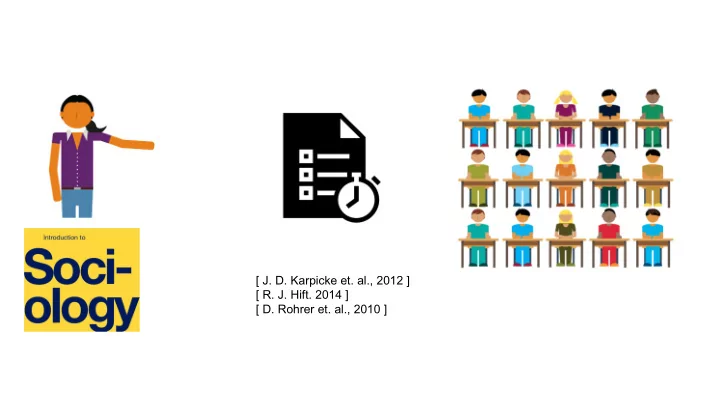
SLIDE 1 [ J. D. Karpicke et. al., 2012 ] [ R. J. Hift. 2014 ] [ D. Rohrer et. al., 2010 ]
SLIDE 2
?
SLIDE 3
SLIDE 4
QG-Net: Data-Driven Question Generation Model for Educational Content
Jack Wang June 25, 2018
SLIDE 5
… one of the positive contributions of deviance is that it fosters social change. What is one of the positive contributions of deviance? Input text QG-Net Generated question ✓ Fluent ✓ relevant
SLIDE 6
Input text QG-Net Generated question
✓ Generates fluent and relevant questions ✓ Adaptive to texts from various subjects
SLIDE 7 QG-Net Reader Generator … one of the positive contributions of deviance is that it fosters social change. What is one of the positive contributions of deviance? LSTM network LSTM network Attention mechanism Copy mechanism ✓ Fluent and relevant questions ✓ Adaptive to texts from various subjects
0100010101 0100110100 1010001010 0111010101 01010101... Intermediate representation
SLIDE 8 Experiment overview
Source sentence (from Wikipedia) Answer (selected from text) Generated question
[ ]
- QG-Net learns to generate questions using SQuAD
Nikola Tesla was a Serbian American inventor, … Serbian American What is Tesla’s nationality?
SLIDE 9 Experiment overview
- QG-Net learns to generate questions using SQuAD
- We test it on three OpenStax textbooks
○ Pre-processed the textbook texts to the same format as SQuAD ○ Compared to 2 of the best existing models (baseline11, baseline 22)
- 1. M. Heilman, 2010
- 2. X. Du et. al., 2017
SLIDE 10
Qualitative evaluation result #1 (Sociology)
Weber noted that different groups were affected differently based on education, race and gender, and that people's’ reactions to inequality were moderated by class differences and rates of social mobility, ... QG-Net: Along with education and race, what did Weber believe different groups were affected by? Baseline 1: What was education, race, and,? Baseline 2: Along with education, race, race, and race, what other groups were affected by the Kinsey scale? Chapter 12.1 Chapter 1.3
SLIDE 11
Qualitative evaluation result #2 (History)
The 1830 Indian Removal Act and subsequent displacement of the Creek, Choctaw, Chickasaw, Seminole, and Cherokee tribes of the southeast fulfilled the vision of a white nation and became one of the identifying characteristics of the age of Jackson. QG-Net: What act became one of the identifying characteristics of the age of Jackson? Baseline 1: What did and subsequent displacement of the Creek, Choctaw, Chickasaw, Seminole, and Cherokee tribes of the southeast fulfil the vision of a white nation? Baseline 2: What was the name of the act that caused a white nation to become a white nation? Chapter 10.4
SLIDE 12
Qualitative evaluation result #2 (History)
The 1830 Indian Removal Act and subsequent displacement of the Creek, Choctaw, Chickasaw, Seminole, and Cherokee tribes of the southeast fulfilled the vision of a white nation and became one of the identifying characteristics of the age of Jackson. QG-Net: What act became one of the identifying characteristics of the age of Jackson? Baseline 1: What did and subsequent displacement of the Creek, Choctaw, Chickasaw, Seminole, and Cherokee tribes of the southeast fulfil the vision of a white nation? Baseline 2: What was the name of the act that caused a white nation to become a white nation?
QG-Net: ✓ Generates fluent and relevant questions ✓ Is adaptive to text from various subjects
SLIDE 13 Human evaluation experiment
- We sample 150 sentences from each textbook
- We use the three models to generate questions
- Human evaluators evaluate the quality of generated questions
○ Fluency ○ relevance
- Human evaluators pick which question(s) could have been generated by human
○ Can choose none of them
SLIDE 14 Human evaluation results
Baseline 1 Baseline 2
QG-Net: ✓ Generates superior questions in terms of both fluency and relevance ✓ Works well for inputs from various subjects
SLIDE 15 Human evaluation results
Baseline 1 Baseline 2
Perceptually, QG-Net generates questions of superior quality than those generated by baseline models.
SLIDE 16 Acknowledgements
Rich Baraniuk Andrew Lan Phil Grimaldi Drew Waters Weili Nie John and Ann Doerr Arthur & Carlyse Ciocca Charitable Foundation
SLIDE 17 Questions?
QG-Net is on Github! https://github.com/moonlightlane/QG-Net jzwang@rice.edu
Input text QG-Net Generated question