IV-E Prevention Family First Implementation & Policy Work Group - - PDF document

iv e prevention
SMART_READER_LITE
LIVE PREVIEW

IV-E Prevention Family First Implementation & Policy Work Group - - PDF document

November 26, 2018 IV-E Prevention Family First Implementation & Policy Work Group LPRO : L EGISLATIVE P OLICY AND R ESEARCH O FFICE 1 IV-E Overview mental health foster care family child(ren) services maintenance situation


slide-1
SLIDE 1

November 26, 2018 1

IV-E Prevention

Family First Implementation & Policy Work Group

1 LPRO: LEGISLATIVE POLICY AND RESEARCH OFFICE

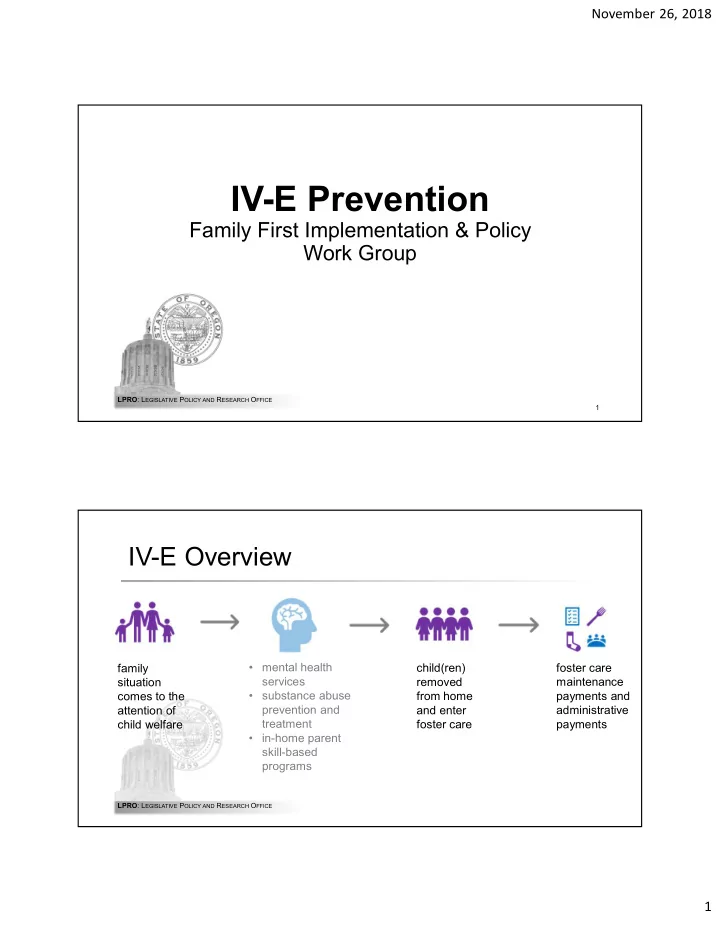
IV-E Overview

LPRO: LEGISLATIVE POLICY AND RESEARCH OFFICE

family situation comes to the attention of child welfare child(ren) removed from home and enter foster care foster care maintenance payments and administrative payments

  • mental health

services

  • substance abuse

prevention and treatment

  • in-home parent

skill-based programs

slide-2
SLIDE 2

November 26, 2018 2

IV-E Prevention

LPRO: LEGISLATIVE POLICY AND RESEARCH OFFICE

Beginning October 1, 2019: IV-E available for up to 12 months for services for families of children who, without these services, would likely enter foster care, and pregnant and parenting foster youth.  No income test  Per family/episode  Uncapped partial matching dollars

IV-E Prevention

LPRO: LEGISLATIVE POLICY AND RESEARCH OFFICE

Services include:  mental health services  substance abuse prevention and treatment services  in-home parent “skill-based” programs (parent training, home visiting, individual and family therapy) Services and programs must be identified and specified in prevention plan for each child prior to providing services.

slide-3
SLIDE 3

November 26, 2018 3

IV-E Prevention

LPRO: LEGISLATIVE POLICY AND RESEARCH OFFICE

family situation comes to the attention of child welfare

  • mental health

services

  • substance abuse

prevention and treatment

  • in-home parent

skill-based programs prevention plan written for child(ren), identifying services and foster care prevention strategy child(ren) remain safely at home or with relative caregivers

Prevention Program Requirements

LPRO: LEGISLATIVE POLICY AND RESEARCH OFFICE

Trauma Informed Services or programs provided under an organizational structure and treatment framework that involves understanding, recognizing, and responding to the effects of all types of trauma and in accordance with recognized principles of a trauma- informed approach and trauma-specific interventions to address trauma’s consequences and facilitate healing.

slide-4
SLIDE 4

November 26, 2018 4

Prevention Program Requirements

LPRO: LEGISLATIVE POLICY AND RESEARCH OFFICE

there is no case data suggesting a risk of harm that was probably caused by the treatment and that was sever or frequent practice has a book, manual, or

  • ther available

writings that specify the components of the practice protocol and describe how to administer the practice there is no empirical basis suggesting that, compared to its likely benefits, the practice constitutes a risk of harm to those receiving it if multiple outcome studies have been conducted, the

  • verall weight of

evidence supports the benefits of the practice

  • utcome

measures are reliable and valid, and are administered consistently and accurately across all those receiving the practice

Evidence Standard

LPRO: LEGISLATIVE POLICY AND RESEARCH OFFICE

Promising: At least one study that used some form of control group (e.g., wait list study, placebo group) to determine effect. Supported: At least one study that used a random control or quasi- experimental trial to determine effect; sustained effect of at least 6 months. Well-supported: At least two studies that used a random control or quasi- experimental trial to determine outcomes; sustained effect of at least 1 year. Services and programs that meet the requirements for being a promising, supported, or well-supported practice shall be IV-E eligible.
slide-5
SLIDE 5

November 26, 2018 5

Outcome Assessments & Evaluation

LPRO: LEGISLATIVE POLICY AND RESEARCH OFFICE

The state must collect and report to HHS the following:

  • The specific services/programs

provided

  • Total expenditures provided
  • Duration of services/programs provided
  • Placement status of child(ren) at the

beginning and end of 12 month period, and whether entered foster care within 2 years The state must have a well-designed and rigorous evaluation strategy for promising, supported, or well-supported practice. HHS may waive this requirement. The state cannot receive FFP for program or service unless the evaluation strategy is included in the 5 year Prevention Plan.*

*HHS must provide technical assistance

Clearinghouse

LPRO: LEGISLATIVE POLICY AND RESEARCH OFFICE

HHS shall, directly or through grants, contracts*, or interagency agreements, evaluate research on the prevention services and programs, including culturally specific, or location- or population-based adaptations of the practices, to identify and establish a public Clearinghouse of the practices that satisfy each category. The Clearinghouse shall include information on the specific outcomes associated with each practice, including whether the practice has been shown to prevent child abuse and neglect and reduce the likelihood of foster care placement by supporting birth families and kinship families and improving targeted supports for pregnant and parenting youth and their children.

*Abt Associates was awarded the contract to build the Clearinghouse

slide-6
SLIDE 6

November 26, 2018 6

Questions, Concerns, & Next Steps

LPRO: LEGISLATIVE POLICY AND RESEARCH OFFICE

Develop Provider Survey Disseminate Provider Survey Analyze results (build map) What else?