IT ALL STARTS HERE A public school budget weaves together various - - PowerPoint PPT Presentation

it all starts here
SMART_READER_LITE
LIVE PREVIEW

IT ALL STARTS HERE A public school budget weaves together various - - PowerPoint PPT Presentation

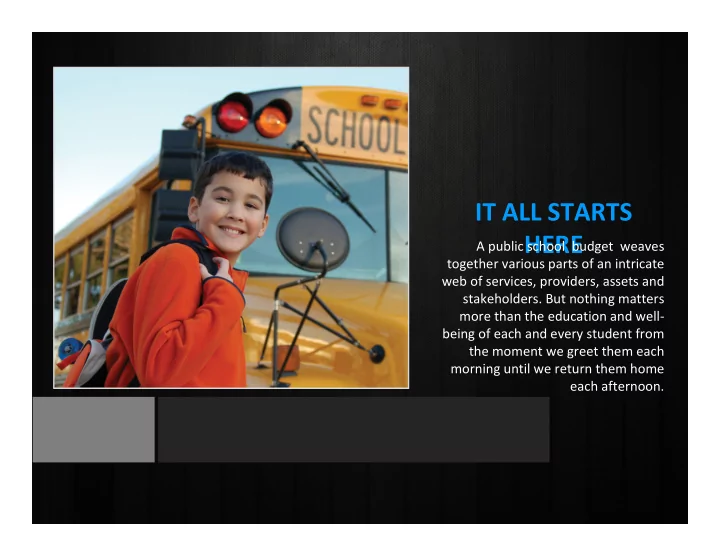
IT ALL STARTS HERE A public school budget weaves together various parts of an intricate web of services, providers, assets and stakeholders. But nothing matters more than the education and well being of each and every student from the moment we


slide-1
SLIDE 1

IT ALL STARTS HERE

A public school budget weaves together various parts of an intricate web of services, providers, assets and

  • stakeholders. But nothing matters

more than the education and well‐ being of each and every student from the moment we greet them each morning until we return them home each afternoon.

slide-2
SLIDE 2

Proposed FY2014 Operating Budget

  • Dr. Morton Sherman

Superintendent January 24, 2013

slide-3
SLIDE 3

ABOUT THEM

Our award‐winning strategic plan guides the development of this budget as well. With this budget, we further our commitment to:

  • Ensure all students demonstrate significant

academic growth, and dramatically improve achievement outcomes for students below grade level

  • Provide a rigorous, relevant, and internationally

benchmarked education to enable all students to succeed as citizens in the global community

  • Create an exceptional learning environment
  • Implement a focused, transparent governance

model that incorporates effective communication and evidence‐based decision‐making

  • Provide clean, safe and conducive learning

environments that use best practices for energy efficiency and environmental sustainability

GOALS

ACPS

slide-4
SLIDE 4

ABOUT THEM

During our budget development process, the ACPS central office staff and school leaders agreed on the following guiding principles:

  • Develop a budget which supports our Strategic Plan elements as they

have driven measureable student success and achievement over the past several years.

  • Develop a budget which reflects the differences among our schools as

we provide targeted school‐based flexibility to adjust staffing patterns to meet student needs.

  • Develop a budget which includes classroom teachers and support staff

to meet the demands of increasing enrollments, changing student needs, and higher expectations for every student.

  • Develop a budget which includes reasonable class sizes, appropriate

classroom and out of classroom support for ELL and Special Education students, and which meets our responsibility to address the social and emotional needs of our students. This includes funding for appropriate and sufficient learning materials such as textbooks, technology, and reading materials. This also includes community outreach and support

  • f partners.
  • Develop a budget which addresses facilities needs, enrollment growth,

and ongoing building maintenance.

GUIDING

BUDGET PRINCIPLES

Thank you for caring!

slide-5
SLIDE 5

ACPS Model for Learning and Teaching

06

INSTRUCTION CURRICULUM

RELATIONSHIPS

OPERATIONS

FINANCIAL SERVICES

HUMAN RESOURCES

slide-6
SLIDE 6

INSTRUCTION

EDUCATORS

EQUIPPING OUR Professional Learning

>

Teacher Growth & Assessment System

>

School Leadership: Principals & Assistant Principals

>

slide-7
SLIDE 7

CURRICULUM

CURRICULUM

A 21ST CENTURY Transformation: From Pacing Guides to Cutting Edge Curriculum

>

Essential Questions & Transfer Tasks

>

College Competencies

>

Reading & Math

>

slide-8
SLIDE 8

RELATIONSHIPS

COMMUNITY

ACPS IS A Partners

>

Office of Equity and Cultural Competence

>

Family and Community Engagement (FACE) Center

>

Student Support Team – Counselors, Psychologists, Social Workers, Nurses

>

slide-9
SLIDE 9

A DIVERSE COMMUNITY

Current Student Population: 13,114

Black – 32.5% White – 27.2%

Hispanic–32.4%

Free/Reduced Meals ‐ 56.1% TAG – 10.1% ELL – 25% Asian – 4.6%

Special Ed 12.5%

slide-10
SLIDE 10

Enrollment Growth

SPECIAL PROGRAMS OVER TIME

A look at changing student population needs through eligibility for free/reduced‐price meals, English Language Learners and Special Education

100 90 80 70 60 50 40 30 20 10

15% 22.1% 53.9% 13.6% 22.3% 53.8% 12.4% 22.8% 55.8% 13% 24.4% 56.2%

SPECIAL EDUCATION ENGLISH LANGUAGE LEARNERS FREE/REDUCED PRICE MEAL ELIGIBILITY

2010 2011 2012 2013

FY 2010

Total Population: 11,661

FY2012

Total Population: 12,349

FY2011

Total Population: 11,999

2013

Total Population: 13,114

slide-11
SLIDE 11

Enrollment Projections

HISTORICAL AND PROJECTED STUDENT POPULATION TRENDS

From FY 2007 to FY 2012, enrollment has increased by more than 2,000 students, for an overall increase of 20% and an average increase of 3.8% per year. Over the next six years through FY 2018, enrollment growth is projected to increase by more than 2,450 students, or a total growth of 19.8% compared with the current

  • level. Growth rates of 3.1% on average are

expected to continue through FY 2018.

13,114 13,707 14,776 15,854

2013 2014 2016 2018

19,500 17,500 15,500 13,500 11,500 9,500

slide-12
SLIDE 12

FREE & REDUCED‐ PRICED MEALS

Eligibility Rates Have Grown

An Alexandria student may receive free and reduced price meals if his or her family income meets eligibility requirements. This chart represents the percentage of students who are eligible at each school.

Reduced‐ Price Meals Free Meal

LYLES‐CROUCH DOUGLAS MACARTHUR CHARLES BARRETT MATTHEW MAURY GEORGE MASON GEORGE WASHINGTON 2 GEORGE WASHINGTON 1 TCW – MINNIE HOWARD TC WILLIAMS MOUNT VERNON SAMUEL TUCKER JAMES K. POLK JOHN ADAMS FRANCIS HAMMOND 3 FRANCIS HAMMOND 1 JEFFERSON‐HOUSTON FRANCIS HAMMOND 2 PATRIC HENRY CORA KELLY WILLIAM RAMSAY

0% 20% 40% 60% 80% 100%

slide-13
SLIDE 13

OPERATIONS

FACILITIES SHOP SERVICES CAPITAL PLANNING

T.C.

TRANSFORMATION

ENERGY CONSERVATION SCHOOL SAFETY FOOD SERVICES TRANSPORTATION

slide-14
SLIDE 14

FINANCIAL SERVICES

ENTERPRISE RESOURCE PLANNING

BUDGET & GRANTS

PAYROL L

PROCUREMENT AND GENERAL SERVICES INTERNAL AUDIT

ACCOUNTING

slide-15
SLIDE 15

HUMAN RESOURCES

RECRUITING COMPENSATION BENEFITS LICENSURE CALENDAR FMLA

EVALUATIONS

TRAINING TEACHER GROWTH AND ASSESSMENT SYSTEM

slide-16
SLIDE 16

TECHNOLOGY

COMPUTER NETWORK INFRASTRUCTURE SOFTWARE LICENSES TO SUPPORT LEARNING:

TECH SUPPORT TO:

POWERSCHOOL BRAINFUSE 1:1

FINANCIAL SERVICES HUMAN RESOURCES ALL STUDENTS

ONLINE LEARNING

slide-17
SLIDE 17

COMBINED EXPENDITURES

FY2010 ACTUAL FY2011 ACTUAL FY2012 ACTUAL FY2013 FINAL BUDGET FY2014 PROPOSED BUDGET

% CHANGE

2010‐ 2014

% CHANGE

2013‐ 2014

OPERATING

191,044,116 193,737,595 204,930,536 217,954,433 228,499,576 10,545,143 4.8%

GRANTS

14,219,056 18,481,156 18,585,285 14,251,475 11,373,998 (2,877,477)

  • 20.2%

SCHOOL NUTRITION

5,416,552 5,789,373 5,992,412 6,973,818 7,127,148 153,330 2.2%

TOTAL

210,679,725 218,008,124 229,508,233 239,179,726 247,000,721 7,820,995 3.3%

TOTAL ENROLLMENT*

11,623 11,999 12,395 12,798 13,707 17.9% 7.1%

TOTAL FTEs (ALL FUNDS)

2,098.45 2,180.88 2,194.91 2,229.83 2,281.74 8.7% 2.3%

CITY APPROPRIATION

164,594,674 167,886,567 174,956,420 179,486,405 $ 188,690,370 14.6% 5.1%

*Enrollment figures represent actuals for FY 2010 through FY 2012; and projected enrollment for

FY 2013 and FY 2014.
slide-18
SLIDE 18

ACPS Cost Per Pupil

Cost Per Pupil (CPP) is a complex figure that summarizes the overall cost of educating each

  • student. Following are the CPPs for FY2013 and

projected 2014.

FY2013

$17,693

FY2014

$17,336

slide-19
SLIDE 19

REALIGNMENT

BUDGET Flexibility in Elementary School Staffing

>

Authentic Texts for Elementary Reading

>

New Science and Social Studies Textbooks for Secondary Schools

>

Additional Counselors for Elementary Schools and Maintenance of Secondary Student‐to‐Counselor Ratio

>

Position Reprogramming:

  • Visiting Science Teachers
  • Bridging the Gap Coordinators
  • Coordinator of Extended Learning and Intervention
  • Elementary Reading Teachers
  • Instructional Coaches
  • Library Media Assistants
  • Other uses of 0.5 FTEs

>

Decreased Stipends

>

Class Size Flexibility

>

NET INCREASE OF MORE THAN 50 FTES INCREASED COMMITMENT TO PRE‐K SUPPORT FOR STEM AND DUAL LANGUAGE

MORE RIGOROUS PROFESSIONAL LEARNING MODEL

Zero‐based approach to secondary instructional staffing

>

slide-20
SLIDE 20

INVESTMENTS IN STUDENT SUCCESS

T.C. SATELLITE CAMPUS

The T.C. Williams STEM Academy is a school‐within‐a‐school. The academy will be formed by a team of students and teachers who create a learning community that is a collaborative, caring

  • environment. Both students and teachers are learners in a real‐world, problem solving, project‐

based environment. Students in the academy will participate in a STEM Exploration course in which they will be immersed in the investigation of real‐world engineering and technology problems and decisions affecting their local, state, national and global problems related to human sustainability.

STEM ACADEMY

In September 2012, ACPS launched a new innovative learning campus to help students fast‐track their way to graduation. It is the first comprehensive, nontraditional satellite high school campus in Northern Virginia. Located in Landmark Mall, the satellite campus delivers a 21st‐century curriculum that is flexible in scheduling and student‐centered in support. This opportunity prepares students to compete in the global marketplace, but with a down‐to‐ earth approach that recognizes the challenges they may face in completing their education.

FLEXIBLE STAFFING EXTENDED LEARNING

COUNSELOR

RATIOS

SPECIAL EDUCATION TEACHERS

ELL SUPPORT MATERIAL

TEXTBOOKS

slide-21
SLIDE 21

INVESTMENTS IN EDUCATOR SUCCESS

This proposed budget provides a comprehensive compensation package that includes a 2% salary increase, reduction in health care contribution by professional employees (teachers, counselors, etc.) and a continued reduction in employee supplemental retirement contributions.

TEACHER GROWTH & ASSESSMENT SYSTEM

The ACPS Teacher Growth and Assessment System provides a balance between structure and flexibility. It is prescriptive in that it defines common purposes and expectations, guiding effective instructional practice. At the same time, it provides flexibility, allowing for creativity and individual teacher initiative. The goal is to support the continuous growth and development of each teacher by monitoring, analyzing and applying pertinent data compiled within a system of meaningful feedback.

SALARY & BENEFITS

slide-22
SLIDE 22

Needs‐Based: $383.4 million Resource‐Constrained (RC): $357.4 million >

$56.0 million difference in FY14 RC and FY13 School Board Approved CIP

>

$212.8 million difference in FY14 RC and FY13 City Council Approved CIP

>

FY 2014‐2023 CAPITAL IMPROVEMENT PROGRAM (CIP) MAJOR DRIVERS

Capacity $189.3 million Classroom Additions, Core Facilities, New Buses

>

Facility Maintenance $93.5 million HVAC system replacements, roofing projects, building envelope repairs and aesthetic projects such as flooring and painting‐ identified by an external facilities maintenance consultant

>

Asset Loss Prevention $29.2 million Access control and security management

>

Equipment and Systems Replacement $17.3 million Replace building infrastructure and equipment

>

Eco‐City $11.7 million “Greenovation” projects to reduce energy use and the ACPS carbon footprint

>

Instructional Environment $10.8 million Project planning

>

Shared Program Priorities and ADA $5.5 million Joint projects with City RPCA

>

slide-23
SLIDE 23

Capacity > Security Access Control and Key System Replacement > Renovations to the Transportation Facility >

SOURCES OF CHANGE (CIP) WORK SESSION SCHEDULE

January 29, 2013 Enrollment and Capacity projections; capacity projects; Review facilities maintenance projects for FY2014‐2016

>

February 5, 2013 Review asset loss prevention projects, shared program priority projects, equipment and systems replacement, instruction environment, EcoCity and ADA projects

>

February 19, 2013 Preliminary Add/Delete

>

February 21, 2013 Final Add/Delete (if needed)

> Replacement and Additional Buses >

slide-24
SLIDE 24

RETURN ON INVESTMENT

The work ACPS budgets supports has not gone

  • unnoticed. Our schools,

employees and even our policies and models have been locally and nationally recognized.

2012

National School Public Relations Association – Chesapeake Chapter 7 COMMUNICATION AWARDS

2011

Government Finance Officers Association of the United States and Canada DISTINGUISHED BUDGET PRESENTATION AWARD

2012

Character Education Partnership LYLES‐CROUCH NATIONAL SCHOOL OF CHARACTER AWARD

2012

American School Board Journal MAGNA AWARD for ACPS Strategic Plan

SAT participation increased; 65% of the senior class took the SAT in 2012; SAT scores increased from 2011‐2012

>

ACHIEVEMENT

ACADEMIC Advanced Placement (AP) participation continues to grow, with number of tests taken and results highest in ACPS history – 37 % of students took at least

  • ne AP test in 2012

>

On‐time Graduation Rate Increased; Dropout Rate Decreased

>

slide-25
SLIDE 25

WE WANT TO HEAR FROM YOU

www.twiter.com/ACPSK12 www.acps.k12.va.us

Got Questions or Comments about the Proposed Budget?

www.acps.k12.va.us/budgets Twitter ACPS Home Page

slide-26
SLIDE 26

The countries who out‐educate us today will out‐ compete us tomorrow. That’s a simple fact. And if we want America to continue to be number one and stay number one, we’ve got some work to do. Other countries are doubling down on education and their investment in teachers — and we should,

  • too. And each of us is here only because at some

point in our lives a teacher changed our life

  • trajectory. The impact is often much bigger than

even we realize. President Barack Obama

  • Feb. 27, 2012