
SLIDE 1
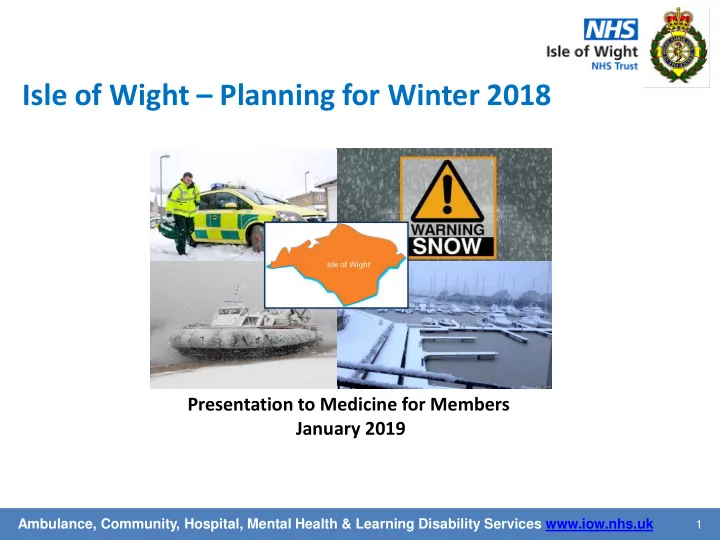
Isle of Wight – Planning for Winter 2018
Ambulance, Community, Hospital, Mental Health & Learning Disability Services www.iow.nhs.uk 1
Isle of Wight Planning for Winter 2018 Presentation to Medicine for - - PowerPoint PPT Presentation
Isle of Wight Planning for Winter 2018 Presentation to Medicine for Members January 2019 Ambulance, Community, Hospital, Mental Health & Learning Disability Services www.iow.nhs.uk 1 NHS trusts fear this winter could be more difficult
Ambulance, Community, Hospital, Mental Health & Learning Disability Services www.iow.nhs.uk 1
Ambulance, Community, Hospital, Learning Disability & Mental Health Services - www.iow.nhs.uk 2
NHS trusts fear this winter could be ‘more difficult than the last’ Hospital patients face worsening A&E performance and a pressurised workforce
NATIONALLY - An NHS review of winter 2017/18 was undertaken to help better understand the issues and pressure the services dealt with on a daily basis, and to contribute to planning for the 2018/19 winter period The main findings were;
2010/11
Emergency were immediately after Christmas and New Year and after the intense cold snap in late February and early March
Ambulance, Community, Hospital, Mental Health & Learning Disability Services - www.iow.nhs.uk 3
LOCALLY Of the support and schemes put in place for winter 2017 there were key areas considered essential to take forward for planning winter 2018/19;
cover
winter
to meet increased peaks in demand
and consider as part of winter ward
new model of delivery for urgent care
provide 1:1 support – consider ‘float team’ similar to nursing float Compared to the previous year
400,000 more people called NHS 111 290,000 more people attended A&E departments 100,000 more people were admitted to hospital as an emergency every day during winter, over 55,000 people were seen in Emergency Dept & admitted or discharged within four hours
*data from NHSI website https://improvement.nhs.uk/
Ambulance, Community, Hospital, Learning Disability & Mental Health Services - www.iow.nhs.uk 4
Dr Kathy McLean, Executive Medical Director and Chief Operating Officer, NHS Improvement
Ambulance, Community, Hospital, Mental Health & Learning Disability Services - www.iow.nhs.uk 5
National winter planning guidance was distributed from the National Director of Urgent and Emergency Care NHS England and NHS Improvement; In Summary the plan is informed from a review of last winter, when health services in England came under significant additional pressure as a result of a ‘perfect storm’ of extreme weather conditions, the worst flu season in a decade and high levels of norovirus.
This year it included some requirements and actions:
free to social care workers again this year
Departments, including through GP’s. To support this, 9 million additional GP appointments were to be made available from October over the year, including access over weekends and evenings
increased demand on hospitals and allow more patients to recover safely at home
effectively to maximise the number of staff available during periods of peak demand
Ambulance, Community, Hospital, Learning Disability & Mental Health Services - www.iow.nhs.uk 6
Ambulance, Community, Hospital, Learning Disability & Mental Health Services - www.iow.nhs.uk 7
Public Health England estimate that an average 8,000 people die from flu in England each year
Ambulance, Community, Hospital, Learning Disability & Mental Health Services - www.iow.nhs.uk 8
Ambulance, Community, Hospital, Learning Disability & Mental Health Services - www.iow.nhs.uk 9
Consistent Clear Messages ‘Help Us To Help You’
Choose Well – Right Place/Right Time Radio & Local Press Social Media 111 National Campaign Flu Vaccination Bank Holiday service availability
https://www.youtube.com/ watch?v=pKINa5xym1s
The approach we have taken in preparing for Winter 2018:
would be required this winter
and when the likely peaks would be to help us determine when and where extra support would be required. As an example the Winter Ward
help us to;
prioritise these
Local Authority, who provide social care and reablement and those that commission health services (CCG), volunteers and the voluntary sector
Effectiveness of the winter plan and safe patient care are measured by the
Trust and its partners meeting performance targets, reducing the number of patients discharges that are delayed over 72 hours and how many beds are
Ambulance, Community, Hospital, Learning Disability & Mental Health Services - www.iow.nhs.uk 10
When we reviewed our bed availability over the winter period October 2018 - March 2019 it demonstrated that we would require 250 + beds during this period. As part of our planning for this year a Winter Ward was opened from 1 November that has provided a further 24 beds in the hospital to support this need and will help us to ensure we are able to manage our emergency demand and surgical patients expected in to the hospital
Ambulance, Community, Hospital, Mental Health & Learning Disability Services - www.iow.nhs.uk 11
Some of the Winter schemes to support us through the winter 2018/19 period were prioritised for this year as;
the Community
therapies, pharmacy, point of care testing
acutely unwell
into Ambulatory Emergency Care
home