Irish Iri sh Sma Small ll T Town wn Michael Woods Aberystwyth - - PowerPoint PPT Presentation

irish iri sh sma small ll t town wn
SMART_READER_LITE
LIVE PREVIEW

Irish Iri sh Sma Small ll T Town wn Michael Woods Aberystwyth - - PowerPoint PPT Presentation

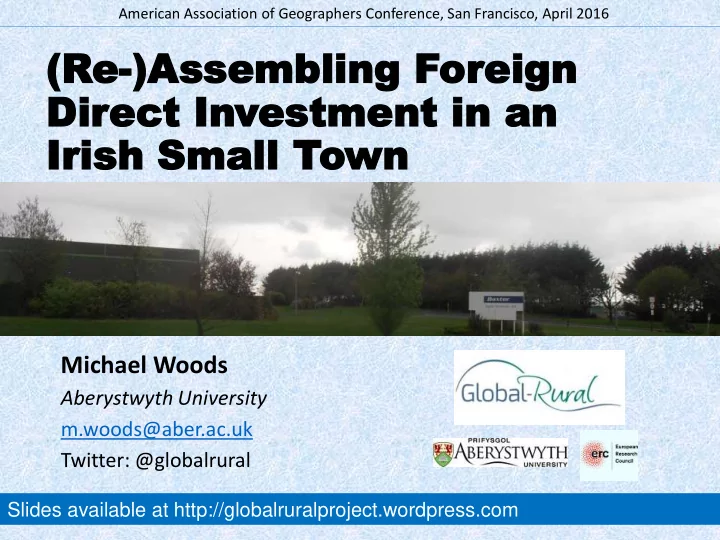
American Association of Geographers Conference, San Francisco, April 2016 (Re-)A (R )Asse ssembling mbling For oreign eign Di Direc ect In t Inves estmen tment i t in n an an Irish Iri sh Sma Small ll T Town wn Michael Woods


slide-1
SLIDE 1

(R (Re-)A )Asse ssembling mbling For

  • reign

eign Di Direc ect In t Inves estmen tment i t in n an an Iri Irish sh Sma Small ll T Town wn

Michael Woods

Aberystwyth University m.woods@aber.ac.uk Twitter: @globalrural

Slides available at http://globalruralproject.wordpress.com

American Association of Geographers Conference, San Francisco, April 2016

slide-2
SLIDE 2

Co Context

  • Examining dynamics and differential geographies of

Foreign Direct Investment in rural towns as an expression of globalization

  • Part of larger European Research Council project

GLOBAL-RURAL

  • FDI as a process of interactions between a

corporation and a locality

  • Impacts of FDI on place
slide-3
SLIDE 3

FDI I Lit Literature

Existing literature on FDI tends to fall into three categories:

  • Economic analysis of factors attracting FDI
  • Political-economic analysis of policies and regimes

underpinning inward investment as a regional development strategy

  • Firm-centred analysis
  • Global Production Networks (GPN) approach allows

more nuanced engagement with locality factors in investigating corporate networks, but still firm-centred

slide-4
SLIDE 4

Ass ssemblage Approach

  • Assemblage as a noun.
  • Analytical framework derived from De Landa (2005) A

New Philosophy of Society:

  • Assemblages made up of components with both material and

expressive functions

  • Assemblages given shape by territorialisation and

deterritorialisation

  • Identity and rules of assemblages established through coding
  • Assemblages interact with other assemblages, from which

larger assemblages may emerge

  • Components may be detached from one assemblage and

plugged into another, where their relations may be different

  • Assemblages tend toward internal homogeneity
  • Assemblages are dynamic and constantly in a state of

becoming

slide-5
SLIDE 5

Firm irms as as Ass ssemblages

  • Firms comprised by material and expressive components

(e.g. plant, labour, resources, products, intellectual property)

  • Territorialisation of firms expressed spatially and
  • rganisationally
  • Coding of firms through branding, internal regulations and

accounting processes

  • Tendency to internal homogeneity
  • Interaction with other assemblages through commodity

chains, relations with other firms and localities

  • Parts may be moved between assemblages (corporate

takeovers; relocation of plants)

  • Firms as dynamic organisations – deterritorialisation

through innovation and restructuring

slide-6
SLIDE 6

Pla laces as as Asse ssembla lages

  • Places compromised by components with material and

expressive roles

  • Territorialised spatially and socially
  • Coding through naming, local laws, social conventions

and discourses of place

  • Interactions with translocal assemblages, including

corporations

  • Components may be part of both place- and translocal-

assemblages but may play different roles in each (e.g. factory)

slide-7
SLIDE 7

Ass ssemblage Approach

  • Assemblage as a verb (= agencement)
  • FDI as a processing of assembling or re-assembling

components to create new assemblages

  • Role of connectors that make linkages between

components and between assemblages

  • Micro-politics
  • Questions of power and agency
slide-8
SLIDE 8

FDI I in in Ir Irela land

  • Foreign Direct Investment a key element in the ‘Celtic Tiger’

boom of the late 20th century

  • Policy initiated by Taoiseach Sean Lemass in 1959 and

accelerated after EC accession in 1972

  • Foreign firms responsible for 45% of expansion of industrial

jobs and 71% of Irish-produced exports by 1996 (Flanagan 2007)

  • Contribution of FDI to GDP growth in Ireland 10x rate in

Germany, 5x France and 4x UK (Financial Times 2009, quoted by McCann 2011)

  • Total US investment in Ireland worth US$87 bn in 2008 (FT

2009, quoted by McCann 2011)

  • Largest volume in Dublin and other major cities, but also

investments in many smaller rural towns

slide-9
SLIDE 9

Cou

  • unty Mayo
slide-10
SLIDE 10

Ca Castlebar

  • Town of 12,318 people (2011)
  • Administrative centre for County

Mayo

  • Early proto-FDI with

establishment of Western Hats factory in 1930s by Czechoslovak Jewish refugees

  • Expansion of FDI by US and

European firms in 1970s and 1980s

  • Baxter Travenol branch plant

1972

slide-11
SLIDE 11
slide-12
SLIDE 12

200 400 600 800 1000 1200

Employment in Castlebar by Major Foreign Firms

Baxter-Travenol (US) Cable Products (US)/Volex (UK) American Power Conversion (APC)(US)

slide-13
SLIDE 13

1) ) Ass ssembli ling FDI

  • Firms attracted to Castlebar by availability of required

material components

  • Land and/or factory units
  • Skilled labour
  • Access to resources and suppliers
  • Transport infrastructure (Knock airport)
  • Assemblage involves re-arranging components or

introducing new components:

“I was working in the Post Office when the county development

  • fficer … arrived over to the Post Office with an man called Doug

Scott who was to become the general manager of Travenol, and they were applying for two telephones. You had to apply at that time for a telephone about six months before you would get it …. Part of the application was how many people are you going to employ, and he put down, this man Scott, optimistically I thought ‘maybe 200’” (Former Chair of Castlebar Town Council)

slide-14
SLIDE 14

1) ) Ass ssembli ling FDI

  • Role of connectors in facilitating interest and investment in Castlebar
  • Promotional material
  • Fiscal incentives
  • Industrial Development Authority (IDA)
  • Key individuals and serendipity

“I was in Dublin, it was the night Brazil were playing Germany in the World Cup, and I met this guy, we were watching the match at first, but as the result was 3-0 and at one stage we lost interest and began to talk… I didn’t know him, I knew the friend he was with, but we began to talk about carbon credits … and then he began to tell me about what he was doing. He’d built up a big company and he sold it and he is developing this project. And I said, “Are you looking for a home for it”, he said, “I am, I’m looking for a big empty building”. And I said, “I have a building for you”, “Where is this?” he said. So he got out his Google maps and Google Earth and we were looking at it. “Actually,” I said, “I proposed at a council meeting that Mayo County Council would buy that building to protect it, so that if a big employer came in one day we’d have a place to put them.” “So,” I said, “If you’re in a position to create jobs in Castlebar, I’ll introduce you to the county manager and we’ll try to sell that building to you.” (County Councillor)
slide-15
SLIDE 15

1) ) Ass ssembli ling FDI

  • Role of patronage in a clientelist political system

Padraig Flynn Enda Kenny “It was a particularly opportune time for me [to attract investors] that while I was Chairman of the Council I was from the same town as the Taoiseach, from the same party as the Taoiseach, and I suppose my brother was in the Senate, in fact we were unique at one stage – I was the Chairman of the Council, my brother was the Chairman of the Senate, and Enda was the Taoiseach, and the three of us were from the same Fine Gael branch, here in Castlebar.” (County Councillor)

slide-16
SLIDE 16

2) ) Rol

  • le of
  • f Ex

Expressive Components

  • Expressive as well as material roles of components

important in attracting investment to Castlebar

  • Appeal to Irish heritage

“I was in a room full of business people that were looking to expand into Ireland from abroad, and I saw so much good will towards Ireland, particularly from America, because of the [family] connections and they love the island of Ireland, and the greenness and the warmth of the people and the connections that they had … They had this kind of notion in their head about the culture, and then they come here and they really enjoy the festivities and the craic that they have here, at the same time there’s a serious side to that too, they come here to get their business done and have some fun along the way.” (County Councillor)

slide-17
SLIDE 17

2) ) Rol

  • le of
  • f Ex

Expressive Components

  • Expressions of rural location, pleasant

environment, culture and craic

“We made a video promoting Castlebar that people from Cable Products participated in, they said that they had come to Castlebar, they had picked Castlebar over others, because they liked the people they met better than anywhere else.” (Former Town Councillor)

slide-18
SLIDE 18

3) ) Cas astle lebar as as an an Asse ssembla lage

  • Spatial re-territorialisation of Castlebar
  • Expansion of town with new industrial development
  • Expansion of commuting field

Residence of Travenol employees 1987

slide-19
SLIDE 19

3) ) Cas astle lebar as as an an Asse ssembla lage

  • Social re-territorialisation of Castlebar
  • For 43% of employees at major foreign-owned factories

in Co. Mayo in 1987 (Baxter-Travenol, Allergan, Asahi, Hollister) it was their first non-farming job (Cuddy 1987)

  • Employment for women – 70% of employees in the

major foreign-owned factories in Co. Mayo in 1987 were women (Cuddy 1987)

slide-20
SLIDE 20

4) ) Fir irms as as Asse ssembla lages

  • Castlebar branch plants were components in the wider

assemblages of their parent companies

  • Corporate hierarchies
  • Internal coding and accounting
  • Internal heterogeneity
  • “Foreign companies brought a new standard of expectations

about work performance as well, pushing aside the ‘manana’ or ‘’twill do’ approaches to doing business that had allegedly been part of the traditional Irish business culture.” (Flanagan 2007, Ireland Now, p 39)

  • Baxter Travelnol imported American managers for its plant during

first decade in Castlebar

  • Factories competing with other branch plants in corporation

rather than with other companies (c.f. Inglis on NEC in Ballivor, Ireland)

slide-21
SLIDE 21

5) ) Dynamic ic Asse ssembla lages?

  • FDI is not a one-off event but a

continuing dynamic process that involves repeated acts of re-assembly

  • Re-coding of branch plants within

corporate assemblages can lead to deterritorialisation

  • Several firms have both invested and

disinvested in Castlebar since 1970s (e.g. APC, Grumbacher, Volex)

  • Baxter Travenol announced plans to

close Castlebar plant in 1984 – but….

Former American Power Conversion (APC) plant

slide-22
SLIDE 22

5) ) Dynamic ic Asse ssembla lages

“Pressure from the French government to switch manufacturing to an expanded plant at La Chatre was the reason given for Baxter- Travenol’s announcement in January 1985 that it was closing its healthcare products factory in Castlebar, Co. Mayo, with the loss

  • f almost 900 jobs.

In fact, the truth was much more upsetting to the workers involved – the factory was closing because it was uncompetitive on price producing goods of a lower quality than other Baxter plants and giving an indifferent customer service.” Irish Times, 19 June 1989

slide-23
SLIDE 23

5) ) Dynamic ic Asse ssembla lages

“The chairperson of the town council, president of the chamber of commerce and all that, they did the usual thing of asking for an IDA task force to be set up, and innocently I suggested, in my capacity at that stage as chairperson of this Community Development Association, that we should endeavour to ask or convince or persuade Travenol to stay. Of course I was laughed at. Not the local media, but the national media thought it was a great laugh… One of the workers at Travenol came to me in a car park, he stopped me in a car park and said, ‘I’m so and so, I’ve read what you said, and whether you know what you’re talking about or not, there’s some sense in it’. He was the Financial Controller in Travenol…. The American management were gone and the man left to close the gates was a fella called [BC], he was the Assistant or Acting HR Manager… But [he] was a Cork man, he was a very outgoing fella, and they began to put a package together and they travelled to meetings within the Travenol empire.” (Former Chair of Community Development Association)

slide-24
SLIDE 24

5) ) Dynamic ic Asse ssembla lages

“The movement with the community was very very strong, the church became involved, the trade unions became involved, the politicians reluctantly became involved, you could see that the whole community was involved in this, it was a really strong movement, a genuine movement. And we had the management of Travenol, you know, feeding information to us, so we were well placed. The union leader was a man called [DM] and he was regarded as a red under the bed, but he bought into this thing and he convinced the workers to go with the package… But it was a complete united front. And bit by bit [the managers] convinced Travenol worldwide to stay in Castlebar.” (Former Chair of Community Development Association)

slide-25
SLIDE 25

5) ) Dynamic ic Asse ssembla lages

  • Coalition assembled in response to closure

announcement comprising local and national politicians, chamber of commerce, trades unions and local plant management

  • Enrolment of plant management critical for

providing access to internal corporate networks

  • Alternative coding of the Castlebar plant and

its future profitability

  • Travel to US to meet Baxter-Travenol

corporate executives

  • Baxter-Travenol announced reversal of plans

1987

  • ‘Line of flight’ that raises questions about

agency within the corporate assemblage

slide-26
SLIDE 26

Con

  • nclusio

ion

  • Assemblage approach as a way of linking firm-

focused and locality-focused perspectives on FDI

  • Corporations as assemblages with material and

expressive components, shifting territorialisation, internal coding and tendency to homogeneity

  • Re-assemblage of localities to attract FDI and by FDI
  • Emphasis on micro-politics and distributed agency
  • FDI as a dynamic and ongoing process

Slides available at http://globalruralproject.wordpress.com